📅 Last updated: 08.09.2026
Oualata, Mauritania’s ancient city of scholars, traders, and scribes, rises like a golden mirage from the stark expanse of the Sahara’s southeastern edge, its silent, decorated facades whispering centuries of intellectual and commercial history. To approach it today is to follow a path once trodden by camel caravans laden with salt, gold, and manuscripts, arriving at a place where the desert’s harshness was met with an extraordinary human ingenuity that turned mud and stone into a beacon of learning. This is not merely a relic of a bygone era; it is a living, breathing testament to the profound connectivity of medieval Africa, a city whose very walls are inscribed with the legacy of a sophisticated society that bridged the Arab world and sub-Saharan Africa.
- The Rise of a Saharan Crossroads: From Wādān to Oualata’s Golden Age
- The Intellectual Heartbeat: A City of Libraries and Scribes
- The Art of the Wall: Oualata’s Unique Architectural Heritage
- The Ebb and Flow of Fortune: Decline and Resilience
- Oualata in the Modern Era: A UNESCO World Heritage Site
- Key Dates in Oualata’s History
- Visiting Oualata Today: An Arduous Journey to Another World
- Safeguarding the Legacy of Oualata Ancient City
Long before the great Atlantic ports of West Africa rose to prominence, Oualata was the terminus of a brutal yet vital trans-Saharan trade route, a crucial link in a chain of commerce and culture that stretched from the Mediterranean coast to the heart of the Niger River. Its story is one of dramatic rises and falls, of intellectual fervor and architectural brilliance, and of a resilient community that clings to its heritage amidst the encroaching sands. For the traveler and the historian alike, Oualata offers a rare, unvarnished glimpse into the soul of the Sahel, a place where the past is not a distant echo but a palpable presence in the narrow, winding streets.
The Rise of a Saharan Crossroads: From Wādān to Oualata’s Golden Age
Oualata’s origins are intrinsically linked to the decline of another great city. In the 13th century, the prosperous Berber trading city of Wādān, located further north in the Adrar plateau, was suffering from a period of instability and conflict. Seeking a new, more secure hub for their caravans, merchants and entire clans made a pivotal decision: they relocated southwards to a more temperate oasis region, founding the settlement that would become known as Oualata. This strategic move, occurring around 1224 CE, placed the new city at a geographical sweet spot—it was close enough to the Niger River’s great bend to facilitate trade with the powerful Mali Empire, yet far enough into the desert to remain safe from the political upheavals of the Sudanic kingdoms.
This calculated relocation proved to be a masterstroke. Oualata quickly eclipsed its northern predecessor, evolving into the primary entrepôt for the southern terminus of the trans-Saharan trade. Caravans arriving from the Maghreb, laden with Saharan salt, dates, and manufactured goods such as textiles and brassware, would find in Oualata a ready market. Conversely, the city was the final staging post for goods flowing north from the Mali Empire—most famously gold from the Bambuk and Bure mines, but also slaves, ivory, kola nuts, and exotic animal skins. The city became a bustling melting pot where Berber, Arab, Tuareg, and Soninke cultures converged, creating a unique and dynamic cosmopolitan society.
The Intellectual Heartbeat: A City of Libraries and Scribes
While the gold trade brought immense wealth, it was the pursuit of knowledge that cemented Oualata’s legendary status. By the 14th century, the city had become a renowned center of Islamic scholarship, a reputation that attracted students and learned men from across the Muslim world. The Moroccan historian and traveler Leo Africanus, writing in the early 16th century, described Oualata as a city where justice was strictly administered and where a thriving community of scholars and judges resided. This intellectual tradition was not confined to a select elite; literacy was remarkably widespread, and the city was famed for its numerous private libraries containing thousands of manuscripts.
The Manuscripts: A Hidden Treasure of West African Thought
The true treasure of Oualata lies not in gold or salt, but in parchment and paper. For centuries, the city’s scholars produced and copied a vast corpus of manuscripts covering an astonishing range of subjects. These were not merely religious texts. While the Quran and its commentaries formed the bedrock of learning, the libraries of Oualata contained works on:
- Astronomy and Mathematics: Treatises on calculating the lunar calendar, determining prayer times, and solving complex geometric problems used in land surveying and inheritance law.
- Medicine and Pharmacology: Practical guides to herbal remedies, anatomy, and treatments for diseases prevalent in the Saharan environment, often blending classical Greek and Arab knowledge with local practices.
- Law and Jurisprudence (Fiqh): Detailed legal opinions (fatwas) and commentaries on the Maliki school of Islamic law, which governed everything from trade contracts to marriage and family life.
- History and Genealogy: Chronicles of local dynasties, biographies of prominent scholars, and intricate genealogies tracing lineages back to the founders of the city.
- Literature and Poetry: Classical Arabic poetry, Sufi devotional verse, and local compositions that celebrated the beauty of the desert and the virtues of a scholarly life.
- Grammar and Linguistics: Works on Arabic grammar and rhetoric, essential for the accurate interpretation of religious and legal texts.
These manuscripts, often written in a beautiful Maghrebi script, were not static relics. They were living documents, actively used and copied by generations of scholars. They represent a written history of West Africa that has long been overlooked, a powerful counter-narrative to the colonial-era belief that Africa south of the Sahara was a continent without its own recorded history. The preservation of these documents is now a matter of urgent global concern, as they face threats from climate, pests, and neglect.
“The ink of the scholar is more sacred than the blood of the martyr.” This hadith, revered throughout the Islamic world, finds its most profound expression in the dusty, manuscript-filled libraries of Oualata, where generations of Saharan thinkers dedicated their lives to the preservation and expansion of knowledge.
The Art of the Wall: Oualata’s Unique Architectural Heritage
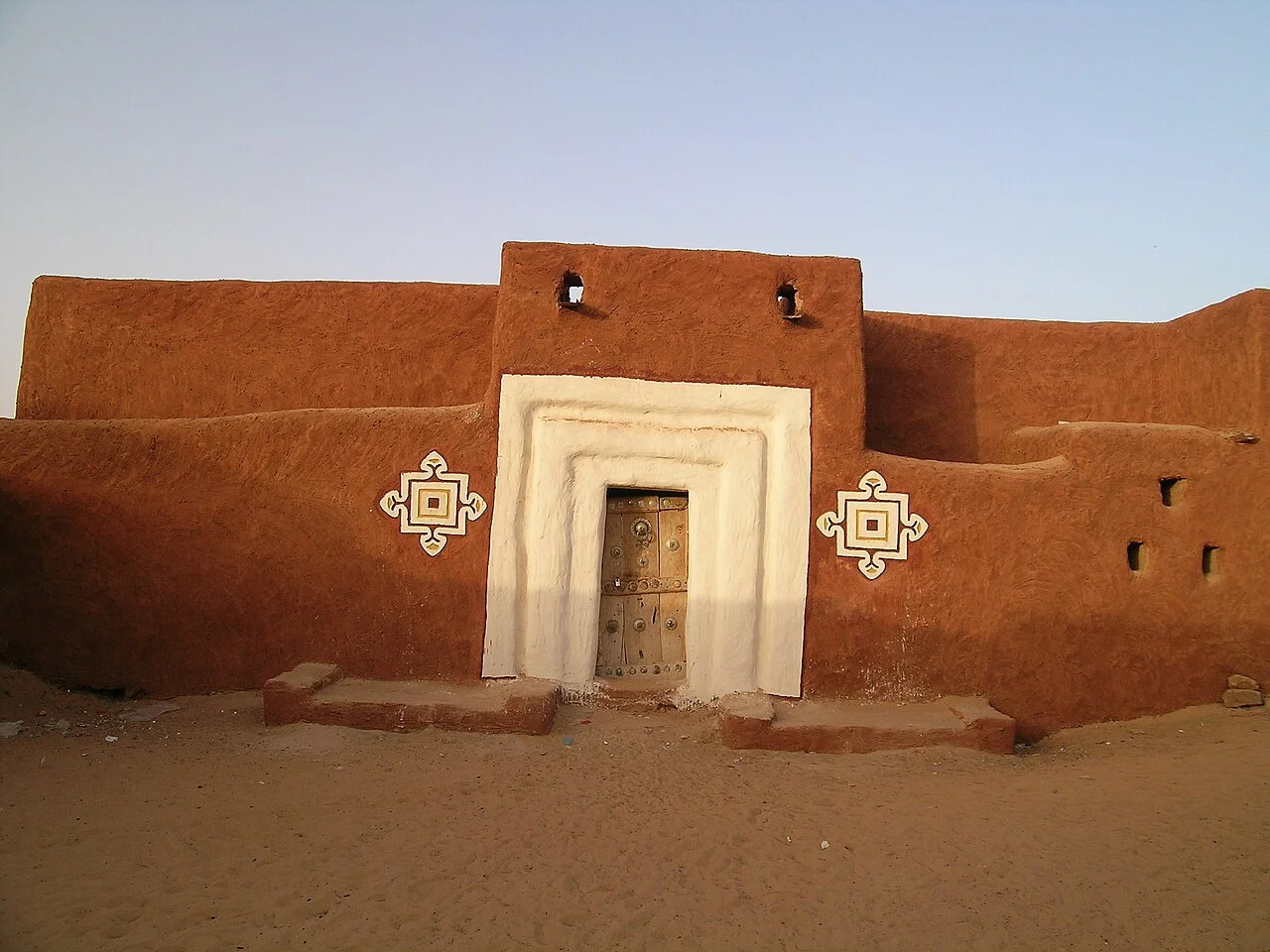
Beyond its intellectual legacy, Oualata is internationally celebrated for a singular and breathtaking art form: its painted architecture. In the late 17th century, a period of economic hardship following the decline of the trans-Saharan trade, the women of Oualata began to decorate the walls of their homes with intricate, geometric frescoes. This practice, which continues to this day, transformed the austere earthen architecture of the Sahel into a vibrant gallery of abstract art. The tradition is said to have been pioneered by a woman named Aïssata, and it has been passed down from mother to daughter for over three centuries.
A Living Canvas of Geometric Symbolism
These are not simple decorations; they are complex compositions with deep cultural and symbolic meanings. The designs are painted using natural pigments found in the surrounding desert—ochre for reds and yellows, kaolin for whites, and charcoal for blacks. The motifs are varied and often carry specific names and meanings, reflecting the world of the women who create them:
- Geometric Patterns: Triangles, diamonds, zigzags, and interlocking lines represent everything from the protective eye of God to the patterns of nomadic tent weaving.
- Architectural Motifs: Stylized representations of millet stalks, date palms, and the distinctive pointed arches of the city’s own doorways and windows.
- Abstract Symbols: Horns, crescents, and other shapes that are believed to offer protection from the evil eye and bring good fortune to the household.
- Calligraphic Elements: Some of the most skilled artists subtly incorporate Arabic lettering or phrases into the geometric chaos, blurring the line between art and scripture.
The technique is a community affair, often involving groups of women working together to replaster and repaint the facades of their homes, especially before important festivals or family events like weddings. This act of collective creation is a powerful symbol of female agency and cultural identity, making Oualata’s architecture a unique and living testament to the role of women in Saharan society. The aesthetics of Oualata were so distinctive that they inspired the modern town of Timbuktu’s famous Bouctou district, which was rebuilt in the 1930s using masons from Oualata.
The Ebb and Flow of Fortune: Decline and Resilience
The 16th and 17th centuries brought profound changes that would ultimately shatter Oualata’s economic dominance. The Portuguese, and later other European powers, established trading posts along the West African coast, creating a maritime alternative to the arduous and dangerous trans-Saharan routes. This shift in the global trade network siphoned off the gold trade, and the once mighty caravans became less frequent. Furthermore, the Moroccan invasion of the Songhai Empire in 1591, which had been a major trading partner to the south, destabilized the entire region.
Oualata was gradually bypassed and impoverished. Its great merchants departed for more lucrative centers, and the city entered a long period of decline. Yet, unlike many other great cities of the era that were completely abandoned, Oualata survived. Its population dwindled, but a core community remained, sustained by oasis agriculture, livestock herding, and the enduring prestige of its scholarly tradition. The city became a quiet, somewhat isolated backwater, its grand architecture slowly crumbling under the relentless assault of sun, wind, and rare but violent rains. This isolation, however, had an unintended consequence: it preserved the city’s unique character and its precious manuscript collections from the destructive forces of modernization and colonialism that swept through other parts of the continent.
Oualata in the Modern Era: A UNESCO World Heritage Site
In 1996, UNESCO recognized the outstanding universal value of Oualata’s cultural and natural heritage, inscribing the ancient ksour (fortified villages) of Oualata, along with Tichitt, Chinguetti, and Ouadane, as a collective World Heritage Site. This designation was a critical first step in bringing international attention and resources to the preservation of this fragile treasure. The listing highlighted the city’s exceptional example of traditional earthen architecture and its role as a major center of Islamic culture and trans-Saharan trade.
The Complexities of Preservation
Being a UNESCO site, however, is a double-edged sword. While it brings prestige and the potential for funding, it also imposes strict guidelines on restoration. The traditional building techniques, using a mixture of banco (earth) and straw, are labor-intensive and require constant upkeep. Modern materials like cement are often deemed inappropriate by heritage experts, but are attractive to local residents for their durability and lower maintenance costs. This creates a tension between preserving the authentic historical fabric of the city and meeting the needs and desires of its current inhabitants, who are not living in a museum but in a functioning community.
Today, Oualata faces a complex set of challenges:
- Climate Change: The encroaching desert and changing rainfall patterns threaten the oasis agriculture that sustains the local population.
- Depopulation: Many young people are leaving for larger Mauritanian cities like Nouakchott and Nouadhibou in search of economic opportunities, leaving an aging population behind.
- Conservation Funding: Securing consistent and adequate funding for the meticulous, traditional restoration work is a constant struggle.
- Hydrological Pressure: The need for water for a growing population and for tourists puts pressure on the ancient water management systems, including the foggaras (underground canals) and wells.
Despite these issues, there is a powerful sense of resilience in Oualata. Local NGOs, in partnership with international organizations like UNESCO, are working to train a new generation of masons in the traditional techniques. There are also efforts to digitize the manuscript collections, ensuring their contents are preserved even if the physical documents are lost. The Mauritanian government, too, has recognized the importance of its heritage as a potential driver for sustainable tourism.
Key Dates in Oualata’s History
| Date (CE) | Event | Significance |
|---|---|---|
| c. 1224 | Founding by migrants from Wādān | Establishes a new hub for trans-Saharan trade and becomes the southern terminus for caravans. |
| 14th – 16th Centuries | Golden Age of Scholarship and Trade | Reaches peak prosperity as a center for gold, salt, and slave trade and a renowned city of Islamic learning and manuscript production. |
| Late 17th Century | Emergence of Painted Architecture | Women begin decorating home facades with geometric frescoes, creating the city’s unique and famous artistic identity. |
| 18th – 19th Centuries | Economic Decline | Shift of trade to Atlantic coast leads to impoverishment and isolation, but preserves the city’s historical character. |
| 1996 | UNESCO World Heritage Inscription | International recognition of its heritage value, bringing global attention and preservation efforts. |
Visiting Oualata Today: An Arduous Journey to Another World
Reaching Oualata is not for the faint of heart. The city is located in the remote southeast of Mauritania, near the border with Mali. There is no paved road leading directly to it; the final approach is a multi-hour drive across a barren, rocky plateau called the dhar. Travelers need a sturdy 4×4 vehicle, a competent guide, and a healthy supply of water and provisions. The journey is an adventure in itself, the vast, empty landscape offering a profound sense of solitude and the immense scale of the Sahara. For those who make the effort, the reward is a truly unforgettable experience.
Walking through the ancient gate of Oualata is like stepping back in time. The streets are narrow, winding canyons of mud-brick walls, often overhanging to create shaded passages. The silence is profound, broken only by the sound of your own footsteps, the distant call to prayer, or the laughter of children playing. The city’s layout is a labyrinth designed for defense and shade, a testament to the ingenuity of its builders in the harsh desert climate.
Experiencing the Culture and People
Hospitality is a cornerstone of Saharan culture, and the people of Oualata are known for their warmth, despite the challenges they face. Visitors are often invited into homes for mint tea, a ritual that is both a social custom and a symbol of friendship. This is an opportunity to see the painted interiors of the houses up close and to meet the women artists who are the custodians of this tradition. The main attractions within the city include:
- The Grand Mosque: A beautiful and austere example of Sudano-Sahelian architecture, with its characteristic pointed towers and buttresses. It is one of the oldest mosques in the region, though it has been rebuilt several times.
- The Manuscript Libraries: Several private family libraries are open to visitors, offering a rare glimpse of the handwritten treasures. It is a privilege to be able to see these documents, which are often held in worn leather satchels and wooden chests.
- The Museum: A small museum houses a collection of local artifacts, including traditional jewelry, tools, and a few examples of the region’s prehistoric rock art.
- The Market: A modest and lively affair, where local women sell fresh vegetables from the oasis, and tradesmen offer goods like leatherwork and simple crafts.
It is crucial to be a respectful traveler. Always ask for permission before taking photographs of people, especially the women. Dress conservatively, covering shoulders and knees. And be mindful that this is a conservative, Muslim community. The key to a rewarding visit is to go with an open heart and a desire to learn, rather than a checklist of sights to tick off.
Safeguarding the Legacy of Oualata Ancient City
The future of Oualata ancient city hangs in a delicate balance, suspended between a glorious past and an uncertain future. The efforts to preserve it are not merely about conserving old buildings and manuscripts; they are about maintaining the identity and dignity of a people and honoring the immense contribution of Africa to global civilization. The story of Oualata challenges the persistent narrative of Africa as a passive recipient of outside influences, instead showcasing a dynamic, literate, and sophisticated society that was a crucial node in the medieval world’s intellectual and commercial networks.
The preservation of Oualata is a shared global responsibility. Supporting organizations that work in heritage conservation, promoting responsible and sustainable tourism that directly benefits the local community, and amplifying the stories and voices of its people are all ways to contribute. The ancient city of Oualata is more than just a collection of mud-brick walls; it is a powerful symbol of resilience, a testament to the enduring power of knowledge, and a call to remember that even in the most unforgiving of environments, humanity can create beauty, wisdom, and a legacy that can inspire the world for centuries to come. To walk its silent streets is to hear the echoes of the scholars and traders who once made it great, and to realize that their spirit, like the intricate paintings on their walls, remains indelibly etched into the very fabric of the Sahara.