📅 Last updated: 24.11.2026
The Timbuktu manuscripts are among the most remarkable written treasures in African history: hundreds of thousands of hand-copied books and documents produced in the medieval and early modern Western Sudan, covering astronomy, medicine, law, poetry, and commerce. For centuries they lay in family libraries and desert archives in the city of Timbuktu, in what is now Mali, surviving conquests, fire, and neglect. Today, scholars and preservationists are working to digitize and protect them, revealing a sophisticated intellectual tradition that challenges old assumptions about Africa’s past.
The Timbuktu manuscripts are handwritten books and documents produced largely between the 13th and 19th centuries in Timbuktu and the wider Western Sudan region, written mainly in Arabic and Ajami script. They cover subjects from Islamic jurisprudence and astronomy to medicine, poetry, and trade, and were preserved for generations in private family libraries. An estimated hundreds of thousands survive, and major collections are now being digitized and safeguarded in Mali and abroad.
- What Are the Timbuktu Manuscripts?
- Why Timbuktu Became a City of Books
- What Subjects Do the Timbuktu Manuscripts Cover?
- How Were the Timbuktu Manuscripts Preserved for Centuries?
- Timbuktu Manuscripts: A Timeline of Survival
- How Many Manuscripts Exist — and Where Are They Now?
- Why the Timbuktu Manuscripts Matter Today
- Reading the Margins: What the Manuscripts Reveal About Daily Life
- The Future of Africa's Written Heritage
What Are the Timbuktu Manuscripts?
The Timbuktu manuscripts are, at their core, a family inheritance. Most were never held in a single royal library or state archive; they were kept by scholarly families who copied, annotated, and handed down texts across generations. A judge’s family might preserve a shelf of legal rulings; a healer’s family might hold treatises on plants and remedies; a merchant’s papers might record debts, marriages, and caravan contracts.
The writing is predominantly Arabic, the language of scholarship across the Islamic world. But many manuscripts carry marginal notes and entire texts in Ajami — local languages such as Songhay, Tamasheq, Fulfulde, and Bambara written in adapted Arabic script. That bilingual reality matters: it shows a region not merely receiving knowledge from the wider Islamic world but adapting it, arguing with it, and recording local life in local tongues.
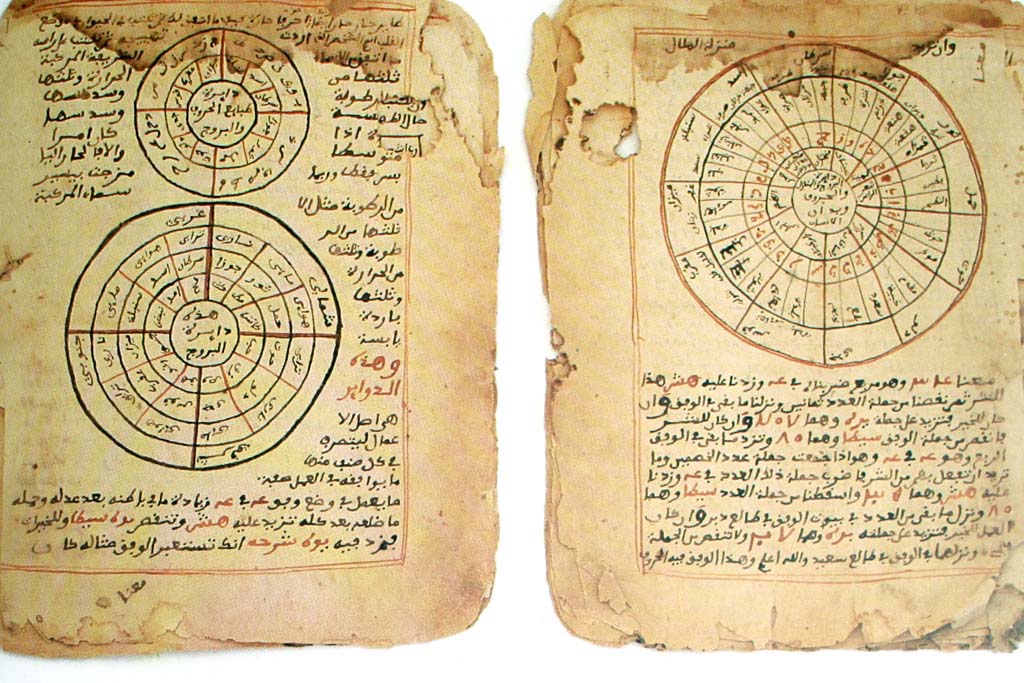
Physically, the manuscripts are striking. Pages of handmade paper, some of them imported from Europe and North Africa, others produced locally, are bound in leather and decorated with geometric patterns. Ink was often made from soot, gum arabic, and water; some pages are illuminated with gold and colored pigments. The oldest known items date to the 13th century, though the bulk span the 16th through 19th centuries.
Why Timbuktu Became a City of Books
Timbuktu sits near the great bend of the Niger River, at the southern edge of the Sahara. That geography made it a hinge between the desert and the savanna. Gold from the south, salt from the north, and scholars from across the Islamic world converged there. By the 14th century it was a commercial hub; by the 15th and 16th centuries it was one of the intellectual centers of the Sahel.
The Golden Age of Scholarship
The city’s scholarly reputation peaked under the Songhai Empire, especially during the reign of Askia Mohammad I (ruled 1493–1528). The emperor’s patronage drew jurists and teachers, and the city’s mosques became centers of learning. The most famous of these, the Sankore mosque, is often described in popular accounts as a “university,” though historians are careful: it was a mosque and teaching complex rather than a degree-granting institution in the European sense. What is certain is the density of scholarship — teachers, students, copyists, and booksellers clustered around the mosques and the homes of leading scholars.
The scholar Ahmad Baba al-Timbukti (1556–1627) is the emblem of this world. A jurist and prolific author, he taught in Timbuktu before being taken captive to Morocco after the Moroccan invasion of 1591. His writings and his personal library were renowned, and his exile became a symbol of the city’s intellectual reach. Other figures — the scholar and diplomat Leo Africanus, who visited around 1510 and described the city’s book trade — left accounts that testify to how central manuscripts were to Timbuktu’s identity.
Books were valuable commodities. A 16th-century account attributed to Leo Africanus notes that manuscripts and books were among the most profitable goods sold in Timbuktu — more lucrative, he wrote, than any other merchandise. That single observation captures the city’s character: this was a place where the written word was treasure.
What Subjects Do the Timbuktu Manuscripts Cover?
The range is astonishing, and it is precisely this breadth that overturns the tired image of Africa as a continent without written records. The collections include:
- Islamic jurisprudence and theology: commentaries on the Qur’an, legal opinions (fatwas), and treatises on Maliki law, the school dominant in North and West Africa.
- Astronomy and mathematics: calendars, astronomical tables, and calculations for prayer times and the lunar months, some with detailed diagrams.
- Medicine and botany: herbal remedies, descriptions of diseases, and pharmacological notes blending Greek, Arabic, and local knowledge.
- Grammar, rhetoric, and poetry: Arabic language studies and verse, including praise poetry and devotional works.
- History, correspondence, and commerce: letters, contracts, genealogies, and chronicles documenting trade, diplomacy, and daily life.
Many manuscripts are annotated in the margins — a sign of active use rather than passive storage. Readers corrected texts, added glosses, and debated points across generations. A single volume could carry the handwriting of a grandfather, a father, and a son, each adding to the conversation.
How Were the Timbuktu Manuscripts Preserved for Centuries?
Preservation was a private, family affair, and it was precarious. The climate helped: the dry Saharan air is unkind to mold and insects that would destroy paper in humid regions. But politics was the greater threat. When Moroccan forces sacked Timbuktu in 1591, scholars were killed or deported, and libraries were scattered. Later, French colonial rule from the late 19th century brought new pressures and new interest: colonial administrators and scholars collected manuscripts, and some were removed to European institutions.
Families developed strategies. Manuscripts were hidden in walls, buried in desert caches, or carried to relatives in rural villages. Some were sealed in leather trunks and stored in caves. The result is that the surviving corpus is dispersed — held in family homes, in the Ahmed Baba Institute in Timbuktu, in the National Library of Mali in Bamako, and in collections abroad.
The 2012 Crisis and the Rescue Operation
In 2012, armed groups seized northern Mali, including Timbuktu. The world watched as fighters destroyed shrines and threatened the city’s heritage. What happened next is one of the great rescue stories of modern conservation. Abdel Kader Haidara, a Timbuktu librarian and collector, organized a network of families and couriers who smuggled manuscripts out of the city — first to Bamako, then onward. Thousands of documents were moved in trunks and sacks, often by boat along the Niger and by road, hidden among ordinary goods.
Estimates vary, but the operation is credited with saving the overwhelming majority of the city’s manuscripts from destruction. Some were damaged by damp and rough handling during the journey, and conservation work continues. The episode demonstrated that these manuscripts are not relics of a dead past but living heritage that people will risk their lives to protect.
Timbuktu Manuscripts: A Timeline of Survival
The history of these documents is best understood as a series of chapters — flourishing, dispersal, and recovery. The table below traces the key moments.
| Period | Event | Significance for the Manuscripts |
|---|---|---|
| 13th–14th century | Earliest surviving manuscripts produced in the Western Sudan | Establishes a written scholarly tradition predating the Songhai Empire |
| 1493–1528 | Reign of Askia Mohammad I | Patronage of scholarship; Timbuktu’s golden age of learning |
| 1510 (approx.) | Leo Africanus visits Timbuktu | Records the city’s thriving book trade |
| 1591 | Moroccan invasion and sack of Timbuktu | Scholars exiled; libraries dispersed and hidden |
| Late 19th–20th century | French colonial rule and manuscript collecting | Some manuscripts removed to European collections; scholarly interest grows |
| 2012–2013 | Armed occupation of northern Mali | Rescue operation evacuates manuscripts to Bamako |
| 2010s–present | Digitization and conservation initiatives | Global access expands; preservation work continues |
How Many Manuscripts Exist — and Where Are They Now?
Precise numbers are impossible. Estimates of surviving manuscripts range from roughly 100,000 to several hundred thousand, depending on whether one counts individual documents or bound volumes. The largest institutional collection is held by the Ahmed Baba Institute (Institut des Hautes Études et de Recherches Islamiques Ahmed Baba) in Timbuktu and Bamako, named for the exiled scholar. Family libraries remain significant: the Haidara family collection, for instance, is one of the best known.
Outside Mali, manuscripts are held in the Bibliothèque Nationale de France in Paris, the University of Timbuktu’s partner institutions, and various university and private collections in Europe and North America. The dispersal is a sensitive subject. There is a growing push for repatriation and for ensuring that Malian institutions have the resources to care for their own heritage.
Digitization has transformed access. Projects led by the Ahmed Baba Institute, the Library of Congress, and academic partners have photographed tens of thousands of pages. Researchers in Bamako, London, or Chicago can now study a 17th-century astronomical table without touching the fragile original. But digitization is not preservation: the physical objects still need climate-controlled storage, trained conservators, and secure facilities — resources that are scarce in a region facing conflict and economic strain.
Why the Timbuktu Manuscripts Matter Today
The manuscripts matter first as evidence. They document a literate, cosmopolitan society in West Africa centuries before European colonization — a society that traded ideas as well as gold and salt. That fact has political weight. It counters narratives that treat Africa’s past as oral-only or ahistorical, and it gives Malians and the wider diaspora a tangible link to a sophisticated inheritance.
They matter second as knowledge. The medical texts record plant-based remedies that modern pharmacologists have begun to study. The astronomical works show careful observation of the sky. The legal and commercial documents offer a window into how a diverse, multi-ethnic trading society governed itself.
They matter third as a test of stewardship. The 2012 rescue showed what communities will do to protect their heritage. The harder, less dramatic work is ongoing: fundraising for conservation, training Malian archivists, building secure storage, and negotiating the return of dispersed items. Institutions like the Ahmed Baba Institute and initiatives supported by UNESCO and international foundations are engaged in this effort, but the needs are large and the funding is fragile.
- Support conservation: Donate to or advocate for organizations working with Malian archives and manuscript libraries.
- Use the digital collections: Researchers and educators can access digitized manuscripts through partner institutions, keeping scholarly attention on the region.
- Back repatriation and training: Support efforts to return dispersed manuscripts and to build local capacity for long-term care.
Reading the Margins: What the Manuscripts Reveal About Daily Life
The most human details often sit in the margins. A legal document records a dispute over a well; a contract lists the goods in a caravan; a letter from a merchant complains about a delayed shipment. These are not grand chronicles but the paper trail of ordinary life in a desert city — marriages, inheritances, debts, and friendships.
Ajami texts are especially revealing. They show scholars and scribes writing local languages in Arabic script, recording poetry, proverbs, and religious instruction for audiences who did not read classical Arabic. This was a bilingual, adaptable intellectual culture, not a borrowed one. The manuscripts are, in this sense, a record of translation and exchange — the very thing that made Timbuktu a crossroads.
The Future of Africa’s Written Heritage
The Timbuktu manuscripts are not a “lost library” in the literal sense; they were never entirely lost, though they were long overlooked outside Mali. The better description is a hidden library now being brought into the light. The work ahead is unglamorous but essential: stable storage, trained hands, secure funding, and a commitment to keeping these documents where they belong — accessible to the communities that made them.
For a global audience, the manuscripts offer a corrective and an invitation. They correct the myth of a continent without books, and they invite readers to see Timbuktu not as a remote curiosity but as a city that once traded in gold and ideas with equal seriousness. The pages survive because families chose, generation after generation, to keep them. That choice — repeated in trunks, caves, and hurried journeys — is the real treasure.