📅 Last updated: 25.11.2026
The Okavango Delta is the world’s largest inland river delta that never reaches the sea, a 15,000-square-kilometre maze of channels, lagoons, and floodplains spread across northwestern Botswana. Every year, water that fell as rain in the highlands of Angola takes months to travel more than 1,000 kilometres down the Okavango River, arriving in the Kalahari at the height of the dry season — and transforming a parched landscape into one of the richest wildlife habitats on Earth. It is a place where a river dies, and in dying, gives life to everything around it.
The Okavango Delta is an endorheic alluvial fan in northwestern Botswana where the Okavango River spreads across the Kalahari sands and evaporates rather than reaching the ocean. Covering roughly 15,000 square kilometres, it was named a UNESCO World Heritage Site in 2014 and one of the Seven Natural Wonders of Africa in 2013. Its annual flood — arriving from Angola’s rainy season — peaks between June and August, drawing some of the continent’s largest concentrations of elephant, buffalo, and wild dog.
- Where exactly is the Okavango Delta, and why does it exist at all?
- How the annual flood works: a river out of sync with the seasons
- Wildlife of the Okavango Delta: what you can actually see
- People of the Delta: the Wayeyi, Hambukushu, and the politics of water
- Why the Okavango Delta matters beyond Botswana
- Okavango Delta travel: how to visit responsibly
- A timeline of the Okavango Delta's modern history
- What are the biggest threats to the Okavango Delta?
- Why the Okavango Delta is Africa's last great wilderness — and what that means
- The Delta as a test case for conservation in the 21st century
Where exactly is the Okavango Delta, and why does it exist at all?
The Delta sits in the far northwest of Botswana, wedged between the Moremi Game Reserve to the east, the Namibian Caprivi Strip to the north, and the vast, dry reaches of the Kalahari to the south and west. The nearest towns are Maun — the tourism gateway and Botswana’s fifth-largest settlement — and Shakawe, near the panhandle where the river enters Botswana.
Its existence is a geological accident. The Okavango River rises in the Angolan highlands near Huambo, flows south through Namibia’s Kavango region, and crosses into Botswana, where it meets a fault line in the Earth’s crust. That fault — part of the East African Rift System’s southwestern extension — blocks the river’s southward path. The water has nowhere to go but sideways, fanning out across ancient sand deposits left by the Kalahari’s prehistoric lakes. The result is a delta without a sea: water that spreads, seeps, evaporates, and is drunk by plants and animals, never completing the journey to an ocean.
The Delta’s size fluctuates dramatically. During the peak flood, water can cover up to 15,000 square kilometres; in the dry months, it shrinks to roughly 6,000. That rhythm — expansion and contraction — is the engine of its ecology.
How the annual flood works: a river out of sync with the seasons
One of the Delta’s most counterintuitive features is its timing. Botswana’s rainy season runs from November to March, when the Delta itself receives rainfall. But the flood that fills the channels arrives months later, between June and August — the middle of the dry winter. The water originates in Angola, where the rainy season peaks in January and February. It then takes four to six months to percolate through the Delta’s channels, pushed by a slow-moving wave of water rather than a fast current.
This lag has profound consequences. When the surrounding Kalahari is at its driest and most animals are desperate for water, the Delta is at its fullest. Herds migrate from hundreds of kilometres away. Predators follow. And the Delta becomes a nursery for fish, birds, and amphibians precisely when other water sources have vanished.
The three “deltas” within the Delta
- The Panhandle: A narrow, deep channel running roughly 80 kilometres from the Namibian border to the apex of the fan. Lined with papyrus and reed beds, it is the domain of tigerfish, hippos, and the Okavango’s famous birdlife.
- The Fan: The main body of the Delta, where the river splits into countless channels and lagoons. This is where most safari camps operate, from the Moremi Game Reserve to the private concessions of the Jao and Vumbura areas.
- The Xudum and Xini systems: The western and eastern extremities, which often dry out completely in low-flood years. These seasonal floodplains are critical grazing for elephants and buffalo.
Wildlife of the Okavango Delta: what you can actually see
The Delta’s species list reads like a who’s who of African wildlife, but the numbers are what set it apart. Botswana holds the world’s largest elephant population — over 130,000 animals nationally, with a significant portion moving through the Delta and adjacent areas. The 2019 Great Elephant Census follow-up and subsequent aerial surveys documented herds of several hundred animals crossing the floodplains, particularly in the dry season.
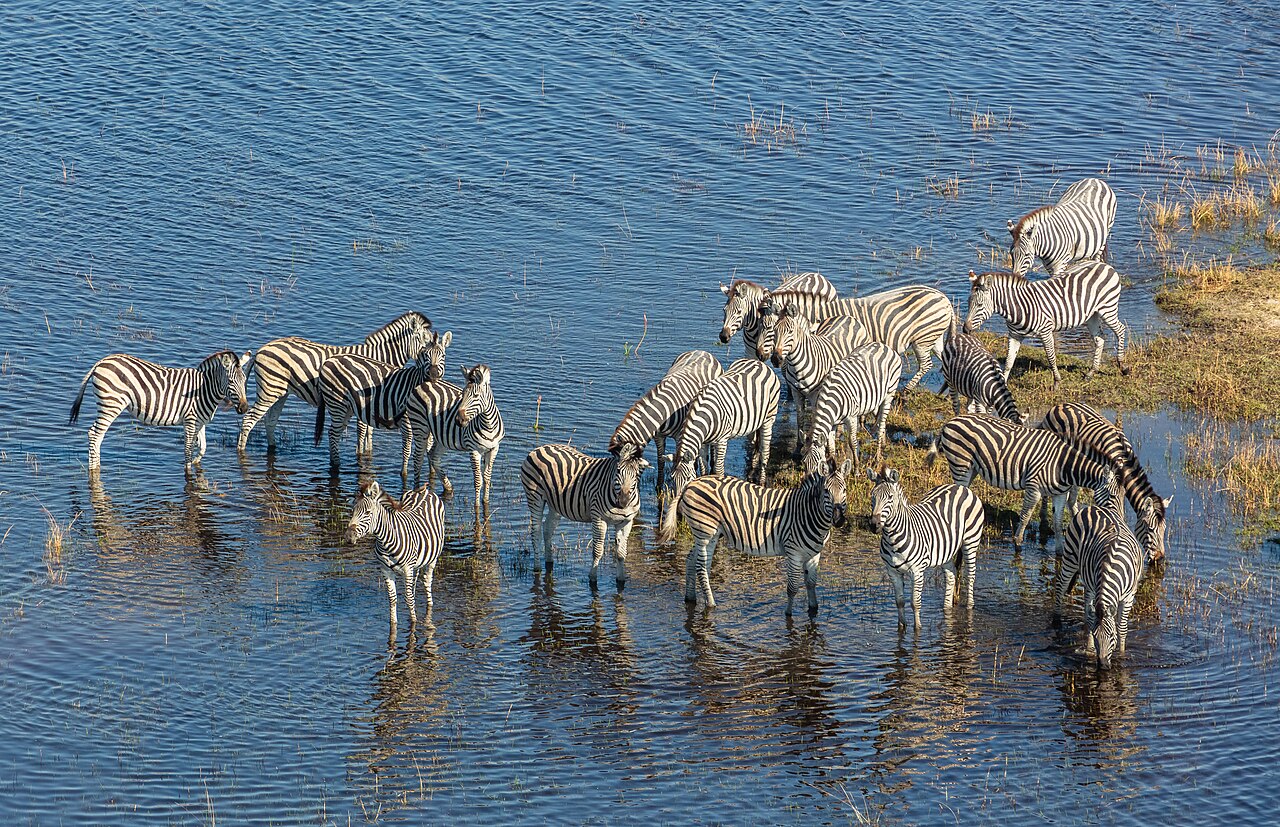
Beyond elephants, the Delta is one of the last strongholds of the African wild dog, with packs roaming the Moremi Game Reserve and the Linyanti–Selinda corridor to the north. The Delta’s waterways support large hippo populations — estimates run to several thousand — and Nile crocodiles. Lion, leopard, cheetah, and spotted hyena are all present, though densities vary by habitat.
The birdlife is exceptional: over 400 recorded species, including the African fish eagle, Pel’s fishing owl, slaty egret, wattled crane, and the endangered African skimmer, which nests on sandbanks exposed by the receding flood.
The Big Five and the water paradox
Rhinos are the exception. Botswana’s white rhino population was decimated by poaching in the 1980s and 1990s; the current population is small and heavily protected, concentrated in the Moremi and northern concessions. Black rhinos were reintroduced to the Delta in 2021 through a translocation programme involving Botswana’s Department of Wildlife and National Parks and conservation partners, part of a broader effort to rebuild the species’ range.
People of the Delta: the Wayeyi, Hambukushu, and the politics of water
The Delta is not empty wilderness. It has been home to fishing and farming communities for centuries. The Wayeyi (also called Bayei) are the Delta’s original water people, skilled in the use of the mokoro — a dugout canoe traditionally carved from a single tree trunk, now often made from fibreglass to protect the large hardwood trees. The Hambukushu, who live along the panhandle, are known for their basket weaving and fishing traditions. The Ditshukuru and other groups have also lived in and around the Delta for generations.
These communities have a complicated relationship with conservation. The creation of the Moremi Game Reserve in 1963 — initiated by the Batawana people under the leadership of Chief Tawana Moremi III — displaced some communities from land they had used for generations. The reserve was one of the first in Africa to be established by local people rather than colonial authorities, a fact often overlooked. Today, community trusts and joint venture partnerships with safari operators channel tourism revenue back to villages, though the distribution of benefits remains contested.
The mokoro is a useful symbol here: a traditional technology that has survived by adapting, now carrying tourists through the same channels that Wayeyi fishers have used for centuries.
Why the Okavango Delta matters beyond Botswana
The Delta’s water comes from Angola, and that makes it a geopolitical story as much as an ecological one. The Okavango River basin covers roughly 700,000 square kilometres across Angola, Namibia, and Botswana, and is home to around half a million people. Angola’s post-civil war development — including plans for hydropower and irrigation in the Cubango-Okavango basin — could alter the flow of water that sustains the Delta.
The three countries signed the Okavango River Basin Water Commission (OKACOM) agreement in 1994, committing to joint management of the basin. OKACOM remains the primary transboundary institution, though critics note that enforcement is limited and that Angola’s development priorities often take precedence. The 2014 UNESCO World Heritage listing added international scrutiny but did not resolve the underlying tension: the Delta’s future depends on decisions made hundreds of kilometres upstream.
Climate change adds another layer. Variability in Angolan rainfall translates directly into flood variability in Botswana. Some years the flood is late or weak; others it is exceptional. The Delta has always been variable, but the range appears to be widening.
Okavango Delta travel: how to visit responsibly
Most visitors fly into Maun, the Delta’s gateway, and then take a light aircraft to a safari camp. The flight itself is part of the experience: the descent over the fan reveals the scale of the place in a way no photograph captures. Camps range from simple mobile operations to high-end lodges in private concessions, where off-road driving, walking safaris, and mokoro excursions are standard.
The best time to visit depends on what you want. For predators and general game viewing, the dry winter months (June to August) coincide with the flood and concentrate animals around water. For birding, the summer months (November to March) bring migratory species and breeding activity, though the heat can be intense. The “shoulder” seasons — April–May and September–October — offer good conditions with fewer visitors.
Key practical considerations
- Permits and concessions: Most of the Delta is either national park (Moremi) or private concession. Access is regulated, and self-drive is possible in Moremi but challenging in the wet season.
- Mokoro and boat safaris: Best experienced in the panhandle and eastern Delta, where channels remain navigable year-round.
- Conservation fees: Botswana charges park fees that fund wildlife management; these are typically included in camp rates.
- Health: Malaria is a risk in the wet season; consult a travel clinic. The Delta is remote, so medical evacuation insurance is essential.
A timeline of the Okavango Delta’s modern history
| Year | Event | Significance |
|---|---|---|
| 1963 | Moremi Game Reserve established | One of Africa’s first reserves created by local people (Batawana), setting a precedent for community-led conservation. |
| 1994 | OKACOM agreement signed | Angola, Namibia, and Botswana commit to joint management of the Okavango basin. |
| 1996 | Okavango Delta listed as a Ramsar Wetland of International Importance | Recognises the Delta’s global ecological significance. |
| 2013 | Named one of the Seven Natural Wonders of Africa | Raises international profile and tourism interest. |
| 2014 | UNESCO World Heritage Site inscription | Formal global recognition; increases conservation scrutiny and funding. |
| 2021 | Black rhino reintroduction | Translocation programme begins rebuilding the species’ presence in the Delta. |
What are the biggest threats to the Okavango Delta?
The Delta’s challenges are not abstract. They are specific, and they are mostly upstream.
Water extraction and upstream development. Angola’s plans for irrigation and hydropower in the Cubango-Okavango basin could reduce the volume of water reaching Botswana. Even modest reductions can shrink the flood’s reach, with cascading effects on wildlife and tourism.
Oil and gas exploration. Reconnaissance permits for oil and gas exploration have been granted in the Okavango basin, particularly in Namibia and Botswana. Any extraction would pose severe risks to the Delta’s hydrology.
Poaching and wildlife crime. Elephant and rhino poaching remains a threat, though Botswana’s anti-poaching efforts — including the use of military-style patrols and aerial surveillance — have been relatively effective compared to some neighbouring countries.
Tourism pressure. The Delta’s popularity is both its lifeline and its vulnerability. High-end, low-volume tourism is the model, but the sector’s footprint — water use, waste, aircraft traffic — requires careful management.
Climate change. Shifting rainfall patterns in Angola and rising temperatures in Botswana could alter the flood’s timing and volume. The Delta is resilient, but resilience has limits.
Why the Okavango Delta is Africa’s last great wilderness — and what that means
The phrase “last great wilderness” is often applied loosely, but the Delta earns it in a specific sense: it is one of the few places on Earth where a large, functioning wetland ecosystem still operates at scale, with its full complement of large mammals, and with a tourism model that funds conservation rather than undermining it. It is not untouched — people have lived here for centuries, and the landscape bears their imprint — but it is intact in a way that few places remain.
That intactness is not guaranteed. The Delta’s future depends on decisions made in Luanda, Windhoek, and Gaborone as much as in Maun. It depends on whether the Okavango’s water is treated as a shared resource or a national one. And it depends on whether tourism continues to pay for conservation, or becomes another extractive industry.
For travellers, the Delta offers something increasingly rare: the experience of a place that still works as a whole. The flood arrives, the herds follow, the predators hunt, and the cycle repeats. You can see it from a mokoro, from a game drive, or from the window of a small plane. But you are seeing a system, not a set piece — and that is what makes it worth protecting.
The Delta as a test case for conservation in the 21st century
What happens in the Okavango Delta over the next two decades will say a great deal about whether large-scale conservation can survive the pressures of development, climate change, and geopolitics. The Delta is not a museum piece; it is a working landscape, and its future will be negotiated, not preserved in amber. The good news is that the institutions exist — OKACOM, the UNESCO listing, Botswana’s relatively strong governance, and a tourism sector with a vested interest in the Delta’s health. The question is whether they can move fast enough.
For now, the flood still arrives. The elephants still cross. The mokoro still glides through the reeds. And the Okavango Delta remains what it has always been: a river that never reaches the sea, and a wilderness that refuses to be taken for granted.