📅 Last updated: 24.09.2026
The Great Migration Serengeti is the largest overland movement of large mammals on Earth — roughly 1.3 million blue wildebeest, some 250,000 plains zebra and a scattering of Thomson’s gazelle walking a 1,200-kilometre loop through Tanzania’s Serengeti National Park and Kenya’s Maasai Mara National Reserve. Most travellers fixate on one moment within that loop: the river crossings, when tens of thousands of animals plunge into water thick with crocodiles. Here is how to actually be there when it happens — and how to watch it well.
- What the River Crossings Actually Are
- Where the Crossings Happen: The Key Locations
- When to Go: A Month-by-Month Reality Check
- How to Plan a Great Migration Serengeti Trip
- What Actually Happens at a Crossing
- Ethical and Practical Watching: How Not to Ruin It
- Beyond the Crossing: What Else to See
- Common Mistakes to Avoid
- The Takeaway
What the River Crossings Actually Are
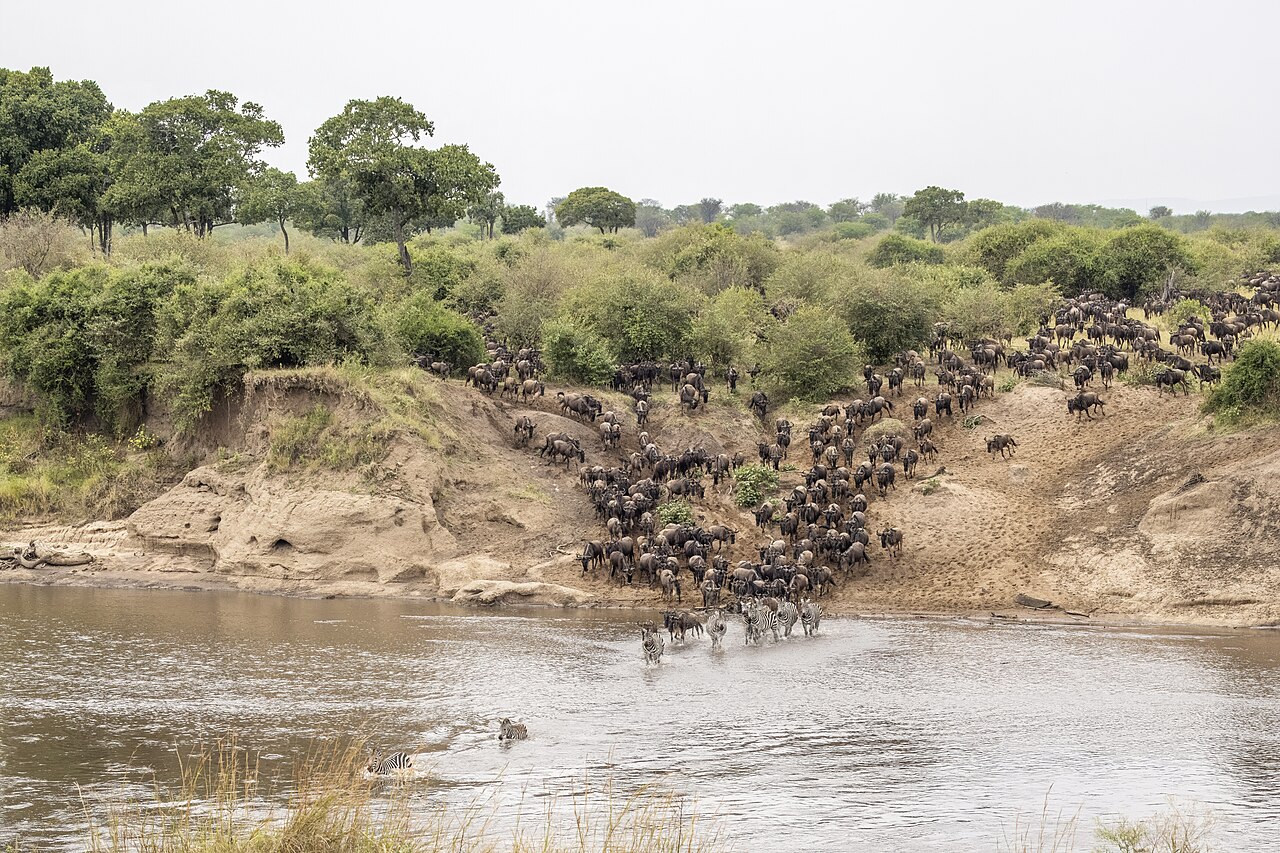
A river crossing is not a scheduled event. It is a decision made by a herd — usually a few hundred to several thousand animals — to move from one bank of a crocodile-filled river to the other. The trigger is almost always grass: wildebeest follow rain and fresh grazing, and rivers happen to lie in the way.
The herds cross two main systems. The first is the Mara River, which flows west from the Mau Escarpment in Kenya, loops through the northern Serengeti, and empties into Lake Victoria. The second is the Grumeti and Mbalageti rivers in the western Serengeti corridor, smaller and less dramatic but still lethal during the June–July push north.
Three things make the Mara crossings the headline act:
- Volume: In a good year, more than 200,000 wildebeest cross the Mara River between July and October.
- Drama: The Mara is deep, fast and holds one of the densest Nile crocodile populations in Africa — some individuals exceed five metres.
- Access: The river is crossable at dozens of points, and both the Tanzanian and Kenyan sides have road networks, airstrips and camps within reach.
What people rarely mention: most crossings are uneventful. A herd approaches, mills about for two hours, then turns and walks away. The famous mass plunges — thousands of animals pouring down a single bank — happen maybe a few dozen times a season, and no one can predict which afternoon.
Where the Crossings Happen: The Key Locations
Tanzania: The Northern Serengeti (Kogatende and Lamai)
Kogatende is the airstrip and the loose name for the stretch of the Mara River inside Tanzania, roughly 20 kilometres south of the Kenyan border. This is where the biggest Tanzanian-side crossings occur, typically from mid-July through early October. The Lamai Wedge, north of the river, is prime grazing and the launchpad for herds heading into Kenya.
Kenya: The Maasai Mara (Musiara, Mara North, Mara Triangle)
On the Kenyan side, the classic crossing points cluster around Serena, Lookout Hill and the Mara Triangle. These are the crossings most photographed in documentaries — partly because the Kenyan side allows off-road driving in some conservancies, and partly because the banks are steep and cinematic.
Western Serengeti: Grumeti and Mbalageti Rivers
Less famous, less crowded and often just as violent. The Grumeti River crossings peak in June and early July as the herds move north. The crocodiles here are famously enormous, though the river is narrower and the crossings shorter.
When to Go: A Month-by-Month Reality Check
The single most common mistake is booking for “the migration” without knowing which phase you are buying. The herds are always somewhere; the crossings are not.
| Period | Herd Location | Crossing Activity |
|---|---|---|
| Jan–Mar | Southern Serengeti / Ndutu | None — calving season, ~8,000 calves born per day at peak |
| Apr–May | Central Serengeti (Seronera) | None — long rains, herds spread out |
| Jun–early Jul | Western Serengeti corridor | Grumeti and Mbalageti crossings begin |
| Mid-Jul–Oct | Northern Serengeti and Maasai Mara | Peak Mara River crossings — the main event |
| Nov–Dec | Return south through the Serengeti | Sporadic crossings; herds disperse |
If your only goal is a river crossing, aim for August and September. That is when herds are most concentrated along the Mara River and the odds are highest. July is a gamble; October is a fading bet.
How to Plan a Great Migration Serengeti Trip
Booking a crossing-focused safari is a logistics problem more than a wildlife one. The herds move; your camp cannot. The solution is either to stay mobile or to stay long.
Option 1: Mobile camps that follow the herds
Several operators run seasonal tented camps that relocate with the migration. These camps are booked out six to twelve months ahead for August and September. Expect US$700–1,500 per person per night, all-inclusive.
Option 2: A fixed camp with enough nights
If you stay five to seven nights at a single northern Serengeti camp in August, your chances of witnessing at least one crossing rise sharply. Three nights is a coin toss.
Option 3: Cross-border itineraries
Combining the northern Serengeti with the Maasai Mara lets you follow the herds across the border. Note that crossing between the two parks overland requires immigration formalities at the Isibania or Namanga posts — most travellers fly instead.
Practical logistics
- Getting there: Fly into Kilimanjaro International Airport (JRO) or Arusha, then take a light aircraft to Kogatende. On the Kenyan side, fly to Mara Serena or Angama airstrips.
- Park fees: Tanzania charges non-resident conservation fees of around US$70–100 per adult per day in peak season, plus vehicle fees. Kenya’s Maasai Mara entry is roughly US$100 per adult per day in peak season.
- Guides: A guide with radio contact to other vehicles is worth more than a better tent. Ask directly whether the camp’s guides share crossing sightings in real time.
- Vehicles: A closed 4×4 with a pop-up roof is standard. Open-sided game viewers are common in Kenya and offer better photography angles.
What Actually Happens at a Crossing
Understanding the behaviour makes the wait bearable and the payoff richer.
Wildebeest are not brave. They are herd animals with poor individual decision-making. A crossing typically unfolds in phases:
- Approach: The herd lines up along the bank. Dust rises. Zebra often lead — they are more decisive.
- Dithering: Animals pace the bank, call, and retreat. This can last minutes or hours.
- The trigger: One animal jumps. Then ten. Then hundreds.
- The crossing: Animals swim, get pushed downstream, climb over each other. Some drown. Crocodiles take their share — though a single crocodile rarely kills more than a few animals per crossing.
- The aftermath: The herd reforms on the far bank and moves on within minutes.
“You can wait four days and see nothing, then see three crossings in one afternoon. The migration does not perform on schedule.” — a common refrain among Serengeti guides, and the truest thing anyone will tell you about this trip.
Drowning and trampling kill far more wildebeest than crocodiles do. Researchers estimate that river crossings account for a meaningful share of annual wildebeest mortality, alongside predation and starvation.
Ethical and Practical Watching: How Not to Ruin It
Crossings attract vehicles. In peak season, forty or more can line a single bank, and the pressure has real consequences.
- Keep your distance. Park rules in Tanzania require vehicles to stay at least 25 metres from the riverbank at crossings; many guides push closer. Ask yours not to.
- Cut your engine. Noise stresses animals and can delay or abort a crossing.
- Do not block the herd’s path. A vehicle parked on the exit ramp can turn a crossing into a fatal pile-up.
- Stay in the vehicle. This is not a walking safari. Hippos and crocodiles are present, and wildebeest can run you down.
- Choose camps that limit vehicle numbers. Conservancies in Kenya and private concessions in Tanzania often cap vehicles per sighting.
Photography tips that matter: bring a 100–400mm lens for the compressed bank shots, and a wide-angle for the chaos. Shoot at f/5.6–f/8 for depth, and be ready in the first 30 seconds — the best frames happen immediately.
Beyond the Crossing: What Else to See
A Great Migration Serengeti trip is not only about water. The same ecosystem offers:
- Ndutu calving season (January–March): Around 8,000 wildebeest calves are born per day at peak, drawing lions, cheetahs and hyenas.
- Seronera Valley: Reliable leopard and lion sightings year-round in the central Serengeti.
- Ngorongoro Crater: A collapsed volcanic caldera with around 25,000 large animals, including black rhino.
- Maasai cultural visits: Community-run experiences around the Mara and Ngorongoro, best booked through operators that pay communities directly.
- Hot-air balloon safaris: Flights over the Serengeti depart at dawn from Seronera and, seasonally, the northern plains.
Common Mistakes to Avoid
Even well-prepared travellers get this wrong. The recurring errors:
- Booking too short a trip. Three nights is not enough for a crossing in peak season. Seven is.
- Choosing the wrong month. Late June is not August. Check herd positions from the previous year before booking.
- Ignoring the Kenyan side. Some of the best crossings are in the Mara Triangle, not Tanzania.
- Assuming a guarantee. No operator can promise a crossing. Anyone who does is selling you a story.
- Overlooking the western corridor. Grumeti crossings in June are quieter, cheaper and often spectacular.
The Takeaway
The river crossings are the most visceral wildlife spectacle on the planet — and also the most unpredictable. The animals owe you nothing. What you can control is when you go, how long you stay, where you position yourself, and how you behave when the herd finally commits.
Go in August or September. Stay at least five nights in the northern Serengeti or the Maasai Mara. Hire a guide who shares information. Bring patience, a long lens and a willingness to spend an afternoon doing nothing but watching dust and waiting. Then, when a single wildebeest jumps and a thousand follow, you will understand why people fly halfway around the world to stand in a vehicle and hold their breath.
The Great Migration Serengeti is not a show. It is a 1.3-million-animal conversation with rain, grass and rivers — and the crossings are the moments when that conversation becomes audible.