📅 Last updated: 15.09.2026
Few places on earth hold the mystery and majesty of the Lalibela rock churches — eleven medieval sanctuaries carved downward into volcanic stone in the highlands of northern Ethiopia, so seamlessly shaped that early European visitors refused to believe they were made by human hands. Standing in the courtyard of Bet Giyorgis as the afternoon light slides across its cruciform roof, you feel the sheer improbability of the place: a church sunk into bedrock like a buried star, connected to the world by a trench cut through solid rock. Lalibela is not a ruin. It is a living pilgrimage site, a UNESCO World Heritage property since 1978, and arguably the single greatest concentration of rock-hewn architecture anywhere on the planet.
- Where Heaven Meets Basalt: The Setting of Lalibela
- How Were the Lalibela Rock Churches Built?
- The Eleven Churches: A Guided Tour of the Lalibela Rock Churches
- Faith, Pilgrimage, and Daily Life at the Lalibela Rock Churches
- Lalibela in Ethiopian and World History
- Practicalities: Visiting the Lalibela Rock Churches Today
- Why Lalibela Still Matters
Where Heaven Meets Basalt: The Setting of Lalibela
The town of Lalibela sits at around 2,500 metres above sea level in the Semien Wollo Zone of the Amhara region, roughly 640 kilometres north of Addis Ababa. The air is thin and cool, the landscape a patchwork of terraced barley fields, juniper groves, and escarpments that tumble toward the Afar lowlands. Farmers here still plough with the maresha, a wooden ard whose design has barely changed in two millennia — a detail that makes the technological leap represented by the churches all the more astonishing.
The town takes its name from Gebre Meskel Lalibela, the Zagwe dynasty king traditionally credited with commissioning the churches in the late 12th and early 13th centuries. The Zagwe were a dynasty of Agaw origin who ruled from their capital at Roha — the settlement that would later be renamed Lalibela after the king. Their reign (roughly 1137–1270) came between the decline of the Aksumite empire and the rise of the Solomonic dynasty, and it produced an architectural legacy that outlived them by eight centuries.
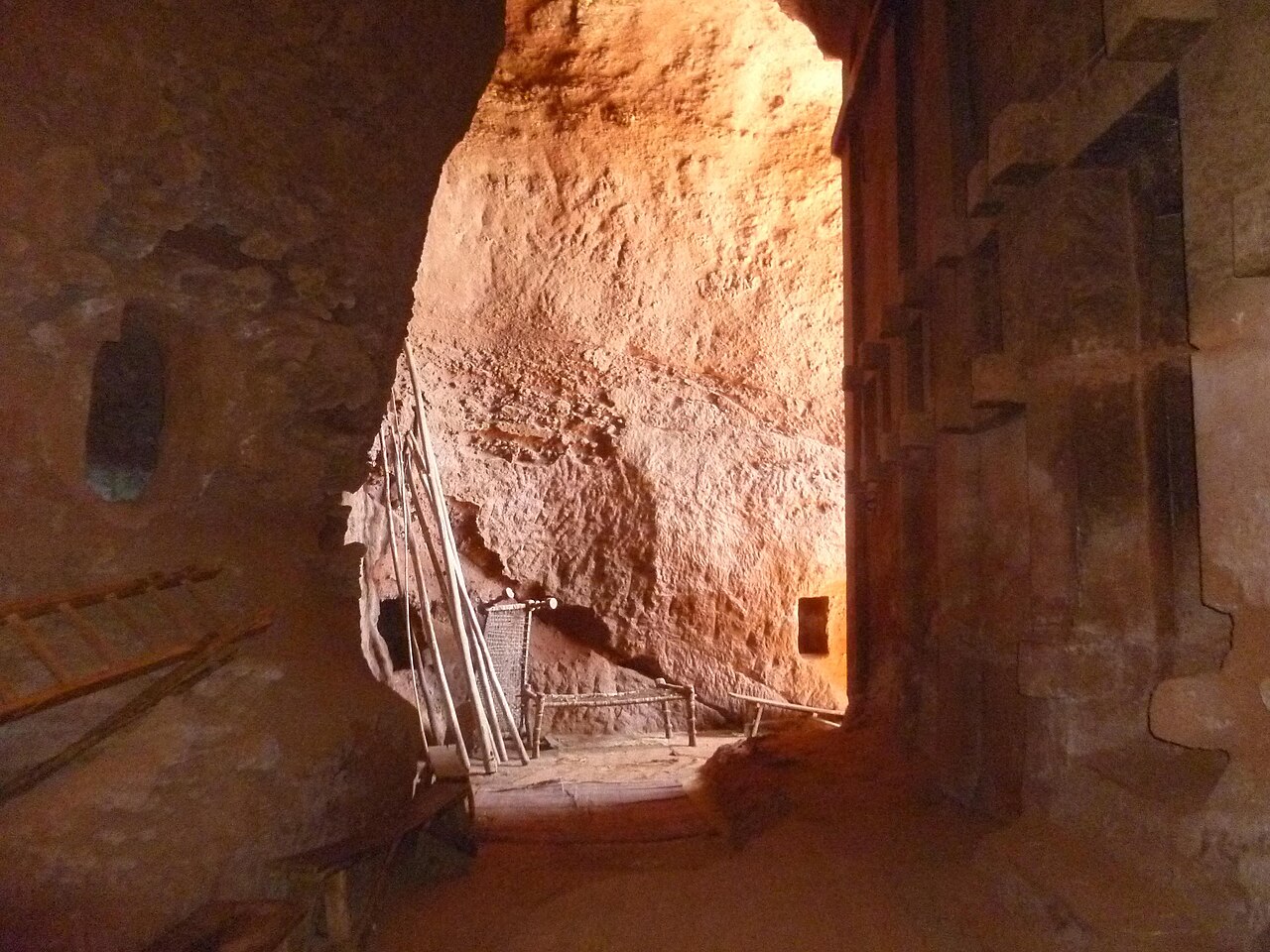
Lalibela’s elevation matters for more than scenery. The churches were carved from scoriaceous basalt, a relatively soft volcanic rock that hardens on exposure to air. Builders worked from the top down, cutting trenches around monolithic blocks before sculpting facades, windows, columns, and interiors. It is the reverse of conventional construction: instead of assembling stone upward, they removed it downward, releasing each church from the living rock like a sculptor freeing a figure from marble.
How Were the Lalibela Rock Churches Built?
No contemporary written record explains the construction. What historians have is a combination of geology, oral tradition, and inference. Radiocarbon dating of organic material associated with the churches, along with the dating of associated manuscripts, supports the 12th–13th century window, though some scholars argue elements may be older or later. The Gadla Lalibela, a hagiographic account of the king’s life written in Ge’ez, describes angels assisting the work by day and night — a theological claim that has fed centuries of legend.
Technique and Tools
Excavation on this scale required enormous organised labour. Estimates of the workforce vary widely, but the logistics alone — removing tens of thousands of cubic metres of rock, provisioning workers, and maintaining precise geometry — imply a state capable of mobilising resources across a wide region. The tools were likely iron chisels, picks, and wooden levers, supplemented by fire-setting: heating rock and then dashing it with water to fracture it.
- Top-down carving: trenches were cut first, isolating a block of rock from the surrounding mass.
- Facade shaping: exteriors were sculpted to mimic Aksumite architecture, with blind windows, projecting beams, and layered cornices.
- Interior excavation: naves, aisles, pillars, and vaults were hollowed out, often leaving structural columns in place.
- Drainage engineering: channels, cisterns, and tunnels managed rainwater — essential in a highland climate with heavy seasonal rains.
The result is a set of buildings that imitate timber-and-stone construction while being made of a single piece of stone. That paradox — carved architecture mimicking built architecture — is central to their fascination.
The Eleven Churches: A Guided Tour of the Lalibela Rock Churches
The churches are conventionally grouped into two main clusters divided by the Yordanos (Jordan) River, plus the isolated Bet Giyorgis to the west. Pilgrims and scholars alike treat the whole complex as a symbolic re-creation of Jerusalem — an idea strengthened by the naming of local features after holy sites: the Jordan River, the Mount of Olives, Golgotha, and the Tomb of Adam.
The Northern Cluster
Bet Medhane Alem (“House of the Saviour of the World”) is the largest monolithic church in the world, measuring roughly 33.5 metres long, 23.9 metres wide, and 11.5 metres high. It rests on a plinth and is surrounded by 36 pillars, with an interior colonnade of 28 more. Its scale and proportions suggest a deliberate echo of Aksumite cathedral architecture, and a nearby trench system links it to the rest of the group.
Bet Maryam (“House of Mary”) is the oldest of the northern group in most accounts and the most venerated. Its interior is decorated with frescoes — some medieval, some later — depicting the Virgin and Child, the Crucifixion, and saints. A small chamber behind the main sanctuary is traditionally identified as the king’s private chapel.
Bet Golgotha and Bet Mikael form a twin complex. Bet Golgotha contains a replica of the Tomb of Christ and is famously restricted: tradition holds that only a single priest may enter certain inner chambers. Nearby, the Selassie Chapel and the Tomb of Adam add to the site’s layered symbolism.
Bet Denagel (“House of Virgins”), Bet Meskel, and Bet Debre Sina complete the northern group, each with distinct proportions and decorative details. Bet Meskel’s cruciform pillars and Bet Denagel’s simpler plan reward close looking.
The Eastern Cluster
Bet Amanuel is often called the most refined of the eleven. Its exterior is richly carved with projecting beam-ends and a frieze of blind windows; the interior has a cruciform plan with finely cut capitals. Some scholars see Aksumite influence, others detect a more local Amhara idiom.
Bet Merkorios, Bet Abba Libanos, and Bet Gabriel-Rufael sit close together. Bet Gabriel-Rufael is entered through a dramatic trench and features a raised walkway and a bridge-like passage. Bet Abba Libanos is unusual in being attached to the rock on three sides rather than fully freed, and local tradition attributes its construction to the king’s wife, Meskel Kebra.
Bet Giyorgis: The Star of the Site
Standing apart to the west, Bet Giyorgis (“House of Saint George”) is the most photographed and, for many visitors, the most moving. Carved as a perfect Greek cross, it drops some 12 metres into a rectangular pit, its roof flush with the surrounding ground so that you approach it from above and look down. The interior is relatively plain, which throws the exterior geometry into sharp relief. Legend says Saint George himself objected that he had been omitted from the original set, prompting the king to build this final church in his honour.
“I have seen the churches of Lalibela, and I do not know whether to call them the work of men or of angels.” — a sentiment widely attributed to early foreign visitors, and one that captures the enduring awe the site provokes.
| Church | Cluster | Notable Feature |
|---|---|---|
| Bet Medhane Alem | Northern | Largest monolithic church in the world; 36 external pillars |
| Bet Maryam | Northern | Oldest of the northern group; medieval frescoes |
| Bet Golgotha & Bet Mikael | Northern | Replica Tomb of Christ; restricted inner chambers |
| Bet Amanuel | Eastern | Most finely carved exterior; cruciform interior |
| Bet Giyorgis | Western (isolated) | Perfect Greek-cross plan; 12 m deep pit |
Faith, Pilgrimage, and Daily Life at the Lalibela Rock Churches
Lalibela is not a museum. It is the spiritual heart of the Ethiopian Orthodox Tewahedo Church, and the churches remain in active liturgical use. Priests in white netela shawls chant the liturgy in Ge’ez, the ancient liturgical language; deacons carry ornate processional crosses; and the sistrum and kebero drum punctuate services that can last for hours.
The biggest event of the year is Timkat, the Ethiopian Epiphany, celebrated on 19 January (20 January in leap years). Timkat commemorates the baptism of Christ, and in Lalibela the tabot — a consecrated replica of the Ark of the Covenant that gives each church its sanctity — is carried in procession to the waters. Crowds of pilgrims, many having walked for days, fill the courtyards. The following day, Ketera, marks the return of the tabots. Other major observances include Genna (Ethiopian Christmas, 7 January) and the feast of Saint George on 23 April (or 6 May in some calendars), which draws devotees to Bet Giyorgis.
Pilgrimage to Lalibela has deep roots. For centuries, the faithful have travelled from across Ethiopia — from Tigray, Gondar, Gojjam, and beyond — often on foot, sleeping in church courtyards. The site’s identification with Jerusalem grew especially strong after the Crusades made travel to the Holy Land difficult for Ethiopian Christians; Lalibela offered a domestic substitute, complete with its own Jordan and Golgotha.
Living Heritage, Modern Pressures
That living status brings challenges. The churches face weathering, water infiltration, and the erosive effect of millions of footsteps. A protective canopy was erected over Bet Medhane Alem in 2008, but it proved controversial — critics argued it altered the visual integrity of the site, and its future has been debated ever since. Conservation efforts involve the Ethiopian government, UNESCO, and international partners, balancing preservation against the ritual needs of a worshipping community.
Access has also improved. Ethiopian Airlines operates regular flights to Lalibela Airport, and a paved road links the town to the regional hub of Woldia. Tourism brings income but also pressure: the site must serve pilgrims, residents, and visitors without being overwhelmed by any one of them.
Lalibela in Ethiopian and World History
The Zagwe dynasty that built Lalibela is sometimes dismissed in older historiography as a “usurping” interlude between Aksum and the Solomonic restoration. That framing does the Zagwe a disservice. Their reign produced not only the churches but also a flourishing of Ge’ez literature and religious art. King Lalibela himself is remembered as a devout ruler who abdicated in favour of his nephew and retired to a monastery.
After the Solomonic dynasty took power in 1270, the political centre shifted south, and Lalibela’s prominence as a capital faded. But its sacred status endured. The churches survived the upheavals of the 16th-century Ahmad Gran campaigns, the 19th-century wars of unification, the Italian occupation (1936–1941), and the Ethiopian Civil War. In 1978, UNESCO inscribed “Rock-Hewn Churches, Lalibela” on the World Heritage List, recognising it as a masterpiece of human creative genius.
Comparisons are inevitable. Ethiopia has other rock-hewn churches — notably the Rock-Hewn Churches of Tigray, with hundreds of examples scattered across the Gheralta mountains, and the monastery of Debre Damo, reached by rope up a sheer cliff. Further afield, the rock-cut temples of Ellora and Ajanta in India, the Churches of Ivanovo in Bulgaria, and the subterranean city of Derinkuyu in Cappadocia share the technique of carving into stone. None, however, matches Lalibela’s combination of scale, coherence, and continued liturgical life.
Practicalities: Visiting the Lalibela Rock Churches Today
A visit rewards preparation. The altitude is significant, the stone surfaces are uneven and sometimes slippery, and the site is sacred ground. Modest dress is expected; shoes are removed before entering churches. Hiring a licensed guide is strongly recommended — the layers of symbolism, from the Jerusalem mapping to the Aksumite architectural references, are easy to miss without expert interpretation.
- Best time to visit: the dry season, October to March. Timkat in January is spectacular but crowded.
- Getting there: daily flights from Addis Ababa to Lalibela Airport, or a long overland drive via Woldia.
- Time needed: at least two full days to see all eleven churches without rushing.
- Respect: photography may be restricted inside some churches; always ask. Do not touch the frescoes.
- Support local: stay in locally owned guesthouses and buy from Lalibela’s artisans and weavers.
Modern Lalibela is a small town with a big responsibility. Its residents — farmers, priests, guides, hoteliers, and craftspeople — live with the daily reality of hosting one of the world’s most extraordinary monuments. The 2020s brought additional hardship: the conflict in northern Ethiopia disrupted travel and tourism, and the community has worked to rebuild. Visiting today is not just sightseeing; it is an act of solidarity with a place that has endured for eight centuries and intends to endure for many more.
Why Lalibela Still Matters
The Lalibela rock churches answer a question that nags at anyone who studies human achievement: what can people build when faith, political will, and technical ingenuity align? The answer, in the Ethiopian highlands, is eleven churches cut from living rock, still echoing with chant after 800 years. They are a monument to the Zagwe dynasty, to Ethiopian Orthodox devotion, and to the wider truth that African civilisations have produced architecture of world-historic importance — not as a curiosity, but as a central chapter in the story of human creativity.
To stand in the trench beside Bet Giyorgis, or to hear the sistrum rise during a dawn liturgy in Bet Maryam, is to understand that Lalibela is not a relic of a lost age. It is a working sanctuary, a pilgrimage destination, and a reminder that the sacred and the engineered are not opposites. The Lalibela rock churches remain what they have always been: a prayer carved in stone, and an invitation to wonder.