📅 Last updated: 12.09.2026
The Yoruba talking drums of southwestern Nigeria are among the most eloquent instruments ever devised by human hands — drums that do not merely keep time but speak, recite poetry, praise kings, and argue with rival drummers in tones any fluent Yoruba speaker can understand. Carved from wood, bound with leather, and tightened with cords, they carry within their hourglass bodies a technology of communication that predates the telephone by centuries and still thrives today, from the palace courtyards of Oyo to the concert halls of Lagos and the diaspora stages of London, Atlanta, and São Paulo.
- What Are Yoruba Talking Drums?
- The Mechanics: How Yoruba Talking Drums Actually "Speak"
- A Living Archive: The History and Cultural Role of Yoruba Talking Drums
- Yoruba Talking Drums in Modern Music and the Diaspora
- The Drum Families: Àyàn, Heredity, and Training
- How the Drums Are Made
- Learning to Hear: The Language of the Drum
- Preserving and Innovating: The Future of Yoruba Talking Drums
- Why the Talking Drum Still Matters
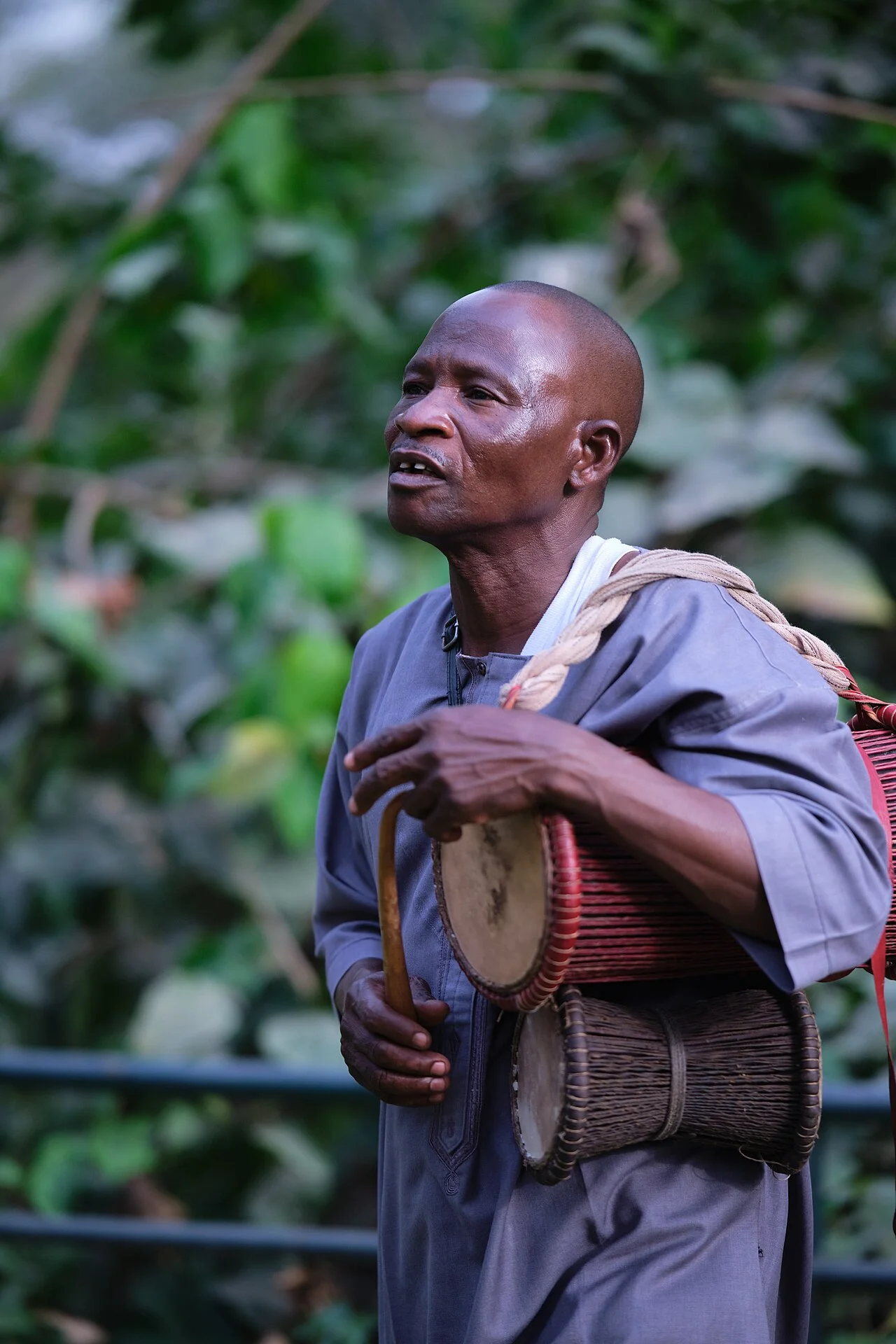
To watch a master drummer perform is to watch language itself take physical form. The drummer squeezes the tension cords under one arm while striking the drumhead with a curved stick, bending each note up or down so that the drum “pronounces” words. It is music, poetry, history, and telephone all at once — and it remains one of Africa’s most sophisticated contributions to world culture.
What Are Yoruba Talking Drums?
The Yoruba talking drums — known collectively in Yoruba as gángan, though the word is also used specifically for the lead drum of an ensemble — are a family of hourglass-shaped, double-headed membranophones whose pitch can be altered during play. The tension cords (ọ̀kọ̀) running along the body of the drum are squeezed between the drummer’s upper arm and ribcage; squeezing tightens the skin and raises the pitch, releasing lowers it. This continuous glissando is what allows the drum to imitate the tonal contours of the Yoruba language.
Yoruba is a tonal language with three basic tones — high (dò), mid (re), and low (mí) — and meaning changes with pitch. The Yoruba word igbá (calabash) and igba (two hundred) and ìgbá (garden egg) are distinguished largely by tone. A drum that can slide between pitches can therefore reproduce the melodic shape of speech. This is not a gimmick or an approximation; trained drummers can transmit intelligible messages, proverbs, and praise poetry across surprising distances.
The main members of the talking drum family include:
- Ìyáàlù — the “mother drum,” the lead instrument, largest and most versatile, capable of the widest pitch range.
- Gúdúgúdú — a larger, deeper drum, often played with a padded stick, holding down the bass line.
- Ìsáájú — the “leader” drum that answers the ìyáàlù.
- Kẹ̀rẹ̀kẹ̀rẹ̀ — a smaller talking drum with a flatter, more percussive tone.
- Gángan — the general name for the hourglass drum, and also the name for the smallest and highest-pitched member in some ensembles.
These drums rarely perform alone. They belong to ensembles that may include dùndún (the broader category of tension drums), bàtá drums (associated with the thunder deity Ṣàngó), ṣẹ̀kẹ̀rẹ̀ (beaded gourds), and agogo (metal bells). The interplay between them creates a dense, polyrhythmic texture that has fascinated ethnomusicologists for over a century.
The Mechanics: How Yoruba Talking Drums Actually “Speak”
The genius of the instrument lies in a simple but demanding principle: pitch control through tension. When the drummer tucks the drum under the arm and squeezes the cords, the drumhead stretches and the note rises. Release, and the note falls. A skilled player can produce swooping, vocal-like phrases that mirror the rise and fall of spoken Yoruba.
But tone alone is not enough. Yoruba speech also relies on rhythm, vowel length, and context. Drums cannot reproduce consonants or vowels directly, so they encode speech through a combination of:
- Pitch contour — matching the tonal pattern of the words.
- Rhythmic phrasing — the number and duration of strokes corresponding to syllables.
- Conventional formulas — standardized phrases and proverbs that listeners recognize instantly, much like a coded shorthand.
This is why the drums are sometimes described as “talking” rather than “speaking.” A drummer does not spell out every word; instead, he plays recognizable melodic-rhythmic patterns that a knowledgeable listener decodes. In this sense, the drum is closer to a poetic language than a phonetic one — and its messages are often proverbs, praises, or warnings rather than plain instructions.
“The drum is the voice of our ancestors. When it speaks, the living and the dead listen.”
— A common saying among Yoruba dùndún families in Òyó and Ìbàdàn
A Living Archive: The History and Cultural Role of Yoruba Talking Drums
The origins of the talking drum are woven into Yoruba oral history. Traditions trace the dùndún to the ancient Yoruba kingdoms, particularly the empire of Ọ̀yọ́, which flourished from roughly the 14th to the 18th century in what is now Oyo State, Nigeria. The drum was inseparable from kingship: it announced the arrival of the Aláàfin (the king of Oyo), praised his lineage, recounted his victories, and even delivered veiled criticism that no courtier dared speak aloud.
In the pre-colonial era, talking drums served functions that modern societies assign to newspapers, radio, and telephones. They were used to:
- Announce royal ceremonies, births, deaths, and wars.
- Recite the genealogy and praise names (oríkì) of kings and noble families.
- Send messages between towns and villages, sometimes over several kilometers.
- Accompany religious rituals for deities such as Ṣàngó, Ọ̀ṣun, and Ọ̀rúnmìlà.
- Provide entertainment and social commentary at markets, festivals, and weddings.
During the transatlantic slave trade, Yoruba people were forcibly carried to the Americas, and the talking drum traveled with them in memory and, in some cases, in physical form. In Cuba, the batá drums — closely related to Yoruba bàtá — became central to Santería (Regla de Ocha) practice. In Brazil, Yoruba-derived traditions shaped Candomblé and the music of Bahia. In Trinidad, the Yoruba influence persists in Orisha worship. The talking drum’s descendants are now global.
Within Nigeria, the instrument survived colonialism, the disruption of the slave trade, and the rise of new musical forms. Missionary Christianity sometimes discouraged drumming as “pagan,” but the drums persisted in traditional settings and, from the mid-20th century, re-entered popular music with force.
Yoruba Talking Drums in Modern Music and the Diaspora
Few African instruments have crossed so many borders so successfully. In the 1960s and 1970s, Nigerian musicians began fusing dùndún with jazz, highlife, and Afrobeat. Fela Kuti, the pioneer of Afrobeat, incorporated Yoruba percussion into his sprawling arrangements, though his primary rhythmic engine was the drum kit and shekere. More directly, drummers like Ọ̀jọ̀ and Àyàn Àgan families kept the classical repertoire alive while adapting it to stage performance.
The 1970s and 1980s saw the rise of jùjú music, pioneered by King Sunny Adé and Chief Commander Ebenezer Obey. Jùjú placed the talking drum at the heart of a modern band, alongside electric guitars and pedal steel. King Sunny Adé’s international tours in the 1980s introduced Yoruba talking drums to audiences in Europe and North America, and his album Juju Music (1982) remains a landmark.
In the diaspora, the drums found new homes. In Cuba, the batá tradition thrived. In Brazil, atabaque drums echo Yoruba rhythms in Candomblé houses. In the United States, artists like Randy Weston and later Art Blakey drew on African percussion, and contemporary musicians such as Babatunde Olatunji — a Nigerian drummer who moved to the U.S. in 1950 — brought Yoruba drumming to global audiences. Olatunji’s 1959 album Drums of Passion sold millions and helped spark the American interest in African percussion that continues today.
More recently, talking drums have appeared in pop, hip-hop, and electronic music. Nigerian artists like Wizkid, Burna Boy, and Adekunle Gold have woven Yoruba percussion into Afrobeats, while producers in London and Atlanta sample dùndún phrases. The drum that once announced a king’s arrival now drops in a club track — and still speaks.
| Era | Key Development | Notable Figures / Places |
|---|---|---|
| Pre-18th century | Talking drums central to Ọ̀yọ́ empire court ritual and communication | Aláàfin of Oyo; Oyo Ile |
| 18th–19th century | Transatlantic slave trade carries Yoruba drum traditions to the Americas | Cuba (batá), Brazil (atabaque), Trinidad |
| 1960s–1970s | Fusion with jazz, highlife, and Afrobeat; jùjú emerges | Fela Kuti; King Sunny Adé; Ebenezer Obey |
| 1980s–1990s | International tours and recordings bring dùndún to global audiences | King Sunny Adé; Babatunde Olatunji |
| 2000s–present | Afrobeats, hip-hop, and electronic producers sample and perform talking drums | Wizkid; Burna Boy; Adekunle Gold; London and Atlanta studios |
The Drum Families: Àyàn, Heredity, and Training
Among the Yoruba, drumming is traditionally a hereditary profession. The patron deity of drummers is Àyàn (also called Àyàn Àgan), and drumming families — known as ẹgbẹ́ Àyàn — trace their lineage to him. A child born into a drummer family is expected to learn the craft from an early age, often beginning with simple rhythms before graduating to the complex praise poetry of the ìyáàlù.
Training is rigorous and oral. There are no written scores in the traditional system; instead, students memorize thousands of phrases, proverbs, and oríkì by ear. They learn the “language” of the drum the way they learn Yoruba itself — through immersion, repetition, and correction. A master drummer may spend decades refining a single repertoire.
This hereditary system has preserved remarkable continuity, but it has also faced challenges. Urbanization, migration, and the pull of formal education have drawn some young people away from the craft. In response, a new generation of drummers — many university-trained — is blending traditional knowledge with contemporary performance, teaching in schools, and touring internationally. The tension between tradition and modernity is real, but it has also produced innovation.
Women and the Drum
Historically, drumming among the Yoruba was largely a male domain, though women played important roles as singers, dancers, and ritual specialists. In recent decades, women drummers have increasingly claimed space on stage and in ensembles. Artists like Àràbà and contemporary performers in Lagos and Ìbàdàn have challenged old assumptions, and the sight of a woman playing the ìyáàlù — once rare — is now more common at festivals and concerts.
How the Drums Are Made
The construction of a talking drum is itself an art. The body is typically carved from the wood of the ọ̀mọ̀ tree or other hardwoods, hollowed and shaped into an hourglass. Goatskin or cowskin is stretched over both ends and secured with leather cords. The cords are then tightened or loosened to tune the drum and to allow the pitch-bending technique.
The process requires skill and patience:
- Carving — the wood is shaped and smoothed, often by specialist carvers.
- Skin preparation — hides are cleaned, soaked, and stretched.
- Assembly — the skins are attached and the tension cords threaded.
- Tuning — the drummer adjusts the cords to achieve the desired pitch range.
- Aging — the drum is played and re-tuned over time to mature its sound.
Different sizes produce different voices. The ìyáàlù, the largest, can range over more than an octave; the gángan is smaller and sharper. A full ensemble balances these voices like a choir.
Learning to Hear: The Language of the Drum
For outsiders, the talking drum can seem mysterious — how can a drum “say” anything? The key is that Yoruba listeners do not hear random beats; they hear patterns they have known since childhood. A phrase like “Ẹ kú àárọ̀” (“Good morning”) has a distinctive tonal shape, and the drum can render that shape recognizably.
Some common drum phrases include:
- Praise names of kings and chiefs, played at ceremonies.
- Proverbs such as “Bí a bá ní ìwà, a ní ọ̀rọ̀” — “If we have character, we have something to say.”
- Warnings or announcements, used historically to alert towns to danger or important news.
- Greetings and salutations for weddings, naming ceremonies, and festivals.
Not every drummer can “speak” fluently. Many play rhythmic accompaniment without full linguistic content. The master drummers — often titled onílù or alágbe — are the ones who command the language. Their skill is measured not just in technique but in eloquence: the ability to praise, provoke, comfort, and commemorate.
Preserving and Innovating: The Future of Yoruba Talking Drums
Today, the Yoruba talking drums face both opportunity and risk. On one hand, global interest in African music has never been higher. Afrobeats is a worldwide phenomenon, and the talking drum is increasingly sampled, studied, and performed far beyond Nigeria. Universities in Europe and North America offer courses in African drumming; festivals from Lagos to London to New York feature dùndún ensembles.
On the other hand, the traditional apprenticeship system is under strain. Many master drummers struggle to earn a living, and some young people see drumming as less prestigious than careers in technology or business. Cultural institutions, NGOs, and individual artists are working to change that. In Nigeria, the Centre for Black and African Arts and Civilization (CBAAC) and various state cultural councils support traditional performance. In Ìbàdàn, Òyó, and Lagos, drumming schools and festivals keep the repertoire alive.
Technology is also playing a role. Drummers use social media to share performances, teach techniques, and connect with global audiences. Online lessons, YouTube channels, and streaming platforms have made it possible to learn from masters without leaving home. At the same time, digital sampling raises questions about credit and compensation — a familiar tension in global music.
What is clear is that the talking drum is not a relic. It is a living instrument, still evolving, still speaking. Its future will be shaped by the same forces that have always shaped it: the creativity of its players, the demands of its audiences, and the enduring power of the Yoruba language and culture it carries.
Why the Talking Drum Still Matters
The Yoruba talking drums are more than musical instruments. They are archives of history, vehicles of poetry, and bridges between generations. They remind us that communication is not only about words but about tone, rhythm, and context — lessons as relevant in the age of social media as they were in the courtyards of Ọ̀yọ́.
For the African diaspora, the drums are a link to ancestral memory, a sound that survived the Middle Passage and took root in new soils. For Nigeria, they are a source of pride and a symbol of cultural depth that predates colonial borders. For the world, they are a reminder that Africa’s contributions to global culture are not marginal but foundational.
When a drummer squeezes the cords and the drum speaks, something ancient and immediate happens. A king is praised. A proverb is recalled. A community is called together. The talking drum does not just make music — it makes meaning. And as long as there are hands to play it and ears to hear it, the Yoruba talking drums will continue to speak, across continents and across time.