📅 Last updated: 07.09.2026
Meroë Pyramids Sudan, the hauntingly beautiful remnants of a once-mighty civilization, rise from the sands of the Bayuda Desert like a mirage, yet they remain one of the African continent’s most profound and least-visited archaeological treasures. While the pyramids of Giza draw millions to Egypt each year, these smaller, steeper cousins—numbering nearly 200—stand in relative solitude along the east bank of the Nile, a silent testament to the power and sophistication of the Kingdom of Kush. For travelers and history enthusiasts alike, the journey to this remote site is not merely a visit to ancient tombs; it is an encounter with a proud African empire that once ruled Egypt itself and whose kings and queens commissioned these enduring monuments to their own divine rule.
- Unearthing the Legacy: Why the Meroë Pyramids Sudan Deserve the Spotlight
- A Royal City of Iron and Gold: The Historical Context of Meroë
- Architecture of the Afterlife: The Unique Design of the Meroë Pyramids
- Kings, Queens, and Conquerors: A Timeline of Royal Burials
- The Enduring Mysteries: The Meroitic Language and Script
- Modern Sudan and the Preservation of a Heritage
- Planning Your Visit: The Experience of a Lifetime
- The Legacy of Kush: A Final Reflection on the Meroë Pyramids Sudan
Unearthing the Legacy: Why the Meroë Pyramids Sudan Deserve the Spotlight
To understand the significance of the Meroë Pyramids Sudan, one must first recalibrate their mental map of ancient history. The narrative of the Nile Valley is often monopolized by its northern neighbor, yet the Kingdom of Kush, with its alternating capitals at Napata and later Meroë, was not a mere vassal or a cultural echo of Egypt. It was a formidable state in its own right, a superpower of the ancient world that controlled vast gold mines, traded with Rome, Greece, and India, and developed a unique script that remains undeciphered to this day. The pyramids at Meroë are the most visible and poignant symbols of this empire’s final and most prosperous phase, a period when the Kushites broke from certain Egyptian artistic conventions to forge a distinctly Nubian identity.
Despite their grandeur, these pyramids have been historically marginalized in the global imagination. Early European explorers often dismissed them as inferior copies of Egyptian monuments, a narrative that modern scholarship has vigorously debunked. The reality is far more complex and fascinating. The Meroitic pyramids are not merely imitations; they are innovations. Their steep angles, decorative sunken reliefs, and the presence of royal burial chambers decorated with intricate, often violent, battle scenes represent a unique artistic language. Moreover, the sheer density of royal burials at Meroë—spanning nearly a millennium—offers an unbroken genealogical record of a dynasty that far outlasted the pharaohs of the New Kingdom.
Today, a growing movement of Sudanese heritage advocates and international archaeologists is working to change the narrative. The site, a UNESCO World Heritage Centre since 2011, is increasingly recognized not as a footnote to Egyptian history, but as a central pillar of African antiquity. With the country slowly opening its doors to tourism following years of political isolation, the world is beginning to rediscover what locals have always known: the Meroë Pyramids Sudan are a source of immense national pride and a wonder of the ancient world waiting to be explored.
A Royal City of Iron and Gold: The Historical Context of Meroë
The story of Meroë begins long before the pyramids were built. Its origins lie in the cultural and political crucible of the Nile Valley. Following the withdrawal of Egyptian control over Nubia at the end of the New Kingdom (circa 1070 BCE), a native kingdom arose at Napata, near the sacred mountain of Jebel Barkal. This state, which we now call Kush, had a complex relationship with Egypt. They adopted Egyptian gods, hieroglyphs, and royal regalia, but they did so on their own terms. In a stunning turn of events in the 8th century BCE, the Kushite king Piye conquered Egypt, founding the 25th Dynasty and ruling a united Nile Valley from the Mediterranean to the confluence of the Blue and White Niles. This period of “Ethiopian” rule, as the Greeks called it, was a golden age of archaism, with pharaohs like Taharqa building and restoring temples across Egypt.
However, the Kushite hold on Egypt was broken by the Assyrian invasion in 671 BCE. The royal court retreated south to Napata, where they continued their traditions for several centuries. But the world was changing. The rise of Persian, and later Greek (Ptolemaic) power in Egypt, created a new political landscape. Sometime between the 3rd and 2nd centuries BCE, the Kushite rulers made a strategic decision to move their primary royal residence and burial ground further south to Meroë. This shift was not arbitrary; it was a calculated move driven by economic and strategic advantages.
The Strategic Advantages of the Island of Meroë
The region around Meroë, known as the “Island of Meroë” (a triangle of land between the Nile and its tributaries, the Atbara and the Blue Nile), was a powerhouse of resources. Unlike the narrow strip of agricultural land at Napata, Meroë was surrounded by savannah grasslands that supported vast herds of cattle, sheep, and goats, providing a robust economic base. More critically, the area was rich in iron ore and timber for smelting. This led to Meroë becoming a major iron production center, a veritable “Birmingham of Africa” in the ancient world, as some historians have dubbed it. The slag heaps found at the site are massive, indicating industrial-scale production that supplied tools and weapons that fueled the kingdom’s wealth and military might.
Moreover, Meroë’s geographical position facilitated trade. It was a nexus for caravan routes linking the Mediterranean world with the interior of Africa and the Red Sea coast. From its ports, like Berenike and Suakin, ivory, ebony, gold, and exotic animals were shipped to the Roman Empire and India, while luxury goods like glass, wine, and olive oil flowed back. This commercial vibrancy is reflected in the archaeological record, with Meroitic artifacts and even Roman goods found in the royal tombs. The move to Meroë, therefore, was a pivot from a theocratic, temple-centric power base to a more commercial and militaristic one, setting the stage for the era of pyramid construction we see today.
Architecture of the Afterlife: The Unique Design of the Meroë Pyramids
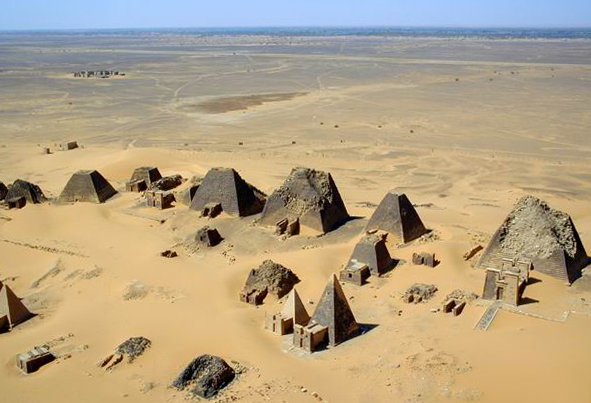
Standing before the necropolis at Meroë, the visual difference from Egyptian pyramids is immediately apparent. The Egyptian pyramids at Giza are smooth-sided, massive structures built with colossal blocks. The Meroë Pyramids Sudan, in contrast, are much smaller, rarely exceeding 30 meters (98 feet) in height, and are distinguished by their steep, narrow angles—often at a 70-degree incline—and their distinctive “shaft and box” design. They are constructed of sandstone blocks and were originally encased in a smooth plaster and painted, often with vibrant colors that have long since faded or been eroded, leaving only a rough, rocky appearance.
Another defining feature is the placement of the burial chamber. In Egypt, the burial chamber is deep within the pyramid’s core. In Meroë, the chamber is cut into the bedrock below the pyramid, with the pyramid itself acting as a massive marker or superstructure. Access was gained via a stairway from the east, which was sealed after burial. This design choice was perhaps a practical solution to the softer sandstone bedrock, but it also reflected a shift in religious belief, focusing on the pyramid as a monument for the living and the dead to see, rather than a secret, protected chamber.
Art and Iconography: A Blend of Cultures
The decoration inside these chambers is where the Meroitic culture truly shines. While the exterior walls of the small chapels attached to each pyramid are adorned with reliefs depicting the king or queen with the gods Isis and Osiris, the interior walls of the burial chambers reveal a different, more militaristic world. These reliefs, often showing the deceased in battle, trampling enemies beneath their chariot horses, or being led to the afterlife by the jackal-headed god Anubis, are a fascinating hybrid. The iconography is Egyptian in origin, but the execution is distinctly Meroitic—the figures are more robust, the poses more dynamic, and the details reflect local customs and dress.
The pyramids at Meroë are not just for kings. They are also the final resting places for a remarkable number of Kandakes, or Queen Mothers. These women were not mere consorts; they were powerful political figures, often acting as regents or joint rulers. The most famous of these is likely Queen Amanirenas, who led Kushite armies against the Roman Empire in a brutal five-year war (circa 25-22 BCE). After initial Roman successes, Amanirenas and her forces defeated a Roman garrison and famously returned with the head of a statue of Augustus, which she buried beneath the steps of a temple in Meroë—a symbolic act of defiance that enraged Rome. Ultimately, a peace treaty was negotiated on favorable terms for Kush, and the kingdom retained its independence. Her pyramid, along with those of other warrior queens, stands as a testament to the unique power women held in this society.
Kings, Queens, and Conquerors: A Timeline of Royal Burials
The royal necropolis at Meroë is split into three distinct cemeteries: the South, North, and West. The North cemetery is the oldest and contains the pyramids of the earliest kings who moved to Meroë, while the South cemetery is the most extensive, with burials dating from the 3rd century BCE to the 1st century CE. The West cemetery, interestingly, is primarily for non-royal elites, indicating a structured social hierarchy even in death. The sheer number of royal pyramids—over 40 in the North and South cemeteries alone—allows archaeologists to trace the lineage and power dynamics of the Kushite state for over 600 years.
One of the most tragic events in the history of these monuments occurred in the 19th century. Giuseppe Ferlini, an Italian physician and treasure hunter, arrived at Meroë in 1834 seeking gold. He was not an archaeologist; he was a plunderer. Frustrated by his initial digs, he decided to attack the pyramids themselves. He famously took a battering ram to the top of several pyramids, including the tomb of Queen Amanishakheto, demolishing their upper portions in his frantic search for treasure. His brutal methods worked, and he found a magnificent hoard of jewelry, now housed in the Egyptian Museum in Munich and the British Museum. While his discovery proved the immense wealth of the Meroitic royals, his actions left many of the pyramids in a ruined state, their tops sheared off, permanently altering the skyline of the ancient city.
| Time Period (approx.) | Ruler | Key Contribution/Event |
|---|---|---|
| c. 270 BCE | King Arkamani I (Ergamenes) | Often credited with beginning the move to Meroë and breaking the power of the Napatan priesthood, establishing a more secular rule. |
| c. 25-22 BCE | Queen Amanirenas | The one-eyed warrior queen who fought Rome to a stalemate, securing Kushite independence and tax exemptions. |
| c. 41-50 CE | King Natakamani & Queen Amanitore | Co-rulers who built extensively, including the grand Lion Temple at Naqa and the massive Amun temple at Meroë. Their pyramids are among the most prominent in the North cemetery. |
| c. 137-150 CE | King Takideamani | One of the last major pyramid builders, his tomb shows a continuation of the royal tradition before the kingdom’s slow decline. |
| c. 350 CE | End of the Kingdom | The kingdom is eventually conquered by the Kingdom of Aksum from Ethiopia, whose King Ezana records his victory, marking the end of the pyramid-building era. |
Despite Ferlini’s destruction, the site remains staggeringly impressive. The pyramids are not isolated; they are part of a vast urban landscape. The royal city of Meroë itself, with its palaces, temples, and the massive “Royal Baths” complex—which was actually a water sanctuary with pools and sculptures—lies just a few kilometers away. The most significant religious structure was the Amun Temple, a sprawling complex that was the spiritual heart of the city. The proximity of the necropolis to this bustling urban center highlights the belief that the dead were not separate from the living but remained integral to the community’s spiritual and political life.
The Enduring Mysteries: The Meroitic Language and Script
Beyond the stone and sand, perhaps the most fascinating mystery of the Meroë Pyramids Sudan is the language of the people who built them. The Meroitic civilization developed its own script in the 2nd century BCE, derived from Egyptian hieroglyphs. It is an alphabetic script with 23 symbols, used for both monumental inscriptions and everyday documents. While the script is remarkably easy to read phonetically, the language itself is a puzzle. It is not a Semitic language like Arabic or Hebrew, nor is it closely related to ancient Egyptian. Its grammatical structure and vocabulary are unique, and linguists have struggled for over a century to find a cognate language.
The discovery of the Rosetta Stone was the key to unlocking Egyptian hieroglyphs. No such bilingual text has been found for Meroitic. While some words can be guessed—such as qore (king) and kandake (queen mother)—the vast majority of the inscriptions remain untranslated. Funerary texts, which are common, usually follow a formulaic pattern of offerings and genealogies, giving us names and titles, but leaving the rich literature, history, and religious beliefs of the Meroites tantalizingly out of reach. Inscriptions on temple walls and offering tables are the primary source of information, but they are often repetitive. The lack of a “Meroitic Rosetta Stone” means that we can read the names of the kings on their pyramids, but we are deaf to their voices and their stories.
Current research is utilizing digital technologies, like photogrammetry and machine learning, to analyze the vast corpus of Meroitic texts. By comparing texts from different contexts, researchers hope to identify patterns and eventually crack the linguistic code. A breakthrough would be akin to opening a library of ancient African thought, revealing the philosophy, poetry, and daily life of a civilization that has been silent for over fifteen centuries. Until then, the script remains a beautiful and frustrating enigma, etched into the very stones of the pyramids, a puzzle waiting for its champion.
Modern Sudan and the Preservation of a Heritage
For the people of modern Sudan, the Meroë Pyramids Sudan are more than just an archaeological site; they are a cornerstone of national identity. In a country with immense ethnic and cultural diversity, the pyramids serve as a unifying symbol of a glorious, indigenous African past. However, the site faces significant challenges in the 21st century. Years of international sanctions, internal conflict, and economic hardship have limited funding for preservation and made it difficult for international tourists to visit. The 2023 conflict in Sudan has further endangered the site, raising fears of looting and unchecked damage as security forces are diverted elsewhere.
Despite these obstacles, dedicated Sudanese archaeologists and conservators are working tirelessly to protect their heritage. Many have been trained in international programs and are applying modern conservation techniques to stabilize the sandstone and prevent further erosion. There is also a growing digital preservation effort, with teams creating 3D models of the pyramids to create a permanent record that can be studied and admired even if the physical site is threatened. International organizations like UNESCO and the British Museum have partnered with the National Corporation for Antiquities and Museums (NCAM) of Sudan to provide training and resources, though the political climate often makes collaboration difficult.
The future of the Meroë Pyramids Sudan is inextricably linked to the stability and prosperity of Sudan itself. As the country navigates its path forward, the government and its people recognize that their ancient heritage is a potential engine for economic development through tourism, as well as a source of soft power on the global stage. The “Forgotten” label is slowly being shed as documentaries, academic papers, and a new generation of African storytellers shine a light on these wonders. For those who cannot travel, virtual tours and high-resolution imagery are making the site more accessible than ever, ensuring that the legacy of the Kushite kings and queens continues to inspire and amaze a global audience.
Planning Your Visit: The Experience of a Lifetime
To stand at the foot of the Meroë Pyramids Sudan is to feel a profound connection to the deep currents of history. The journey there is an adventure in itself. Most travelers base themselves in Khartoum, Sudan’s capital, and make the roughly 200-kilometer (124-mile) drive north-northeast. The road is surprisingly good, and the drive offers a fascinating glimpse of modern Sudanese life—camel herders moving across the desert, vibrant markets in small towns, and the ever-present Nile glinting on the horizon. As you approach the site, the pyramids appear suddenly on the horizon, a cluster of dark, jagged triangles against the stark yellow sand.
The experience is vastly different from the crowded, policed sites in Egypt. Here, you are likely to have the place almost to yourself, with perhaps only a few other intrepid travelers and the local guards who live in a small village nearby. The silence is profound, broken only by the wind and the occasional cry of a bird. You can walk freely among the pyramids, touching the sandstone that was quarried and carved over two millennia ago. The sense of solitude and discovery is palpable; you feel less like a tourist and more like an explorer stumbling upon a lost city.
Essential Tips for the Intrepid Traveler
Visiting Sudan requires preparation, but the reward is immense. Here is a quick guide to ensure a smooth and memorable visit:
- Visa and Security: Secure your tourist visa well in advance from a Sudanese embassy. It is essential to register with the authorities within three days of arrival. Always check the latest travel advisories from your home country, as the security situation can change rapidly. Hiring a local guide and driver is highly recommended; they are essential for navigating logistics and provide invaluable context.
- Best Time to Visit: The ideal months are from November to February, when the desert heat is bearable (ranging from 20-30°C / 68-86°F). From March onwards, temperatures soar, making midday exploration challenging and exhausting.
- Accommodation: There are no luxury hotels at Meroë. Most visitors stay in Khartoum and make a day trip, or they opt for a basic but functional guesthouse or camp near the site. For a truly immersive experience, camping under the stars within sight of the pyramids is an unforgettable option, but it requires a tour operator to arrange permits and logistics.
- What to Bring: Water is essential—bring far more than you think you need. Sunscreen, a wide-brimmed hat, and sunglasses are non-negotiable. A good flashlight is useful for exploring the dark burial chambers (if accessible and permitted). And, of course, bring a camera with extra batteries and memory cards; you will take hundreds of photos.
- Cultural Respect: Sudan is a conservative Muslim country. Dress modestly, covering shoulders and knees, especially in rural areas. Always ask permission before photographing local people. Showing respect for the site itself—not climbing on the fragile pyramids and not removing artifacts—is paramount to its preservation.
While the area around the pyramids is remote, the nearby town of Shendi offers a glimpse into local life, with its bustling souq (market) and traditional architecture. The confluence of the Nile and the Atbara rivers is also nearby, a landscape of dramatic contrasts that has sustained human life for millennia. A visit to Meroë is not just a historical tour; it is a deep dive into the heart of Sudan, a country of warm, generous people and breathtaking landscapes that are slowly, cautiously, opening up to the world.
The Legacy of Kush: A Final Reflection on the Meroë Pyramids Sudan
The Meroë Pyramids Sudan are far more than a collection of ancient tombs; they are a powerful symbol of African agency, resilience, and sophistication. For centuries, the story of Africa was too often told from the outside, with the continent’s great civilizations downplayed or attributed to outside influences. The Kingdom of Kush, with its magnificent capital at Meroë, stands as a definitive refutation of these outdated narratives. Here was a civilization that not only survived but thrived in the shadow of Rome and Egypt, building a unique culture, mastering iron technology, and creating a powerful state led by both men and women of remarkable capability.
To walk among these pyramids is to pay homage to the engineers, artisans, priests, and laborers who shaped them. It is a reminder that the impulse to honor the dead, to celebrate power, and to leave a lasting mark on the world is a universal human trait, expressed with unique brilliance on the banks of the Nile. The rediscovery and appreciation of Meroë is part of a larger, vital movement to reclaim African history and to recognize the continent’s central role in the human story. As you stand there, looking out over the desert, you are not looking at a “lost” civilization, but at one that is being found again, its stones whispering tales of kings, queens, and a glorious past that continues to shape the identity of a modern nation. The pyramids of Meroë are not forgotten; they are simply waiting for us to remember them.