📅 Last updated: 05.07.2026
The San people culture, often referred to as the world’s most ancient continuous lineage, represents a living library of humanity’s deep past, yet it remains vibrantly present across the arid landscapes of Southern Africa. To speak of the San is to speak of the original inhabitants of a subcontinent, a people whose genetic and linguistic roots stretch back over 20,000 years, predating the Bantu migrations and the arrival of European colonizers. They are not a single monolithic tribe but a diverse constellation of communities—including the !Kung (Juǀʼhoansi) of Namibia and Botswana, the Gǀui and Gǁana of the Central Kalahari, and the Khwe and !Xun of Angola and Zambia—each with its own dialect, territory, and distinct traditions. For millennia, they thrived as hunter-gatherers, not from a lack of ambition but from a profound, symbiotic relationship with some of the harshest yet most beautiful environments on Earth. Today, their story is one of resilience, cultural survival, and a hard-won reclamation of identity in the face of displacement, assimilation, and marginalization. Understanding the San is essential to understanding the soul of Southern Africa itself.
- The Ancient Footprints: Origins and the Dawn of San People Culture
- The Art of the Earth: Rock Art as a Spiritual and Historical Record
- Living on the Land: Ecology, Knowledge, and the Hunter-Gatherer Ethos
- Modern Faces, Ancient Voices: San People Culture in the 21st Century
- Struggles for Land and Justice: A Continuing Battle
- Voices of the Future: Art, Music, and the Diaspora
- Conclusion: The Enduring Lesson of the San
The Ancient Footprints: Origins and the Dawn of San People Culture
The evidence of San antiquity is written not just in DNA but in the very rocks of the continent. Archaeological sites like the Apollo 11 Cave in the Huns Mountains of southern Namibia have yielded mobile art—painted stone slabs—dated to approximately 25,500 years ago, making them among the oldest known portable art in Africa. These are not random scratches; they are deliberate representations of animals, most likely zebras or antelope, echoing the trance-induced visions that still feature in San shamanic rituals today. Even older are the footprints preserved in volcanic ash at a site near Lactoli in Tanzania, but for symbolic expression, the San are the clear pioneers.
Linguistically, the San languages belong to the Khoe-Kwadi and Kxʼa families, most famously characterized by their use of click consonants—sounds produced by sucking air into the mouth, creating a percussive pop or cluck. The !Kung language, for example, has four distinct clicks: the dental click (like “tsk-tsk” for a horse), the lateral click (like calling a dog), the alveolar click (like a cork popping), and the palatal click (a sharp, high-pitched sound). These languages are not primitive relics; they are highly complex systems of communication, capable of expressing subtle nuances of the environment. Genetic studies, including landmark research published in Nature in 2012, have confirmed that the San possess some of the most divergent lineages of Homo sapiens, meaning their ancestors split from other human populations before our species left Africa. They are, in a very real sense, the oldest family on the human tree.
The Art of the Earth: Rock Art as a Spiritual and Historical Record
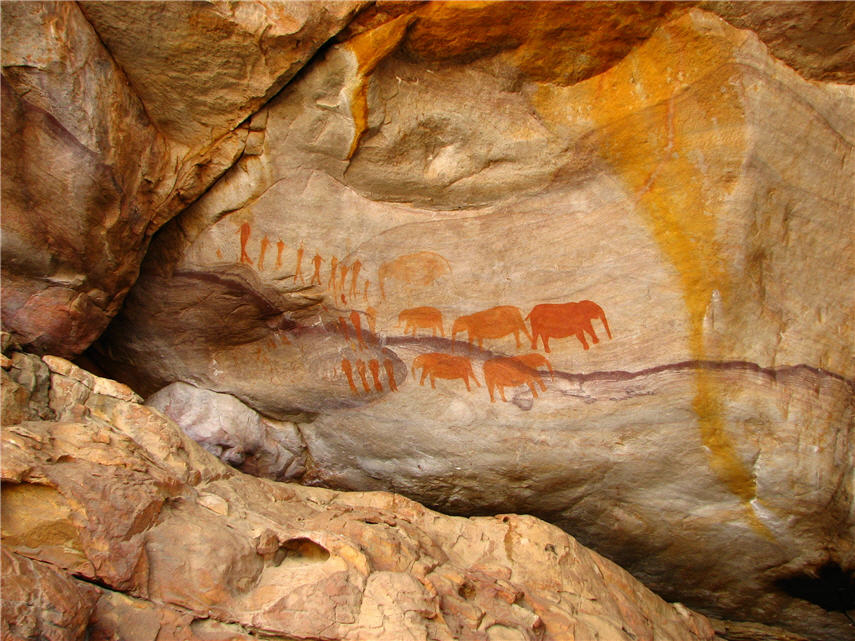
No discussion of San people culture is complete without a journey into their most profound legacy: the rock art that adorns over 15,000 sites across South Africa, Lesotho, Botswana, and Namibia. This is not mere decoration; it is a sophisticated, symbolic system that maps the spiritual landscape of the shaman. The most famous sites, like the Drakensberg Mountains in South Africa (a UNESCO World Heritage Site), contain thousands of paintings in ochre, charcoal, and white clay. Figures of eland, the most sacred animal to the San, are depicted bleeding from the nose or with their legs in a shaking posture—both classic signs of the trance state that a healer enters.
The work of researchers like David Lewis-Williams and Thomas Dowson in the 1980s and 1990s revolutionized our understanding. They demonstrated that the art is a “map” of the spirit world. A dying eland, for instance, is a metaphor for a shaman in a state of heightened spiritual potency. The “flying buck” or “therianthropes” (half-human, half-animal figures) are shamans transforming into the animals whose power they are harnessing. The art is not a passive record of daily life but an active tool of healing, rainmaking, and social cohesion. At Game Pass Shelter in the Kamberg Valley, you can see a famous panel where a shaman, depicted with an antelope head and clapping hands, appears to be dancing on the back of a giant eland—a visual representation of entering the spirit realm. This rock art is the most direct, unmediated window we have into the inner world of ancient San thought.
The Shaman’s Journey: The Trance Dance
The central ritual of traditional San life is the Trance Dance, often called the “Healing Dance” or “Dance of the Moon.” It is a communal, all-night affair that forms the bedrock of spiritual practice. The women sit in a circle, clapping in a complex, polyrhythmic pattern and singing songs that are said to contain ancient “medicine.” The men, and sometimes women, dance around them in a tight circle, their feet stomping the earth, creating a vibration that is believed to awaken a powerful force called n/um (in !Kung). As the dance intensifies, the healer enters a state of altered consciousness, known as !kia. In this state, they can see the “threads of the sky” (a spiritual path to God) and, crucially, they can “pull out” sickness from a person’s body—often described as seeing the illness as a dark, arrow-like object lodged in the flesh. The healer might shake, sweat profusely, and even bleed from the nose, all signs that the n/um is “boiling” inside them. This is not a performance; it is a life-or-death struggle against the malevolent spirits that cause misfortune. The dance is a powerful expression of community interdependence—everyone has a role, and the well-being of the group depends on the courage of the healer.
Living on the Land: Ecology, Knowledge, and the Hunter-Gatherer Ethos
The San are often romanticized as “pristine” hunter-gatherers, but their relationship with the land is far more complex and intelligent. They are not passive scavengers; they are active managers of their ecosystem. The !Kung of the Nyae Nyae region in Namibia, for example, have an encyclopedic knowledge of over 200 species of edible plants and 100 species of animals. A San tracker can identify a single animal by the shape of its footprint, the scuff mark on a stone, or the way a blade of grass has been bent. This skill is so refined that modern anti-poaching units in places like Kruger National Park have recruited San trackers to help catch rhino and elephant poachers.
Their hunting techniques are a masterclass in efficiency and respect. The poison used on arrow tips is derived from the larvae of the Diamphidia beetle, a toxin so potent that a single drop can kill a large antelope within hours. Yet the hunter will not eat the meat from an animal he has killed alone; the kill is shared according to strict kinship rules. The hunter who shot the arrow owns the meat, but his wife must distribute it to relatives and neighbors, ensuring no one goes hungry. This system of “demand sharing” prevents hoarding and reinforces social bonds. But life for the San is not idyllic. The Kalahari is a land of extreme drought and heat. They have faced existential threats from colonialism, forced relocation, and the encroachment of pastoralists and mining interests. The story of the Bushmen of the Central Kalahari Game Reserve (CKGR) in Botswana is a stark example. In the 1990s and 2000s, the Botswana government forcibly removed the Gǀui and Gǁana from their ancestral lands within the reserve, citing the cost of providing services. After a landmark legal battle in 2006, the High Court ruled in their favor, but the government has continued to restrict access to water and hunting rights, making a return to the land nearly impossible. This is a contemporary struggle, not a historical footnote.
Modern Faces, Ancient Voices: San People Culture in the 21st Century
To assume the San are a people of the past is a profound error. Today, there are an estimated 100,000 San people across Southern Africa, though exact numbers are difficult to ascertain due to assimilation and intermarriage. They are lawyers, tour guides, artists, and activists. The Kuru Family of Organisations, based in the Ghanzi District of Botswana, is a remarkable network of community-based projects that includes the Kuru Art Project, where San artists like Qwaa Qwaa and Coex’ae Qgam produce vibrant, modern paintings that blend traditional motifs with contemporary life. Their work sells in galleries worldwide, providing a vital income stream that bypasses the exploitative middlemen of the past.
Education is a double-edged sword. For decades, San children were forced into boarding schools where they were forbidden to speak their own languages and punished for their “backward” ways. Today, organizations like the Nyae Nyae Foundation and the Juǀʼhoansi Trust are fighting for bilingual education, where children learn in their mother tongue alongside English and the national language. The San Youth Network, formed in 2015, is a dynamic group of young leaders using social media, film, and music to assert their identity. They are not rejecting modernity; they are demanding a seat at the table on their own terms. One powerful voice is Xhasi Kambinda, a young San activist from Namibia, who speaks at international forums about land rights and cultural preservation, arguing that the San are not a “museum piece” but a vital part of a diverse, modern Africa.
| Community / Group | Primary Location | Estimated Population | Key Challenge | Notable Cultural Feature |
|---|---|---|---|---|
| Juǀʼhoansi (!Kung) | Nyae Nyae (Namibia) & Tsumkwe (Botswana) | ~8,000 | Land rights & water access | Complex kinship system; Trance Dance |
| Gǀui & Gǁana | Central Kalahari Game Reserve (Botswana) | ~3,500 | Forced relocation & restricted hunting | Deep ecological knowledge; use of Diamphidia poison |
| Khwe | Caprivi Strip (Namibia) & Angola | ~7,000 | Marginalization & inter-ethnic conflict | Fishermen & canoe builders; distinct language |
| !Xun (Northern San) | Angola & northern Namibia | ~10,000 | Post-war displacement & poverty | Strong oral history traditions; skilled trackers |
| Nǁng | Northern Cape (South Africa) (near extinction) | Fewer than 10 fluent speakers | Language extinction & cultural assimilation | Last speakers of the Nǁng language; rich rock art heritage |
Struggles for Land and Justice: A Continuing Battle
The legal and political landscape for the San has been a battlefield. The most famous case is the Central Kalahari Game Reserve (CKGR) case in Botswana. In 2002, the government cut off water supplies to the Gǀui and Gǁana, effectively forcing them out. The First People of the Kalahari (FPK), an advocacy group led by figures like Jumanda Gakelebone and Roy Sesana, took the government to court. In 2006, the High Court declared the eviction unlawful and ruled that the San had the right to live in the reserve. However, the victory was hollow. The government refused to allow drilling for water, and without water, life in the Kalahari is unsustainable. Only a handful of families have managed to return, and they face constant harassment. The case exposed a deep tension: the government’s desire to promote tourism and mining (diamonds are found in the CKGR) versus the San’s ancestral rights. It also highlighted the failure of the international community to enforce the court’s ruling.
In South Africa, the !Xun and Khwe communities, who were displaced by the apartheid-era South African Defence Force’s involvement in the Angolan Civil War, now live in settlements like Platfontein near Kimberley. They were given land, but it is far from their ancestral territories. They have struggled with unemployment, alcoholism, and a loss of cultural continuity. Yet, they have also created a vibrant community, with a school that teaches San languages and a cultural village that hosts tourists. The !Xun and Khwe Cultural Village is a place where you can see the traditional hunting bows being made, taste morula fruit, and hear the elders tell the stories of their migration. It is a testament to survival, but it is also a stark reminder that land is not just a resource; it is the foundation of identity.
The Role of the San in Conservation
Paradoxically, the same governments that have displaced the San from their lands are now hiring them as trackers and rangers in national parks. The Kgalagadi Transfrontier Park (linking South Africa and Botswana) and Etosha National Park in Namibia employ San trackers whose skills are unmatched by any modern technology. They can follow a poacher’s trail across bare rock, reading the faintest disturbance of gravel. This is a complex dynamic: the San are paid to protect the very wildlife that they once hunted for survival, on land that was taken from them. Some activists argue this is a form of cultural prostitution; others see it as a pragmatic way to maintain skills and earn a living in a cash economy. The truth lies somewhere in between. What is clear is that the San are not passive victims. They are negotiating their place in a rapidly changing world, using their ancient knowledge as a bargaining chip for a better future.
Voices of the Future: Art, Music, and the Diaspora
San people culture is not static. It is evolving. One of the most exciting developments is the emergence of a new generation of San musicians who are blending traditional sounds with contemporary genres. The group !Xausa from Namibia uses the !gombi (a mouth-bow) and the !ke (a hunting bow used as a musical instrument) alongside electric guitars and hip-hop beats. Their lyrics, sung in Juǀʼhoansi, speak of the land, the ancestors, and the struggle for recognition. Similarly, the Kuru Dance Festival, held annually in D’Kar, Botswana, is a vibrant celebration where traditional dances are performed alongside modern choreographies. It is a space where elders teach children the old steps, and where young San can express their identity without shame.
The art world has also become a platform for San voices. The work of Qangwadi Qgam, a Gǀui artist from Botswana, is exhibited in the Smithsonian National Museum of African Art. His paintings are not “primitive” or “naive”; they are sophisticated explorations of space, color, and narrative, depicting the trance dance and the spirit animals with a modern sensibility. The Kuru Art Project has been so successful that it has spawned a cooperative model that is now being replicated by other marginalized communities. This is not about preserving a “dying culture” in a glass case; it is about a living culture adapting, innovating, and demanding respect in the global marketplace of ideas.
Conclusion: The Enduring Lesson of the San
The San people culture offers a profound lesson for a world grappling with ecological crisis and social fragmentation. For over 20,000 years, they lived in a balance with their environment that our industrial society has failed to achieve. They understood that wealth is not measured in accumulation but in relationships—with family, with the land, and with the spirit world. They demonstrated that a society can function without kings, without armies, and without a police force, based on a system of deep reciprocity and egalitarian decision-making. As the anthropologist Richard B. Lee famously noted in his study of the !Kung, the most aggressive act in their society is to be boastful or to hoard food; the social pressure to share is immense and effective.
But the lesson is not about romanticizing the past. It is about recognizing the resilience and intelligence of a people who have faced genocide, dispossession, and cultural erasure, yet still speak their languages, dance their dances, and teach their children to track a steenbok across the red sand. The San are not a relic of the Stone Age. They are our contemporaries, our teachers, and our fellow citizens. To listen to their stories, to support their land rights, and to celebrate their art is to honor the deepest roots of our shared humanity. As the sun sets over the Kalahari, casting long shadows across the acacia trees, the sound of clapping and singing still rises from the village fires. The dance continues. And it must not be allowed to stop.