📅 Last updated: 02.11.2026
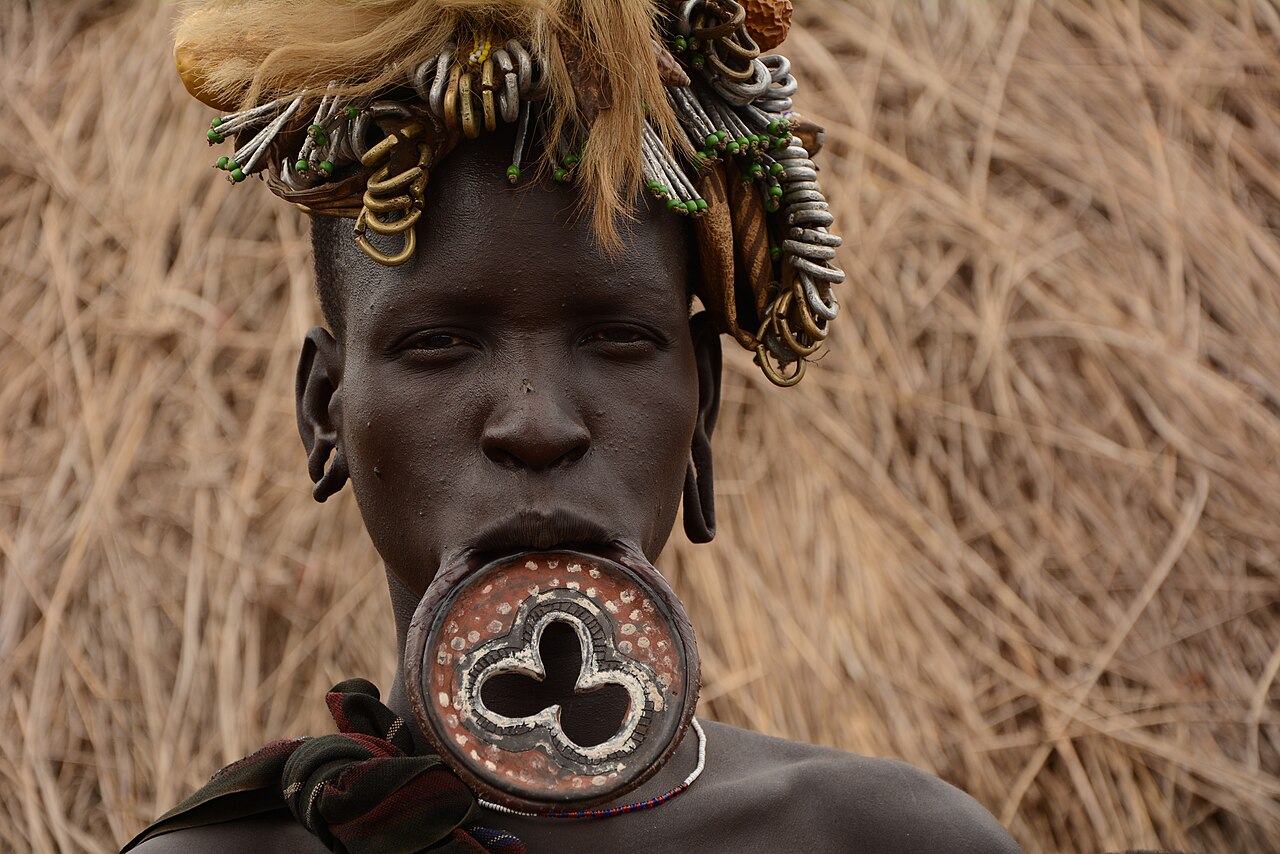
Mursi lip plates are among the most photographed and least understood adornments in Africa—a clay or wooden disc worn in a deliberately stretched lower lip by women of the Mursi (Mun) people, a pastoralist community of roughly 7,500 to 11,000 people living in the Lower Omo Valley of southwestern Ethiopia. Far from a curiosity for passing cameras, the practice is a living cultural institution tied to coming-of-age ceremony, marriage negotiation, personal identity, and a community’s long negotiation with the Ethiopian state and the tourist economy.
The Mursi lip plate is a clay or wooden disc inserted into a deliberately pierced and gradually stretched lower lip, traditionally begun by young women around the onset of puberty and worn by married women at ceremonies and markets. The plates vary in size—from a few centimetres to more than 20 centimetres in diameter—and serve as markers of adult status, beauty, and, in the past, a form of personal wealth tied to bridewealth negotiations. The practice is concentrated among the Mursi of the Lower Omo Valley in Ethiopia’s Southern Nations, Nationalities, and Peoples’ Region, near the towns of Jinka and Hana.
- Who Are the Mursi, and Where Do Mursi Lip Plates Come From?
- How Are Mursi Lip Plates Made and Worn?
- What Do Mursi Lip Plates Mean? Beauty, Status, and Bridewealth
- A Timeline of Mursi Lip Plates: From Tradition to Tourism
- Are Mursi Lip Plates Still Worn Today?
- The Ethics of Photographing Mursi Lip Plates
- What Mursi Lip Plates Reveal About Beauty and Body Modification
- How to Visit Mursi Communities Respectfully
- Frequently Asked Questions About Mursi Lip Plates
- Mursi Lip Plates and the Future of the Omo Valley
- The Lasting Meaning of Mursi Lip Plates
Who Are the Mursi, and Where Do Mursi Lip Plates Come From?
The Mursi live on the western edge of the Lower Omo Valley, in the Mago National Park area and along the Omo River’s eastern banks, in what is today the South Ethiopia Regional State (formerly part of the Southern Nations, Nationalities, and Peoples’ Region). Their language, Mursi (also called Mun), belongs to the Surmic branch of the Nilo-Saharan family—making them linguistic cousins of the Suri and Me’en peoples of the wider region rather than of the Omotic-speaking groups such as the Hamar who live nearby.
Mursi oral history places their arrival in the Omo lowlands within the last two to three centuries, with migration traditions pointing westward from the Boma Plateau area of what is now South Sudan. They are primarily agropastoralists: cattle hold enormous social value, but the Mursi also cultivate sorghum, maize, and beans on riverbank flood-retreat plots, a practice that depends on the Omo’s seasonal floods—now altered by the Gibe III hydroelectric dam upstream, which began generating power in 2016.
Why the Lower Lip?
Anthropologists and Mursi elders offer overlapping explanations. The piercing is made in the lower lip rather than the upper because the lower lip can be stretched more extensively and the plate can rest against the chin and jaw. The practice is documented among several Surmic and Nilotic groups in the borderlands of Ethiopia and South Sudan—most notably the Suri and, historically, some Dinka and Nuer communities—which suggests a shared regional tradition rather than an isolated Mursi invention.
How Are Mursi Lip Plates Made and Worn?
The process is gradual and often begins in early adolescence, though timing varies by family and has shifted over generations. A girl’s lower lip is pierced—traditionally by an older female relative—and a small plug, often made of wood or rolled leaf, is inserted to keep the hole open. Over months and years, progressively larger plugs are used until the opening can accommodate a first clay plate.
Plates are shaped by hand from local clay, fired, and smoothed; some are decorated with incised patterns or pigment. Wooden plates also exist, particularly for the early stages. Women remove the plate to eat, sleep, and work, and reinsert it for ceremonies, markets, and visitors.
- Piercing stage: usually in adolescence, performed by a female relative with local knowledge of healing.
- Stretching stage: wooden or clay plugs of increasing size over months or years.
- First plate: often a small disc worn during coming-of-age ceremonies.
- Full-size plate: worn by married women at public events; some plates exceed 20 cm across.
What Do Mursi Lip Plates Mean? Beauty, Status, and Bridewealth
Outsiders often ask whether the plate is “for beauty” or “for protection.” The honest answer is that it carries several meanings at once, and those meanings have changed. Elders in Mursi communities describe the plate as an enhancement of a woman’s beauty and a sign of maturity—a marker that a girl has become a woman eligible for marriage. In the past, a larger plate could signal a family’s standing and a woman’s desirability, and it entered into bridewealth discussions in which cattle were the principal currency.
Some popular accounts claim the plates were invented to make women unattractive to slave raiders. Anthropologists have found little documentary evidence for this in Mursi oral tradition, and it is best treated as a widely repeated story rather than a verified origin. What is well documented is the plate’s role in ceremony: Mursi women wear their plates during donga (stick-fighting) gatherings, at cattle camps, and at the weekly markets near Jinka and Hana, where the plates are both everyday adornment and, increasingly, part of the encounter with outside visitors.
Bridewealth and Cattle
Mursi marriage traditionally involves the transfer of cattle from the groom’s family to the bride’s. The lip plate does not itself constitute the bridewealth, but it signals that a young woman has entered the marriageable category—and in some families, the size of the plate and the ceremony surrounding it are matters of pride and negotiation. Cattle numbers in Mursi bridewealth have been reported in the dozens, though figures vary widely by family and era and should not be treated as fixed.
A Timeline of Mursi Lip Plates: From Tradition to Tourism
| Period | Development | Significance |
|---|---|---|
| Pre-19th century | Lip modification documented across Surmic and Nilotic groups in the Ethiopia–South Sudan borderlands | Regional tradition predating any single ethnic label |
| Late 19th–early 20th century | Ethiopian imperial expansion and early European travel accounts reach the Lower Omo | First written external descriptions of the region’s peoples |
| 1960s–1970s | Ethnographic research and early tourism begin in the Omo Valley | Mursi lip plates enter international photography and travel writing |
| 1980s–1990s | Mago National Park established; road access improves | Tourist visits to Mursi villages increase |
| 2000s–2010s | Omo Valley becomes a major Ethiopian tourism destination | Payment for photographs becomes a significant local income source |
| 2016–present | Gibe III dam alters Omo flooding; debate grows over tourism ethics and cultural change | Younger Mursi women increasingly choose not to adopt plates |
Are Mursi Lip Plates Still Worn Today?
Yes—but the practice is contracting. In Mursi villages today, plates are most commonly worn by women over roughly 40, while many younger women choose not to begin the process. The reasons are practical and social: schooling, displacement from traditional flood-retreat farming, the influence of neighbouring groups and Christian missions, and the simple fact that the plate is uncomfortable and time-consuming to maintain.
At the same time, tourism has created a countervailing incentive. Visitors to Mursi villages—typically reached from Jinka via Mago National Park—pay for photographs, and women who wear plates are more likely to be photographed. This has produced a complicated dynamic in which the plate is simultaneously a heritage practice, a personal choice, and a commodity in the encounter between Mursi women and foreign visitors.
The Ethics of Photographing Mursi Lip Plates
The Mursi are among the most photographed peoples in Africa, and the images circulate far beyond Ethiopia—in travel magazines, stock libraries, and social media. That visibility has brought income to some communities and discomfort to others. Researchers and Mursi advocates have raised concerns about staged encounters, unequal payment, and images that strip context from the people depicted.
For travellers, a few principles matter:
- Ask first, always. Photography should follow consent, not assumption.
- Pay fairly and directly. Agree on amounts before shooting, and pay the person photographed.
- Buy from local makers. Crafts, honey, and sorghum sold at markets support households beyond the photo economy.
- Choose responsible operators. Ask tour companies how they compensate communities and whether they employ local guides.
What Mursi Lip Plates Reveal About Beauty and Body Modification
Body modification is not exotic; it is human. Ear piercing, tattoos, dental modification, and cosmetic surgery are practised worldwide, and the line between “beauty” and “tradition” is drawn differently in every society. The Mursi lip plate belongs to a global family of practices in which the body is shaped to mark identity, status, and belonging—from the coiled brass neck rings of the Ndebele to the stretched earlobes of Maasai and Samburu men and the lip plugs historically worn by some Amazonian and African communities.
What distinguishes the Mursi case is its visibility and its entanglement with tourism. The plate is not a relic; it is a choice made—or declined—by women who are also farmers, mothers, traders, and increasingly, students. Treating the plate as either a timeless emblem or a tragic anachronism misses the point: it is a living practice, changing at the pace of the people who wear it.
How to Visit Mursi Communities Respectfully
Most visitors reach Mursi territory from Jinka, the administrative town of the South Omo Zone, via the road into Mago National Park. The journey takes roughly an hour and a half to two hours depending on conditions, and park fees apply. Local guides—ideally Mursi speakers—are essential, both for navigation and for fair dealings.
- Best season: the dry months from October to March, when roads are passable and ceremonies more frequent.
- What to bring: water, cash in Ethiopian birr for guide fees and photography payments, and a respectful curiosity.
- What to avoid: photographing people without consent, distributing sweets or money to children, and treating villages as open-air museums.
Frequently Asked Questions About Mursi Lip Plates
Why do Mursi women wear lip plates?
Primarily as a marker of beauty, maturity, and adult status, with historical ties to marriage negotiation and family standing. Meanings vary by individual and generation.
How big can a Mursi lip plate get?
Plates typically range from a few centimetres to more than 20 centimetres in diameter, with the largest examples among older women.
Do Mursi men wear lip plates?
No. The practice is specific to women, though men participate in related ceremonies and adornment traditions, including scarification and body painting.
Is the practice dying out?
It is declining among younger women, but it remains a living tradition for many older women and a visible part of Mursi public life.
Mursi Lip Plates and the Future of the Omo Valley
The Mursi face pressures that have little to do with lip plates: the Gibe III dam’s effect on the Omo’s floods, the expansion of commercial agriculture, the creation of new administrative boundaries, and the question of how tourism revenue is shared. In 2018, Ethiopia’s government began a process of reorganising regional states, and by 2023 the South Ethiopia Regional State had been established, changing the administrative frame around the Lower Omo. How these changes affect Mursi land rights and livelihoods will matter far more to the community’s future than any photograph.
For the Mursi themselves, the plate is one element of a rich material and ceremonial culture that includes elaborate body painting, cattle naming, donga stick fighting, and a sophisticated oral tradition. Visitors who arrive curious about the plate and leave curious about the people behind it—their agriculture, their language, their politics—will have had a better journey, and will have done less harm.
The Lasting Meaning of Mursi Lip Plates
Mursi lip plates are not a puzzle to be solved or a spectacle to be consumed. They are an adornment chosen by women in a specific place, at a specific time, for reasons that are partly aesthetic, partly social, and partly economic—and those reasons are shifting as the Omo Valley shifts. The plate’s endurance, and its gradual decline, both tell the same story: that culture is not static, and that the people who carry it are the ones who decide what it means. To see a Mursi woman wearing her plate is to see a decision, made in a landscape of cattle, sorghum fields, and camera lenses, about how to be beautiful, how to belong, and how to face a changing world on her own terms.