📅 Last updated: 30.10.2026
The Benin Bronzes are not simply a collection of artworks in European museums; they are the scattered memory of one of Africa’s most sophisticated kingdoms, and their return is one of the defining cultural stories of our time. For over a century, these brass plaques, commemorative heads, ivory tusks and ceremonial regalia have sat thousands of kilometres from the palace courtyards of Benin City where they were created. Now, in fits and starts, they are coming home.
The Benin Bronzes are thousands of brass, bronze and ivory artworks looted by British forces during the 1897 punitive expedition against the Kingdom of Benin, in present-day Edo State, Nigeria. Their “return” refers to the ongoing process of repatriating these objects from European and North American museums to Nigeria, which has accelerated since 2022. The returns are partial and uneven — some are outright restitutions, others are long-term loans — and the debate over full ownership, custody and display remains unresolved.
- What exactly are the Benin Bronzes, and why do they matter?
- The Benin Bronzes' return: what has actually happened?
- Why is the return of the Benin Bronzes so complicated?
- Who is leading the Benin Bronzes' return, and who is holding back?
- What does the return mean for Benin City and for Africa?
- What are the main criticisms of the return process?
- The truth about the Benin Bronzes' return
What follows is the honest picture: what was taken, who holds it now, what has genuinely come back, and what the word “return” still hides. This is a story of diplomacy, of quiet deals and loud refusals, and of a city that never stopped asking for its inheritance.
What exactly are the Benin Bronzes, and why do they matter?
The name is a little misleading. Many of the objects are not bronze at all but brass, and a significant number are carved ivory, coral, wood and terracotta. They were produced over several centuries by the Edo people of the Kingdom of Benin, a powerful West African state centred on Benin City, whose Oba (king) ruled a realm that traded with Portuguese, Dutch and British merchants from the late 1400s onward.
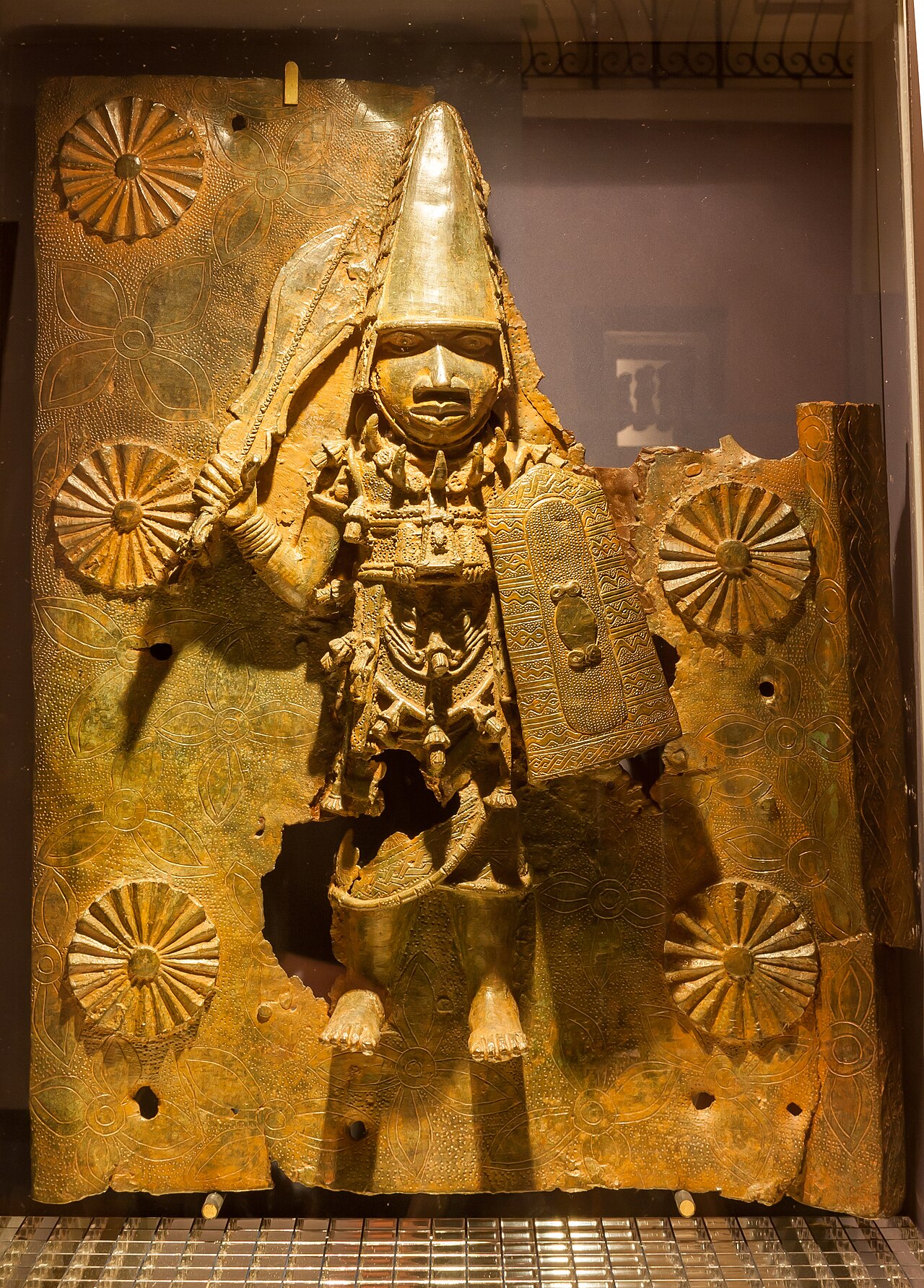
The most famous pieces are the rectangular brass plaques — several hundred of them — that once decorated the pillars of the Oba’s palace. Cast using the lost-wax method, they record court ceremonies, battles, ritual sacrifice, the arrival of Portuguese traders in distinctive hats and long hair, and the genealogy of kings. There are also commemorative heads of Obas and queen mothers, free-standing figures, bells, masks and the great ivory tusks that rested on altars.
These are not decorative trinkets. They are a court archive cast in metal — a written history in a society that recorded its memory in objects and oral tradition rather than paper. The British ethnographer and colonial administrator R.E. Dennett, who worked in the region in the early 1900s, described Benin City’s craft guilds as among the most organised in West Africa. The brass casters of Igun Street in Benin City still work today, organised into a guild that traces its lineage back to the palace workshops.
The 1897 expedition: how the objects left Africa
In January 1897, a British force under Admiral Harry Rawson entered Benin City. The pretext was the killing of an earlier British party led by Acting Consul James Phillips, who had marched on the city despite being warned not to. The Oba, Ovonramwen, was blamed and deposed; the city was burned, altars were destroyed, and the palace was stripped. The British called it a punitive expedition. The Edo remember it as the destruction of a kingdom.
The loot was auctioned in London later that year to help cover the cost of the campaign. Pieces scattered into the British Museum, the Pitt Rivers Museum in Oxford, the Horniman Museum, and institutions across Germany — above all the Ethnologisches Museum in Berlin, which holds one of the largest collections. Others went to the United States, including the Metropolitan Museum of Art in New York. Estimates of the total number of objects taken vary widely; a commonly cited figure is around 3,000 to 5,000 items, though precise counts are contested because records are incomplete.
The Benin Bronzes’ return: what has actually happened?
For decades, Western museums offered loans, replicas and technical assistance rather than ownership. Nigeria’s formal requests — including a landmark 1972 appeal by the Nigerian government to the United Nations — went largely unanswered. The turning point came in 2018, when a group of European museum directors and scholars met in Benin City and, in what became known as the Benin Dialogue Group, began discussing returns. Then in 2021 and 2022, the pace broke open.
In July 2022, Germany and Nigeria signed a memorandum of understanding transferring ownership of more than 1,100 Benin Bronzes held in German museums to Nigeria. Crucially, the agreement included a plan for a rotating selection to remain on loan in Berlin — a compromise that drew criticism from those who wanted everything back immediately. Around the same time, the Smithsonian Institution in Washington announced it would return 29 of its Benin objects. The Metropolitan Museum of Art in New York followed with returns of its own. In the United Kingdom, the Horniman Museum transferred ownership of 72 objects to Nigeria in 2022 and returned six of them to Benin City in 2023.
The British Museum, which holds the largest single collection — roughly 900 objects — has not returned any Benin Bronzes. It is bound by the British Museum Act of 1963, which restricts deaccessioning, though its leadership has spoken of “partnership” and has discussed loans to Nigeria. The Pitt Rivers Museum in Oxford has transferred ownership of more than 90 objects to Nigeria while retaining some on loan.
Key milestones in the return of the Benin Bronzes
| Year | Event | Institution / Actor |
|---|---|---|
| 1897 | Punitive expedition; palace looted and objects auctioned in London | British colonial forces |
| 1972 | Nigeria appeals to the UN for return of looted cultural property | Nigerian government |
| 2018 | Benin Dialogue Group meets in Benin City | European and Nigerian museums |
| 2022 | Germany transfers ownership of 1,100+ objects to Nigeria; Smithsonian and Met announce returns | German government, Smithsonian, Metropolitan Museum |
| 2022–2023 | Horniman Museum transfers 72 objects and returns 6 to Benin City | Horniman Museum, London |
| Ongoing | British Museum retains ~900 objects; legal restrictions on deaccessioning | British Museum |
Why is the return of the Benin Bronzes so complicated?
The complications are real, and they cut in several directions at once. The first is legal. Many European national museums are governed by statutes that forbid them from permanently removing objects from their collections. The British Museum is the most prominent example, but it is not alone. Changing those laws requires parliamentary action, and governments have shown little appetite for it.
The second is custodial. Nigeria has argued, correctly, that it has the right and the capacity to care for its own heritage. The Edo State government has built the Edo Museum of West African Art (EMOWAA), a major new institution in Benin City designed in partnership with the architect David Adjaye, intended to house returned objects and to anchor a broader cultural district. Critics have questioned whether the museum will be ready in time, whether security and climate control will meet international standards, and — more pointedly — where returned objects will physically live in the interim. Some have gone into the Oba’s palace; others are held by the National Commission for Museums and Monuments in Lagos and Benin City.
The third complication is the nature of the “return” itself. Not all returns are equal. Some are outright transfers of title. Others are long-term loans that can, in theory, be revoked. Some are “shared custody” arrangements. This matters enormously: a loan is not a return, and Nigerian officials have been clear that they distinguish between the two.
- Full restitution: Legal ownership transferred permanently to Nigeria, with objects physically returned.
- Ownership transfer with loan-back: Nigeria owns the objects, but some remain on display abroad under renewable agreements.
- Long-term loan: Ownership stays with the foreign institution; the object is lent to Nigeria for a defined period.
- Digital and replica sharing: High-resolution scans and casts circulate while the original stays put — useful, but not restitution.
Who is leading the Benin Bronzes’ return, and who is holding back?
The most consequential actor is the Nigerian state itself, working through the National Commission for Museums and Monuments and, increasingly, the Edo State government. The Oba of Benin, Ewuare II, has been a central voice, insisting that returned objects come to Benin City rather than to Lagos or Abuja, and that the palace — the original home of the objects — be recognised in any arrangement. That internal Nigerian debate over custody is sometimes overlooked abroad but is central to how returns will actually work.
Among European institutions, Germany moved furthest and fastest, driven by a combination of diplomatic pressure, public campaigning and a genuine reckoning with its colonial history in what is now Tanzania, Namibia, Cameroon and Togo as well as Nigeria. The Netherlands, Belgium and France have all faced similar questions, and France’s 2018 Sarr-Savoy report — commissioned by President Emmanuel Macron — recommended broad returns of African heritage, though implementation has been slow.
The British Museum remains the great holdout, and its position is increasingly awkward. In 2022, the museum’s then-director, Hartwig Fischer, told a Nigerian audience that the 1897 expedition was “never a legitimate enterprise” — a striking admission — while stopping short of promising returns. The museum has since faced its own internal crises, including a major theft scandal in 2023 that undercut its claims to be a safer custodian than institutions in Africa. That irony has not been lost on campaigners.
The role of the diaspora and digital restitution
African diaspora communities in London, Berlin, Paris and New York have been among the most effective campaigners, organising protests outside museums, lobbying parliaments and building digital archives that document where each object is held. Projects like Digital Benin, launched in 2022, catalogue thousands of objects across more than 100 institutions worldwide, making the scattered collection visible as a whole for the first time. That database is itself a form of restitution — a return of knowledge, if not of metal.
What does the return mean for Benin City and for Africa?
Benin City is not a museum piece. It is a living, growing city of more than a million people, with a vibrant contemporary art scene, a university, and a young population impatient for change. The return of the bronzes is bound up with a broader question: whether Nigeria can build the institutions — museums, conservation labs, cultural tourism — that make restitution meaningful rather than symbolic.
The economic stakes are real. Cultural tourism around returned heritage could bring visitors and revenue to Edo State, which has long been overshadowed by Lagos and Abuja. EMOWAA is designed with that in mind, as part of a wider plan that includes archaeological work at the site of the old palace. The Oba’s palace itself remains a living institution, and the annual Igue festival, which reaffirms the Oba’s spiritual authority, continues much as it has for centuries.
There is also a moral dimension that extends well beyond Nigeria. If the Benin Bronzes can go home, so can the Rosetta Stone, the Parthenon sculptures, the Ethiopian Maqdala treasures and countless other objects. The Benin case has become a template — and a test — for how museums everywhere reckon with colonial collections. What happens in Benin City will shape what happens in Athens, Addis Ababa and beyond.
What are the main criticisms of the return process?
Not everyone cheering restitution agrees on what it should look like, and the criticisms are worth taking seriously.
- It is too slow and too partial. Campaigners point out that after years of announcements, only a fraction of the objects have physically left Europe. Ownership transfers that leave objects on long-term loan abroad are, in this view, a rebranding of the status quo.
- The British Museum’s legal shield is a choice, not a fact. Critics note that the 1963 Act could be amended by Parliament, as it has been before for other purposes, and that “we cannot return” often means “we will not.”
- Custody questions in Nigeria are real. Some scholars and officials worry about competition between federal and state authorities, and about whether returned objects will be properly conserved and displayed. These concerns are legitimate, though they are sometimes used abroad as a convenient excuse for delay.
- The definition of “return” is being stretched. Loans, replicas and digital copies are valuable, but they are not the same as giving back what was taken. Precision in language matters here.
The truth about the Benin Bronzes’ return
Here is the honest summary. The return is real, and it is happening — but it is uneven, incomplete and still contested. Germany has transferred ownership of more than a thousand objects. The Smithsonian, the Metropolitan Museum and the Horniman have returned or transferred ownership of dozens more. Nigeria has built, and is building, the institutions to receive them. The British Museum, which holds the largest collection, has returned nothing.
The deeper truth is that the Benin Bronzes were never just art. They were the record of a kingdom, the physical memory of a court, and their removal was an act of erasure as much as of theft. Returning them is not simply a matter of moving metal across oceans. It is a matter of restoring a people’s ability to tell their own story in their own place, on their own terms. That process is underway. It is not finished, and it will not be finished until the last plaque, head and tusk that can come home has come home — and until the museums that hold them stop calling it a loan and start calling it what it is.
The bronzes are coming back to Benin City. The question now is how much of them, how soon, and on whose terms. The world is watching, and the Edo people, who have waited more than a century, are not inclined to wait much longer.