📅 Last updated: 07.11.2026
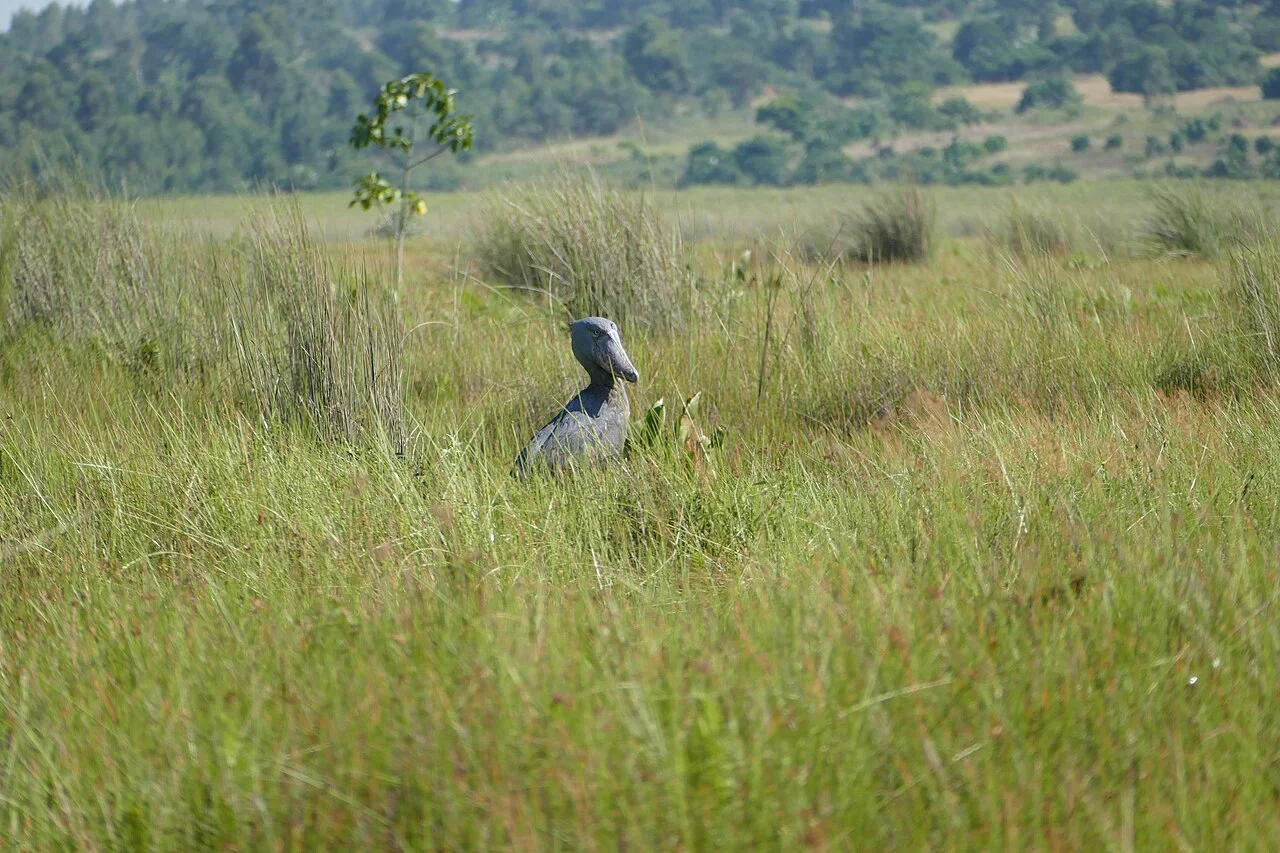
No bird in Africa carries the weight of deep time quite like the shoebill stork in Uganda, a grey, statue-still giant whose lineage reaches back through the fossil record to an age before the savannah grasslands took shape. To watch one stand motionless in a papyrus channel of the Mabamba wetlands, on the northern edge of Lake Victoria, is to feel you have stumbled into a living diorama. The bird rarely moves, then suddenly it does — a fast, clacking lunge into the mud — and the spell breaks. Uganda, remarkably, is one of the easiest and most reliable countries on the continent to see this species in the wild, and that fact alone has quietly reshaped parts of its tourism economy.
The shoebill stork (Balaeniceps rex) is a large, prehistoric-looking wading bird found in the freshwater swamps of East and Central Africa. Uganda holds a significant share of the global population, estimated at roughly 5,000 to 8,000 birds, with key strongholds including the Mabamba Swamp near Entebbe, Murchison Falls National Park, and the wetlands around Lake Albert and the Nile Delta. Uganda is widely regarded as the premier destination for seeing the species in the wild.
- What exactly is the shoebill stork, and why does it look prehistoric?
- Where in Uganda can you see the shoebill stork?
- When is the best time to visit Uganda for shoebill stork watching?
- How does the shoebill hunt, and what makes its swamp home so special?
- Why is the shoebill stork Uganda's conservation flagship?
- What should a visitor know before going shoebill watching?
- What does the shoebill's future look like?
- A bird that asks us to slow down
What exactly is the shoebill stork, and why does it look prehistoric?
The shoebill is not, despite the name, a true stork. Taxonomists have moved it around repeatedly — once grouped with storks, then with herons, and now placed in its own monotypic family, Balaenicipitidae, with affinities to pelicans. The bill is the giveaway: a massive, shoe-shaped, hook-tipped structure that can measure up to 24 centimetres long and 20 centimetres wide, capable of seizing a lungfish or a young crocodile with bone-crushing force. Standing up to 1.5 metres tall with a wingspan near 2.4 metres, adults are a soft blue-grey with a slightly shaggy crest and a stare that photographers describe, without exaggeration, as unnerving.
The “prehistoric” reputation comes from both anatomy and behaviour. The shoebill’s lineage is ancient, and its hunting method — long periods of frozen stillness followed by an explosive strike — reads like a relic of an older ecological order. It is a patient, solitary ambush predator that specialises in oxygen-poor swamps where fish must surface to breathe. That narrow ecological niche is precisely why the bird is so range-restricted, and so vulnerable.
The taxonomy question
Genetic studies have confirmed the shoebill’s closest living relatives are pelicans, not storks — a finding that surprised many field observers. The species is listed as Vulnerable on the IUCN Red List, with a global population that most estimates place between 5,000 and 8,000 individuals. Human disturbance, wetland drainage, and the live-bird trade are the principal threats. In Uganda, conservation attention has focused on protecting the swamps themselves, because a shoebill without a functioning wetland is a bird without a home.
Where in Uganda can you see the shoebill stork?
Uganda’s geography works in the bird’s favour: the country holds a vast network of papyrus swamps, floodplains, and shallow lakes along the Nile and around Lake Victoria. Several sites stand out for accessibility and reliability.
- Mabamba Swamp (Entebbe): The most famous and accessible site, roughly 40 kilometres from Entebbe, reached by canoe through papyrus channels. Community-managed guides have made it a model of birding-based tourism.
- Murchison Falls National Park and the Nile Delta: Boat safaris on the Victoria Nile and into the delta near Lake Albert offer strong chances, often combined with big-game viewing.
- Lake Albert and the Semliki flats: Remote wetlands with substantial shoebill habitat, less visited but rewarding for serious birders.
- Queen Elizabeth National Park’s Kazinga Channel and Lake George: Occasional sightings, though less reliable than Mabamba or the Nile Delta.
Mabamba deserves special mention because it demonstrates how a local community can turn a swamp into an asset without draining it. Guides paddle visitors out at dawn in dugout canoes, and the income flows directly to village households. The bird became a reason to protect the wetland rather than convert it.
When is the best time to visit Uganda for shoebill stork watching?
Shoebills are present year-round, but sighting odds and comfort vary with the seasons. The dry months from December to February and June to September generally offer easier canoe access and better light for photography. The wetter months bring higher water levels, which can push birds into different channels, but they also coincide with the breeding season, when nests are active and adults are more territorial.
| Period | Conditions | Shoebill Sighting Notes |
|---|---|---|
| December–February | Dry, clear, good roads | Excellent access; birds concentrated in shrinking channels |
| March–May | Long rains | Higher water, lush scenery; nesting activity possible |
| June–September | Dry season | Peak visitor season; strong odds at Mabamba and the Nile Delta |
| October–November | Short rains | Fewer visitors, variable access, still good birding |
How does the shoebill hunt, and what makes its swamp home so special?
The shoebill’s hunting technique is a study in economy. It stands motionless for minutes at a time, head lowered, then strikes with a forward lunge that can be over in a fraction of a second. Its prey includes lungfish, tilapia, catfish, frogs, water snakes, and occasionally small crocodiles or monitor lizards. The bill’s hooked tip grips slippery prey, and the bird often tosses food back before swallowing.
This strategy depends on a very particular kind of wetland: shallow, slow-moving, choked with papyrus and reed, and rich in fish that must gulp air at the surface. Such swamps are among the most productive ecosystems on earth, and also among the most threatened. Drainage for agriculture, pollution from lakeside towns, and the encroachment of fishing communities all press on Uganda’s wetlands. The shoebill is, in effect, an indicator species — where it thrives, the swamp is healthy.
Nesting and family life
Shoebills are solitary nesters. A pair builds a large platform of reeds and grasses on floating vegetation, and the female lays one to three eggs. Typically only one chick survives, a consequence of intense sibling competition and the parents’ inability to feed more than one demanding offspring. Fledging takes roughly three to four months, and young birds remain dependent for longer. This slow reproductive rate makes the species especially sensitive to disturbance — a single failed nesting season matters.
Why is the shoebill stork Uganda’s conservation flagship?
Uganda’s national bird is the grey crowned crane, but the shoebill has become the country’s most sought-after avian attraction for international birders. That status carries real conservation leverage. Birding tourism in Uganda generates income for local guides, canoe operators, and lodges, and it gives communities a financial stake in keeping wetlands intact. Mabamba’s community-run operation is the clearest example: visitors pay for a canoe and a guide, and the money stays local.
Conservation organisations, including NatureUganda and international partners, have worked to map shoebill distribution, monitor nesting sites, and promote sustainable tourism. Uganda’s National Environment Management Authority has repeatedly warned about wetland encroachment, and the Ramsar Convention designation of several Ugandan wetlands — including Mabamba Bay — provides an international framework for protection. The bird is, in a sense, a diplomatic asset as well as an ecological one.
- Economic incentive: A single shoebill sighting can support a guide, a canoe, and a village for a day.
- Legal protection: Ramsar designations and national wetland laws give conservationists tools to resist drainage.
- Monitoring: Citizen science and guide networks help track nesting pairs and disturbances.
What should a visitor know before going shoebill watching?
Patience is the operative virtue. Shoebills do not perform. A good guide will read the swamp — watching for the bird’s grey shape against papyrus, listening for the distinctive bill-clattering display — and will often find one within an hour, but there are no guarantees. Dawn departures from Entebbe to Mabamba are standard, and the canoe trip itself, through tunnels of papyrus with malachite kingfishers and purple herons, is worth the journey even if the shoebill stays hidden.
Binoculars and a long lens are useful, but the bird is large enough to see clearly with the naked eye at moderate distance. Visitors should keep quiet, avoid sudden movements, and follow the guide’s instructions about approach distance. The swamp is fragile, and the birds are sensitive to disturbance, especially during nesting.
Practical notes
Mabamba is reachable from Entebbe in about an hour by road, followed by a canoe ride. Most tour operators offer half-day or full-day trips. For Murchison Falls and the Nile Delta, boat safaris are typically booked through lodges in the park. Birding guides in Uganda are generally excellent, and many are members of the Uganda Bird Guides Club, which sets standards for the profession.
What does the shoebill’s future look like?
The species’ survival in Uganda depends less on the bird itself than on the fate of its wetlands. Uganda’s population is growing fast, and pressure to drain swamps for agriculture and settlement is intense. The shoebill’s slow reproduction means populations cannot recover quickly from losses. Climate change adds uncertainty, with shifting rainfall patterns affecting water levels in the Nile system and around Lake Victoria.
Yet there is reason for measured optimism. The economic case for protecting wetlands has never been clearer, and Uganda’s birding tourism sector is growing. Community-led models like Mabamba show that conservation and livelihoods can reinforce each other. The shoebill, ancient and improbable, has become a symbol of what Uganda stands to lose — and a reason to keep the swamps wet.
A bird that asks us to slow down
The shoebill stork in Uganda rewards a particular kind of attention: the willingness to sit still, to watch a grey shape in the papyrus, to accept that the swamp sets the pace. In a world that prizes speed, the bird offers something rarer — a reminder that the oldest things often move slowest, and that the health of a landscape can be read in the patience of its inhabitants. Uganda’s wetlands hold one of Africa’s most extraordinary creatures, and the country’s growing commitment to birding tourism suggests that the shoebill may yet have a secure future in the swamps that shaped it.