📅 Last updated: 19.10.2026
The Battle of Adwa, fought on 1 March 1896 near the town of Adwa in northern Ethiopia, stands as one of the most consequential military engagements in modern African history. On that Sunday morning, an Ethiopian army of roughly 100,000 soldiers under Emperor Menelik II and Empress Taytu Betul destroyed an invading Italian force, ending Italy’s attempt to colonize the Ethiopian highlands. The victory preserved Ethiopian sovereignty, humiliated a European colonial power, and sent shockwaves through the imperial capitals of Europe.
The Battle of Adwa was fought on 1 March 1896 between the Kingdom of Italy and the Ethiopian Empire near Adwa, in what is now the Tigray Region of Ethiopia. Ethiopian forces under Emperor Menelik II and Empress Taytu Betul decisively defeated the Italian army led by General Oreste Baratieri, killing or wounding thousands and forcing Italy to recognize Ethiopian independence in the Treaty of Addis Ababa.
- Why Did Italy Invade Ethiopia in the First Place?
- How Did Menelik II and Taytu Betul Prepare Ethiopia for the Battle of Adwa?
- What Happened on the Day of the Battle of Adwa?
- Who Were the Key Figures Behind Ethiopia's Victory?
- What Did the Battle of Adwa Mean for Africa and the World?
- Why Is the Battle of Adwa Still Commemorated Today?
- What Lessons Does the Battle of Adwa Offer Today?
- Why the Battle of Adwa Remains a Defining Moment
Why Did Italy Invade Ethiopia in the First Place?
Italy’s interest in Ethiopia grew out of the scramble for Africa, but it began with a foothold rather than a full invasion. In 1869 an Italian shipping company purchased the Red Sea port of Assab from a local sultan. By 1890 Italy had consolidated this coastal territory into the colony of Eritrea, a base from which it eyed the vast, fertile, and strategically important Ethiopian highlands to the west.
The path to war ran through a diplomatic trap. In 1889 Menelik II, newly crowned Emperor of Ethiopia, signed the Treaty of Wuchale with Italy. The treaty contained a fatal ambiguity: the Italian-language version stated that Ethiopia must conduct its foreign affairs through Italy, while the Amharic version stated merely that the Emperor could use Italian good offices if he chose. When Menelik discovered the discrepancy and rejected Italy’s claim of a protectorate in 1893, Rome began preparing for military conquest.
Italy’s political leadership, including Prime Minister Francesco Crispi, believed a swift victory would secure prestige, land, and a place among the great colonial powers. General Oreste Baratieri, the colony’s commander, had already pushed Italian troops into Ethiopian territory around Mekelle. The stage was set for a confrontation that neither side’s capitals fully understood.
How Did Menelik II and Taytu Betul Prepare Ethiopia for the Battle of Adwa?
Menelik’s response to Italian aggression was methodical and extraordinary. Rather than rush into battle, he spent more than a year mobilizing the empire. In September 1895 he issued a proclamation calling on all Ethiopians to defend their country, and the response drew on the deep traditions of a state that had existed for centuries.
A Nation Mobilizes
Regional lords, known as ras, arrived with their own armies and provisions. Ras Alula Engida, the famed commander of the north, brought his forces from Tigray. Ras Makonnen of Harar, Ras Mengesha Yohannes, and Ras Mikael of Wollo all answered the call. The Empress Taytu Betul, a shrewd political figure in her own right, led her own contingent and advised the Emperor throughout the campaign. Chroniclers describe a force of about 100,000 fighters, including cavalry and infantry, supported by tens of thousands more carrying food, water, and ammunition.
Menelik also understood the value of modern logistics. He had spent years importing rifles and ammunition from France, Russia, and other suppliers, and his army fielded thousands of modern breech-loading rifles alongside traditional swords, shields, and spears. The Ethiopian force was not a tribal levy but a structured national army with a clear chain of command.
The Long March and the Siege of Mekelle
As the Ethiopian army moved north toward the Italian positions, it demonstrated discipline that European observers had not expected. In January 1896 Menelik’s forces besieged the Italian garrison at Mekelle. After a lengthy standoff, Baratieri’s troops withdrew, and the Ethiopian army followed, shadowing the Italians as they retreated toward the Eritrean border.
- Unity of command: Menelik coordinated regional armies under a single strategy rather than fighting as separate factions.
- Logistical depth: Supply lines carried grain, water, and ammunition across hundreds of kilometres of highland terrain.
- Intelligence advantage: Local knowledge of terrain and Italian movements shaped Ethiopian positioning.
What Happened on the Day of the Battle of Adwa?
By the end of February 1896, Baratieri’s army was camped near Adwa, short of food and under pressure from Rome to act. On the night of 29 February, he ordered his approximately 17,000 troops to advance in four columns toward the Ethiopian positions around Mount Semayata. The plan called for a coordinated dawn attack across difficult, rocky ground.
The columns became separated in the dark. Local guides, some of whom deliberately misled the Italians, led units astray. When dawn broke on 1 March, the Italian forces were strung out and unable to support one another. Ethiopian commanders, alerted to the movement, seized the initiative.
The Fighting on the Slopes
Ras Alula’s men struck the Italian left. Ras Makonnen’s forces engaged the centre, while Ras Mengesha and others pressed the right. Ethiopian riflemen used the high ground effectively, and waves of cavalry and infantry exploited the gaps between the Italian columns. By mid-morning the Italian brigades were being broken piecemeal. Baratieri’s reserve, the last hope of a coordinated defence, was committed too late and in the wrong place.
By early afternoon the Italian army was in full retreat. Roughly 6,000 Italian and Eritrean colonial soldiers were killed, and around 4,000 were taken prisoner, including two generals. Ethiopian losses are estimated in the thousands, but the army remained intact and in control of the field. Baratieri himself escaped, later facing a court-martial in Italy.
Key Facts at a Glance
| Category | Ethiopian Forces | Italian Forces |
|---|---|---|
| Commanders | Emperor Menelik II, Empress Taytu Betul, Ras Alula, Ras Makonnen | General Oreste Baratieri |
| Approximate troop strength | ~100,000 | ~17,000 |
| Date of battle | 1 March 1896 | |
| Outcome | Decisive Ethiopian victory | Defeat and retreat |
| Estimated casualties | Several thousand killed and wounded | ~6,000 killed, ~4,000 captured |
Who Were the Key Figures Behind Ethiopia’s Victory?
The triumph at Adwa was not the work of a single leader. It rested on a coalition of rulers, commanders, and ordinary soldiers whose names deserve to be remembered.
Emperor Menelik II
Born Sahle Maryam in 1844, Menelik had been King of Shewa before ascending the imperial throne in 1889. His diplomatic skill and patience shaped the campaign: he waited for Italy to commit the first act of aggression, then rallied the empire behind a defensive war. After the battle, he chose not to march on Eritrea or push Italy into the sea, a restraint that reflected both military caution and diplomatic calculation.
Empress Taytu Betul
Taytu Betul was no ceremonial consort. She commanded her own troops, advised on strategy, and is credited by Ethiopian tradition with urging the Emperor to fight rather than accept a negotiated settlement that would have ceded territory. Her political networks and personal authority strengthened the coalition.
Ras Alula Engida and Ras Makonnen
Alula, a veteran of decades of border warfare, knew the terrain around Adwa intimately and led the opening assault. Makonnen, father of the future Emperor Haile Selassie, commanded a central division and later served as a key negotiator in the peace talks.
What Did the Battle of Adwa Mean for Africa and the World?
The immediate diplomatic consequence was the Treaty of Addis Ababa, signed in October 1896, in which Italy recognized Ethiopia’s independence and agreed to pay an indemnity. Italy’s colonial ambitions in the Horn of Africa were checked, though it retained Eritrea and later returned to invade Ethiopia in 1935 under Mussolini.
The wider significance was seismic. Adwa was the first time in the era of the scramble for Africa that an African state had decisively defeated a European power in a full-scale battle. News of the victory travelled fast. In the United States, Black newspapers and churches celebrated; in the Caribbean and South Africa, the name Adwa became a rallying cry. The victory became a reference point for Pan-African thinkers and anti-colonial movements for generations.
How Adwa Shaped Pan-African and Global Politics
- Proof of sovereignty: Ethiopia’s victory demonstrated that African states could defend themselves against industrial-era European armies.
- Inspiration for the diaspora: Black intellectuals in the Americas and the Caribbean cited Adwa in arguments for dignity and self-determination.
- Diplomatic precedent: The treaty established Ethiopia as a recognized member of the international system, later joining the League of Nations in 1923.
The battle also influenced European military thinking. Italian officers studied their defeat for years, and the engagement became a case study in the dangers of poor reconnaissance, divided command, and underestimating an opponent’s organization.
Why Is the Battle of Adwa Still Commemorated Today?
Every year on 1 March, Ethiopians mark the anniversary of Adwa with ceremonies, parades, and public reflection. The date is a national holiday and a touchstone of Ethiopian identity. In Adwa itself, a memorial and museum preserve the memory of the battle, and visitors can walk the slopes of Mount Semayata where the fighting unfolded.
The commemoration is not only about military history. It speaks to a broader claim about African agency. The victory is studied in schools across the continent and cited in discussions of decolonization, sovereignty, and the capacity of African institutions to organize at scale. Contemporary scholars, including Ethiopian historians and international researchers, continue to examine the battle’s logistics, the role of intelligence, and the diplomatic aftermath.
Adwa in Modern Ethiopian and African Culture
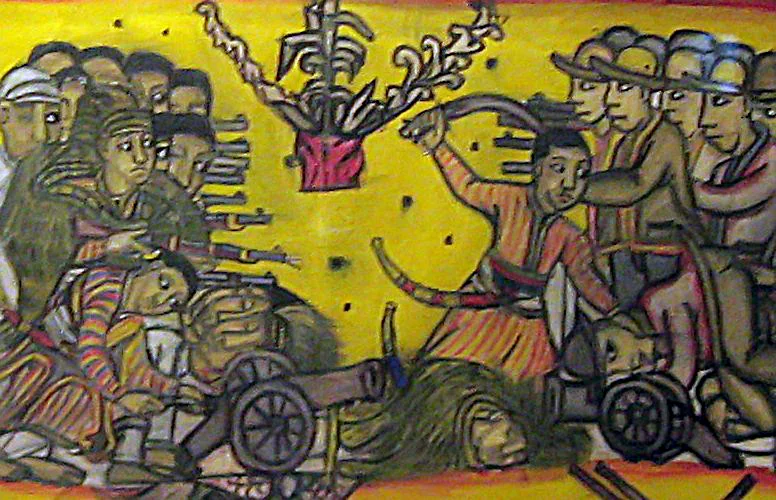
The battle appears in Ethiopian literature, music, and art. Paintings in churches and museums depict Menelik and Taytu at the head of their armies. The story has also entered popular culture through films, documentaries, and diaspora community events. For many Ethiopians, Adwa is a reminder that national unity and strategic patience can overcome overwhelming odds.
What Lessons Does the Battle of Adwa Offer Today?
Adwa rewards close study because it was not a lucky accident. It was the product of preparation, coalition-building, intelligence, and a clear understanding of what was at stake. Menelik’s decision to modernize his army’s equipment while preserving the empire’s organizational traditions proved decisive. Taytu’s insistence on resistance shaped the political will. The commanders’ use of terrain and timing turned a defensive war into a rout.
There are practical lessons for contemporary leaders and students of strategy:
- Preparation beats improvisation: Ethiopia’s years of arms procurement and mobilization paid off on the battlefield.
- Coalitions need clear command: Regional armies fought under a unified strategy rather than as separate forces.
- Intelligence and local knowledge matter: Ethiopian familiarity with the terrain and Italian movements shaped the outcome.
- Restraint after victory can be strategic: Menelik’s decision not to pursue a wider war preserved gains and secured a favourable treaty.
The battle also carries a cautionary dimension. Italy’s defeat did not end European colonial ambitions in the region, and Ethiopia faced another invasion four decades later. Adwa secured independence for a generation, but it did not eliminate the geopolitical pressures that surrounded the country.
Why the Battle of Adwa Remains a Defining Moment
The Battle of Adwa endures because it overturned an assumption that had shaped global politics: that a European army could not be beaten by an African state. On the highlands near Adwa, that assumption collapsed in a single day. The victory was built on institutions, alliances, and the courage of soldiers and commanders whose names are still spoken in Ethiopia and across the diaspora.
For readers encountering the story for the first time, Adwa is more than a date on a timeline. It is a case study in sovereignty, a source of pride, and a reminder that Africa’s modern history includes not only the pain of colonization but also the determination of those who resisted it. The battle belongs to Ethiopia, but its echo reaches across the continent and around the world.