📅 Last updated: 18.10.2026
M-Pesa mobile money began in 2007 as a modest pilot by Safaricom in Kenya, and it has since grown into the world’s most studied model for branchless banking, moving billions of shillings a day and pulling millions of unbanked people into the formal financial system. What started as a way to send airtime credit between phones became a parallel currency of daily life — for market traders in Gikomba, boda boda riders in Kisumu, and diaspora relatives sending school fees home. The numbers tell a story of scale: more than 30 million active customers in Kenya alone, transactions worth a substantial share of the country’s GDP flowing through phones each year, and a template that has been copied, adapted, and debated from Tanzania to Afghanistan.
M-Pesa is a mobile money service launched by Safaricom in Kenya in 2007 that lets users deposit, send, withdraw, and pay for goods using a basic mobile phone, without needing a bank account. By the mid-2020s it had grown to over 30 million active users in Kenya and processed transactions worth a large fraction of the national economy each year. Its success transformed financial inclusion in East Africa and became the global reference point for mobile money.
- What Is M-Pesa Mobile Money and Why Did It Start in Kenya?
- How Does M-Pesa Mobile Money Actually Work?
- M-Pesa Mobile Money's Journey: A Timeline of Key Milestones
- Why Did M-Pesa Mobile Money Succeed Where So Many Others Stalled?
- What Has M-Pesa Mobile Money Meant for Financial Inclusion in Kenya?
- How Has M-Pesa Mobile Money Shaped Innovation Across Africa and Beyond?
- What Are the Challenges and Criticisms Facing M-Pesa Mobile Money?
- What Does the Future Hold for M-Pesa Mobile Money?
- Why M-Pesa Mobile Money Remains a Defining African Innovation
What Is M-Pesa Mobile Money and Why Did It Start in Kenya?
The name comes from pesa, Swahili for “money,” and the “M” stands for mobile. The service launched commercially in March 2007 after a pilot the previous year, developed by Safaricom with backing from Vodafone and the UK government’s Department for International Development. The timing was not accidental. Kenya in the mid-2000s had a fast-growing mobile network, a large population locked out of traditional banking by distance, documentation, and minimum balances, and a regulator — the Central Bank of Kenya — willing to allow experimentation in a sandbox that didn’t yet have a formal name.
The founding insight was simple and radical: the SIM card was already a de facto identity document, and the mobile agent network — small shops selling airtime — could be repurposed as cash-in and cash-out points. A customer registers with a national ID, deposits cash with an agent, and receives an electronic balance on the phone. That balance can be sent to any other registered user by SMS, cashed out at another agent, or used to buy goods.
Early growth was driven less by marketing than by necessity. Urban workers sending money to rural relatives had relied on bus conductors and informal couriers, with real risk of loss and delay. M-Pesa collapsed that friction to seconds. Within a few years the service had more registered users than the country had bank accounts.
How Does M-Pesa Mobile Money Actually Work?
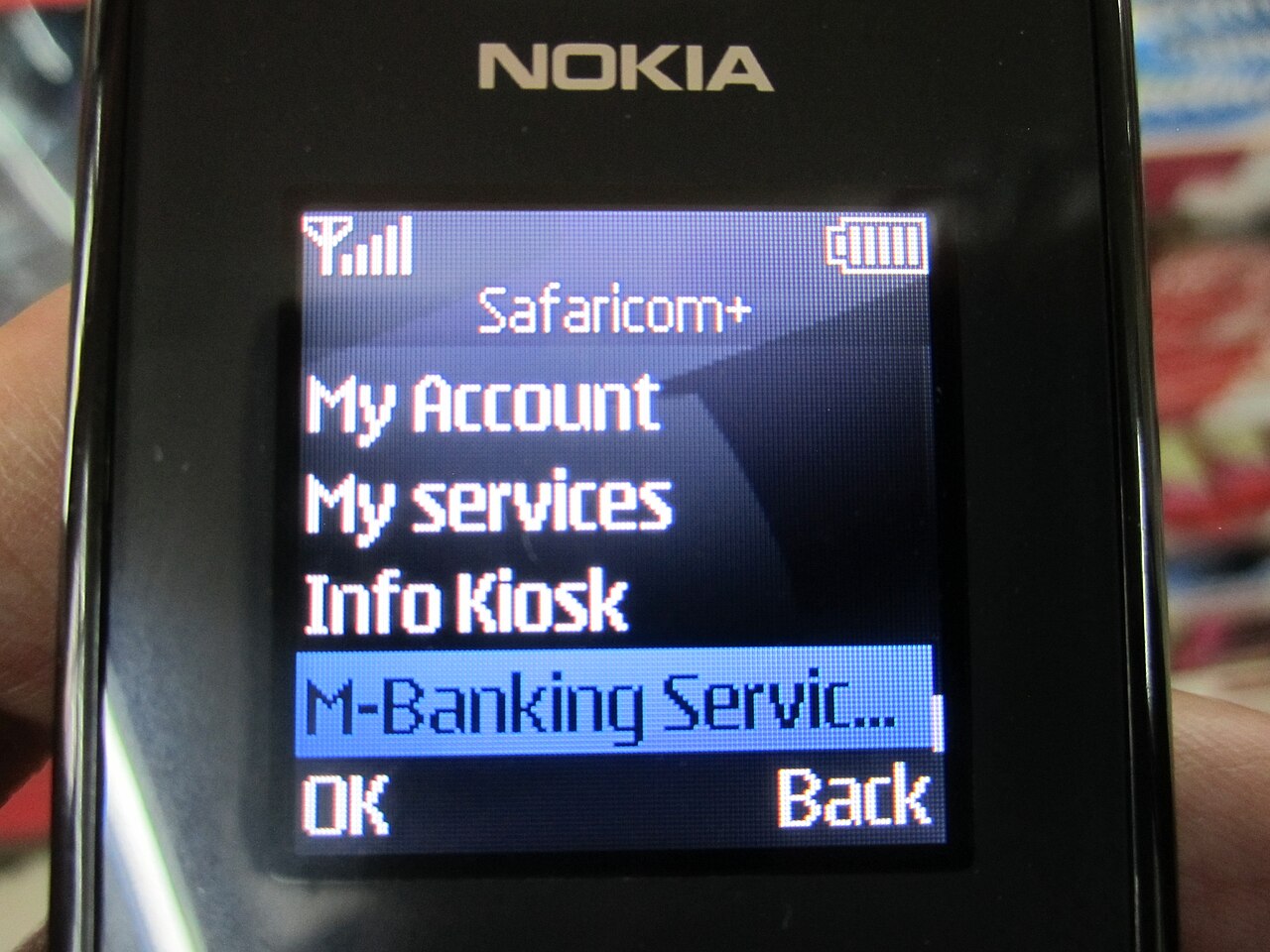
The mechanics are deliberately low-tech so they work on feature phones, not just smartphones. That design choice is a big part of why M-Pesa mobile money reached people that app-based fintech often misses.
The core transaction flow
- Registration: A user signs up at an agent or Safaricom shop with a national ID; the phone number becomes the account.
- Deposit (cash-in): Cash is handed to an authorized agent, who credits the e-wallet via the agent’s own M-Pesa line.
- Transfer: Money moves between users by entering a recipient’s number and a PIN; the recipient gets an SMS confirmation.
- Withdrawal (cash-out): The recipient visits an agent, enters a code, and receives cash, with the agent earning a commission.
- Payments: The same wallet pays utility bills, school fees, supermarket tills, and, increasingly, government services.
Behind the scenes sits a network of tens of thousands of agents — often the same dukas and kiosks that sell airtime and sodas. The agent network is the real infrastructure. It is what turns a phone balance into usable cash in a village with no bank branch for 40 kilometers.
Security and the PIN
Every transaction requires a secret PIN, and the system uses encryption and transaction limits to reduce fraud. Fraud and SIM-swap scams remain a persistent challenge, and Safaricom and the Communications Authority of Kenya have invested heavily in public education and tighter identity checks. The lesson for other markets: trust is the product, and it has to be maintained continuously.
M-Pesa Mobile Money’s Journey: A Timeline of Key Milestones
The service’s evolution tracks Kenya’s broader digital economy, from SMS transfers to a full financial ecosystem with savings, credit, and merchant payments.
| Year | Milestone | Why It Mattered |
|---|---|---|
| 2006 | Pilot launched by Safaricom and Vodafone | Tested agent-based cash-in/cash-out in a live market |
| 2007 | Commercial launch in Kenya | First large-scale mobile money deployment in the region |
| 2010 | M-KOPA and pay-as-you-go solar emerge | M-Pesa rails enabled asset financing for off-grid households |
| 2012 | M-Shwari savings and loan product | Extended mobile money into savings and microcredit |
| 2017 | 10th anniversary; ~27 million customers | Established as core national financial infrastructure |
| 2020 | Pandemic push for cashless payments | Waived fees on small transactions boosted digital adoption |
| 2023–2025 | Expansion into Ethiopia via Safaricom Ethiopia; API ecosystem growth | Regional replication and deeper merchant integration |
Why Did M-Pesa Mobile Money Succeed Where So Many Others Stalled?
Dozens of countries tried mobile money before and after 2007. Most failed to reach scale. Kenya’s success came from a combination of factors that are hard to replicate wholesale but instructive to study.
- Agent density: Safaricom recruited and trained a vast network of small retailers, reaching deep into rural areas.
- Network effects: Because the dominant telecom had the largest subscriber base, M-Pesa became useful the moment it launched — everyone you wanted to pay was already on the network.
- Light-touch early regulation: The Central Bank of Kenya allowed the service to grow under a “test and learn” approach before formal rules arrived.
- Real pain point: Domestic remittances were expensive and risky; M-Pesa solved a problem people felt every week.
- Trusted brand: Safaricom’s existing reputation for network reliability transferred to the money service.
Compare that with markets where mobile money struggled: fragmented telecom competition, heavy-handed regulation, or a banking sector that saw mobile money as a threat rather than a complement. The Kenyan case shows that interoperability and a dominant, trusted operator can accelerate adoption — but also that concentration raises competition concerns that regulators now scrutinize more closely.
What Has M-Pesa Mobile Money Meant for Financial Inclusion in Kenya?
Before M-Pesa, a large majority of Kenyan adults had no bank account. Today, financial inclusion — measured by access to formal financial services — covers the vast majority of adults, according to successive FinAccess surveys by the Central Bank of Kenya, the Kenya National Bureau of Statistics, and FSD Kenya. M-Pesa mobile money is not the only driver, but it is the central one.
The impact shows up in specific, measurable ways:
- Rural households receive remittances faster and more safely, smoothing consumption during droughts and school-fee season.
- Women gain a private, individual account, which research links to greater control over household spending.
- Small businesses accept digital payments and build transaction histories that can unlock credit.
- Savings groups (chamas) digitize contributions, reducing the risk of cash loss.
Economists have documented knock-on effects: a study by researchers including Jack and Suri found that M-Pesa access helped households absorb negative income shocks without cutting consumption as sharply. The service has also been linked to reduced crime associated with cash handling and to greater financial resilience among the poor.
The M-Shwari and Fuliza extensions
In 2012, M-Shwari — a partnership between Safaricom and the Commercial Bank of Africa (now NCBA) — let users open a savings account and access small loans directly from the M-Pesa menu. Fuliza later offered overdraft facilities. These products extended the ecosystem beyond payments into credit and savings, though they also raised concerns about over-indebtedness that regulators and consumer groups continue to debate.
How Has M-Pesa Mobile Money Shaped Innovation Across Africa and Beyond?
The Kenyan model traveled. Tanzania’s Tigo Pesa and Airtel Money, Uganda’s MTN Mobile Money, Ghana’s MTN MoMo, and Zimbabwe’s EcoCash all drew on lessons from M-Pesa, adapting agent models and regulatory approaches to local conditions. In West Africa, where mobile money has grown rapidly in recent years, the Kenyan experience informed interoperability rules and agent-network design.
Beyond payments, M-Pesa’s rails enabled a generation of startups. M-KOPA used mobile payments to sell solar home systems on installment plans, lighting millions of homes. Agri-tech platforms pay farmers via mobile money. Ride-hailing and e-commerce firms accept it. Health insurers collect premiums through it. The service became a platform, not just a product.
Lessons for other markets
The replication story is not a simple copy-paste. Ethiopia, which opened its telecom sector to competition, saw Safaricom launch M-Pesa there in 2023, betting that a large unbanked population and a fast-growing mobile market could support the model. Success will depend on agent networks, regulatory clarity, and interoperability with the existing financial system. The broader lesson: mobile money works best where it solves a real, frequent, painful problem and where the operator has the trust and reach to make it the default.
What Are the Challenges and Criticisms Facing M-Pesa Mobile Money?
A celebratory story still needs an honest accounting. M-Pesa mobile money faces scrutiny on several fronts.
Market concentration and competition
Safaricom’s dominance in Kenyan telecom and mobile money has drawn regulatory attention. The Communications Authority of Kenya has pushed for greater competition, and the entry of Airtel Money and Telkom’s T-Kash has added choice. Interoperability rules now require transfers between mobile money networks, reducing the “walled garden” problem that once made M-Pesa’s network effect a moat.
Costs and consumer protection
Transaction fees are low relative to bank charges but not trivial for low-income users. Regulators and consumer advocates have pushed for transparency and, during the pandemic, for fee waivers on small transfers. Fraud, SIM-swap attacks, and loan-app harassment are ongoing concerns.
Over-indebtedness and data privacy
Digital credit products built on M-Pesa transaction histories have expanded access to credit, but critics warn about aggressive collection practices and the risk of trapping borrowers in cycles of debt. Data privacy — who can see transaction histories and how they are used — is an evolving policy question across the continent.
None of these challenges erase the achievement. They are the natural frictions of a system that became too important to leave unregulated.
What Does the Future Hold for M-Pesa Mobile Money?
The next chapter is about integration and regional reach. Safaricom has invested in APIs that let developers build services on top of M-Pesa, from e-commerce checkouts to savings apps. Partnerships with banks, insurers, and governments are deepening. Cross-border remittances — long dominated by expensive international money transfer operators — are a major opportunity, with M-Pesa positioning itself as a cheaper corridor for diaspora flows into East Africa.
There is also the question of what happens as smartphones replace feature phones. M-Pesa’s low-tech design was its original advantage; now the service must compete with app-based fintechs and digital banks that offer richer interfaces. Safaricom’s response has been to build a super-app ecosystem while keeping the USSD menu working for everyone. The balance between innovation and inclusion will define the next decade.
Regionally, the model continues to spread. Ethiopia’s entry, Tanzania’s mature market, and West Africa’s rapid growth all suggest that mobile money is not a Kenyan curiosity but a continental financial architecture in the making.
Why M-Pesa Mobile Money Remains a Defining African Innovation
M-Pesa mobile money is often described as a fintech success story, but its deeper significance is social. It gave millions of people a financial identity, a way to save, send, and receive money without a bank branch, and a measure of control over their economic lives. It changed how families support each other across distances, how small businesses operate, and how governments think about financial inclusion.
The service was not inevitable. It required a telecom willing to experiment, a regulator willing to allow it, and a public willing to trust a phone with their money. That combination — technical pragmatism, regulatory flexibility, and social trust — is the real Kenyan innovation, and it is why M-Pesa mobile money continues to be studied, copied, and adapted from Nairobi to Accra to Addis Ababa. The story is still being written, but its first two decades already rank among the most consequential financial innovations to come out of Africa.