📅 Last updated: 12.10.2026
The Kingdom of Axum rose in the highlands of northern Ethiopia nearly two thousand years ago and grew into one of the great powers of the ancient world — a trading empire whose ships linked Rome, India, and Arabia, whose kings minted their own gold coinage, and whose stonemasons raised obelisks that still stand today as the tallest single blocks of stone ever quarried by human hands. Its name survives in the modern Ethiopian town of Aksum, in the Tigray Region, where farmers still plough fields beneath the shadows of those monuments. Yet outside Ethiopia and the wider Horn of Africa, few people have heard of it. This is the story of an African empire that helped shape the world — and of the monuments it left behind.
- Where the Kingdom of Axum Began
- A Trading Empire of Gold and Ivory
- Kings, Queens, and the Rise of a Christian Kingdom
- Obelisks, Tombs, and the Engineering of Power
- Axum in the Wider World: Rome, Arabia, and the Red Sea
- Why the Kingdom of Axum Declined
- Axum's Living Legacy
- The Empire the World Forgot — and Is Rediscovering
Where the Kingdom of Axum Began
The city of Aksum sits on a plateau around 2,100 metres above sea level, in what is now the Tigray Region of Ethiopia, roughly 150 kilometres from the border with Eritrea. It was here, in the first century CE, that a local polity began to expand from the fertile highlands into a regional power. The Greek Periplus of the Erythraean Sea, a merchant’s guide written around 40–60 CE, already mentions a trading centre called “Axomites” on the route inland from the Red Sea port of Adulis — the earliest written reference we have to the kingdom.
Axum’s geography was its fortune. From the port of Adulis, on the Red Sea coast near modern Massawa, its merchants could reach the Arabian Peninsula, Egypt, and the Mediterranean. Inland, the highlands produced ivory, frankincense, myrrh, gold, and slaves. The kingdom sat at the crossroads of three continents, and it made the most of it.
By the third century, the Axumite state controlled a corridor running from the Red Sea coast deep into the Ethiopian highlands, and it had begun to project power across the water into southern Arabia. Its rulers adopted the title negus — king — and later, in some inscriptions, basileus, the Greek word for sovereign, a deliberate claim to stand alongside Rome and Persia.
A Trading Empire of Gold and Ivory
What made Axum wealthy was not conquest alone but commerce. Axumite merchants exported ivory, tortoiseshell, rhinoceros horn, gold, emeralds, and spices. They imported textiles, glassware, olive oil, wine, and silver from the Roman world, and cotton and spices from India. Axumite ships — the kingdom maintained a Red Sea fleet — carried these goods across the water, and Axumite coins have been found as far away as India.
The kingdom’s most striking economic innovation was its coinage. Beginning in the late third century under King Endubis, Axum became one of the few ancient states outside the Mediterranean to mint its own coins — in gold, silver, and bronze. The gold coins were struck to the same weight standard as Roman aurei, a clear signal that Axum intended to trade on equal terms with the empire to its north. The coins carried the king’s portrait, his name in Ge’ez script, and often a cross after the kingdom’s conversion to Christianity. They are among the most important archaeological finds in the region, and they allow historians to reconstruct a king list that would otherwise be lost.
Adulis: The Gateway Port
Adulis was the engine of Axumite trade. Ancient sources describe it as a bustling harbour where merchants from Egypt, Arabia, and India met. Excavations there have uncovered Roman pottery, glass, and coins alongside local goods. The port was so important that when the Axumite king Kaleb invaded Yemen in the sixth century, he sailed from Adulis with a fleet — a reminder that this was a maritime power, not merely a landlocked highland kingdom.
Kings, Queens, and the Rise of a Christian Kingdom
Axum’s history is punctuated by rulers whose names survive in inscriptions, coins, and later Ethiopian tradition. Among the earliest well-attested kings are Endubis (late third century), Ezana (mid-fourth century), and Kaleb (early sixth century). Ezana is the most consequential. Around 330–340 CE, he converted to Christianity — making Axum one of the first states in the world to adopt the faith as an official religion, decades before the Roman Empire did so under Theodosius.
Ezana’s conversion is recorded in his own inscriptions. In one, he thanks “the Lord of Heaven” for victory over the Nubian kingdom of Kush, a striking departure from the earlier inscriptions that credited local gods. He struck coins bearing the cross. He corresponded with Athanasius, the Patriarch of Alexandria, and the Ethiopian church was placed under the authority of the Coptic Patriarch — a link that shaped Ethiopian Christianity for centuries.
Axumite Christianity was not a passive import. The kingdom developed its own liturgy, its own scriptural tradition in Ge’ez, and its own monastic movement. The Nine Saints, a group of Syriac-speaking monks who arrived in the fifth century, are credited with spreading monasticism across the highlands and translating scripture into Ge’ez. Their legacy survives in the rock-hewn churches of Tigray, some of which were carved directly into cliffs centuries later.
“May the Lord of Heaven grant me victory, and may He preserve my kingdom.” — adapted from an inscription attributed to King Ezana, reflecting the new Christian identity of the Axumite court.
Obelisks, Tombs, and the Engineering of Power
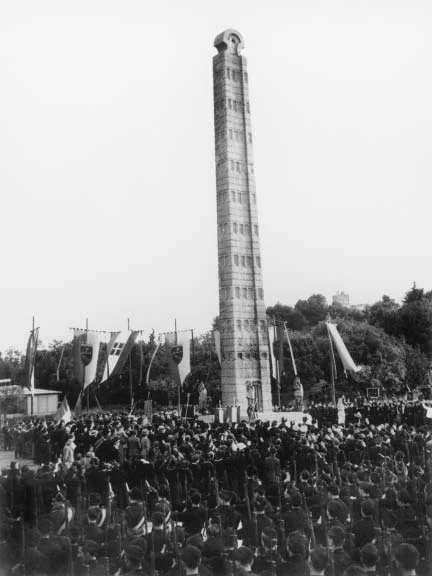
If Axum’s coins announced its wealth, its obelisks announced its ambition. The stelae field at Aksum contains dozens of carved granite monuments, the largest of which — the Great Stele — would have stood around 33 metres tall and weighed an estimated 520 tonnes. It lies where it fell, probably during construction, cracked into sections. The tallest still standing is the 24-metre Obelisk of Axum, carved to resemble a multi-storey building with false windows and doors, a symbolic “house” for the spirit of a deceased king.
These monuments were quarried several kilometres away, at a site called Gobedra, and transported to the city — a feat of engineering that scholars still debate. Some researchers have proposed that water, rollers, and animal traction were used; others suggest a large labour force with wooden sledges. Whatever the method, the precision of the carving and the scale of the blocks mark Axum as one of the great monumental cultures of the ancient world, comparable to Egypt and Nubia.
Beneath the stelae lie tombs. Excavations in the 1970s uncovered underground chambers with stone stairways, granite sarcophagi, and grave goods including bronze lamps, glass vessels, and gold jewellery. The most elaborate tombs are associated with the fourth century, when Axumite kings were buried with the ceremony of an empire.
The Obelisk That Came Home
The most famous of Axum’s obelisks has a modern history as dramatic as its ancient one. In 1937, Italian troops under Mussolini looted the 24-metre stele and shipped it to Rome, where it was erected in front of the headquarters of the United Nations Food and Agriculture Organization. For decades, Ethiopia demanded its return. Italy agreed in 1947 but delayed for over fifty years. The obelisk was finally dismantled in 2003, flown back to Ethiopia in three pieces in 2005, and re-erected at Aksum in 2008. Its return is remembered across Africa as a landmark in the struggle for the restitution of looted heritage.
Axum in the Wider World: Rome, Arabia, and the Red Sea
Axum’s relationship with Rome was complex. The two powers traded extensively, and Roman writers treated Axum as a significant state. The fourth-century historian Ammianus Marcellinus described Axum as one of the great nations of the world. In the sixth century, the Byzantine emperor Justinian sought Axum’s help against the Persian Empire, recognising the kingdom’s strategic position on the Red Sea.
Axum also intervened militarily in Arabia. Around 520 CE, King Kaleb invaded the kingdom of Himyar in what is now Yemen, after Himyar’s ruler had persecuted Christians. Kaleb’s campaign was successful, and Axumite rule in southern Arabia lasted for decades. It was one of the few times an African power projected military force across the sea into Asia — a reminder that the Red Sea was, in this era, an African lake as much as an Asian one.
| Date | Event | Significance |
|---|---|---|
| c. 40–60 CE | Periplus of the Erythraean Sea mentions Axum | Earliest written reference to the kingdom |
| Late 3rd century | King Endubis mints Axumite coins | Axum joins the small club of coin-minting states |
| c. 330–340 CE | King Ezana converts to Christianity | Axum becomes one of the world’s first Christian states |
| c. 520 CE | King Kaleb invades Himyar (Yemen) | Peak of Axumite military reach across the Red Sea |
| 7th–8th century | Rise of Islamic caliphates, decline of Axum | Trade routes shift; the kingdom’s power fades |
Why the Kingdom of Axum Declined
No empire lasts forever, and Axum’s decline was gradual rather than sudden. Several forces combined. The rise of Islam in the seventh century transformed the Red Sea. Arab Muslim forces took control of Egypt and the Levant, and the Red Sea trade that had enriched Axum came increasingly under Muslim control. Adulis was eventually abandoned; its exact fate is debated, but by the eighth century it had ceased to function as a major port.
Environmental factors may also have played a role. Some scholars point to soil erosion, deforestation, and shifting rainfall patterns in the highlands, which would have undermined agricultural surpluses. Others emphasise internal political fragmentation. Whatever the mix of causes, Axum’s political centre of gravity shifted southward, toward the region of Lasta, where the Zagwe dynasty eventually rose and built the famous rock-hewn churches of Lalibela in the twelfth and thirteenth centuries.
Yet Axum did not simply vanish. Its church, its script, and its royal ideology survived. The Solomonic dynasty, which took power in 1270, claimed descent from the Axumite kings — and, through the Kebra Nagast, from King Solomon and the Queen of Sheba. That claim gave Ethiopia a continuous sense of imperial identity that lasted until the fall of Emperor Haile Selassie in 1974.
Axum’s Living Legacy
Today, Aksum is a town of around 60,000 people, the spiritual centre of the Ethiopian Orthodox Tewahedo Church, and a UNESCO World Heritage Site. Pilgrims still gather at the Church of St Mary of Zion, which Ethiopian tradition holds to be the original site of the Ark of the Covenant. The church’s treasury is said to house the Ark itself — a claim that has fascinated the world for centuries.
The Axumite legacy is visible in more than monuments. The Ge’ez script, developed in the kingdom, is still used to write Amharic and Tigrinya, the languages of millions of Ethiopians and Eritreans. The Ethiopian Orthodox liturgy retains prayers and hymns composed in Axumite times. The kingdom’s coin designs and architectural motifs continue to inspire Ethiopian artists and designers.
There is also a modern, forward-looking dimension. Ethiopian archaeologists, often working with international partners, are using satellite imagery, ground-penetrating radar, and digital mapping to survey Axum’s underground tombs without disturbing them. In 2019, researchers announced the discovery of a previously unknown church and buried structures at Aksum, suggesting that much of the ancient city remains unexcavated. The site is not just a relic — it is an active field of discovery.
Key Places to See the Axumite World Today
- The Stelae Field, Aksum — home to the Obelisk of Axum, the Great Stele, and dozens of carved monuments.
- The Church of St Mary of Zion — the spiritual heart of Ethiopian Christianity, with its adjacent chapel said to house the Ark of the Covenant.
- The Tombs of Kings Kaleb and Gebre Meskel — two rock-cut tombs on a hill outside the town, with carved stairways and chambers.
- The Ezana Stone — an inscription in Ge’ez, Sabaean, and Greek recording King Ezana’s conquests and his conversion.
- Adulis — the ancient port near Massawa, Eritrea, now an archaeological site on the Red Sea coast.
- Yeha — a pre-Axumite temple site, roughly 50 kilometres from Aksum, with a still-standing temple wall dating to around 700 BCE.
The Empire the World Forgot — and Is Rediscovering
Why is Axum so little known outside Africa? Partly because the written record is thin. Axumite inscriptions are relatively few, and much of what we know comes from coins, archaeology, and the accounts of foreign merchants. Partly because the kingdom’s decline coincided with the rise of Islamic empires that dominated the historical narrative of the region. And partly because colonial-era scholarship tended to treat African civilisations as peripheral — a bias that has taken decades to correct.
That is changing. Ethiopia’s own scholars, and a growing international field of Axumite studies, are putting the kingdom back where it belongs: alongside Rome, Persia, and the other great powers of late antiquity. The return of the obelisk from Rome in 2008 was a symbolic turning point. The ongoing excavations are a scholarly one.
Axum matters because it shows what Africa has always been: a place of cities, trade, engineering, faith, and global connection. It was not a footnote to the classical world. It was one of its architects. The obelisks that still stand in the Tigray highlands are not just monuments to dead kings — they are evidence of an African empire that helped shape the world, and that the world is only now beginning to remember.