📅 Last updated: 08.10.2026
Cut into the red volcanic rock of northern Ethiopia’s highlands, the Lalibela rock churches are among the most audacious feats of sacred architecture anywhere on Earth: eleven complete churches, carved top-down into living stone, still in active use after roughly eight centuries. Pilgrims in white shawls still file through their tunnels at dawn; priests still guard illuminated manuscripts in their shadows. Yet Lalibela is not a ruin frozen in amber — it is a working town of some 30,000 people, a UNESCO World Heritage Site since 1978, and a place where faith, geology, and engineering meet in ways that continue to puzzle and inspire scholars.
- Where Are the Lalibela Rock Churches?
- The History Behind the Lalibela Rock Churches
- How Were the Lalibela Rock Churches Built?
- A Tour of the Churches: What You'll See
- Key Facts at a Glance
- Faith and Daily Life at Lalibela
- Practical Guide: Visiting Lalibela
- Why Lalibela Matters Today
- Planning Your Visit: A Final Word
Where Are the Lalibela Rock Churches?
Lalibela sits in the Amhara region of northern Ethiopia, in the Semien Wollo Zone, at an altitude of about 2,500 metres (8,200 feet). The nearest large city is Woldia, roughly 130 kilometres to the east; the regional capital, Bahir Dar, lies some 260 kilometres to the west, on the shores of Lake Tana. The town is named after King Gebre Mesqel Lalibela, the Zagwe dynasty ruler traditionally credited with commissioning the churches in the late 12th and early 13th centuries.
The setting matters. This is a landscape of high plateaus, deep gorges, and cool mountain air — a world away from the desert imagery often associated with Ethiopia. The churches themselves are clustered in two main groups, separated by a seasonal river called the Jordan River (Yordanos), with a third church, Biete Giyorgis, standing apart to the west. The site is compact enough to walk in a day, though most visitors spend two or three.
The History Behind the Lalibela Rock Churches
The story begins with a political shift. In the late 10th century, the Aksumite Empire — the ancient civilisation that had dominated the region since the 1st century CE and converted to Christianity in the 4th century — was in decline. A new dynasty, the Zagwe, rose to power around 1137, ruling from a capital in the Lasta mountains. The Zagwe kings were devout Christians, and their most famous ruler, Lalibela, is said to have commissioned the churches as a “New Jerusalem.”
The motivation was practical as well as spiritual. In 1187, the Muslim sultan Saladin captured Jerusalem, cutting off the pilgrimage route that Ethiopian Christians had long travelled. According to tradition, Lalibela built his churches as an alternative holy land — a place where the faithful could complete their pilgrimage without risking the journey to the Middle East. The site’s geography was even renamed to mirror Jerusalem: the river became the Jordan, and a nearby hill became the Mount of Olives.
Historians debate the exact dates. Ethiopian tradition holds that the churches were built during Lalibela’s reign (c. 1181–1221), but some scholars argue construction continued into the 13th century and possibly beyond. What is not disputed is the scale of the achievement: eleven churches, each carved from a single block of stone, connected by tunnels, trenches, and ceremonial passages. The UNESCO inscription in 1978 described the site as “a unique artistic achievement” and noted that the churches “were carved from the living rock” in a manner “unique in the world.”
A Legend of Angels
Ethiopian tradition offers a more poetic explanation. According to the Kebra Nagast and local oral histories, Lalibela was visited by angels who helped complete the work overnight. Some versions say the king himself worked alongside the angels; others say the churches were built by angels while the king slept. The legend persists because the speed and precision of the construction seem, to many, beyond human capability. Modern engineers disagree — but the fact that the story endures says something about how deeply the site is woven into Ethiopian identity.
How Were the Lalibela Rock Churches Built?
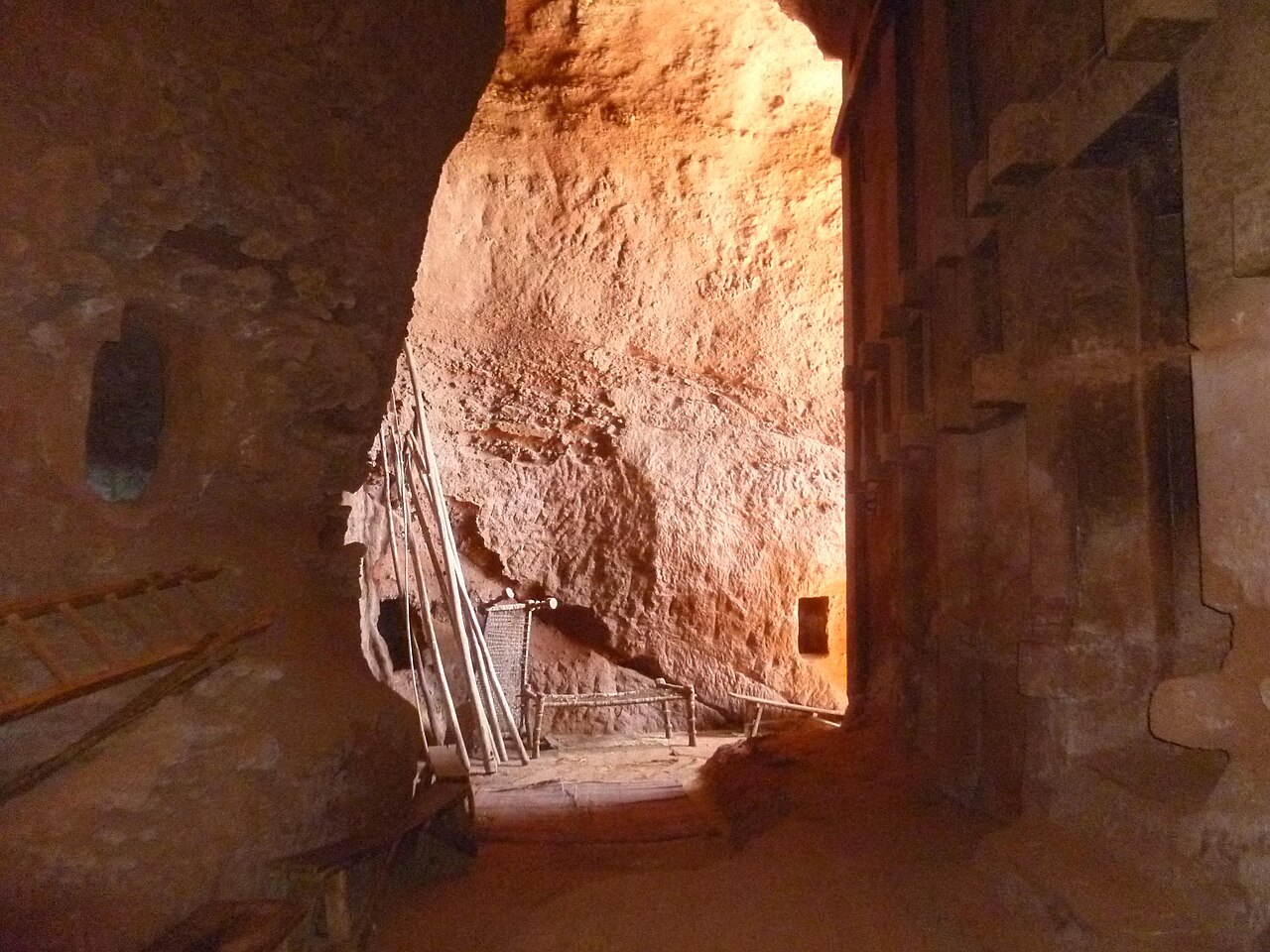
This is the question that draws engineers, geologists, and historians to Lalibela year after year. The churches were not built up from the ground. They were carved down from the top, cut from solid volcanic tuff — a soft, porous rock formed from compressed volcanic ash. The process likely began by excavating a trench around a rectangular block of rock, then carving downward to create the church’s exterior walls. Interior spaces, pillars, arches, and windows were then hollowed out from the inside.
The tools were simple: chisels, picks, hammers, and human labour. No mortar was used. No blocks were stacked. Each church is a single, continuous piece of stone, structurally integrated with the rock around it. This is why the churches have survived earthquakes, invasions, and centuries of erosion — they are, in a sense, part of the landscape itself.
The engineering challenges were immense. Carving downward meant there was no scaffolding to support the workers; they had to remove rock in carefully sequenced stages to avoid collapse. Drainage systems — trenches, channels, and cisterns — were cut to manage rainwater, which would otherwise flood the churches during Ethiopia’s rainy season. Some churches, like Biete Medhane Alem, are surrounded by deep trenches that serve both as walkways and as water channels.
Why the Rock Matters
The volcanic tuff at Lalibela is relatively soft when first exposed but hardens over time. This made it workable with simple tools but durable once carved. Geologists have noted that the rock’s composition varies across the site, which may explain why some churches are better preserved than others. The churches are also oriented — most face east, toward Jerusalem, in keeping with Christian liturgical tradition.
A Tour of the Churches: What You’ll See
The eleven churches are traditionally divided into three groups. Each has its own character, history, and architectural quirks. Here is a guide to the main sites.
The Northern Group
- Biete Medhane Alem (House of the Saviour of the World): The largest monolithic church in the world, measuring about 33.5 metres long, 23.5 metres wide, and 11.5 metres high. It is supported by 72 pillars and is believed to have once housed the Ark of the Covenant. Its scale is staggering — you enter through a trench and look up at walls that seem to rise forever.
- Biete Maryam (House of Mary): The oldest of the group, according to tradition, and the most richly decorated. Its interior walls are covered in frescoes, some dating to the 15th century. The church has a distinctive cruciform shape and is connected to Biete Medhane Alem by a tunnel.
- Biete Golgotha Mikael (House of Golgotha Michael): A double church, with Golgotha above and Mikael below. It is said to contain the tomb of King Lalibela himself. Only priests are allowed into the innermost chamber.
- Biete Denagel (House of Virgins): A smaller, simpler church, often overlooked by visitors but notable for its carved windows and quiet atmosphere.
- Biete Maskal (House of the Cross): Named for the ceremonial crosses kept inside, this church is connected to the northern group by a series of tunnels.
The Eastern Group
- Biete Amanuel (House of Emmanuel): A beautifully proportioned church with a cruciform plan and elaborate exterior carvings. Some scholars believe it was the royal chapel.
- Biete Qeddus Mercoreus (House of St. Mercurius): A tall, narrow church with a distinctive shape and a deep trench surrounding it. Its interior is relatively plain, but the exterior is striking.
- Biete Abba Libanos (House of Abba Libanos): A cave church, partially attached to the rock face, with a roof that is still connected to the surrounding stone.
- Biete Gabriel-Rufael (House of Gabriel and Raphael): A large, twin-nave church with a deep courtyard. It is connected to Biete Qeddus Mercoreus by a tunnel.
- Biete Lehem (House of Bread): A small, simple church, possibly used as a refectory or storage space.
The Western Group
- Biete Giyorgis (House of St. George): The most famous and most photographed of all the churches. Carved in the shape of a Greek cross, it stands in a deep pit, its roof level with the surrounding rock. The symmetry is almost perfect. According to legend, it was built after Lalibela’s death, and St. George himself complained that he had been left out — so the king built this one in his honour.
Key Facts at a Glance
| Feature | Detail |
|---|---|
| Number of churches | 11 monolithic churches (plus several cave churches and chapels) |
| Location | Lalibela, Amhara Region, northern Ethiopia |
| Construction period | Late 12th to early 13th century, during the Zagwe dynasty |
| Rock type | Volcanic tuff (soft, porous, hardens over time) |
| UNESCO status | World Heritage Site since 1978 |
| Largest church | Biete Medhane Alem (33.5m x 23.5m x 11.5m) |
Faith and Daily Life at Lalibela
The Lalibela rock churches are not a museum. They are a living pilgrimage site, and the rhythms of worship shape every day. Priests in white robes chant in Ge’ez, the ancient liturgical language of the Ethiopian Orthodox Tewahedo Church. Deacons carry ornate crosses and censers. Pilgrims arrive from across Ethiopia — and increasingly from around the world — to pray, to touch the walls, to kiss the stone.
The most important celebration is Timkat, the Ethiopian Epiphany, which falls on 19 January (or 20 January in leap years). Timkat commemorates the baptism of Jesus in the Jordan River, and at Lalibela it is celebrated with particular intensity. Thousands of pilgrims gather as replicas of the Ark of the Covenant — called tabots — are carried in procession to the waters. Priests in bright vestments chant; drums and sistrums fill the air; the whole town becomes a stage for one of Africa’s most spectacular religious festivals.
Other important dates include Genna (Ethiopian Christmas, 7 January) and Meskel (Finding of the True Cross, 27 September). But even on ordinary days, the churches are busy. Morning and evening prayers draw crowds. The smell of incense hangs in the air. The sound of chanting echoes through the tunnels. It is a place of devotion first, and a tourist attraction second — a distinction that visitors are asked to respect.
Preservation and Modern Challenges
Lalibela faces real pressures. The churches are carved from soft rock, and centuries of rain, wind, and foot traffic have taken a toll. In the 1960s, a protective shelter was built over Biete Medhane Alem to shield it from the elements. More recently, the Ethiopian government and UNESCO have worked on drainage improvements, structural monitoring, and visitor management.
There are also tensions between preservation and access. In 2018, a controversial restoration project — partly funded by the European Union and carried out by a Greek team — drew criticism from some conservationists who feared the use of modern materials could damage the ancient stone. The debate continues, reflecting a broader question: how do you protect a living heritage site without freezing it in time?
Tourism brings economic benefits but also challenges. Visitor numbers have grown steadily, and the town’s infrastructure — roads, hotels, water supply — has struggled to keep pace. The COVID-19 pandemic hit Lalibela hard, as it did tourism across Ethiopia. More recently, the conflict in northern Ethiopia (2020–2022) disrupted travel to the region, though Lalibela itself was largely spared direct damage. As stability returns, the town is once again welcoming visitors.
Practical Guide: Visiting Lalibela
Lalibela is accessible by air and road. Ethiopian Airlines operates daily flights from Addis Ababa to Lalibela Airport (LLI), a 45-minute journey. By road, the drive from Addis takes two days, with an overnight stop in Dessie or Woldia. Most visitors fly.
The best time to visit is during the dry season, from October to March. The rainy season (June to September) brings heavy downpours and muddy paths. Timkat in January is spectacular but crowded; if you want quiet, visit in November or February.
Entrance to the churches requires a ticket, which costs around 50 USD for foreign visitors (as of 2024) and covers all eleven churches for several days. Guides are available at the entrance and are highly recommended — the site’s history and symbolism are not always obvious without explanation. Dress respectfully: shoulders and knees should be covered, and shoes must be removed before entering the churches.
Accommodation ranges from simple guesthouses to mid-range hotels. The town has several restaurants serving Ethiopian staples — injera, shiro, tibs — as well as some international options. The altitude (2,500 metres) can cause mild breathlessness, so take it easy on the first day.
What to Bring
- Comfortable walking shoes (the terrain is uneven, with steps and trenches)
- A scarf or shawl (for covering up and for the cool mornings)
- A torch or headlamp (some tunnels and interiors are dimly lit)
- Cash in Ethiopian birr (for guides, tickets, and small purchases)
- A respectful attitude — this is an active place of worship
Why Lalibela Matters Today
Lalibela is more than a wonder of engineering. It is a statement of faith, a political act, and a cultural anchor. For Ethiopian Orthodox Christians, it is a holy site second only to Aksum. For historians, it is a window into the Zagwe dynasty and the medieval Ethiopian state. For architects and engineers, it is a case study in what humans can achieve with simple tools and extraordinary vision.
It is also a reminder that Africa’s history is not a story of waiting to be discovered. The Lalibela rock churches were built centuries before many European cathedrals. They were carved by African hands, for African worshippers, in an African landscape. They are not a curiosity or an anomaly — they are part of a deep, continuous, and sophisticated tradition of African architecture and spirituality.
In a world where heritage sites are increasingly threatened by climate change, conflict, and mass tourism, Lalibela offers a model of resilience. It has survived invasions, earthquakes, and pandemics. It has adapted to new political realities while remaining true to its purpose. And it continues to draw pilgrims and travellers who come not just to see, but to feel — to stand in a trench carved eight centuries ago and look up at a church that is also a mountain.
Planning Your Visit: A Final Word
If you go to Lalibela — and you should — go with time. This is not a site to rush. The churches reward slow looking: the way light falls through a carved window at noon, the texture of the stone under your hand, the sound of chanting drifting through a tunnel. Walk the trenches. Sit in the courtyards. Talk to the priests. Let the place work on you.
And go with respect. Lalibela is not a theme park. It is a place where people pray, fast, celebrate, and mourn. The Lalibela rock churches have been a sanctuary for centuries, and they remain one today. To visit is to step into that living history — and to carry a piece of it home.