📅 Last updated: 21.09.2026
The Zulu Reed Dance, known in isiZulu as Umhlanga, is one of southern Africa’s most visually arresting cultural gatherings: tens of thousands of young women in beaded skirts carrying tall reeds to the royal palace at Nongoma. Held annually in South Africa’s KwaZulu-Natal province, it is at once a coming-of-age ritual, a celebration of virginity and self-respect, a showcase of Zulu craft and choreography, and a living link to a monarchy that has survived colonialism, apartheid and the complexities of modern democracy.
- What Is the Zulu Reed Dance? Origins and Meaning
- Where and When: The KwaZulu-Natal Setting
- Who Takes Part: Age, Roles and Regalia
- The Ceremony Step by Step: From Riverbank to Royal Palace
- Key Facts About the Zulu Reed Dance at a Glance
- Culture, Controversy and the Zulu Reed Dance Today
- The Monarchy, Politics and Modern South Africa
- How to Experience Umhlanga Respectfully
- Why Umhlanga Still Matters
For outsiders, the ceremony is often reduced to a single photograph — a sea of colour, barefoot girls walking for kilometres under the sun. The reality is far richer. Umhlanga is a carefully organised cultural institution with its own protocols, its own politics and its own quiet debates about tradition, gender and the future. To understand it is to understand something essential about how Zulu identity is performed, negotiated and passed on today.
What Is the Zulu Reed Dance? Origins and Meaning
Umhlanga takes its name from umhlanga, the isiZulu word for reed. The ceremony’s central act is simple and symbolic: young women and girls cut reeds from riverbeds and carry them to the royal residence, where they present them to the king. The reeds are used to repair and reinforce the eNkundla, the royal enclosure, and to build the windbreaks and screens that form part of the palace’s structure.
The ritual’s deeper meaning lies in what the reed represents. In Zulu cosmology, the reed is associated with purity, resilience and continuity — it bends in the wind without breaking, and it grows where water gathers. Carrying a reed is a public declaration of ubuntombi, a state of unmarried, sexually abstinent girlhood that is framed not as restriction but as dignity and self-respect.
Historically, scholars trace the reed-gathering tradition to the era of King Shaka kaSenzangakhona in the early nineteenth century, though the modern, mass-participation ceremony owes much to King Goodwill Zwelithini kaBhekuzulu. In 1984, Zwelithini revived Umhlanga as a large-scale annual event, explicitly linking it to HIV prevention and moral renewal at a time when the epidemic was spreading rapidly across the region. What began as a royal initiative has become a national cultural fixture.
The ceremony is sometimes described in English as the “Zulu Reed Dance”, though participants are quick to point out that it is not primarily a dance. The dancing is celebratory; the ritual is the gathering, the procession and the presentation of the reeds.
Where and When: The KwaZulu-Natal Setting
Umhlanga is held in the heart of Zululand, in northern KwaZulu-Natal. The main ceremony takes place at the eNyokeni Royal Palace in Nongoma, the traditional seat of the Zulu monarchy, though some years have seen events at other royal residences such as KwaKhethomthandayo. Nongoma is a small town surrounded by rolling hills, thornveld and scattered homesteads — a landscape that gives the ceremony its scale and atmosphere.
The timing is tied to the southern African season. Reeds are typically cut in the days before the main event, and the ceremony itself usually falls in early-to-mid September, when the reeds along rivers such as the Umfolozi, Mkuze and Pongola are tall and mature, and before the summer rains arrive. Exact dates are set by the royal household each year and announced through the amakhosi (chiefs) and local structures, with the event often running across two days.
Participants travel from every corner of the province and beyond — from Durban, Pietermaritzburg, Empangeni, Ulundi and rural districts, and increasingly from Gauteng and other provinces. Some arrive by bus, some by minibus taxi, and some walk long distances. The logistics are enormous: food, water, accommodation, security and medical support for tens of thousands of young people.
Who Takes Part: Age, Roles and Regalia
The core participants are young women and girls — commonly described as izintombi — who have not yet married and who observe ubuntombi. Ages range widely, from around eight or nine years old to women in their early twenties. The ceremony is voluntary; families and communities decide whether their daughters will take part, and the decision is often a matter of both faith and custom.
While the girls are the centre of attention, the ceremony depends on a large supporting cast:
- Amakhosi and izinduna — chiefs and headmen who organise transport, logistics and local mobilisation.
- Older women and mentors — mothers, aunts and community elders who teach songs, steps and conduct, and who supervise the girls throughout.
- Royal family members — who receive the girls and preside over proceedings alongside the king.
- Security, health and media teams — a modern necessity for an event of this size.
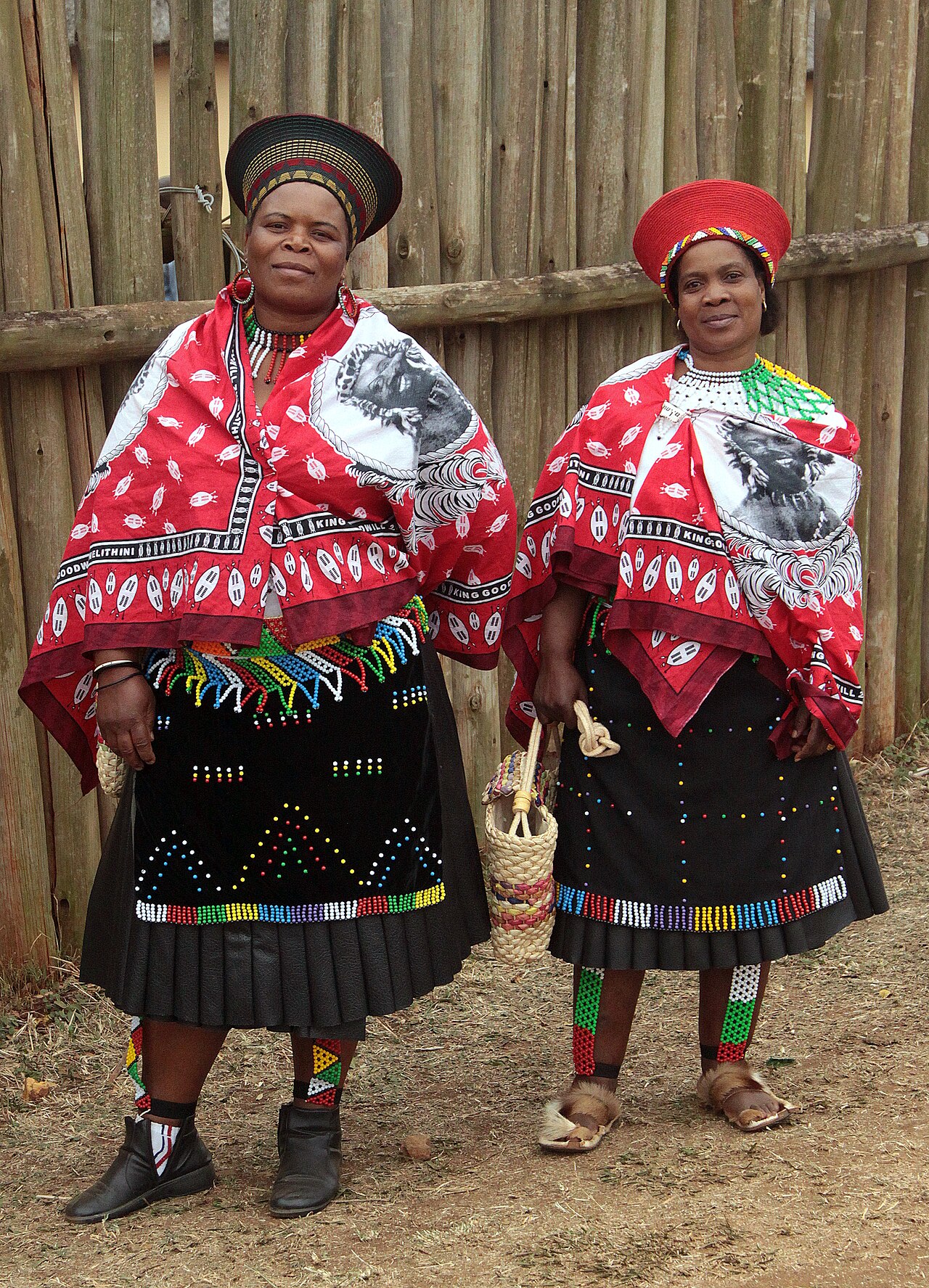
Regalia is a crucial part of the visual language. Participants wear izigege and izinculuba — short beaded skirts and aprons — often with a beaded belt and a small beaded loincloth. Many wear necklaces, anklets and headbands, and carry a small isihlangu (shield) or a knobkerrie in some years. The beadwork is not decorative fluff: specific colours and patterns can signal a family, a region, or a stage of life, and beadwork itself is a highly valued Zulu art form.
Many girls travel with a small bundle of belongings and a blanket or mat for sleeping. On the day of the main procession, they walk barefoot, often for several kilometres, carrying the reeds upright in their hands — a striking, disciplined formation that has become the ceremony’s signature image.
The Ceremony Step by Step: From Riverbank to Royal Palace
Umhlanga unfolds over several days, and the sequence matters. Understanding it reveals how much of the event is about order, respect and collective effort rather than spectacle.
Cutting the Reeds
Groups of girls travel to designated river areas with adult supervision. The reeds are cut carefully — usually the tall, straight stems — and trimmed. There is a practical element here: the girls learn which reeds are suitable, how to harvest without damaging the riverbank, and how to carry what they have cut. Songs accompany the work, and the walk to the river is itself part of the bonding experience.
The Procession
On the main day, participants form long columns and walk toward the royal palace, singing amahubo (traditional songs) and performing the indlamu, a powerful, stamping Zulu dance. The columns stretch for kilometres. Spectators line the route; families and community members cheer, take photographs and hand out water. The atmosphere is festive but disciplined, with marshals keeping order and health workers on standby.
The Presentation and Royal Address
At the palace, the girls present their reeds, which are gathered and later used in construction and repair work. The king then addresses the gathering. These speeches are significant: they are public statements about moral conduct, HIV prevention, education, respect for elders and the role of young women in society. In recent years, the Zulu monarch has used the platform to speak about gender-based violence, teenage pregnancy and the importance of schooling — themes that connect an ancient ritual to contemporary social challenges.
Dancing and Celebration
The dancing that follows is the ceremony’s most photographed element. Dancers move in coordinated lines, their feet striking the ground in unison, dust rising, voices layered in call-and-response. It is competitive in spirit, celebratory in tone, and deeply communal. For many participants, it is the moment they have rehearsed for weeks.
Key Facts About the Zulu Reed Dance at a Glance
The table below summarises the essentials for readers new to Umhlanga.
| Element | Detail |
|---|---|
| isiZulu name | Umhlanga (the reed) |
| Main location | eNyokeni Royal Palace, Nongoma, KwaZulu-Natal |
| Typical timing | Early-to-mid September, dates set annually by the royal household |
| Participants | Tens of thousands of young women, mostly aged 8 to early 20s |
| Central act | Cutting and presenting reeds to the king |
| Revived as mass event | 1984, under King Goodwill Zwelithini kaBhekuzulu |
Culture, Controversy and the Zulu Reed Dance Today
Umhlanga is not without debate, and a serious article should say so. Supporters describe it as a source of pride, discipline and cultural continuity — a rare space where young women are publicly honoured rather than sexualised, and where Zulu identity is affirmed on a grand scale. Many participants speak of confidence, sisterhood and a sense of belonging.
Critics raise several concerns. Some argue that the emphasis on virginity testing, which has occurred alongside the ceremony in some contexts, is invasive and can stigmatise girls who do not participate. Others point to the risk of pressure on young women to conform, and to the way the event can be packaged for tourists in ways that flatten its meaning. There are also practical worries: long walks in the heat, inadequate sanitation at times, and the risk of exploitation by adults.
It is important to avoid two lazy positions. The first treats Umhlanga as a timeless, unchanging relic. It is not: it has been revived, reorganised and re-framed repeatedly, and it now includes modern elements such as HIV awareness messaging, media coverage and even a degree of celebrity attendance. The second treats it as simply backward. That ignores the agency of the participants themselves, many of whom choose to take part and describe the experience as empowering.
“The reed is not heavy. What is heavy is the respect we carry with it.”
That sentiment, expressed by participants in various forms over the years, captures the duality at the heart of the ceremony: a physical object that is light, and a social meaning that is substantial.
The Monarchy, Politics and Modern South Africa
Umhlanga cannot be separated from the institution that hosts it. The Zulu monarchy is recognised under South African law, and the king — since 2022, King Misuzulu kaZwelithini — holds significant cultural authority, though not executive political power. The ceremony is one of the clearest moments when that authority is made visible.
Political figures have long attended Umhlanga, from provincial premiers to national leaders, and the event has occasionally become a stage for tensions within the royal family and between traditional and elected leadership. The death of King Goodwill Zwelithini in March 2021, during the COVID-19 pandemic, disrupted the ceremony; the subsequent succession dispute added further uncertainty. The return of a full-scale Umhlanga under King Misuzulu has been read by many as a sign of continuity and stability.
There is also an economic dimension. The ceremony brings visitors, media attention and spending to northern KwaZulu-Natal, and it supports local artisans who make beadwork, clothing and crafts. For a region with high unemployment, that matters. At the same time, the benefits are unevenly distributed, and some residents argue that the ceremony’s commercialisation should be managed carefully so that it does not overshadow its cultural purpose.
How to Experience Umhlanga Respectfully
If you are fortunate enough to attend, or to encounter coverage of the Zulu Reed Dance, a few principles will deepen your understanding and show respect.
- Ask before photographing individuals. The ceremony is public, but people are not exhibits. Follow the guidance of marshals and organisers.
- Dress and behave modestly. This is a cultural and, for many, spiritual occasion. Revealing clothing or loud, disruptive behaviour is inappropriate.
- Do not touch the reeds or participants. The procession is orderly; stay behind barriers and keep the route clear.
- Listen to the speeches. The king’s address and the songs carry the ceremony’s message. Treat them as the main event, not background.
- Support local businesses. Buy crafts from local makers, use local guides, and stay in the area where possible.
- Read beyond the photographs. Understand the history, the debates and the voices of participants before forming conclusions.
For South Africans and the diaspora, attending can be a powerful reconnection with heritage. For international visitors, it is an opportunity to see a living tradition rather than a staged performance — provided they come with humility.
Why Umhlanga Still Matters
The Zulu Reed Dance endures because it does several things at once. It honours young women in a society where they too often face violence and limited opportunity. It affirms Zulu identity in a country where colonial and apartheid systems worked hard to erase it. It transmits knowledge — songs, steps, beadwork, language, conduct — from one generation to the next. And it adapts, absorbing new concerns such as HIV prevention, education and gender-based violence while keeping its core ritual intact.
It is also a reminder that African traditions are not frozen in the past. They are argued over, reformed, revived and reinterpreted by the people who practise them. The girls who walk for kilometres with reeds in their hands are not performing a museum piece; they are making a statement about who they are and who they intend to become.
That is the real story of Umhlanga — not a single photograph, but a living institution, carried forward one reed at a time.