📅 Last updated: 13.09.2026
In the popular imagination, Mansa Musa is often reduced to a single, dazzling fact: he was the richest human being who ever lived. But the man who ruled the Mali Empire from roughly 1312 to 1337 was far more than a walking treasury. He was a statesman, a devout Muslim, a patron of scholarship and architecture, and the steward of a West African realm whose wealth, sophistication, and reach astonished the medieval world. To understand him properly is to see beyond the gold — into the politics, faith, and networks of trade that made his empire one of the great powers of its age.
- Who Was Mansa Musa? A King in a Land of Gold
- The Hajj of 1324: The Pilgrimage That Shook the World
- Mansa Musa and the Building of Timbuktu
- Key Facts: Mansa Musa at a Glance
- How Rich Was He, Really?
- A Complex Reign: Faith, Power, and the Limits of Empire
- The Legacy of Mansa Musa in Africa and the World
- Separating Fact from Legend
- The Richest Man, and the Richer Story
Who Was Mansa Musa? A King in a Land of Gold
Mansa is a Mandinka title meaning “king of kings” or “emperor,” and Musa I inherited it as the ruler of the Mali Empire, a vast state that at its height stretched across what is now Mali, Senegal, Gambia, Guinea, Mauritania, Niger, and parts of Nigeria. He belonged to the Keita dynasty, the ruling line that traced its legitimacy back to Sundiata Keita, the legendary founder who had defeated the Sosso kingdom at the Battle of Kirina around 1235 and forged Mali from a coalition of Mandinka chiefdoms.
Musa came to power after a period of instability. His predecessor, Abu Bakr II, is said to have abdicated to lead a great expedition across the Atlantic — a story that has fascinated historians and fueled endless speculation about pre-Columbian contact with the Americas. Whether or not that voyage ever reached the New World, the tale itself reveals something important: Mali was a maritime-curious power with ambitions that extended far beyond the Sahel. When Musa took the throne, likely in 1312, he inherited not just gold and armies but an imperial project still expanding.
His domain sat atop one of the richest mineral regions on Earth. The Bambuk and Bure goldfields, along the upper Senegal and Niger rivers, produced the metal that lubricated trade across the Sahara and the Mediterranean. Yet Mali’s rulers understood a crucial economic truth: gold was valuable partly because it was scarce. They controlled its flow carefully, and much of the trade was conducted in salt — mined at Taghaza in the Sahara and worth its weight in gold in the forest zones to the south, where it was essential for preserving food. This north–south exchange, gold for salt, was the engine of Mali’s prosperity.
The Hajj of 1324: The Pilgrimage That Shook the World
Mansa Musa’s fame rests above all on his hajj, the pilgrimage to Mecca that every able Muslim is expected to undertake at least once. In 1324, he set out with a caravan of staggering proportions. The Arabic historian al-Umari, writing from Cairo, recorded that the emperor traveled with a retinue numbering in the thousands, including soldiers, officials, scholars, and slaves, and that he carried an enormous quantity of gold — accounts speak of dozens of camel loads, though the exact figures vary wildly and were likely embellished by those who saw the spectacle.
What is not disputed is the effect. Passing through Cairo, the Mamluk capital of Egypt and the great hub of the medieval Islamic world, Musa and his entourage spent and donated gold so freely that they crashed the local market. The value of gold in Cairo reportedly fell by as much as ten to twelve percent and took years — by some accounts more than a decade — to recover. It is one of the earliest recorded examples of a single individual’s spending power destabilizing a major economy.
The chronicler Shihab al-Din al-Umari, who interviewed people who had met the emperor in Cairo, left a memorable description of Mali’s ruler. He described Mansa Musa as a man of “generous character” who was deeply devoted to his faith, and he noted the emperor’s dignified conduct and his serious commitment to Islamic learning and law. These are not the words of a fabulist. They come from a scholar writing within living memory of the events, and they remind us that Musa’s reputation in the Islamic world rested on piety and statesmanship, not merely on gold.
“This man spread upon Cairo the flood of his generosity: there was no person, officer of the court, or holder of any office of the Sultan who did not receive a sum of gold from him.”
— attributed to the account of Mansa Musa’s visit recorded by medieval Egyptian chroniclers
The pilgrimage was also a diplomatic masterstroke. By passing through Cairo and the holy cities of Arabia, Musa announced Mali’s existence to a wider world. He returned with scholars, jurists, and architects in tow, transforming his capital into a center of learning and connecting West Africa more tightly to the intellectual currents of the Islamic world.
Mansa Musa and the Building of Timbuktu
If the hajj made Musa famous, his building program made him consequential. Under his patronage, the city of Timbuktu — already a trading post on the Niger River where desert and savanna met — blossomed into a center of commerce and scholarship. He commissioned the construction of mosques and madrasas, and he is credited with ordering the building of the Djinguereber Mosque, a massive mud-brick structure that still stands today and remains one of the most important religious sites in Mali.
The emperor also brought back from his travels an architect named Abu Ishaq al-Saheli, a Andalusian poet and designer who introduced new techniques in mud-brick construction and helped shape the distinctive Sudano-Sahelian architectural style. The great mosques of the region — with their sloping, tapering walls and protruding wooden toron beams — owe much to this fusion of North African and West African traditions.
Scholars, Manuscripts, and the University of Sankore
Timbuktu’s rise as a scholarly capital is inseparable from Musa’s reign. The University of Sankore, associated with the Sankore Mosque, became a magnet for astronomers, mathematicians, jurists, and theologians. Scholars traveled from as far as Egypt, Morocco, and the Arabian Peninsula to study and teach there. The city’s libraries filled with manuscripts — treatises on astronomy, medicine, law, history, and poetry — many of them written in Arabic by Black African scholars and copied by skilled calligraphers.
These Timbuktu manuscripts, tens of thousands of which survive in family collections and archives, are among the most important documentary sources for West African history. They testify to a literate, cosmopolitan society that predated European colonialism by centuries and that produced original scholarship rather than merely importing it. When we talk about Africa’s contribution to world knowledge, Timbuktu is not a footnote — it is a chapter.
Key Facts: Mansa Musa at a Glance
| Detail | Information |
|---|---|
| Full title | Mansa Musa I, Emperor of Mali |
| Reign | c. 1312–1337 |
| Dynasty | Keita dynasty |
| Empire capital | Niani (on the upper Niger, in present-day Guinea/Mali) |
| Famous for | The 1324 hajj to Mecca; patronage of Timbuktu; gold wealth |
| Religion | Sunni Islam |
How Rich Was He, Really?
Modern headlines love to call Mansa Musa the richest person in history, with net worth estimates that would make a tech billionaire blush. One widely circulated figure puts his wealth at around $400 billion in today’s money. The honest answer is that we cannot know, and the numbers are educated guesses at best. But the difficulty of measuring his wealth is itself revealing.
Musa did not hold wealth in the modern sense — as liquid assets or a portfolio. His power lay in control of territory, trade routes, and the production of gold. He was, in effect, a sovereign whose realm sat on the world’s leading source of the most desired metal. In an era when gold was the foundation of monetary systems from Europe to China, controlling the supply gave him leverage that no individual today could replicate.
Consider the scale. The Mali Empire’s goldfields supplied a large share of the gold that circulated in the Mediterranean and Europe during the fourteenth century. When Musa traveled, he distributed gold as gifts and alms on a scale that distorted prices across three continents. The Venetian and Genoese merchants who traded in North Africa felt the ripples. In a very real sense, the emperor of Mali was a macroeconomic force.
- Control of supply: Mali dominated the Bambuk and Bure goldfields, the primary sources of West African gold.
- Trade leverage: Gold flowed north across the Sahara in exchange for salt, textiles, horses, and manufactured goods.
- Symbolic power: Lavish giving during the hajj demonstrated wealth that impressed even the wealthiest courts of the era.
- Durable investment: Musa spent on mosques, schools, and infrastructure, converting wealth into lasting institutions.
A Complex Reign: Faith, Power, and the Limits of Empire
It would be a mistake to romanticize Mansa Musa into a purely benevolent figure. He was an emperor who ruled through military power, tribute, and a hierarchical system that included slavery. His armies campaigned to expand and secure Mali’s borders, and his court was structured around the privileges of the ruling elite. Like all rulers of his time, he governed within the brutal realities of medieval statecraft.
His embrace of Islam also deserves nuance. Musa was a devout Muslim who built mosques and supported Islamic scholarship, yet Mali’s population remained largely animist, and the empire governed a religiously plural society. The famous account of his visit to Cairo includes a moment when he was criticized for allowing his people to practice customs that Islamic jurists found improper — a reminder that his rule balanced imperial tradition, local religion, and global Islamic norms. He was not a theocrat imposing uniformity; he was a pragmatic sovereign managing diversity.
Economically, his generosity during the hajj had a downside. The sheer volume of gold he released depressed its value in Egypt for years, and some historians argue that the episode contributed to a longer-term shift in the region’s monetary fortunes. Musa himself reportedly regretted the extent of his spending once he understood its effects. Even the richest man in history could miscalculate.
The Legacy of Mansa Musa in Africa and the World
Mansa Musa’s most enduring legacy is not his gold but the institutions he nourished. The intellectual culture of Timbuktu outlasted his reign and the Mali Empire itself. When Mali declined and the Songhai Empire rose to dominate the region in the fifteenth century, Timbuktu remained a beacon of learning, and its scholars continued to produce work of genuine intellectual importance.
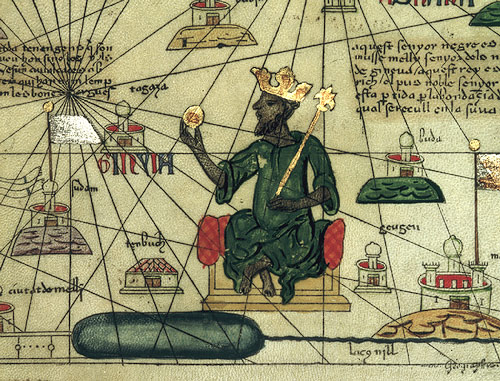
His influence also shaped how the wider world imagined Africa. The Catalan Atlas of 1375, produced in Spain, depicts a Black king seated on a throne holding a gold nugget, with the label “Musa Mali, Lord of the Negroes of Guinea.” For European mapmakers, Mali was so synonymous with gold that the emperor became the icon of the region’s wealth. That image circulated widely and helped cement the legend of West African riches — a legend that, tragically, would later help fuel European ambitions along the coast.
Within Africa, Musa is remembered as a builder and a unifier. The Djinguereber Mosque still stands in Timbuktu, a UNESCO World Heritage site and a testament to the era’s architectural ambition. The manuscripts of Timbuktu, painstakingly preserved through centuries of upheaval, are being digitized and studied by scholars around the world. And the griots of the Mandinka people still recite the epic of Sundiata and the deeds of the Keita kings, keeping the memory of Mali’s golden age alive in oral tradition.
Why He Still Matters Today
In a world that often tells a story of Africa as a continent of poverty and crisis, Mansa Musa is a necessary corrective. He reminds us that West Africa was home to sophisticated states, thriving cities, and globally connected intellectual networks centuries before European exploration reached its shores. The wealth of Mali was not a curiosity — it was central to the medieval world economy.
His story also speaks to the diaspora. For people of African descent around the world, Mansa Musa is a symbol of dignity, achievement, and sovereignty. He is a reminder that the history of Black excellence did not begin with struggle against colonialism; it stretches back to emperors who negotiated with the great powers of their day, funded universities, and commanded the respect of the Islamic world.
Separating Fact from Legend
The problem with a figure as famous as Mansa Musa is that legend tends to crowd out history. Popular accounts inflate his wealth, invent dramatic details, and sometimes present him as a singular superhero rather than the product of a complex society. It is worth being clear about what we actually know.
- Well documented: His reign dates, his 1324 hajj, his patronage of Timbuktu, and his Islamic devotion appear in multiple medieval sources.
- Reasonably attested: The scale of his caravan and the economic impact in Cairo are reported by contemporary and near-contemporary chroniclers, though with varying numbers.
- Uncertain: Exact net worth figures, the precise number of people in his entourage, and the fate of his predecessor’s Atlantic voyage.
- Legendary: Stories that present him as wealthier than any modern billionaire are rhetorical devices, not measurements.
None of this diminishes him. If anything, the documented record is more impressive than the myth, because it shows a ruler whose influence was real, institutional, and lasting. He did not merely possess gold; he used it to build a civilization.
The Richest Man, and the Richer Story
Mansa Musa deserves his place in the global imagination, but not only as a curiosity about gold. He was the head of a state that connected the forests of West Africa to the markets of the Mediterranean and the scholarship of the Islamic world. He turned wealth into mosques, libraries, and learning. He made Timbuktu a name that still resonates, and he left behind a documentary and architectural legacy that challenges lazy assumptions about Africa’s past.
When we call him the richest man in history, we should be careful. The phrase is catchy but imprecise. What we can say with confidence is that he was one of the most consequential rulers of the medieval world — a leader whose gold bought influence, whose faith built institutions, and whose story continues to inspire millions across Africa and its diaspora. The real treasure of Mansa Musa was never the metal in his caravans. It was the civilization he helped to build, and the proof it offers that Africa’s greatness is not a recent development but an ancient inheritance.