📅 Last updated: 25.08.2026
Perched on sheer cliff faces and hidden atop mesas in the far north of Ethiopia, the Tigray rock churches are not merely ancient relics but a living, breathing testament to faith, ingenuity, and the enduring spirit of a people. This remarkable cluster of over 120 monolithic and semi-monolithic sanctuaries, carved from the living rock of the Gheralta Mountains and its surrounding valleys, represents one of the most breathtaking, yet under-visited, architectural wonders on the continent. Unlike the more famous, sprawling complex at Lalibela to the south, the Tigray rock churches offer a raw, intimate, and vertiginous encounter with a thousand years of Orthodox Christian worship, a journey that requires not just a guide, but often a head for heights and a willingness to climb.
- The Geography of the Sacred: A Landscape of Stone and Sky
- Architectural Ingenuity: How the Tigray Rock Churches Were Built
- A Journey Through Time: Key Churches and Their Stories
- The Living Heritage: Culture, Faith, and Community in the Present
- Planning a Visit: The Practicalities of a Pilgrimage
- The Modern Context: Conservation and the Future of the Tigray Rock Churches
- The Enduring Spirit of the Cliffs
The Geography of the Sacred: A Landscape of Stone and Sky
To understand these churches, one must first understand the landscape that cradles them. The Tigray region, bordering Eritrea to the north and the Amhara region to the south, is a land of dramatic contrasts. This is not the lush, green highlands of the south; it is a harsh, arid, and breathtakingly beautiful terrain of jagged sandstone mountains, deep gorges, and vast plateaus. The Gheralta massif, the heartland of these churches, is a climber’s paradise and a devotee’s sanctuary, a maze of sheer vertical cliffs and precariously balanced boulders that have been sculpted by wind and rain over millennia.
It was within these natural fortresses that early Christian monks sought refuge, isolation, and a closer connection to the divine. Beginning as early as the 5th century, and reaching a golden age between the 10th and 15th centuries, these ascetics carved their places of worship directly into the rock face. The choice was both practical and spiritual. The cliffs provided natural protection from invaders and a physical manifestation of the spiritual ascent required of a believer. The rock itself, unadorned and raw, was seen as a pure material, a direct creation of God, making the churches carved from it more sacred than those built by human hands. The result is a unique symbiosis of geology and theology, where the architecture is not imposed upon the landscape but is an intrinsic, inseparable part of it.
Gheralta: The Crown Jewel of the Tigray Rock Churches
The Gheralta area is the most concentrated and accessible, though by no means easy, collection of these churches. Villages like Megab, with its dusty main road and simple lodges, serve as the base camp for explorations. From here, the silhouettes of the mountains rise like the spines of sleeping dinosaurs, each ridge holding a secret. The most famous, and arguably the most spectacularly situated, is Abuna Yemata Guh. The approach to this church is a rite of passage. After a short walk from the village, visitors are confronted with a sheer, polished rock face. The ascent involves a precarious scramble up natural handholds and footholds, followed by a nerve-wracking walk along a narrow ledge with a sheer drop of hundreds of meters.
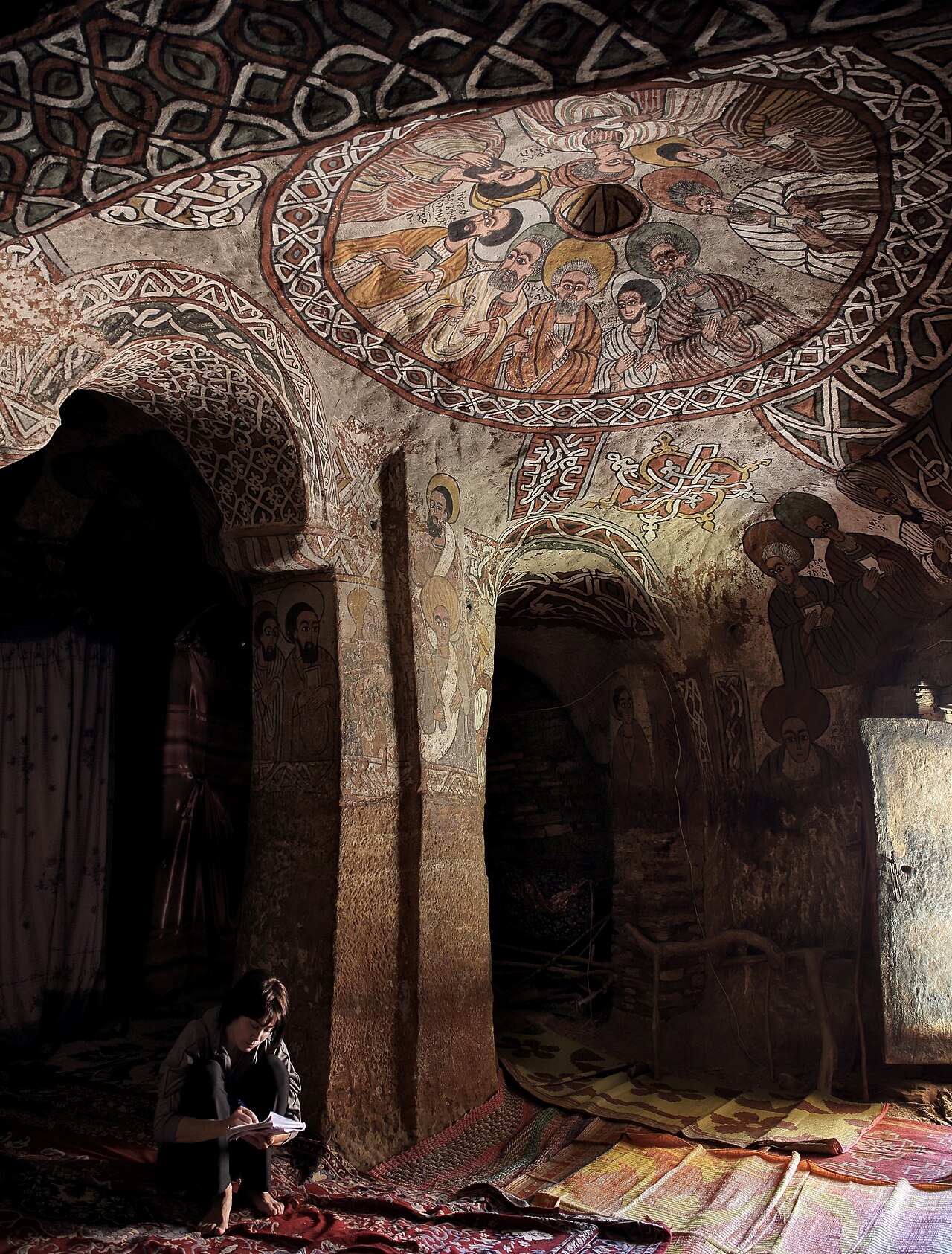
The reward for this terrifying climb is an intimate, cave-like chapel whose interior is covered in some of the oldest and best-preserved murals in Ethiopia. Dating from the 15th century, the frescoes depict the nine saints of the Ethiopian Orthodox Church, the Virgin Mary with the Christ Child, and the twelve apostles with startling vibrancy. The colors—deep ochres, brilliant blues, and rich reds—remain luminous, a testament to the skill of the artists and the dry, stable climate of the cave. Standing inside, the wind whistling outside the small opening, one feels a profound sense of peace and awe. It is a moment of connection not just to history, but to the sheer audacity of human faith.
Architectural Ingenuity: How the Tigray Rock Churches Were Built
The construction of these churches was a monumental feat of engineering and patience. They were not built, but excavated, from the top down. Builders, likely a combination of skilled masons and monks, began by clearing a platform on the cliff face or the summit of a mesa. Using simple tools—iron chisels, hammers, and picks—they then began to carve a trench around the desired footprint of the church, creating a free-standing block of rock. From this block, they painstakingly hollowed out the interior, carving out the nave, the sanctuary, the dome, and the pillars.
This process is known as monolithic (when the entire church is carved from a single piece of rock, like at Lalibela) or semi-monolithic (when it is carved from a rock face, with only the front and interior fully exposed, as is common in Tigray). The work was incredibly dangerous and slow, requiring generations to complete. The builders had to have an intimate knowledge of the rock’s geology, working with its natural fissures and strata to avoid catastrophic collapse. The final touches were the intricate carvings on the interior walls, the arches, and the distinctive Aksumite-style windows, which are often shaped like crosses or geometric patterns. These windows not only let in light but also create a stunning play of light and shadow inside the dark interiors, highlighting the carvings and paintings.
| Feature | Lalibela (Amhara) | Tigray Rock Churches |
|---|---|---|
| Construction Type | Primarily Monolithic (fully detached from rock) | Primarily Semi-Monolithic (carved into cliff face) |
| Setting | Lowland town, purpose-built complex | Remote, isolated cliff faces and mountain summits |
| Approximate Number | 11 major churches in a central complex | Over 120 scattered across a vast region |
| Accessibility | Relatively easy, on flat ground | Often requires strenuous climbing and hiking |
| Primary Period | 12th-13th Century | 5th to 15th Century (with many from the 10th-15th) |
This table highlights the fundamental differences between the two most famous rock-hewn church sites in Ethiopia. While Lalibela is a showcase of royal ambition and centralized power, the Tigray churches are a testament to decentralized monasticism and the search for solitude. The experience of visiting each is profoundly different: Lalibela is a grand, theatrical pilgrimage site, while Tigray is an adventure into the wilderness of faith.
A Journey Through Time: Key Churches and Their Stories
Beyond Abuna Yemata Guh, the Tigray region is a treasure trove of unique churches, each with its own character and history. A journey through them is a journey through the very timeline of Ethiopian Christianity.
- Debre Damo: Perhaps the most legendary and inaccessible of all. Perched atop a flat-topped mountain with sheer cliffs on all sides, it is reached only by climbing a 15-meter rope, traditionally lowered by a monk from above. This 6th-century monastery is the oldest standing church in Ethiopia and is said to house a library of ancient manuscripts. Its isolation has preserved a unique and ancient form of monastic life, and it is famously closed to women, a tradition that has been upheld for over 1,500 years.
- Maryam Korkor: This church offers one of the most spectacular views in the region. Carved high into a cliff face, its entrance is a small doorway that opens onto a vast panorama of the Gheralta plains. Inside, it is a complex structure with multiple rooms and a domed sanctuary, adorned with 18th-century murals that are remarkably well-preserved. It represents a later, more developed phase of rock church architecture.
- Teka Tesfay: This church is a true hidden gem. It is tucked away in a narrow canyon and requires a final, slightly intimidating climb up a rock chimney. Its interior is surprisingly large and airy, with a high vaulted ceiling and a beautiful 15th-century painting of the Virgin Mary. The name, meaning “My Hope is the Lord,” speaks to the profound spirituality of the place.
- Yohannes Maequddi: Located near the town of Wukro, this church is famed for its stunningly detailed and colorful 15th-century frescoes that cover almost every inch of its interior walls and dome. The paintings depict scenes from the Old and New Testaments, as well as the life of Saint John the Baptist, to whom the church is dedicated. The artistry is breathtaking, showing Byzantine, Coptic, and indigenous Aksumite influences.
These churches are not static museums. They are active places of worship, where priests in flowing white robes and turbans still chant the ancient liturgy in Ge’ez, the liturgical language of Ethiopia. Visitors are often welcomed with a warmth and curiosity that is humbling. On the feast days of the saints to whom the churches are dedicated, the cliffs come alive with pilgrims, dressed in their finest white shammas, climbing the same paths their ancestors have climbed for centuries. The sound of drums, the chanting of prayers, and the burning of frankincense create an atmosphere that is both ancient and profoundly alive.
The Living Heritage: Culture, Faith, and Community in the Present
The Tigray rock churches are far more than just tourist attractions; they are the beating heart of the local communities. They serve as centers for religious festivals, education, and community gathering. The priests and deacons are not just spiritual leaders but also the custodians of a vast cultural heritage, preserving ancient manuscripts, processional crosses, and ceremonial robes that have been passed down through generations. Many of these treasures, including beautifully illuminated gospels written in Ge’ez, are kept within the churches and are only brought out for special ceremonies.
However, this heritage is under immense pressure. The recent conflict in Tigray, which began in November 2020 and lasted for two years, has had a devastating impact on the region. The churches, while not deliberately targeted, have suffered from the general chaos, looting, and displacement. Many priests and their communities were forced to flee, and the fate of some remote churches and their treasures remains uncertain. The economic impact has also been severe, with the near-total collapse of tourism, which was a vital source of income for local guides, mule handlers, and lodge owners.
Despite these immense challenges, there is a remarkable resilience. Communities are returning, and priests have begun the slow process of assessing damage and restoring their sanctuaries. The local guides, who possess an encyclopedic knowledge of the mountains and their secrets, are again leading visitors, their passion for their heritage undimmed. The restoration and preservation of these churches is not just a matter of preserving stone and paint; it is about preserving the identity, memory, and spiritual life of an entire people. The re-opening of the region to visitors is a crucial step in this recovery, providing both economic sustenance and a global audience to witness and appreciate the enduring value of their heritage.
Planning a Visit: The Practicalities of a Pilgrimage
For the modern traveler, visiting the Tigray rock churches is an adventure that requires planning and a spirit of flexibility. The region is best visited from October to February, when the weather is dry and cool. During the rainy season, from June to September, the rock faces become dangerously slippery and many roads are impassable.
Getting there is an adventure in itself. The main gateway is the city of Mekelle, which has an airport with flights from Addis Ababa. From Mekelle, it is a drive of about two hours to the town of Megab, the most common base for exploring the Gheralta churches. While there are a few comfortable lodges with stunning views, they are basic. This is not the place for luxury tourism; it is a place for immersive, authentic experience.
As a local guide in Megab once said, “We do not show these churches to visitors; we share them with our guests.” This philosophy encapsulates the Tigrayan approach to their heritage—one of profound generosity and a desire for connection, not transaction.
Here are some essential tips for your visit:
- Hire a Local Guide: This is non-negotiable. Not only are they essential for navigating the complex trails and rock climbs, but they are also invaluable sources of historical and cultural context. They know which priests are available, which churches are open, and the safest routes.
- Wear Appropriate Footwear: A sturdy pair of hiking boots with excellent grip is essential. The rock scrambles are challenging, and sandals or trainers will not suffice. For Abuna Yemata Guh, you may even be offered climbing shoes by locals for a small fee, which is highly recommended.
- Dress Respectfully: As these are active places of worship, it is important to dress modestly. Long trousers or skirts and tops that cover the shoulders are required. You will also be asked to remove your shoes before entering the churches.
- Bring a Flashlight: The interiors of the churches are very dark. A headlamp or a small flashlight is essential for appreciating the murals and carvings.
- Be Prepared for a Physical Challenge: This is not a passive sightseeing tour. It involves real hiking and climbing. A reasonable level of fitness is required to fully enjoy and appreciate the experience.
The effort, however, is repaid a thousandfold. To stand on a ledge that has been worn smooth by the feet of pilgrims for a millennium, to touch the cool, carved rock of a sanctuary, and to look out over a landscape that has remained virtually unchanged for centuries is to experience a profound sense of wonder. It is a journey that challenges the body and enriches the soul, offering a perspective on Africa that is both ancient and deeply relevant to our modern search for meaning and connection.
The Modern Context: Conservation and the Future of the Tigray Rock Churches
The future of the Tigray rock churches is inextricably linked to the peace and stability of the region. The conflict has highlighted the fragility of these ancient sites and the vulnerability of the communities that protect them. International organizations, such as UNESCO, have listed many of these churches as tentative World Heritage Sites, and there are ongoing efforts to document and preserve them. However, conservation is a complex issue. The very remoteness that has preserved them for so long also makes them difficult to protect and maintain.
There is also a delicate balance to be struck between preservation and accessibility. Increased tourism brings much-needed revenue, but it also brings wear and tear. The fragile murals are particularly susceptible to damage from increased humidity, dust, and touching. Sustainable tourism, managed by the local communities, is the most viable path forward. This involves training more guides, investing in basic infrastructure, and creating a system where the revenue from tourism directly benefits the preservation of the churches and the well-being of the local people.
Furthermore, the role of the Ethiopian Orthodox Church is paramount. They are the ultimate custodians, and their traditions and rituals are as much a part of the heritage as the stone walls themselves. Any conservation effort must be done in close partnership with the church, respecting its traditions and authority. The future of these churches depends on a collaborative approach, one that brings together the local communities, the church, the government, and the international community in a shared commitment to safeguarding this unique and irreplaceable treasure for generations to come.
The Enduring Spirit of the Cliffs
The rock-hewn churches of Tigray are more than just an extraordinary example of human architectural achievement; they are a profound symbol of resilience, faith, and the unbreakable bond between a people and their land. They are a living library of art, history, and theology, carved not from ambition but from devotion. In a world increasingly defined by the fleeting and the virtual, these sanctuaries of stone offer a grounding and transcendent experience. They remind us that the greatest human creations are often those that are most intimately connected to the earth, and that the most profound journeys are those that require not just physical effort, but a willingness to look inward. To climb those cliffs and stand within those ancient walls is to witness the enduring power of belief and to understand that some marvels are not just seen, but truly felt, leaving an indelible mark on the soul of every traveler fortunate enough to make the ascent.