📅 Last updated: 25.08.2026
The Afar salt caravans are one of the last living links to a mercantile world that predates the written word, a stark and brutal tradition that has outlived empires, colonialism, and the arrival of the jet engine. For centuries, caravans of camels and donkeys have descended into the otherworldly crucible of the Danakil Depression—a searing, sub-sea-level furnace straddling northeastern Ethiopia and Eritrea—to quarry vast slabs of white crystal from the ancient lakebed of Lake Asale. This is not a tourist re-enactment or a heritage display; it is a grueling, dangerous, and surprisingly modern economic enterprise, one that continues to supply salt to millions of people across the Horn of Africa even as the world around it transforms at a dizzying pace.
- The Geology of a Mirage: Why the Salt Is Here
- The Caravan Route: From Lake Asale to the Highlands
- The Economics of a Pre-Modern Trade
- The People of the Salt: Life in Berhale
- Rituals and Resilience: The Cultural Weight of Salt
- Challenges on the Horizon: Climate, Conflict, and Change
- Seeing the Caravans Today: A Traveler's Perspective
- Selling a Story: The Caravans in the Modern Imagination
- The Future of an Ancient Road
- Legacy in the Dust
The Geology of a Mirage: Why the Salt Is Here
To understand the caravans, you must first understand the land they cross. The Danakil Depression is one of the most extreme environments on Earth. Its hottest inhabited settlement, Dallol, regularly records average temperatures above 34°C (93°F), and ground temperatures can exceed 60°C (140°F). It sits as low as 125 meters (410 feet) below sea level, a vast, cracked plain of sulfur springs, acid pools, and salt flats that looks less like a landscape than a wound in the planet’s crust.
The salt itself is a relic of geological time. Millions of years ago, the Red Sea repeatedly flooded this rift valley, only to retreat and evaporate. Each cycle left behind a thick layer of halite (sodium chloride). The result is a deposit up to 2,000 meters (6,500 feet) deep in places—a mineral fortune that has been exposed and concentrated by the relentless, arid heat. For the Afar people, who have inhabited this harsh region for millennia, this white expanse was never a barren waste but a treasure house. The salt, known locally as teso, became a form of currency itself, traded for grain, coffee, and livestock in the highlands of the Ethiopian Plateau.
The quarrying process is medieval in its simplicity but punishing in its execution. Men, often working in teams of two or three, use iron pry bars and mallets to cut the salt crust into rectangular blocks. The work is done in the coolest hours of the early morning, but even then, it is a race against the sun. Each block, known as an amole, is a standardized size—roughly 40 centimeters long, 15 wide, and 8 thick—and weighs around 4 to 5 kilograms (9 to 11 pounds). In centuries past, the amole was a recognized unit of currency in Ethiopia, with a fixed exchange rate against gold and Maria Theresa thalers, the Austrian silver coins that circulated widely in the Red Sea trade.
The Caravan Route: From Lake Asale to the Highlands
The journey begins at the two primary quarries: Lake Asale near the town of Berhale, and the vast salt plain of Lake Karum (also known as Lake Afrera) further south. From these points, the caravans strike out toward the escarpment town of Berhale, a historic trading post that serves as the nerve center of the salt trade. It is a brutal commute. The route crosses 20 to 30 kilometers (12 to 18 miles) of flat, blinding salt pan before climbing into the volcanic foothills of the Great Rift Valley.
Here, the real danger begins. The paths wind through narrow canyons and over sharp volcanic scree, where a single misstep can break a camel’s leg. The ascent from the depression floor to the Ethiopian highlands is a rise of over 2,000 meters (6,500 feet) in a matter of hours. The air thins, the temperature drops dramatically, and the landscape shifts from lunar desolation to thorny acacia scrub, then to green, terraced fields.
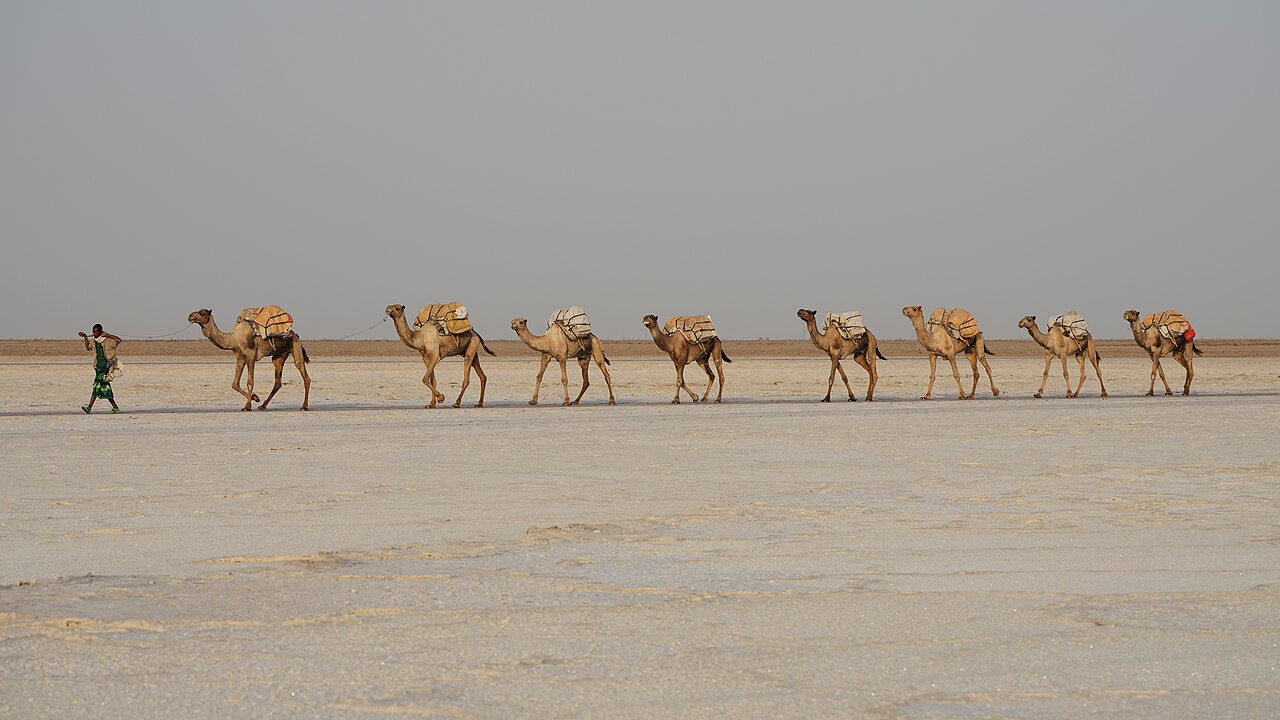
The caravans are not solitary affairs. A typical caravan, or galla, can include anywhere from 200 to 1,000 camels, led by Afar camel handlers known as geblo. These men are not anonymous laborers; they are highly skilled navigators and animal doctors, often from families that have worked the route for generations. They know every water hole, every shadowed rest stop, and every potential flash-flood gorge. Their knowledge is a living archive, passed down orally, containing the coordinates of survival in a land that offers no second chances.
The Camel: The Unsung Hero
No account of the Afar salt caravans is complete without acknowledging the true protagonists: the dromedaries. These are not the sleek racing camels of the Arabian Peninsula but the hardy, single-humped beast of burden of the Horn. They are famously stubborn, but their endurance is legendary. A healthy camel can carry up to 12 to 15 salt blocks—roughly 60 to 75 kilograms (130 to 165 pounds)—for eight to ten hours a day in searing heat.
The camels are treated with a mix of hard pragmatism and deep affection. Their handlers know each animal by name and personality. The camels are loaded with a complex system of ropes and wooden frames that distribute the weight evenly across their humps and ribs. In Berhale, you can see the caravan masters carefully checking the animals’ feet for cracks, applying a paste of tar and animal fat to protect them from the sharp lava rocks. This is not cruelty; it is economics. A dead camel is a ruined investment. The relationship is symbiotic, a partnership forged over thousands of years in the fire of necessity.
The Economics of a Pre-Modern Trade
It is tempting to view the Afar salt caravans as a relic, a romantic holdout against globalization. But that would be a profound misreading. The trade is a sophisticated, multi-tiered economic engine that moves millions of dollars’ worth of commodity annually. The salt is not a niche product for exotic markets; it is an essential staple for rural communities across Ethiopia, used for cooking, curing hides, and preserving dairy products.
The supply chain is surprisingly complex. At the quarry, diggers are paid per block. The camel owners (who are often different from the diggers) charge a transport fee per block to the wholesalers in Berhale. From Berhale, the salt is loaded onto trucks for the final leg to Mekelle, the capital of the Tigray region, and from there, it is distributed to the vast network of highland markets. The entire process is a cash-based, informal economy that operates on trust, credit, and deep-seated clan relationships.
Yet, the economics are shifting. The price of salt in the highlands has remained remarkably low—a testament to the efficiency of the caravans—but the cost of feeding camels has risen. Droughts, which have become more frequent and severe due to climate change, have decimated grazing lands. A growing number of Afar traders are abandoning camels for trucks, which can make the journey from Berhale to Mekelle in a few hours instead of a week. However, this is not a simple replacement. The roads are often poor, and during the rainy season, they become impassable, leaving the camels as the only reliable option. The caravans, it seems, are not dying; they are adapting, operating in a hybrid world of hoof and horsepower.
To put the scale in perspective, consider the following data from recent trade assessments in the Tigray and Afar regions:
| Aspect | Traditional Camel Caravan | Modern Truck Transport |
|---|---|---|
| Average Load | 10-12 blocks per camel | Up to 10,000 blocks per truck |
| Travel Time (Berhale to Mekelle) | 5-7 days | 8-12 hours |
| Primary Cost | Animal feed and labor | Fuel and vehicle maintenance |
| Reliability in Rainy Season | High | Low (roads wash out) |
| Employment Impact | High (supports hundreds of handlers) | Low (requires few workers) |
This table illustrates the central tension of the trade: efficiency versus resilience. The trucks are faster and cheaper when the roads are good, but they are brittle. The caravans are slow and expensive, but they are unbreakable. In a region defined by volatility, that resilience has kept the old ways alive.
The People of the Salt: Life in Berhale
Berhale is the beating heart of the salt trade. It is a dusty, sprawling town of roughly 30,000 people, a frontier settlement where the paved road ends and the desert begins. Here, the air is thick with the smell of camel dung, diesel smoke, and the metallic tang of salt dust. The town’s main square is a chaotic symphony of commerce: traders shouting prices in Afar and Amharic, camels groaning under their loads, and children weaving through the legs of the beasts, selling tea and roasted barley.
The salt trade dictates the rhythm of life in Berhale. The market, held every day but peaking on the weekly market day (usually Thursday), is a sight to behold. Piles of white blocks, stacked like bricks, line the streets. Buyers—mostly highland merchants—walk the rows, tapping the blocks with their fingers to test for density and purity. They are looking for the “diamond” grade, the purest, most crystalline salt from the deepest layers of the lake.
But Berhale is more than just a market. It is a cultural crossroads. The Afar people who live here are predominantly Muslim, and their social structure is built on a complex system of clans and age-sets. The geblo are not just workers; they are respected members of the community, often serving as mediators in disputes and advisors to clan elders. Their profession is a source of pride, a marker of masculine endurance. Young men aspire to become geblo; it is a rite of passage that proves their courage and their ability to navigate the harsh world of the desert.
However, the town is also modernizing. Solar panels are sprouting on tin roofs. Mobile phones are ubiquitous, with handlers using them to call ahead to check on water availability or to negotiate prices with wholesalers before they even arrive. A new generation of Afar youth is getting an education, and some are questioning whether they want to inherit the grueling life of the caravan. This is not a static, frozen culture; it is a dynamic society grappling with the same pressures of globalization and opportunity as any other community on the continent.
Rituals and Resilience: The Cultural Weight of Salt
Salt is not just a commodity in the Afar world; it is woven into the fabric of social and spiritual life. In many Afar traditions, salt is a symbol of purity and permanence. It is used in marriage ceremonies, where a block of salt is often presented as part of the bride price, a gift that signifies the solidity and endurance of the union. It is also used in peace-making rituals, where elders will share a piece of salt as a sign of reconciliation.
The amole blocks themselves have a symbolic weight. They are a tangible link to the past, a physical object that has remained unchanged in its form and function for centuries. When a caravan departs Berhale, the entire community often turns out to see it off. There are prayers said by the local imam for a safe journey. The handlers wear their finest clothes—brightly colored cotton wraps and curved daggers, called jile—a visual reminder that this is not just a work trip but a significant social event.
“The salt is our life, but it is also our honor,” says Haji Mohammed, a 60-year-old caravan master who has made the journey over 500 times. “When you carry the salt, you are carrying the history of your grandfathers. You are proving that you are a man of the desert, that you can endure what others cannot. The money is good, but it is not the only reason we go.”
This sense of honor is critical to understanding the caravan’s persistence. The Afar are a proud, fiercely independent people with a reputation for resistance. They have never been fully conquered, and their relationship with the central Ethiopian state has often been tense. The salt caravans are a symbol of that independence—an economic activity that they control entirely, from the quarry to the market. It is a form of sovereignty in a world that often seeks to marginalize them.
Challenges on the Horizon: Climate, Conflict, and Change
The future of the Afar salt caravans is not guaranteed. The region is caught in a pincer movement of environmental and political pressures. The most immediate threat is climate change. The Danakil Depression is getting hotter. Rainfall is becoming even more unpredictable, leading to prolonged droughts that kill the grazing grass the camels depend on. In 2021 and 2022, a severe drought in the Horn of Africa killed an estimated 30% of the livestock in some Afar districts, and the caravans were severely curtailed. Many camel owners were forced to sell their animals for meat, destroying their livelihoods.
There is also the specter of conflict. The northern Ethiopian conflict, which raged from 2020 to 2022, hit the Afar region hard. The Tigray People’s Liberation Front (TPLF) forces, retreating from Mekelle, pushed into Afar territory, disrupting the trade routes and looting salt stores. The war shattered the delicate economic ecosystem of the region. Even with the peace agreement signed in November 2022, the scars remain. Many caravans are only now returning to the full route, and the trust between highland buyers and Afar sellers has been damaged.
Finally, there is the inexorable march of technology and industry. The Ethiopian government has invested heavily in modern salt extraction plants, particularly in the Afar region, using massive pumps and evaporation pools to harvest salt on an industrial scale. These operations produce a finer, cleaner salt that is cheaper for large food processors. The traditional salt blocks, with their gritty texture and occasional impurities, are being pushed to the margins of the market. For now, they remain dominant in the rural highlands, where the preference for the traditional block is strong, but the pressure is mounting.
The Environmental Cost
There is also a growing environmental concern. The quarrying at Lake Asale is not a sustainable practice. The salt crust is being extracted faster than it is naturally replenished by the briny groundwater that seeps into the depression. Geologists have noted that the quarry pits are getting deeper and the salt layer thinner. While the resource is vast, it is not infinite. The Afar community is aware of this, and there are discussions about introducing quotas and more sustainable mining techniques, but these are difficult to enforce in a region where the state has limited presence and the local economy is entirely dependent on the extraction.
Seeing the Caravans Today: A Traveler’s Perspective
For the intrepid traveler, witnessing the Afar salt caravans is a profound, life-altering experience. It is not easy to get there. Visitors require a permit from the Ethiopian government, and it is strongly advised to travel with a reputable tour operator and an armed escort, as the border region with Eritrea is volatile. The journey from Mekelle to Berhale takes a full day on a rough, unpaved road that winds through the mountains before plunging into the depression.
But for those who make the trip, the reward is immense. There is nothing quite like watching a caravan emerge from the heat haze, a string of hundreds of camels moving in eerie silence, their bells clanking a slow, hypnotic rhythm. The stark beauty of the landscape—the blinding white of the salt flats against the ochre and black of the volcanic hills—is visually stunning. It is a landscape that forces you to confront the limits of human endurance.
Travelers should be aware of a few practical points to ensure a respectful visit:
- Hire a local guide: Do not attempt to navigate the Danakil alone. The terrain is lethal without local knowledge.
- Respect local customs: The Afar are a conservative, Muslim community. Dress modestly, covering shoulders and knees. Ask permission before taking photographs, especially of women.
- Be prepared for the heat: Carry at least 4 liters of water per person per day. The combination of heat and dehydration can be fatal.
- Negotiate fairly: When buying salt as a souvenir, expect to pay a premium, but do not haggle aggressively. This is their livelihood, not a tourist trap.
Seeing the caravans is not a passive act of observation; it is a participation in a living economy. The money spent on fuel, guides, and accommodation directly supports the communities that keep this tradition alive.
Selling a Story: The Caravans in the Modern Imagination
The Afar salt caravans have long captured the imagination of photographers and documentarians. The images are iconic: the stark geometry of the white blocks, the weathered faces of the handlers, the vast emptiness of the desert. They have appeared in National Geographic, the BBC, and countless coffee-table books. This global attention is a double-edged sword. On one hand, it brings a degree of prestige and economic opportunity to the region. On the other, it risks turning a deeply meaningful cultural practice into a spectacle, a “zoo” of human endurance for the entertainment of outsiders.
The key is to tell the story with nuance. The caravans are not a tragedy or a triumph; they are a complex reality. They represent hardship, but also pride. They are a glimpse into the past, but they are also a vital part of the present. The men who lead these caravans are not victims of poverty or heroes of a bygone age; they are entrepreneurs, making calculated decisions in a difficult environment. They are as modern as any stockbroker, even if their tools are older.
The media coverage has also spurred a local film industry. The Ethiopian film Difret touched on themes of rural life, but more directly, the acclaimed documentary Salt of the Earth (2006) brought the caravans to the attention of a global audience. Since then, several Afar filmmakers have begun documenting their own culture, providing an insider perspective that challenges the often-exoticizing gaze of Western media. This is the future: not a passive heritage to be preserved, but a living culture that is telling its own story.
The Future of an Ancient Road
What will happen to the Afar salt caravans in the next fifty years? The most likely scenario is a continued, gradual decline in their dominance, but not their disappearance. The caravans will continue to serve the niche markets in the highlands where road access is poor and where the traditional, unrefined salt is preferred for its taste and preservative qualities. The number of camels will likely shrink, but the practice will not vanish entirely. It will become what it always has been: a specialized, resilient trade that adapts to the conditions of its environment.
The more profound shift may be cultural. As the Afar become more integrated into the Ethiopian state, as education spreads, and as the youth migrate to cities like Mekelle and Addis Ababa, the social prestige of being a geblo may diminish. The caravans may become the domain of a smaller, more dedicated group of traditionalists. This is not necessarily a loss. The Afar are not a frozen people; they are a dynamic society that has survived by adapting. The salt trade has been their anchor, but it will not be their shackle.
Legacy in the Dust
The salt roads of the Afar are more than a logistical route; they are a thread that connects the deep geological past of the planet to the complex social fabric of modern Ethiopia. They are a testament to the ingenuity of a people who turned a seemingly barren wasteland into a source of wealth and identity. They are a reminder that “progress” is not always a straight line from the camel to the truck, but a complex negotiation between the two. As the world speeds up, the slow, deliberate pace of the caravan offers a powerful counter-narrative—a lesson in endurance, patience, and the unbreakable bond between a people, their animals, and their land. The dust they kick up may be ancient, but the story they tell is one that is still being written.