📅 Last updated: 22.08.2026
The kente cloth history of Ghana is a story woven in silk and cotton, in regal gold and deep indigo, a narrative that begins not in a museum display case but in the skilled hands of master weavers in the ancient Ashanti Kingdom. To behold a length of authentic kente is to witness a vibrant, living chronicle of a people — a visual language of proverbs, power, and prestige that has dressed kings, inspired liberation movements, and now adorns the shoulders of the global elite. More than just a textile, it is a profound symbol of African identity, a masterpiece of engineering and artistry that has survived centuries, adapting and thriving while never losing the thread of its royal origins.
- The Legendary Origins: A Spider's Web and a King's Vision
- Decoding the Weave: The Symbolism of Kente Cloth History
- The Heart of the Loom: A Master Weaver's Craft in Bonwire
- Kente's Global Journey: From Ashanti Royalty to the World Stage
- Kente in the 21st Century: Modernity, Fashion, and Global Commerce
- Preserving the Thread: Challenges and the Future of Kente
- A Woven Legacy: The Enduring Power of Kente
The Legendary Origins: A Spider’s Web and a King’s Vision
The precise beginnings of the kente cloth history are shrouded in the mists of oral tradition, but the most enduring and beloved legend places its birth in the 17th century, in the town of Bonwire, a weaving village still renowned today. As the story goes, two brothers, Kurugu and Ameyaw, ventured into the forest one afternoon and stumbled upon a remarkable sight: a giant spider, known as Ananse, meticulously weaving an intricate web. The web’s complex, interlacing patterns shimmered with dew, catching the sunlight in a way that seemed almost magical. Fascinated, the brothers studied the spider’s technique for hours, memorizing the rhythm of its movements and the structure of its design.
Returning to their village, they attempted to replicate the web’s intricate lattice using fibers from the raffia palm. Their early efforts were crude, but they persevered, refining their technique on a rudimentary loom. The result was a narrow, rough strip of woven fabric. Recognizing the beauty and potential of their creation, they presented it to their king, the Asantehene (the king of the Ashanti Empire). The king was profoundly impressed. He saw not just a piece of cloth, but a powerful emblem of his kingdom’s ingenuity and divine favor. He adopted the fabric as his own royal garb, and the craft was quickly established in Bonwire, which became the official weaving center for the Ashanti court. The name “kente” itself is derived from the Ashanti word kenten, meaning “basket,” a nod to the basket-like, interwoven texture of the cloth.
From Raffia to Royal Silk: The Evolution of Materials
The earliest kente was woven from local materials, primarily raffia and wild silk. However, the cloth’s destiny changed irrevocably with the arrival of European traders on the Gold Coast in the 18th century. The Ashanti, a powerful and militaristic empire, engaged in lucrative trade, exchanging gold and enslaved people for a variety of goods. Among these were luxurious Italian and French silks, which the Ashanti weavers would meticulously unravel to obtain the fine, lustrous threads. These imported threads, known as silk, were far more vibrant and durable than raffia, allowing for a more brilliant color palette and finer, more intricate patterns. This infusion of foreign material was not a dilution of tradition but an elevation of it, a testament to the Ashanti kingdom’s global connections and its ability to absorb and transform external influences into a uniquely powerful form of cultural expression. The silk, coupled with locally spun cotton, became the gold standard for royal kente, a fabric fit for a divine king.
Decoding the Weave: The Symbolism of Kente Cloth History
To truly appreciate the kente cloth history, one must learn to read its visual grammar. Kente is not merely decorative; every pattern, color, and motif carries profound philosophical, historical, and spiritual meaning. The cloth is a repository of Ashanti wisdom, encoding proverbs, historical events, and social values into a wearable form. The weaver is not just an artisan but a scholar and a storyteller, using threads to transcribe the collective memory of his people.
Each kente design is known by a specific name, often referencing a proverb or an important concept. For instance, the pattern Sika Futuro (“gold dust”) reflects the Ashanti obsession with gold, a symbol of wealth, royal power, and spiritual purity. Adweneasa (“my skill is exhausted”) is a particularly intricate design that represents the pinnacle of weaving mastery and the limitless potential of human creativity. Another famous pattern, Eban (“fence”), symbolizes safety, security, and the sanctity of the home. Wearing a particular pattern is a deliberate act of communication, allowing the wearer to express their values, aspirations, or social standing without uttering a single word.
| Kente Pattern Name | Literal Meaning | Symbolic Significance |
|---|---|---|
| Sika Futuro | Gold dust | Wealth, royal power, spiritual purity, and prosperity. |
| Adweneasa | My skill is exhausted | Creativity, perfection, the pinnacle of artistic achievement. |
| Eban | Fence | Safety, security, protection of the home and family. |
| Fathia Fata Nkrumah | Fathia is worthy of Nkrumah | A modern pattern celebrating the marriage of Ghana’s first president, Kwame Nkrumah, to the Egyptian Fathia Rizk. |
| Obaakofoo Mmu Man | One person does not rule a nation | Democracy, communal effort, and the importance of unity in leadership. |
The colors themselves are equally significant. Gold represents royalty, wealth, and spiritual purity. Green signifies growth, renewal, and the fertility of the land. Blue embodies peace, harmony, and love. Red conveys political and spiritual passion, often associated with bloodshed in defense of the nation. Black symbolizes maturity, spiritual energy, and the ancestors. White is the color of purity, victory, and celebration. A single piece of kente can contain a dozen or more colors, creating a rich and complex tapestry of layered meanings that speaks to the depth and sophistication of Ashanti philosophy.
The Heart of the Loom: A Master Weaver’s Craft in Bonwire
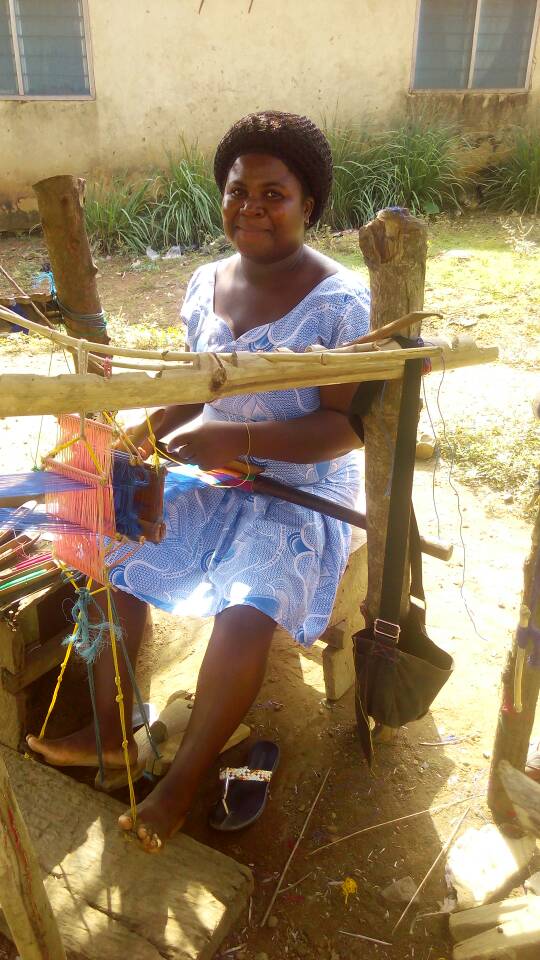
To witness the creation of kente is to appreciate the sheer physical and intellectual labor involved. The heart of the operation is the loom, a horizontal apparatus with multiple heddles and pedals. The process is painstakingly slow; a master weaver might produce only a few inches of cloth per day. A full kente cloth for a chief or a special occasion is not a single piece of fabric but is instead composed of numerous narrow strips, typically 4 to 6 inches wide, which are meticulously sewn together. This strip-weave technique is a hallmark of West African weaving and gives kente its distinctive, ribbed texture.
The weaver sits at the loom, his feet working the pedals to raise and lower the warp threads while his hands deftly pass the shuttle carrying the weft. The process requires immense concentration, as the weaver must constantly refer to a mental map of the design, counting threads and changing colors at precise intervals to create the intended pattern. This is a deeply meditative and skilled practice, often passed down from father to son over generations. Today, the town of Bonwire remains the epicenter of kente production, with hundreds of weavers working in family compounds, their rhythmic clacking looms a constant soundtrack to village life. While raffia is rarely used now, weavers use a combination of cotton and silk threads, with imported rayon and acrylic also common for more affordable pieces. This vibrant cottage industry supports thousands of families and preserves a craft that is both an ancient art form and a viable modern livelihood.
Kente’s Global Journey: From Ashanti Royalty to the World Stage
For centuries, the kente cloth history was largely confined to the royal courts of the Ashanti Empire. Wearing it was a privilege reserved for the king, his family, and high-ranking chiefs and advisors. The cloth was a marker of immense social status, and the Asantehene would often bestow gifts of kente on loyal subjects and visiting dignitaries as a sign of honor. This exclusivity began to erode in the 20th century, a period of profound social and political change in Ghana. As the country moved towards independence in the 1950s, kente became a potent symbol of a unified national identity, a visual rallying point for a people shaking off colonial rule.
The man most responsible for catapulting kente onto the global stage was Ghana’s first president, Kwame Nkrumah. He adopted the cloth as his personal uniform, wearing flowing kente gowns at major state functions and on international diplomatic trips. His image, captured by the world’s press, became synonymous with African independence and pride. When he addressed the United Nations in 1960, he did so in a striking kente cloth, a powerful visual statement that resonated far beyond the diplomatic chamber. This act transformed kente from a marker of Ashanti royalty into a pan-African symbol of liberation, dignity, and self-determination. It was a masterful piece of soft power, using a traditional textile to project an image of a confident, modern, and culturally rooted African nation.
The 1960s and Beyond: Kente as a Symbol of Black Pride
The political symbolism of kente was amplified by the global civil rights and Black Power movements in the United States. For African Americans seeking to reconnect with their ancestral heritage, kente cloth became a tangible and powerful link to the African continent. It was adopted as a ceremonial garment for graduation ceremonies, church services, and other significant milestones, particularly within Historically Black Colleges and Universities (HBCUs). The sight of Black graduates in kente stoles became an iconic image of academic achievement and cultural affirmation. This adoption was not without its complexities, as it represented a pan-African ideal that often transcended specific Ghanaian or Ashanti meanings, but its power as a symbol of unity and pride was undeniable. Today, kente is a global phenomenon, seen on fashion runways in Paris and New York, worn by celebrities like Beyoncé and Lupita Nyong’o, and used in political protests from Accra to Atlanta. Its journey from a royal Ashanti cloth to a global symbol of Black identity is a remarkable testament to its enduring power and adaptability.
Kente in the 21st Century: Modernity, Fashion, and Global Commerce
Far from being a static relic of the past, kente is a vibrant and dynamic art form that continues to evolve. In the 21st century, Ghanaian designers are pushing the boundaries of the tradition, incorporating kente into contemporary fashion in innovative and exciting ways. They are creating tailored suits, chic dresses, stylish handbags, sneakers, and even jewelry from the fabric, proving that it can be seamlessly integrated into modern wardrobes. This is not a dilution of tradition but a natural evolution, a continuation of the same creative impulse that saw the Ashanti weavers adopt imported silk centuries ago. The global demand for authentic kente has also created significant economic opportunities for weavers in Ghana.
The commerce of kente has expanded far beyond the village looms of Bonwire. There is a thriving market, both physical and digital, for kente cloth and kente-inspired products. While this has brought economic empowerment to many communities, it has also raised complex questions about authenticity, intellectual property, and cultural appropriation. The Ghanaian government, in a bid to protect this national treasure, has sought legal protections for kente designs, attempting to register them as a form of geographical indication, similar to how Champagne is protected in France. This effort acknowledges that kente is not just a beautiful product but a piece of cultural heritage that belongs to a specific people and place. The challenge for the 21st century is to balance commercial viability with cultural integrity, ensuring that the weavers of Bonwire and other villages benefit from the global demand for their craft while maintaining the high standards of artistry that have defined kente for centuries.
Beyond the Cloth: Kente-Inspired Art and Design
The influence of kente extends far beyond the textile itself. Its bold geometric patterns and vibrant color combinations have inspired artists, architects, and designers across the African continent and the world. From the striking facades of modern buildings in Accra to the graphic design of album covers and the patterns on ceramic tiles, the visual language of kente is inescapable. This cross-pollination is a testament to the design’s inherent aesthetic power and its deep cultural resonance. It demonstrates that kente is not just a cloth to be worn but a source of creative inspiration that continues to shape the visual landscape of the modern world.
Preserving the Thread: Challenges and the Future of Kente
Despite its global fame, the future of kente weaving faces significant challenges. The craft is labor-intensive and time-consuming, and the younger generation in Ghana is often lured away by the promise of more lucrative and less demanding work in the cities. The average age of a master weaver in Bonwire is rising, and there is a real concern that this intricate knowledge could be lost if it is not passed on. To combat this, various initiatives have been established to support and promote the craft. Non-profit organizations, cultural institutions, and the Ghanaian government have invested in training programs, providing modern looms and materials to young apprentices, and creating market access for their products. These efforts are crucial for ensuring that the next generation sees weaving not just as a tradition but as a viable and prestigious career path.
The challenge is not only economic but also about perception. In a rapidly modernizing Ghana, there is a risk that traditional crafts can be seen as old-fashioned or provincial. The key to preservation lies in reframing kente as a symbol of innovation and national pride, not just a relic of the past. The success of contemporary Ghanaian designers in using kente in high-fashion contexts is a powerful counter-narrative, demonstrating that the cloth is as relevant and stylish today as it was in the 17th century. By celebrating the artistry and the cultural significance of kente, and by providing tangible economic incentives for weavers, Ghana can ensure that the looms of Bonwire continue to sing for generations to come.
“Kente is not just a cloth. It is our history, our philosophy, our identity. When you wear it, you are carrying the wisdom of our ancestors.” — A master weaver from Bonwire.
The story of kente is also one of resilience. It has survived the transatlantic slave trade, colonial rule, and the pressures of globalization. It has been a symbol of a royal court, a nation, and a global diaspora. Each iteration has added a new layer of meaning to the cloth, enriching its history without ever erasing its core identity. This ability to adapt and absorb new influences while maintaining its essential character is the secret to its longevity. It is a metaphor for Africa itself: a continent with a deep and glorious past that is constantly innovating and redefining itself for the future.
A Woven Legacy: The Enduring Power of Kente
As we look at a piece of kente cloth, we are not simply looking at a textile. We are looking at a complex and beautiful document of human history. We see the ingenuity of the spider and the skill of the brothers Kurugu and Ameyaw. We see the power and wealth of the Ashanti Empire and the vision of Kwame Nkrumah. We see the struggle for civil rights and the celebration of Black identity across the globe. We see the hands of master weavers in the village of Bonwire, their rhythmic movements connecting them to their ancestors and their culture. The kente cloth history is a living, breathing narrative that is still being written with every thread.
Its future, though uncertain, is full of potential. As long as there are weavers willing to dedicate their lives to the loom, and as long as there are people around the world who recognize the profound power and beauty of this cloth, kente will endure. It will continue to grace the shoulders of kings and presidents, to celebrate the achievements of graduates, and to make a bold statement on the global fashion stage. It is a symbol of Africa’s enduring greatness, a tangible reminder that the continent’s heritage is not a thing of the past but a vibrant and essential part of its present and its future. In its radiant colors and intricate patterns, we find a universal story of creativity, resilience, and the unbreakable bond between a people and their art.