📅 Last updated: 05.07.2026
- The Danakil Depression: A Crucible of Salt and Fire
- The Ancient Tradition of the Afar Salt Miners
- How the Afar Salt Miners Extract the White Gold
- The Economic Reality: Modernity Meets Tradition
- Health, Hardship, and the Human Cost
- The Changing Landscape: Tourism and the Afar Salt Miners
- Innovation and Resilience: The Future of the Salt Trade
- Conclusion: A Legacy Carved in Salt
The Afar salt miners of Ethiopia carry a tradition that has endured for over six centuries, a practice as harsh and beautiful as the landscape that defines it. Deep in the Danakil Depression, one of the hottest and most inhospitable places on Earth, these miners extract gleaming white slabs of salt from a vast, cracked crust, continuing a trade that once fueled the empires of the Horn of Africa and still sustains entire communities today.
The Danakil Depression: A Crucible of Salt and Fire
To understand the life of the Afar salt miners, one must first appreciate the stage on which they perform. The Danakil Depression, straddling the borders of Ethiopia and Eritrea, is a geological wonder and a human trial. Lying more than 100 meters below sea level, it is one of the lowest points on the African continent and among the hottest places on Earth, with average temperatures soaring above 34°C (93°F) and frequently exceeding 50°C (122°F) in the summer months.
This stark, otherworldly terrain is the product of the African and Arabian tectonic plates pulling apart, creating a rift valley filled with volcanic activity, sulfur springs, and vast salt flats. The most famous of these flats is the Lake Assale (also known as Lake Karum), a dry, glittering expanse of salt that stretches to the horizon. It is here, on this blinding white crust, that the Afar have worked for generations.
The salt itself is not mined from a cave or mountain. It is harvested from the surface of the dried lake bed. The Afar miners, predominantly from the Afar ethnic group, a traditionally pastoralist and warrior people, have adapted their ancient knowledge of camel herding to this unforgiving environment. They are not just miners; they are navigators, camel masters, and survival experts in one of the planet’s most extreme climates.
The Ancient Tradition of the Afar Salt Miners
The history of salt extraction in the Danakil Depression is intertwined with the history of the Ethiopian Empire itself. For centuries, salt was a form of currency, known as amoleh. These salt bars, roughly 30 centimeters long and weighing about 4 to 6 kilograms, were used as a medium of exchange in the highlands of Ethiopia, a region rich in gold, ivory, and slaves but desperately poor in salt.
Historical records, including accounts from the 16th-century Portuguese explorer Francisco Álvares, describe caravans of hundreds of camels carrying salt bars from the Danakil to the markets of Axum, Gondar, and Harar. A single salt bar could buy a goat; a dozen could purchase a cow. This trade was a lifeline, connecting the lowland Afar with the highland Amhara and Tigrayan peoples.
The tradition is not merely economic; it is deeply cultural and social. The work is organized into a strict, hierarchical system. The Hagara (the village chief) or a respected elder often coordinates the expeditions. The miners themselves, known as Diro (singular: Diro), are skilled laborers who use simple, time-honored tools: a heavy iron bar called a mekala to break the salt crust, a wooden mallet, and a sile (a curved knife or chisel) to shape the blocks.
The Journey: From Village to Salt Flat
A typical salt expedition, or Kollo, begins long before dawn. Men gather in their villages, often in the town of Berhale, the primary gateway to the salt flats. They load their camels with water, food (usually sorghum or millet porridge and dried meat), and the tools of their trade. The journey from Berhale to the extraction sites at Lake Assale is about a three-day walk across brutal, stony terrain.
The camels are the unsung heroes of this operation. Each camel can carry up to 30 salt bars, a load of roughly 120 to 180 kilograms. The Afar have bred a unique breed of camel, smaller and hardier than those of the lowlands, capable of enduring days without water on this punishing journey.
“The salt is our life,” says Mohammed Hassen, a 47-year-old miner who has been coming to the flats since he was twelve. “It is harder than it was for my father. The camels are fewer, the water cost is higher, but we must do this. It is what we know.”
How the Afar Salt Miners Extract the White Gold
The process of extracting salt is deceptively simple but requires immense physical strength and knowledge. It is a dance of precision under a merciless sun.
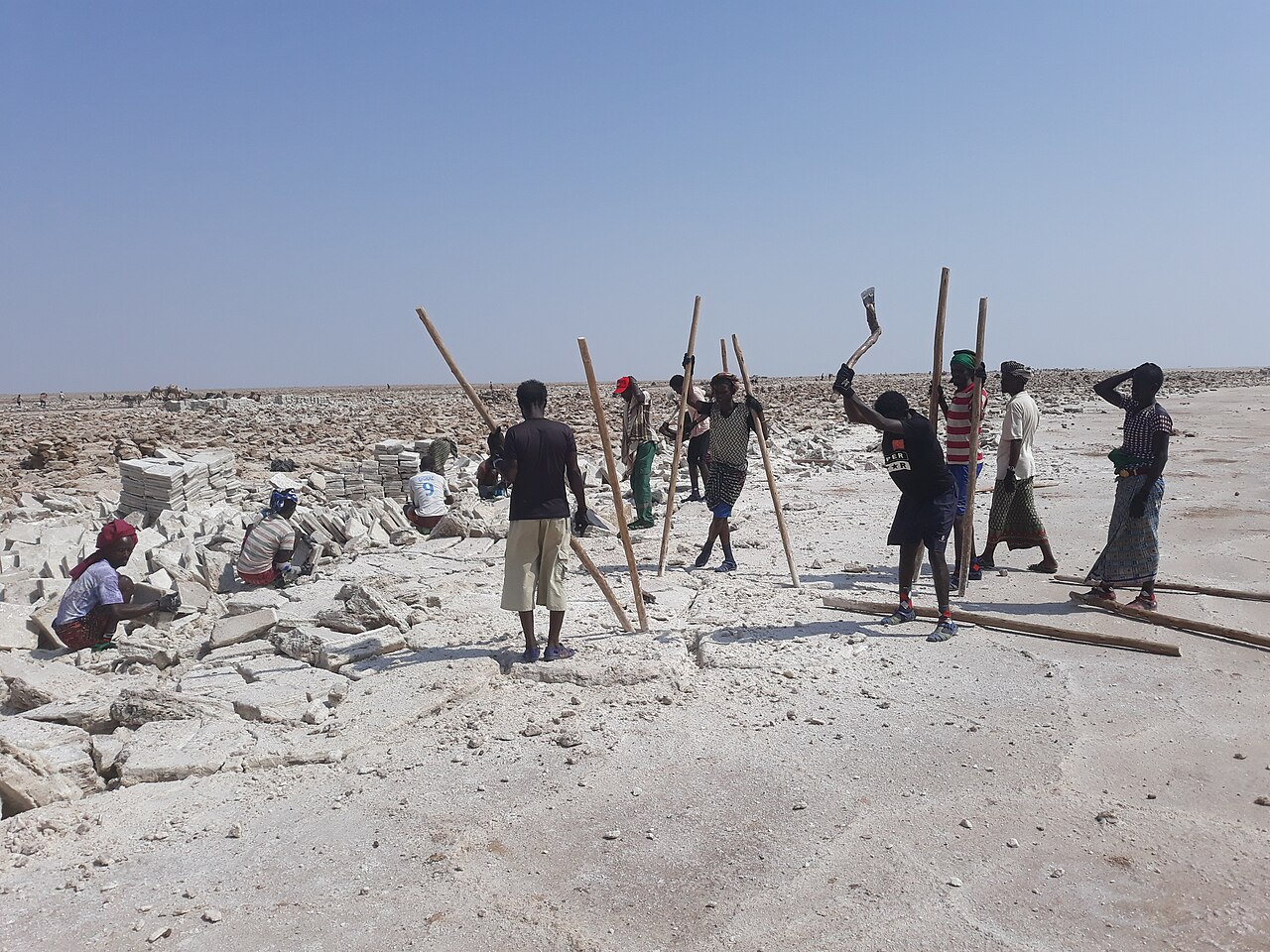
- Breaking the Crust: The miners first locate an area where the salt crust is thick, often over 15 centimeters deep. Using the heavy mekala (iron bar), they drive it into the crust, splitting it into large, irregular slabs. This is the most strenuous part of the work, requiring a full-body swing that sends shockwaves through the arms and back.
- Shaping the Blocks: Once the slab is broken, the miner uses the sile (chisel) and mallet to trim the edges. The goal is to create a rectangular block of standard size. The blocks are not weighed; they are sized by eye and tradition. A finished block is roughly 40 cm x 30 cm x 6 cm.
- Loading and Drying: The freshly cut blocks are piled and left to dry in the sun for a day. This hardens them and makes them easier to transport. The camels are then loaded, a process that requires careful balancing to prevent injury to the animals.
- The Return Journey: The caravan begins the return trip to Berhale. This is dangerous. The heat is intense, and the path is littered with sharp volcanic rocks that can lame a camel. The miners walk alongside their animals, often in bare feet or thin sandals, their faces wrapped in scarves against the dust and sun.
The entire expedition, from leaving the village to returning with the loaded camels, takes between 10 and 14 days. The miners are paid per block, and the income, while meager by global standards, is often the only cash income for their families.
The Economic Reality: Modernity Meets Tradition
In recent years, the ancient trade of the Afar salt miners has faced profound challenges. The rise of modern roads, trucks, and a cash economy has transformed the market. The once-prized amoleh salt bars, which served as currency, are now a commodity. They are primarily used for livestock consumption, water softening, and in some traditional food preservation, rather than as human table salt.
The trade is now dominated by a complex network of middlemen, truck drivers, and traders. A salt bar that a miner might sell for 15 to 20 Ethiopian Birr (about $0.25 to $0.35 USD) in Berhale can fetch 60 to 80 Birr (over $1 USD) in the highland markets of Mekelle or Addis Ababa. The miners, at the bottom of the supply chain, see very little of this profit.
| Stage | Price per Salt Bar (Approx. 2024) | Key Actor |
|---|---|---|
| At the Salt Flat (Lake Assale) | 10-15 Birr ($0.18 – $0.27) | Afar Miner |
| At Berhale Market | 15-25 Birr ($0.27 – $0.45) | Local Trader / Camel Owner |
| At Mekelle (Regional Capital) | 50-80 Birr ($0.90 – $1.45) | Wholesale Trucker |
| At Addis Ababa (National Market) | 100-150 Birr ($1.80 – $2.70) | Retail Distributor |
The advent of the Bure River Bridge and the all-weather road from Mekelle to Berhale has made truck transport cheaper and faster than camel caravans. This has undercut the traditional system. Many younger Afar men are leaving the salt trade for work in the burgeoning mining sector (gold and potash) or in towns.
Yet, the tradition persists. For the older generation, and for many families who own the camels, the salt trade remains the only viable livelihood. The camels, which can cost 30,000 to 50,000 Birr ($550 – $900 USD) each, are a family’s most valuable asset. Selling them is unthinkable.
Health, Hardship, and the Human Cost
The life of the Afar salt miners is one of extreme physical hardship. The health risks are numerous and severe.
- Dehydration and Heatstroke: Working under a sun that can crack the earth, with limited water, dehydration is a constant threat. Miners carry water in goat-skin bags, but it is often warm and insufficient.
- Eye Damage: The blinding white of the salt flats reflects 80% of the sun’s UV radiation. Without adequate eye protection, many miners develop pterygium (a growth on the eye) and severe cataracts by their 40s.
- Respiratory Issues: The fine salt dust, mixed with volcanic ash, is inhaled constantly. Chronic bronchitis and other lung diseases are common.
- Injuries: The heavy iron bars, sharp chisels, and the unpredictable nature of the salt crust lead to frequent cuts, fractures, and back injuries. Medical care is days away.
- Snake and Scorpion Bites: The Danakil is home to venomous snakes and scorpions, which seek shelter in the cracks of the salt crust.
There is no formal healthcare system for the miners. They rely on traditional remedies and, if they can afford it, a visit to a clinic in Berhale. Non-governmental organizations (NGOs), such as the Afar Pastoralist Development Association (APDA), have run mobile health clinics, but coverage is sparse.
The Changing Landscape: Tourism and the Afar Salt Miners
In a surprising turn, the Afar salt miners have become a subject of global fascination. The Danakil Depression, with its acid lakes, active volcanoes (like Erta Ale), and surreal salt flats, has become a bucket-list destination for adventure travelers. Tour operators from Addis Ababa now run regular expeditions into the region.
For the miners, this has been a mixed blessing. On one hand, it has brought some income. Tourists pay to photograph the caravans, and some miners have been hired as guides or porters. On the other hand, it has turned their ancient labor into a spectacle. Many feel objectified, their struggle reduced to a photo opportunity.
Yet, there is also a sense of pride. The miners are aware that their tradition is unique. They know that no machine can replicate the delicate work of shaping a salt block by hand, and no truck can navigate the deepest, most remote parts of the flats where the best salt lies. The camel caravans, with their ghostly lines of animals and men, are a living museum of human endurance.
Innovation and Resilience: The Future of the Salt Trade
Despite the challenges, the Afar salt miners are not a relic of the past. They are adapting. Some have formed cooperatives to negotiate better prices with truckers. Others have invested in solar-powered pumps to access fresh water at the extraction sites, reducing the need to carry water from Berhale.
There is also a growing movement to brand and market the salt as a premium product. The white, crystalline salt of the Danakil is exceptionally pure, with a unique mineral profile. Some enterprising individuals are packaging it for export, labeling it “Danakil White Gold” or “Afar Desert Salt.” This could offer a higher-margin market for the miners, bypassing the middlemen.
However, the scale is tiny. The miners lack access to capital, packaging equipment, and international marketing channels. The Ethiopian government, focused on large-scale industrial projects like the Grand Ethiopian Renaissance Dam and the potash mines, has given little direct support to the traditional salt trade.
A Conversation with an Elder
Sitting in the shade of a thorn tree in Berhale, I spoke with Ibrahim Ali, a 72-year-old former miner who now owns 40 camels. His face is a map of wrinkles, his eyes milky from decades of sun.
“This is not a job for my sons,” he says, gesturing towards the town. “They want to go to school, to drive a car, to work on a computer. I do not blame them. The salt is heavy, and the sun is not kind. But I tell them this: when you eat food without salt, it is nothing. Salt gives flavor. And we, the Afar, we have given flavor to Ethiopia for a thousand years.”
His words capture the bittersweet reality. The tradition of the Afar salt miners is slowly fading, eroded by economics, climate change (which makes the heat even more punishing), and the aspirations of a younger generation. But it is not gone. It remains a powerful testament to human ingenuity and resilience—a story of how a people turned a barren, hellish landscape into a source of life and wealth.
Conclusion: A Legacy Carved in Salt
The Afar salt miners of Ethiopia’s Danakil Depression are more than just laborers. They are the custodians of an ancient tradition that shaped the economy and culture of the Horn of Africa. Their work is a lesson in adaptation, a story of survival in one of the most extreme environments on Earth.
As the world races towards modernity, we must pause to recognize and honor such traditions. They are not obstacles to progress but windows into a different way of knowing the world—one where community, endurance, and a deep connection to the land matter more than profit margins. The salt they mine is not just a mineral; it is a legacy, crystallized over millennia, carried on the backs of camels and the shoulders of men. It is a story that deserves to be told, not as a footnote in a guidebook, but as a vibrant, living chapter in the ongoing narrative of Africa’s diverse and resilient peoples.