📅 Last updated: 12.11.2026
The Nyiragongo volcano hike is one of the most electrifying experiences on the African continent — a steep, steam-wreathed climb through Virunga National Park to the rim of a crater holding the world’s largest active lava lake. Standing at 3,470 metres above sea level on the edge of a churning cauldron of molten rock, with the lights of Goma and Lake Kivu glittering far below, hikers confront a force that has shaped this landscape for millions of years and reshaped the lives of the two million people living in its shadow.
The Nyiragongo volcano hike is a guided overnight trek in Virunga National Park, Democratic Republic of Congo, climbing from Kibati ranger post (about 1,990 m) to the summit crater at 3,470 m — roughly 5–6 hours of steep ascent. Hikers spend the night in summit shelters above the lava lake, the largest and most active in the world, then descend in 4–5 hours the following morning. Permits are booked through Virunga’s official channels and cost around US$300–400.
- Where Is Nyiragongo and Why Does It Matter?
- What Does the Nyiragongo Volcano Hike Actually Involve?
- How Do You Plan and Book the Nyiragongo Volcano Hike?
- When Is the Best Time to Hike Nyiragongo?
- What Makes Nyiragongo's Lava Lake So Extraordinary?
- Is the Nyiragongo Volcano Hike Safe?
- What Else Should You Know Before You Go?
- Why the Nyiragongo Volcano Hike Belongs on Your List
Where Is Nyiragongo and Why Does It Matter?
Nyiragongo rises from the floor of the Albertine Rift, the western branch of the East African Rift System, in North Kivu province, eastern Democratic Republic of Congo. It is one of eight volcanoes in the Virunga Massif, a chain shared with Rwanda and Uganda that also includes Nyamuragira — Africa’s most active volcano by eruption frequency — and the misty highlands where mountain gorillas cling to existence.
The mountain sits barely 20 kilometres north of Goma, a city of around two million people and the capital of North Kivu. That proximity defines everything about Nyiragongo: its scientific importance, its danger, and its pull on travellers. The volcano’s lava is unusually fluid — among the fastest-flowing in the world, capable of moving at up to 60 kilometres per hour on steep slopes — because of its low silica content and the persistent convection of its magma chamber. When it erupted on 17 January 2002, lava poured down the southern flank and through central Goma, killing dozens, displacing hundreds of thousands, and filling much of Lake Kivu’s shoreline with solidified rock that remains visible today.
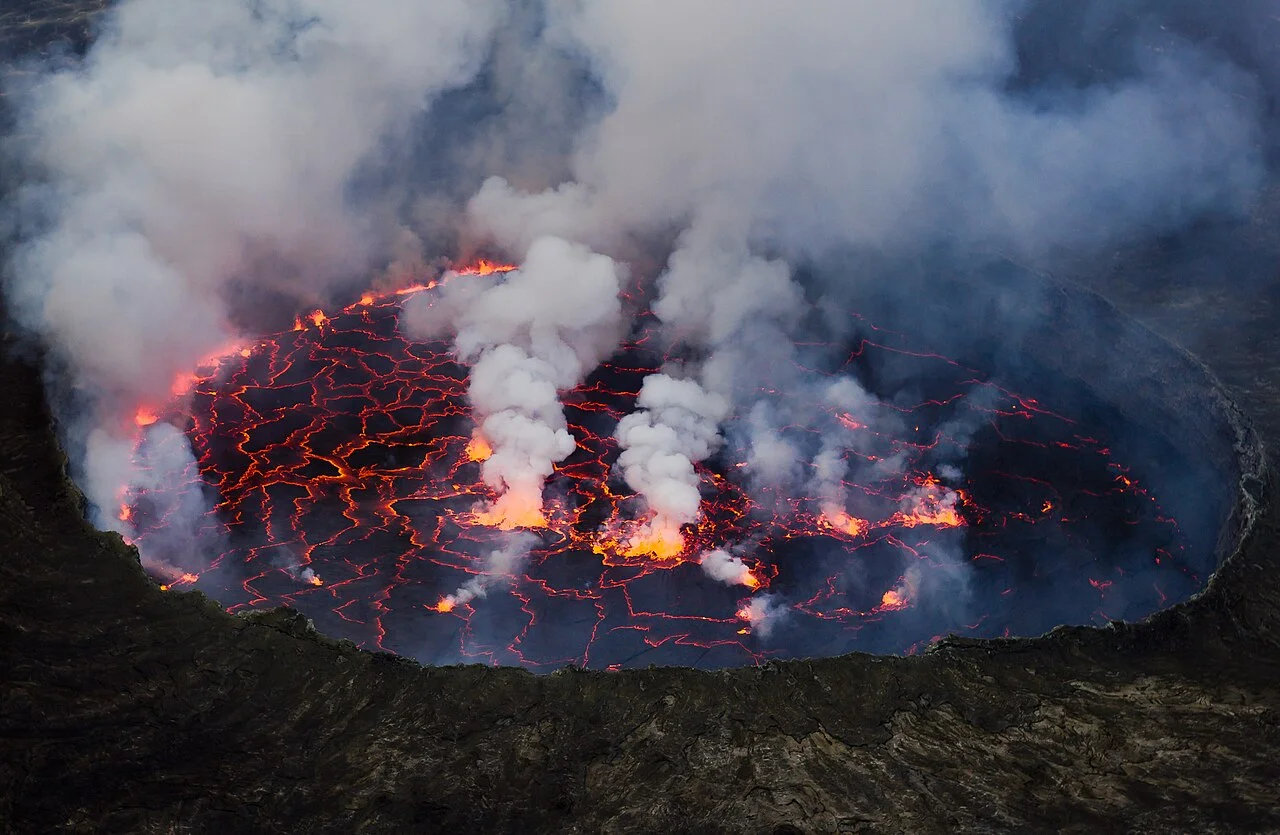
The lava lake itself is the headline. Nyiragongo hosts the largest persistent lava lake on Earth, a churning expanse that has fascinated volcanologists since the first scientific descents in the 1950s and 1960s. French volcanologist Haroun Tazieff’s expeditions brought the lake to global attention, and the Nyiragongo Scientific Team — Congolese researchers working with international partners — has monitored it through eruptions, lulls, and refills ever since.
What Does the Nyiragongo Volcano Hike Actually Involve?
The trek begins at Kibati, a ranger post on the road between Goma and Rumangabo, at roughly 1,990 metres. Hikers register, meet their armed ranger escort — a standard requirement in a region where park protection is serious business — and set off through montane forest and old lava fields. The trail climbs steadily, then steeply, through zones of giant heather and open volcanic rock.
The ascent: five to six hours of honest climbing
There is no cable car, no jeep track to the top. The route gains about 1,500 metres of elevation over roughly 8 kilometres of trail. Fit hikers with altitude experience manage it in four to five hours; most take five to six, with rest stops at wooden benches installed at intervals. Porters — local men and women from villages around the park — carry supplies, sleeping gear, and sometimes backpacks for a fee that puts money directly into the surrounding communities. Altitude sickness is a real risk: the summit sits at 3,470 metres, and overnighting there can trigger headaches and breathlessness even in strong walkers.
The night on the rim
Summit shelters — simple A-frame cabins with bunks and basic bedding — sit on the crater’s edge. After dark, the lava lake puts on its show: fountains of incandescent rock, shifting crusts, and the deep rumble of gas explosions. The glow lights the clouds above the crater and casts an orange sheen on the shelters. Temperatures at night drop close to freezing, and the wind is relentless. Most hikers sleep little, and nobody minds.
The descent
The morning descent takes four to five hours on the same trail, with the reward of Goma, Lake Kivu, and — on clear days — the Rwandan hills spread out below. The full Nyiragongo volcano hike is typically a two-day, one-night affair, though some operators run it as a demanding single day for acclimatised trekkers.
How Do You Plan and Book the Nyiragongo Volcano Hike?
Logistics are the hard part, and they demand honesty about the security situation. Virunga National Park, Africa’s oldest national park (gazetted in 1925), has been closed to tourism for extended periods because of armed conflict in North Kivu. The park reopened to visitors in 2022 after a two-year closure, but access has fluctuated with the security environment, and in early 2025 fighting between the M23 movement and Congolese forces reached Goma itself, prompting further closures. Check the park’s official channels and your embassy’s travel advisories before committing.
When the park is open, the process looks like this:
- Permits: Booked through Virunga National Park’s official website or authorised operators; expect US$300–400 per person for the hike, with proceeds funding ranger salaries and conservation.
- Visas: A DRC tourist visa is required for most nationalities, arranged in advance through the Congolese embassy or an authorised agency; Virunga can advise on the correct visa category for park visitors.
- Access: Most hikers fly into Goma (flights from Kinshasa and Kigali) and transfer to Kibati; overland entry from Rwanda via the Grande Barrière at Gisenyi–Goma is possible when borders are functioning normally.
- Operators: Reputable agencies in Goma and Kigali bundle permits, transport, ranger fees, porters, and accommodation, which simplifies an otherwise complicated trip.
When Is the Best Time to Hike Nyiragongo?
The dry seasons — roughly June to August and December to February — offer the clearest skies and the best views of the lava lake and the surrounding volcanoes. The rainy months (March to May, September to November) bring mud, cloud, and slick volcanic rock, though the lake’s glow is often visible through the night regardless of weather. The summit is cold year-round; pack layers, a waterproof shell, and a headlamp.
| Period | Conditions | Verdict |
|---|---|---|
| June–August | Dry, clear, cold nights | Best overall window |
| December–February | Dry, warm days, clear crater views | Excellent, busier |
| March–May | Heavy rain, mud, cloud | Challenging; fewer bookings |
| September–November | Short rains, mixed visibility | Workable with flexibility |
What Makes Nyiragongo’s Lava Lake So Extraordinary?
Most of the world’s lava lakes are ephemeral — they appear during eruptions and drain away. Nyiragongo’s has persisted for decades, sustained by a deep, hot magma system that feeds continuously from below. The lake’s surface is a moving mosaic of crust and molten rock, punctuated by fountains that can rise tens of metres. Gas emissions — sulphur dioxide, carbon dioxide, and water vapour — pour from the crater, and the plume is sometimes visible from Goma.
Volcanologists study the lake to understand how magma behaves in open-conduit systems, and the Nyiragongo Scientific Team, working with the Goma Volcanological Observatory, monitors seismic activity and gas output. The observatory, founded in 1959, is one of Africa’s oldest volcanological stations and remains central to early-warning efforts for the city below.
Is the Nyiragongo Volcano Hike Safe?
The honest answer: it is a managed risk, not a casual stroll. The climb itself is safe when guided, but three factors demand respect.
- Volcanic activity: The lake can change behaviour quickly; rangers and scientists assess conditions daily, and the park closes the trail when the crater is too active.
- Altitude and weather: The summit is cold, windy, and high enough to cause altitude illness; pace yourself and hydrate.
- Regional security: North Kivu has endured decades of armed conflict; travel only when the park is officially open and follow ranger instructions without exception.
The rangers who escort every hike are part of a force that has protected Virunga through extraordinary adversity — more than 200 have been killed in the line of duty since the 1990s, a sacrifice commemorated at the park’s headquarters in Rumangabo. Hiking with them is both a privilege and a direct contribution to conservation.
What Else Should You Know Before You Go?
Fitness matters more than technical skill: no ropes or climbing gear are needed, but the gradient is relentless and the altitude unforgiving. Pack light — porters can carry the rest — and bring cash for tips, which are customary and meaningful. Goma has decent hotels and restaurants, and Lake Kivu’s shores offer a gentler counterpoint to the mountain. Combine the trek with gorilla trekking in Virunga’s southern sectors when permits and security allow, and allow buffer days for weather and logistics.
The Nyiragongo volcano hike also carries a cultural dimension. The communities around the park — Nande, Hunde, Tutsi, and others — have lived with the volcano for generations, and their knowledge of its moods is woven into local life. Visiting respectfully, hiring local guides and porters, and supporting park-linked community projects turns a bucket-list adventure into something with lasting local value.
Why the Nyiragongo Volcano Hike Belongs on Your List
Few places on Earth let you stand at the edge of an active lava lake after a day’s climb through African montane forest, with a city of two million people glowing below and the Rwandan hills on the horizon. The Nyiragongo volcano hike is not a theme-park thrill; it is a confrontation with the planet’s interior, mediated by Congolese rangers and scientists who have devoted their lives to understanding and protecting this mountain. Go when it is open, go prepared, and go with respect — and you will carry the memory of that orange glow for the rest of your life.