📅 Last updated: 25.11.2026
Long before medieval Europe raised its first cathedrals, the Kingdom of Kush ruled the Nile’s middle reaches with a sophistication that rivaled Egypt and, for a century, conquered it. Stretching across what is now northern Sudan, Kush produced pharaohs, iron-working cities, a written script of its own, and more pyramids than Egypt ever built. Yet for most of the world, its story has been buried under sand and colonial-era neglect.
The Kingdom of Kush was an ancient Nubian civilization centered between the First and Sixth Cataracts of the Nile, in present-day northern Sudan. Flourishing from roughly 2500 BCE to 350 CE, it was crowned by the city of Kerma, then Napata, and finally Meroë. Kushite kings conquered Egypt around 744 BCE and ruled as its 25th Dynasty, and the kingdom’s later Meroitic phase left behind more than 200 pyramids and a still-undeciphered script.
- Where Was the Kingdom of Kush and Why Did It Matter?
- How Did the Kingdom of Kush Conquer Egypt?
- Why Did the Kingdom of Kush Move Its Capital to Meroë?
- How Many Pyramids Did the Kingdom of Kush Build?
- Who Were the Kandakes, the Warrior Queens of Kush?
- What Did the Kingdom of Kush Trade and Produce?
- Why Is the Kingdom of Kush So Often Forgotten?
- What Can the Kingdom of Kush Teach Us Today?
- Final Perspective: A Civilization That Refused to Be Peripheral
Where Was the Kingdom of Kush and Why Did It Matter?
Kush occupied the fertile corridor where the Nile carves through sandstone and granite between modern Aswan in Egypt and the confluence of the Blue and White Nile near Khartoum. That geography was destiny. The river gave water, fish, and a highway for trade; the cataracts made natural borders; and the surrounding desert protected a culture that developed on its own terms. Gold, ivory, ebony, ostrich feathers, and later iron flowed north through Kush to Egypt and the Mediterranean, while Egyptian grain, linen, and luxury goods flowed south.
The Egyptians knew this land well. They called its people Nehesy and its southern territory Ta-Seti, “Land of the Bow,” a nod to Nubian archers whose skill became legendary. Egyptian texts from the Old Kingdom record raids and trade expeditions into Nubia, and the boundary inscription of the official Harkhuf, carved around 2300 BCE, describes journeys deep into the south to bring back exotic goods. Egypt’s own artists depicted Nubians with dark skin and distinctive dress—evidence of a long, tense, and intimate relationship between two Nile civilizations.
Kerma: The First Capital
The earliest flowering of Kush was at Kerma, near the Third Cataract, around 2500 BCE. Kerma grew into a substantial urban center with a monumental mud-brick temple complex called the deffufa, still standing today as one of the largest mud-brick structures in Africa. Its rulers were buried in enormous tumuli, some over 90 meters in diameter, accompanied by hundreds of sacrificed retainers—a practice that speaks to both the wealth and the spiritual cosmology of the kingdom.
Kerma’s power was such that around 1650 BCE it allied with the Hyksos rulers of northern Egypt against the Egyptian pharaohs of Thebes. When the Theban king Ahmose finally expelled the Hyksos and reunified Egypt around 1550 BCE, he turned his army south and destroyed Kerma. Egypt then colonized Nubia outright, building temples at Soleb and Sedeinga and installing a viceroy titled “King’s Son of Kush.”
How Did the Kingdom of Kush Conquer Egypt?
Egypt’s New Kingdom occupation of Nubia lasted roughly five centuries. But as Egypt weakened after 1100 BCE—beset by internal strife, Libyan incursions, and the collapse of its imperial reach—the Nubian elite reasserted independence. A new Kushite state rose with its capital at Napata, near the sacred mountain of Gebel Barkal, which the Egyptians regarded as the home of the god Amun.
The turning point came with a king named Kashta, who pushed north into Upper Egypt around 750 BCE. His son Piye (also spelled Piankhy) completed the work. Around 728 BCE, Piye marched a disciplined army down the Nile, besieged Hermopolis, and took Memphis. The victory is recorded on a granite stela found at Gebel Barkal in 1862—one of the great primary documents of African history. The stela, written in Egyptian hieroglyphs, describes Piye’s campaign in his own voice, including his insistence that his soldiers purify themselves before battle and his refusal to enter the palace of a defeated rival because its occupants had eaten fish, which he considered ritually impure.
Piye did not linger in Egypt. He returned to Napata and ruled his expanded realm from the south. It was his successors—Shabaka, Shebitku, Taharqa, and Tantamani—who consolidated the 25th Dynasty, a line of Black African pharaohs who ruled a united Egypt and Kush from roughly 744 to 656 BCE.
Taharqa, the Greatest of the Kushite Pharaohs
Taharqa (reigned c. 690–664 BCE) stands out even among the dynasty’s impressive rulers. He built and restored temples across Egypt and Nubia, including major works at Karnak, Kawa, and Sanam. The Bible names him: in 2 Kings 19:9, the Assyrian king Sennacherib receives word that “Tirhakah king of Ethiopia” is marching against him—”Ethiopia” here being the Greek term for Kush. Taharqa’s armies clashed repeatedly with Assyria, the superpower of the age, and although he eventually lost Egypt to the Assyrian king Esarhaddon in 671 BCE, his reign marked the high-water mark of Kushite power.
The 25th Dynasty left a lasting imprint. Kushite pharaohs revived Egyptian temple building, restored the cult of Amun, and promoted the arts. Their rule demonstrated something the ancient world understood and modern audiences often forget: that the Nile Valley was a zone of shared civilization in which African kingdoms from the deep south could govern the north.
Why Did the Kingdom of Kush Move Its Capital to Meroë?
After the Assyrians pushed the Kushites out of Egypt, the kingdom withdrew south. Around 590 BCE, an Egyptian army under Pharaoh Psamtik II sacked Napata, and the Kushite court relocated further upstream to Meroë, between the Fifth and Sixth Cataracts. The move proved transformative.
Meroë sat at the crossroads of trade routes reaching the Red Sea, the African interior, and the Nile. It became a major industrial city. Archaeological surveys have identified extensive slag heaps around the city, evidence of large-scale iron smelting. Kushite smiths produced tools, weapons, and implements that supported agriculture and warfare, and some scholars argue that Meroë was one of the earliest and most important iron-producing centers in Africa.
The Meroitic Script: Africa’s Early Writing System
The kingdom’s cultural independence is most visible in its writing. Around the 3rd century BCE, the Kushites developed the Meroitic script, an alphabetic system with two forms—hieroglyphic and cursive—used to write the Meroitic language. It was not a copy of Egyptian writing but an original creation, though its signs borrowed some Egyptian forms.
The script was deciphered enough in the early 20th century to read names and titles, but the Meroitic language itself remains poorly understood. No bilingual text comparable to the Rosetta Stone has been found. This is one of the great unresolved puzzles of African archaeology: a civilization that wrote extensively, yet whose words still resist full translation.
How Many Pyramids Did the Kingdom of Kush Build?
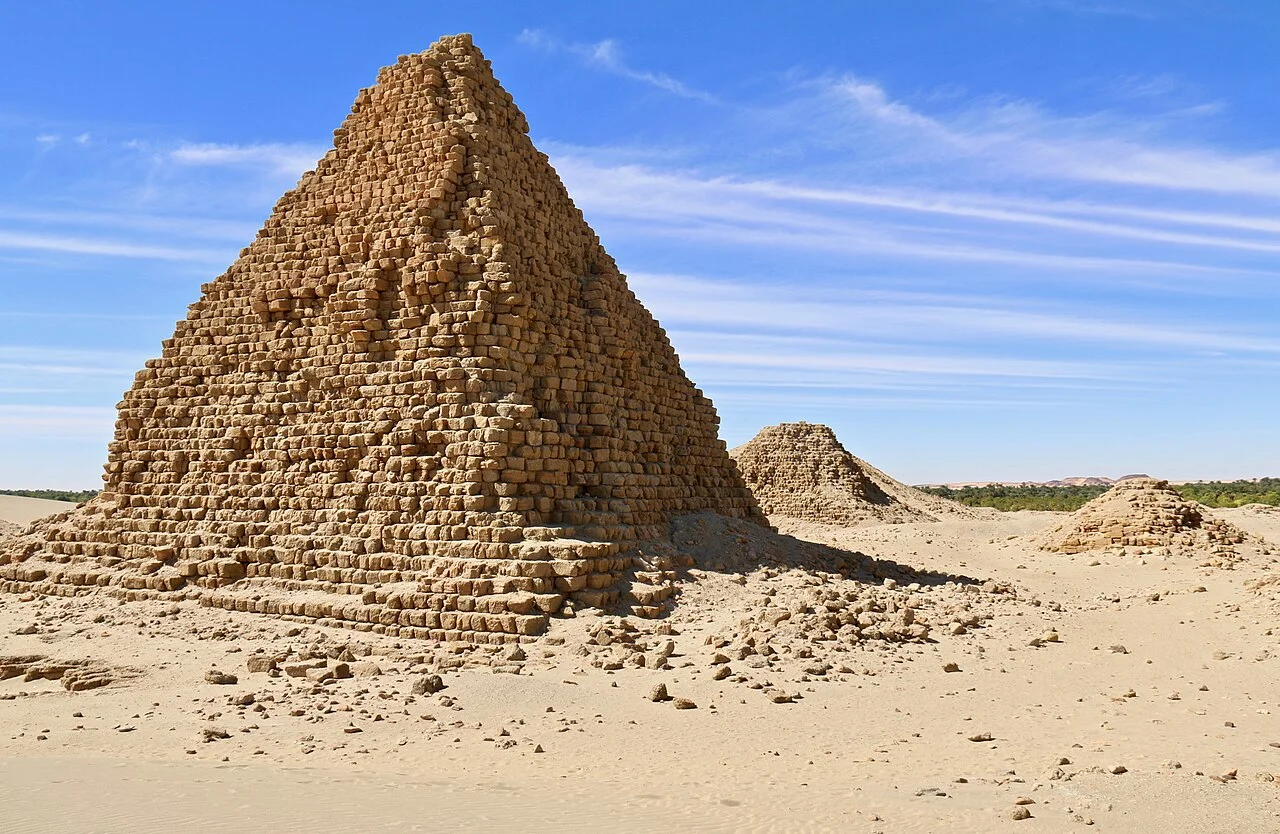
More than Egypt. The royal cemeteries of Kush—at El-Kurru, Nuri, and above all Meroë—contain well over 200 pyramids, compared to roughly 120 in Egypt. The Kushite pyramids are smaller and steeper than their Egyptian counterparts, with solid cores and narrow offering chapels attached to the eastern face. They were built over centuries, from the 8th century BCE at El-Kurru through the Meroitic period.
The pyramids served as tombs for kings, queens, and nobles. Their decoration includes reliefs showing the deceased before deities such as Amun, Isis, and the lion-headed Apedemak, a distinctly Kushite god. The site of Meroë, a UNESCO World Heritage Site since 2011, contains the largest concentration of these monuments.
| Period | Dates (approx.) | Capital | Key Developments |
|---|---|---|---|
| Kerma Phase | 2500–1500 BCE | Kerma | First Kushite state; monumental deffufa temple; extensive trade with Egypt |
| Napatan Phase | c. 750–590 BCE | Napata | Conquest of Egypt; 25th Dynasty pharaohs including Piye and Taharqa |
| Meroitic Phase | c. 590 BCE–350 CE | Meroë | Iron production; Meroitic script; over 200 pyramids; powerful queens (kandakes) |
| Decline | c. 350 CE | Meroë | Kingdom collapses, likely due to Aksumite pressure and internal change |
Who Were the Kandakes, the Warrior Queens of Kush?
The Kingdom of Kush produced a series of remarkable female rulers known as kandakes (often rendered “Candace” in Greco-Roman sources, which used the title as a name). These were not consorts but monarchs in their own right, commanding armies and commissioning monuments.
The most famous is Amanirenas, who ruled around 40–10 BCE. When Rome annexed Egypt under Augustus, Kushite forces under Amanirenas struck north, attacking Roman garrisons and even carrying off a bronze head of the emperor Augustus from a statue in Egypt. That head, now in the British Museum, was reportedly buried beneath the steps of a temple at Meroë so that worshippers would trample it—a gesture of defiance that has fascinated historians ever since.
The Roman historian Strabo records the conflict, noting that the Kushites were led by a queen who was “a woman of masculine spirit.” A peace treaty followed, favorable enough to Kush that it was renewed by later emperors. The episode shows a Kush confident enough to negotiate with the greatest power on earth.
What Did the Kingdom of Kush Trade and Produce?
Kush’s economy rested on several pillars:
- Gold and precious goods: Nubian gold was legendary, and the region supplied Egypt and the Mediterranean world for centuries.
- Iron and metalwork: Meroë’s smelting industry produced tools and weapons that supported agriculture and military power.
- Agriculture: The Nile floodplain supported sorghum, millet, and other crops; irrigation works extended cultivation.
- Long-distance trade: Ivory, ebony, ostrich feathers, animal skins, and slaves moved north; luxury goods moved south.
- Religion and pilgrimage: The cult of Amun drew worshippers and wealth to temples at Gebel Barkal, Kawa, and Meroë.
The kingdom’s reach extended far beyond the Nile. Kushite goods have been found in Red Sea ports and Mediterranean markets, and the kingdom maintained diplomatic and commercial ties with Ptolemaic Egypt and later Rome.
Why Is the Kingdom of Kush So Often Forgotten?
The neglect is not accidental. Nineteenth-century European Egyptology framed ancient Egypt as a “white” civilization and treated Nubia as a peripheral, inferior neighbor. Early archaeologists, including some who excavated Kushite sites, interpreted the evidence through racial hierarchies that minimized African achievement. The 25th Dynasty was sometimes dismissed as a period of decline rather than recognized as a renaissance.
Modern scholarship has overturned much of this. Excavations at Kerma, Meroë, and Gebel Barkal—carried out by teams from Sudan, Europe, and the United States—have revealed a sophisticated, independent civilization. Sudanese archaeologists such as those trained at the University of Khartoum now lead major projects. The UNESCO designation of Meroë in 2011, alongside Gebel Barkal and the sites of the Island of Meroë, brought new attention.
Yet challenges remain. Sudan’s recent conflicts have threatened heritage sites and disrupted tourism and research. The pyramids of Meroë, though a World Heritage Site, receive a fraction of the visitors that flow to Giza. The Meroitic script remains undeciphered. There is, in short, still much to learn.
What Can the Kingdom of Kush Teach Us Today?
Kush matters for reasons beyond historical curiosity. It demonstrates that ancient Africa produced states capable of monumental architecture, complex religion, long-distance trade, and written literature. It shows a civilization that interacted with Egypt, Assyria, and Rome as a peer—sometimes as a conqueror. And it challenges the narrow geography of “ancient history” taught in many schools, where the Nile Valley begins and ends at Giza.
The kingdom also speaks to the present. Sudan’s cultural heritage, from the pyramids of Meroë to the temples of Gebel Barkal, is part of a living national identity. The diaspora, from Khartoum to London to New York, can claim a heritage that predates many of the world’s most celebrated civilizations. For travelers, the sites offer something increasingly rare: monumental history without the crowds.
There is a lesson in the forgetting, too. The Kingdom of Kush was not lost; it was overlooked. The evidence was always there, in stone and script and slag heap. What changed was the willingness to look.
Final Perspective: A Civilization That Refused to Be Peripheral
The Kingdom of Kush endured for nearly three thousand years. It buried its kings under more pyramids than Egypt built, wrote in a script of its own making, forged iron on an industrial scale, and sent armies to the Mediterranean. Its queens negotiated with Rome. Its pharaohs ruled a united Nile Valley. When the kingdom finally faded around 350 CE, it left behind monuments that still stand in the Sudanese desert, waiting for the world to catch up with what its own people have always known.
The next time someone lists the great civilizations of the ancient world, Kush belongs on that list—not as a footnote to Egypt, but as a chapter of its own.