📅 Last updated: 21.11.2026
Fela Kuti Afrobeat is more than a musical genre — it is the sound of a continent refusing to be silenced. Born in colonial-era Nigeria and forged in the fires of military dictatorship, Fela Anikulapo Kuti’s creation fused West African highlife, Yoruba rhythm, jazz, and funk into a hypnotic, horn-driven force that doubled as political artillery. From the smoky clubs of Lagos to concert halls in London, Paris, and New York, that sound carried a message of pan-African pride, anti-corruption defiance, and unapologetic joy.
Fela Kuti Afrobeat is a genre created by Nigerian musician and activist Fela Anikulapo Kuti in the late 1960s and early 1970s. It blends Yoruba percussion, highlife guitar lines, jazz horns, and American funk into long, groove-based compositions, most famously performed with his band Africa 70. More than music, Afrobeat became a vehicle for political resistance against Nigeria’s military regimes and a rallying cry for pan-Africanism worldwide.
- Who Was Fela Kuti, and Why Does His Story Matter?
- How Did Afrobeat Actually Sound? The Anatomy of Fela Kuti Afrobeat
- Key Recordings: The Albums That Defined Fela Kuti Afrobeat
- Timeline: Fela Kuti's Life and the Rise of Afrobeat
- Why Was Fela Kuti Targeted by Nigeria's Military Regimes?
- How Did Afrobeat Travel Beyond Nigeria?
- What Does Fela Kuti Afrobeat Mean Today?
- Common Misconceptions About Fela Kuti and Afrobeat
- Why Fela Kuti Afrobeat Still Resonates Across Africa and the Diaspora
- The Lasting Perspective: A Sound That Refuses to Fade
Who Was Fela Kuti, and Why Does His Story Matter?
Fela was born on 15 October 1938 in Abeokuta, in what was then colonial Nigeria. His family was steeped in anti-colonial politics: his mother, Funmilayo Ransome-Kuti, was a pioneering feminist and nationalist who led the Abeokuta Women’s Union; his father, Israel Oludotun Ransome-Kuti, was a Protestant minister and school principal. That household gave Fela both a moral compass and a taste for confrontation.
In 1958 he traveled to London to study music at Trinity College of Music, where he absorbed jazz and classical theory while playing in a highlife band. He returned to Nigeria in the mid-1960s, then spent time in Ghana, where he encountered the highlife scenes of Accra and began experimenting with longer, rhythmically layered arrangements. The turning point came during a 1969 tour of the United States, when he met Sandra Smith (later Sandra Isidore), a Black Panther Party member who introduced him to the writings of Malcolm X, Eldridge Cleaver, and the Black Power movement. Fela came home transformed — politically awakened and musically radicalized.
He renamed his band Africa 70 (later Egypt 80), built a communal compound in Lagos called the Kalakuta Republic, and declared it independent of the Nigerian state. What followed was two decades of music, persecution, and legend.
How Did Afrobeat Actually Sound? The Anatomy of Fela Kuti Afrobeat
Afrobeat is not a quick hook. It is architecture. A typical Fela composition runs ten to twenty-five minutes, sometimes longer, and unfolds in layers rather than verses and choruses. Understanding its structure reveals why it remains so influential among contemporary producers and DJs.
The Rhythm Section: Yoruba Drums Meets Funk
At the foundation sit interlocking Yoruba percussion patterns — talking drums, congas, shekere, and claves — locked to a funk bassline and a crisp, syncopated drum kit. Tony Allen, Fela’s drummer and musical director for much of the 1970s, is widely credited with defining the Afrobeat groove. Allen described his approach as playing “highlife with a funk feel,” and his cymbal work and off-beat accents became a template for generations of drummers.
The Horn Section: A Choir of Brass
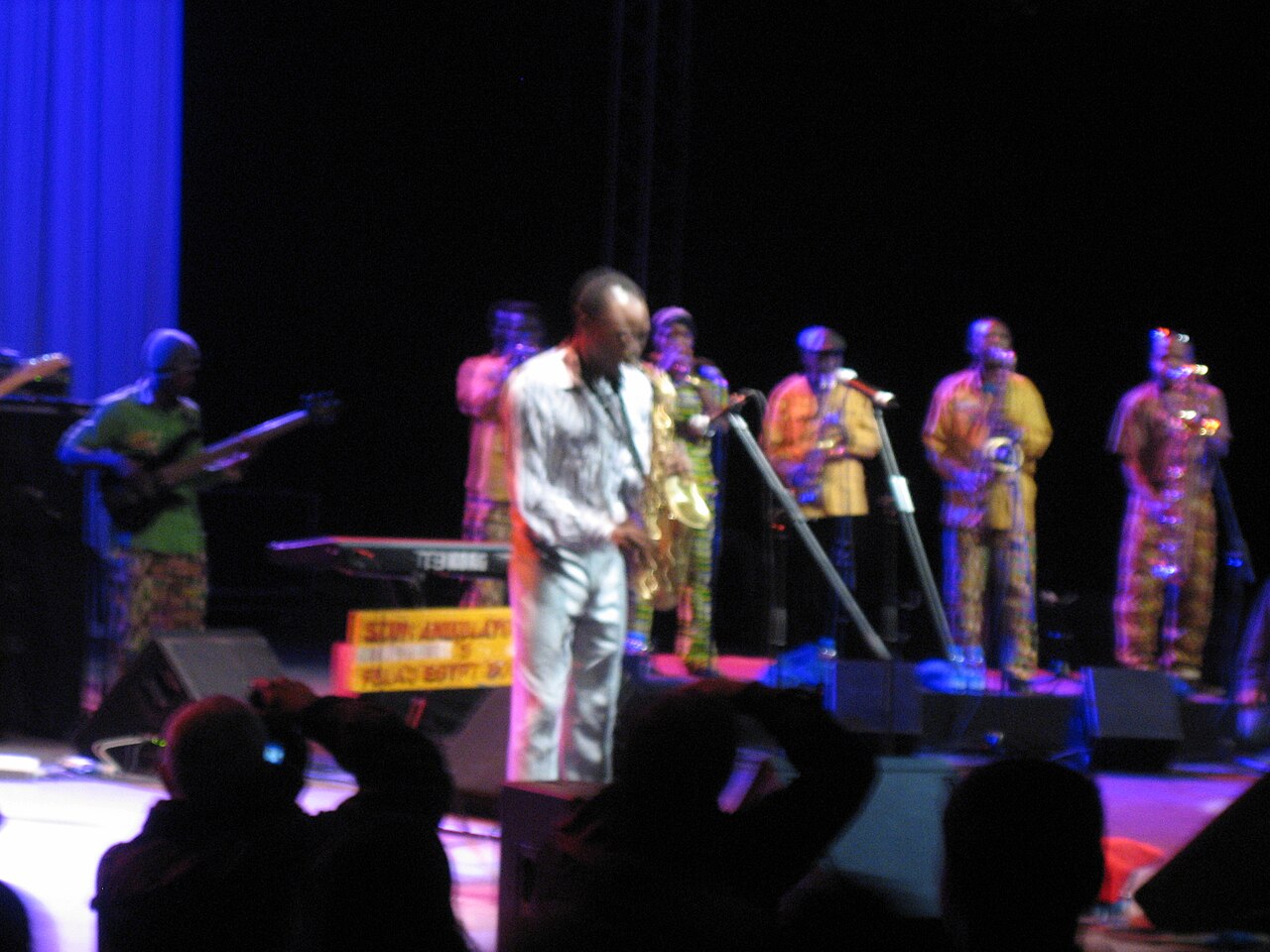
Fela’s bands featured two baritone saxophones, two tenor saxophones, two trumpets, and a trombone. The horns function as a call-and-response chorus, echoing Yoruba vocal traditions while delivering tightly arranged riffs that punctuate Fela’s own saxophone solos. The result is a wall of sound that feels both communal and martial.
Guitar and Keys: The Highlife DNA
Guitarists like Oghene Kologbo and keyboardists like Dele Sosimi played clipped, percussive lines rooted in highlife’s palm-wine style, layered over electric piano and organ. This texture gave Afrobeat its distinctly West African feel even when the rhythm leaned toward James Brown.
Vocals: Pidgin English as a Weapon
Fela sang in Nigerian Pidgin English and Yoruba, often using call-and-response with his chorus of female singers. Pidgin made his lyrics intelligible across ethnic lines and social classes — a deliberate choice for a man who wanted his message to travel.
Key Recordings: The Albums That Defined Fela Kuti Afrobeat
Fela’s discography is vast, but a handful of records stand as landmarks of the genre and of African music more broadly.
- “Zombie” (1976) — A blistering satire of Nigerian soldiers who follow orders without thought. The military regime banned it and raided Kalakuta in retaliation.
- “Expensive Shit” (1975) — Inspired by a police raid in which Fela allegedly swallowed a marijuana joint; the title track became a symbol of defiance.
- “Gentleman” (1973) — A critique of colonial mimicry and Western dress codes, delivered with a groove that refuses to sit still.
- “Water No Get Enemy” (1975) — A proverb-driven meditation on the unstoppable force of water, later sampled by artists from Mos Def to Burna Boy.
- “Teacher Don’t Teach Me Nonsense” (1986) — A late-career statement on education, colonialism, and self-knowledge.
Timeline: Fela Kuti’s Life and the Rise of Afrobeat
| Year | Event |
|---|---|
| 1938 | Fela Anikulapo Kuti born in Abeokuta, Nigeria |
| 1958 | Travels to London to study at Trinity College of Music |
| 1969 | Tours the United States; encounters Black Power movement |
| 1970–1971 | Forms Africa 70; establishes Kalakuta Republic in Lagos |
| 1977 | Military raid on Kalakuta; mother Funmilayo Ransome-Kuti dies from injuries |
| 1978 | Marries 27 women in a single ceremony; releases “Unknown Soldier” |
| 1986 | Releases “Teacher Don’t Teach Me Nonsense”; performs at Amnesty International concert |
| 1997 | Dies in Lagos on 2 August; hundreds of thousands attend funeral |
Why Was Fela Kuti Targeted by Nigeria’s Military Regimes?
Fela’s politics were not abstract. He named names. He accused Nigerian generals of corruption, condemned oil companies, and called out the hypocrisy of a post-independence elite that had replaced colonial rulers with local tyrants. His lyrics were in Pidgin, which meant the message reached market traders and taxi drivers as easily as university students.
The Kalakuta Raid of 1977
The most notorious assault came on 18 February 1977, when roughly a thousand soldiers stormed the Kalakuta Republic. Fela was beaten, his studio and instruments were destroyed, and his elderly mother was thrown from a window. Funmilayo Ransome-Kuti died weeks later from her injuries. Fela responded with the album “Coffin for Head of State” and a song titled “Unknown Soldier,” mocking the military’s claim that the raid was the work of unidentified assailants.
The 1979 Concert and the Run for President
After the raid, Fela and his band relocated briefly to Ghana, then returned to Lagos. In 1979, he staged a concert at the National Theatre in Lagos and later attempted to run for president of Nigeria under the banner of his own Movement of the People party. The military regime refused to register the party. Fela’s political career was blocked, but his cultural influence only deepened.
How Did Afrobeat Travel Beyond Nigeria?
Fela’s music reached global audiences through a combination of touring, record deals, and the advocacy of early champions. In 1986, he performed at the Amnesty International “Conspiracy of Hope” concert in Giants Stadium, New Jersey, alongside U2, Sting, and Peter Gabriel — a moment that introduced Afrobeat to millions of Western listeners.
Labels like Barclay in France and Knitting Factory in the United States reissued his catalog. DJs and producers in London and New York began sampling his records, and by the 1990s, Afrobeat had become a foundational influence on electronic music, jazz, and hip-hop.
The New Afrobeat Generation
In the 2010s, a new wave of Nigerian and diaspora artists — led by Fela’s own son, Seun Kuti, who fronts Egypt 80, and his elder son Femi Kuti, who leads the Positive Force — carried the sound forward. Artists like Burna Boy, Wizkid, and Davido have cited Fela as an influence, and Burna Boy’s 2019 album “African Giant” explicitly channels Fela’s pan-African spirit. Contemporary producers like Tony Allen (who died in 2020) continued to collaborate with international artists, keeping the Afrobeat rhythm alive in new contexts.
What Does Fela Kuti Afrobeat Mean Today?
Fela’s legacy is not just musical. It is a template for how artists can engage with power. In an era of streaming, social media, and global Afrobeats dominance, his example remains instructive: music can be both commercially successful and politically fearless.
- Political courage: Fela showed that artists can speak truth to power without sacrificing artistry.
- Pan-Africanism: His collaborations across West Africa and the diaspora anticipated today’s global African music networks.
- Institutional independence: Kalakuta Republic was a radical experiment in self-governance and artistic autonomy.
- Musical innovation: Afrobeat’s long-form, groove-based structure influenced genres from house to hip-hop.
The Kalakuta Museum and Ongoing Legacy
Today, the site of the Kalakuta Republic in Lagos is home to the Kalakuta Museum, where visitors can see Fela’s instruments, photographs, and personal effects. The Felabration festival, held annually in Lagos around his birthday in October, draws artists and fans from across Africa and the world. In 2021, Fela was posthumously inducted into the Rock and Roll Hall of Fame — a recognition that his sound had traveled far beyond the continent that birthed it.
Common Misconceptions About Fela Kuti and Afrobeat
As Afrobeat’s influence has grown, so has confusion about what it is and what it is not. Clarifying a few points helps separate the genre from its descendants.
Afrobeat vs. Afrobeats
The two terms are often conflated, but they describe different things. Afrobeat (singular) is Fela’s genre: long-form, horn-driven, politically charged, rooted in 1970s Lagos. Afrobeats (plural) is a contemporary West African pop movement that emerged in the 2010s, blending dancehall, hip-hop, R&B, and highlife into shorter, radio-friendly tracks. Burna Boy, Wizkid, and Davido are Afrobeats artists; Fela is the father of Afrobeat. The distinction matters because it honors both traditions.
Fela Was Not a Saint
Fela’s personal life was complicated. He was a serial polygamist, a heavy marijuana user, and a man whose relationships with women were often contentious. Acknowledging these complexities does not diminish his achievements; it makes his story more human and more instructive.
Why Fela Kuti Afrobeat Still Resonates Across Africa and the Diaspora
Walk through Lagos today and you will hear Afrobeat’s DNA in everything from street-corner speakers to high-end clubs. In London, Paris, and New York, DJs drop Fela tracks alongside contemporary Afrobeats, and the crowd responds the same way it did in the 1970s: bodies moving, fists raised.
Fela’s music endures because it was never just entertainment. It was a conversation between a man and his people, conducted through rhythm and horn. It was a refusal to accept that poverty, corruption, and dictatorship were inevitable. And it was a declaration — in Pidgin, in Yoruba, in the language of drums — that Africa’s voice would not be silenced.
For a generation of African artists now commanding global stages, Fela is both ancestor and challenge. His sound opened doors; his courage set the bar. The rebel sound he created in Lagos continues to echo wherever people gather to dance and to demand better.
The Lasting Perspective: A Sound That Refuses to Fade
Fela Kuti Afrobeat remains one of the most important cultural exports Africa has ever produced — not because it was polished for foreign ears, but because it was unapologetically local and, in being so, became universal. Fela took the rhythms of Yoruba drums, the swagger of highlife guitar, the discipline of jazz horns, and the funk of James Brown, and forged them into something that belonged to Lagos and to the world at once.
His story is a reminder that the most enduring art often comes from the most difficult circumstances. Military raids, censorship, and personal tragedy did not silence him; they sharpened his message. Today, as African music dominates global charts and African artists negotiate new forms of power and visibility, Fela’s example offers a clear lesson: the most powerful sound is the one that tells the truth.
Whether you are discovering “Zombie” for the first time or revisiting “Water No Get Enemy” for the hundredth, Fela’s music asks something of you. It asks you to listen closely, to move your body, and to think about the world you live in. That is the rebel sound — and it is still playing.