📅 Last updated: 04.11.2026
The Virunga Mountains rise like a green spine along the borders of Rwanda, Uganda, and the Democratic Republic of Congo (DRC), forming one of the most biologically rich volcanic ranges on Earth. Stretching roughly 80 kilometres across the Albertine Rift, this chain of eight major volcanoes holds the world’s last wild population of mountain gorillas. Trekking here is not a zoo visit or a safari drive — it is a disciplined, permit-controlled, guided hike into high-altitude rainforest to sit, briefly, among a family of great apes going about their morning.
The Virunga Mountains are a chain of eight major volcanoes spanning Rwanda, Uganda, and the DRC, and the only place on Earth where mountain gorillas live in the wild. Gorilla trekking takes place in four parks across these slopes — Volcanoes National Park (Rwanda), Mgahinga Gorilla National Park (Uganda), and Virunga and Kahuzi-Biega national parks (DRC) — under strict permit systems that cap visitor numbers and fund conservation. More than 1,000 mountain gorillas now survive, up from around 250 in the 1980s, and trekking revenue has been central to that recovery.
- Where exactly are the Virunga Mountains?
- Why the Virunga Mountains are the only home of the mountain gorilla
- Trekking the Virunga Mountains: how the four parks compare
- What a gorilla trek actually involves
- Conservation, communities, and the economics of a permit
- Beyond the gorillas: what else the Virunga Mountains offer
- When to go and how to plan
- Why the Virunga Mountains still matter
Where exactly are the Virunga Mountains?
The range runs east to west along the junction of three national borders, from the low volcanic fields near Rwanda’s Musanze district westward toward Lake Kivu and the DRC’s North Kivu province. Eight principal summits define the chain: Mount Karisimbi (4,507 m, the highest), Mount Mikeno, Mount Muhabura, Mount Bisoke, Mount Sabyinyo, Mount Gahinga, Mount Nyiragongo, and Mount Nyamuragira. The last two are among the most active volcanoes in Africa; Nyiragongo’s lava lake has drawn volcanologists and, more recently, hikers to its crater rim when conditions allow.
Altitude matters enormously here. The gorilla habitat sits between roughly 2,200 and 4,300 metres, and treks can involve hours of walking through stinging nettles, bamboo, and mud at gradients that leave even fit visitors breathless. The vegetation shifts as you climb: cultivated foothills give way to Hagenia woodland, then bamboo, then open Afro-alpine moorland dotted with giant lobelia and groundsels.
Why the volcanoes matter beyond the gorillas
The Virunga massif anchors the Albertine Rift, a biodiversity hotspot that also shelters golden monkeys, forest elephants, chimpanzees, and more than 300 bird species. The volcanic soils make the surrounding highlands some of the most fertile farmland in Central Africa — the terraced hills around Musanze grow potatoes, pyrethrum, and maize in profusion. The mountains are a working landscape as much as a wilderness, and trekking revenue is one thread in a larger economy of farming, tourism, and hydropower (the region’s rivers feed several small plants).
Why the Virunga Mountains are the only home of the mountain gorilla
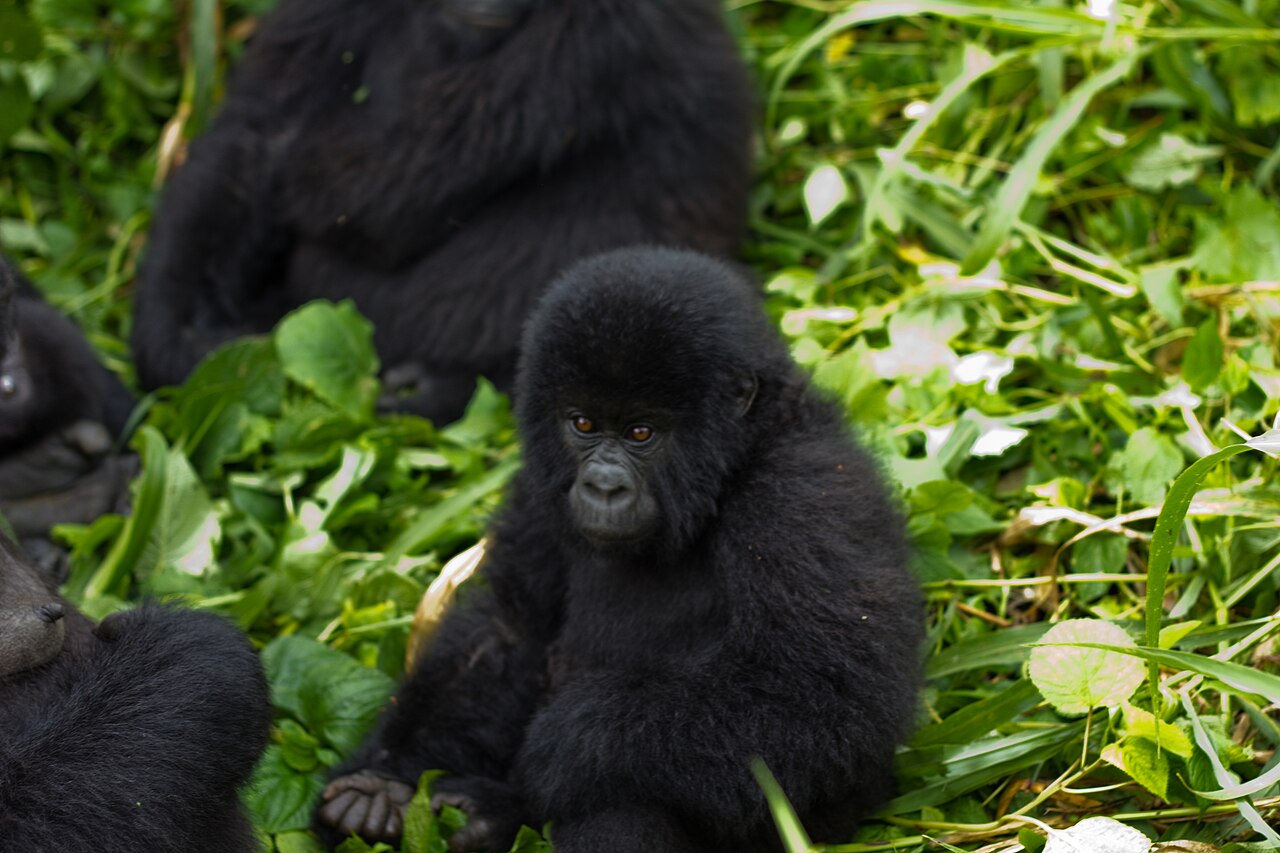
Mountain gorillas (Gorilla beringei beringei) exist nowhere else. The entire wild population is split between two isolated blocks: the Virunga massif, shared by Rwanda, Uganda, and the DRC, and the Bwindi Impenetrable Forest in Uganda. The Virunga population has been counted systematically since the 1970s, and the most recent full census, published in 2019, put the Virunga massif at 604 individuals — up from 480 in 2010. Combined with Bwindi’s roughly 460 gorillas, the global total now exceeds 1,000.
That number is a genuine conservation success, and it was not inevitable. In the 1970s and 1980s, poaching for the live-animal trade and for trophies, combined with habitat loss to farmland, pushed the population toward collapse. The turning point came through a mix of armed ranger patrols, veterinary intervention, and — critically — tourism revenue that gave governments and communities a financial stake in the animals’ survival. The Dian Fossey Gorilla Fund, founded by Fossey in 1967 and now headquartered in Atlanta and Musanze, has tracked individual gorillas for more than five decades, building the demographic dataset that underpins modern management.
The gorilla families visitors actually meet
Gorillas live in family groups led by a dominant silverback, typically numbering 10 to 30 animals. Each habituated family — accustomed over years to the calm presence of humans — is visited by a maximum of eight tourists per day for one hour. Rwanda’s Volcanoes National Park manages around a dozen habituated families; Uganda’s Mgahinga has one (the Nyakagezi group, which occasionally wanders across the border into the DRC); and Virunga National Park in the DRC operates a smaller, more restricted programme centred on the southern sector.
The one-hour rule is not arbitrary. Primates are vulnerable to human respiratory disease, and close contact is limited to reduce transmission risk. Visitors with colds or fevers are turned away at the trailhead, and a minimum distance of seven metres from the gorillas is enforced — though curious juveniles sometimes close the gap anyway, which is part of the experience.
Trekking the Virunga Mountains: how the four parks compare
Permits, prices, and logistics differ sharply between the three countries, and the choice shapes the whole trip. Rwanda runs the most polished operation; Uganda offers a lower price and the option of combining gorillas with savannah safaris; the DRC offers the wildest experience at the lowest cost, tempered by security considerations that require careful, current advice.
| Park & country | Gorilla families (approx.) | Permit price (USD) | Access & notes |
|---|---|---|---|
| Volcanoes National Park, Rwanda | 12+ habituated | 1,500 | 2–3 hours’ drive from Kigali; daily treks; optional golden monkey and Mount Bisoke hikes |
| Mgahinga Gorilla National Park, Uganda | 1 (Nyakagezi) | 800 | Near Kisoro; often combined with Bwindi treks and Queen Elizabeth National Park |
| Bwindi Impenetrable Forest, Uganda | 20+ habituated | 800 | The larger Ugandan option; four trailhead sectors; not part of the Virunga chain but the same species |
| Virunga National Park, DRC | A handful (southern sector) | 400–450 | Access via Goma; security situation must be verified before travel; ranger programme is renowned |
| Kahuzi-Biega National Park, DRC | Eastern lowland gorilla groups | 400 | Near Bukavu; a different subspecies (Gorilla beringei graueri), not mountain gorillas |
Prices change — Rwanda raised its permit from $750 to $1,500 in 2017 — so confirm current rates with the national tourism boards before booking. Permits sell out months ahead in peak season (June–September and December–February), and in Rwanda they are best secured through the Rwanda Development Board or a licensed tour operator.
What a gorilla trek actually involves
Treks begin early, usually around 7 a.m., at a park headquarters where visitors are assigned to families based on fitness and preference. Trackers who spent the previous afternoon with each family radio in its overnight location, and guides then lead groups up the slopes — sometimes 30 minutes, sometimes four hours, depending on where the gorillas have moved. Porters carry bags and, on steep sections, help push and pull; hiring one is customary and supports local livelihoods.
Once the trackers signal the family’s position, visitors leave their walking sticks, lower their voices, and follow the guide into the vegetation. The encounter is quiet and close. Silverbacks may charge — a bluff display of chest-beating and a rush that stops short — and the rule is to stay still, avoid eye contact, and let the guide manage the situation. Infants tumble from branch to branch; juveniles show off; the silverback eats and watches.
Practical preparation
- Fitness: Treks range from gentle to genuinely strenuous; the altitude (2,500–3,000 m at trailheads) is the real challenge. Request a closer family if you have doubts.
- Gear: Broken-in hiking boots, long trousers tucked into socks (nettles and ants), gardening gloves, rain jacket, and gaiters. Porters rent gloves and sticks at the trailhead.
- Health: A yellow fever certificate is required for entry to Rwanda and Uganda; carry a mask for the close encounter and cancel if you are unwell.
- Photography: No flash. Low light under the canopy means fast lenses help; a guide will position you for a clear view.
Conservation, communities, and the economics of a permit
Gorilla tourism is one of the clearest cases in Africa where a high-value, low-volume model has demonstrably funded conservation. In Rwanda, a portion of permit revenue goes to park management and to a community development fund that has built schools, water tanks, and roads around the park boundary. Uganda’s revenue-sharing arrangements channel a percentage of park income to local governments. In the DRC, Virunga National Park’s ranger force — around 600 strong — has operated through years of armed conflict, and tourism revenue, when it flows, helps pay salaries.
The model has critics. Habituation carries disease risk, and the one-hour rule is a compromise rather than a guarantee. Community compensation for crop raiding by buffalo and elephants remains contentious. But the demographic trend is hard to argue with: mountain gorilla numbers have roughly quadrupled since the 1980s, and the IUCN downgraded the subspecies from Critically Endangered to Endangered in 2018.
Responsible trekking checklist
- Book through operators that employ local guides and porters and pay fair wages.
- Keep the seven-metre distance, even when a juvenile approaches.
- Never visit if you have a cough, cold, or fever — gorillas share our respiratory vulnerabilities.
- Support community-run lodges and cooperatives around Musanze, Kisoro, and Goma where possible.
Beyond the gorillas: what else the Virunga Mountains offer
Rwanda’s Volcanoes National Park runs a golden monkey trek, a hike to Mount Bisoke’s crater lake, and the popular Dian Fossey hike to the Karisoke Research Center site where the primatologist worked and is buried beside her favourite gorilla, Digit. Uganda’s Mgahinga offers the Sabyinyo summit climb — a three-peak scramble straddling the Uganda–Rwanda–DRC border — and Batwa cultural experiences led by the Indigenous community displaced from the forest when the park was gazetted in 1991.
In the DRC, Virunga National Park’s southern sector includes the Nyiragongo crater hike, when open, and the Tchegera Island camp on Lake Kivu. The park’s broader landscape — Africa’s oldest national park, established in 1925 — stretches north through savannah and forest toward the Rwenzori foothills, though large areas remain closed to visitors for security reasons. Travellers considering the DRC should check their government’s current travel advisories and work with operators who have demonstrated safety protocols.
When to go and how to plan
Dry seasons — June to September and December to February — offer the best trail conditions, but the Virunga Mountains are rainforest, and rain can fall any month. The wetter months (March–May, October–November) bring fewer visitors and cheaper lodging, at the cost of mud and leeches. Mornings are usually clearer than afternoons, which is one reason treks start early.
A typical trip pairs two or three nights near the trailhead with a broader itinerary: Kigali’s genocide memorial and craft markets, Lake Kivu’s shores, or Uganda’s Queen Elizabeth National Park for tree-climbing lions and boat safaris on the Kazinga Channel. Flights into Kigali or Entebbe are the usual entry points; road transfers to Musanze take about two and a half hours from Kigali.
Why the Virunga Mountains still matter
The Virunga Mountains are a rare thing: a place where a species was pulled back from the edge, and where the mechanism of that recovery — careful, paid, regulated human attention — is visible in the faces of the rangers, trackers, porters, and hoteliers who depend on it. The gorillas themselves are indifferent to the economics. They eat, groom, and raise their young on the same slopes their ancestors used, and the volcanoes above them continue to smoke and, occasionally, erupt. What visitors carry home is not just a photograph but a sense of how close the whole arrangement came to failing, and how deliberately it was rebuilt. Go with respect, go with the right operator, and go knowing that the permit in your pocket is part of the reason the forest still has gorillas in it.