📅 Last updated: 04.11.2026
Kora music is one of West Africa’s most sophisticated and globally resonant traditions — a living art form carried by families of hereditary musicians across the Sahel for centuries and now heard everywhere from Bamako courtyards to London concert halls and Grammy-winning albums. Played on a 21-string harp-lute built from a halved calabash gourd, cowhide, and nylon or antelope-gut strings, it produces a rippling, harp-like sound that has travelled from the courts of Mandinka kings to the world stage.
The kora is a 21-string harp-lute of the Mandinka people, played across Mali, Senegal, The Gambia, Guinea, Guinea-Bissau and Mauritania. It is central to the jali (griot) tradition, in which hereditary musician-storytellers preserve genealogies, epics such as Sunjata, and praise songs. The kora is classified as a “harp-lute” because its strings run from a notched bridge to a neck, combining harp and lute features.
- What Exactly Is the Kora, and Why Is It Called a Harp-Lute?
- Who Plays Kora Music? The Jali Tradition and Its Hereditary Roots
- A Short History of Kora Music: From Mande Courts to Global Stages
- How Is Kora Music Played? Technique, Tuning, and the Art of the Ostinato
- Which Artists Define Kora Music Today?
- How Has Kora Music Shaped Global Music?
- What Does Kora Music Sound Like in the 21st Century?
- Why the Kora Still Matters
What Exactly Is the Kora, and Why Is It Called a Harp-Lute?
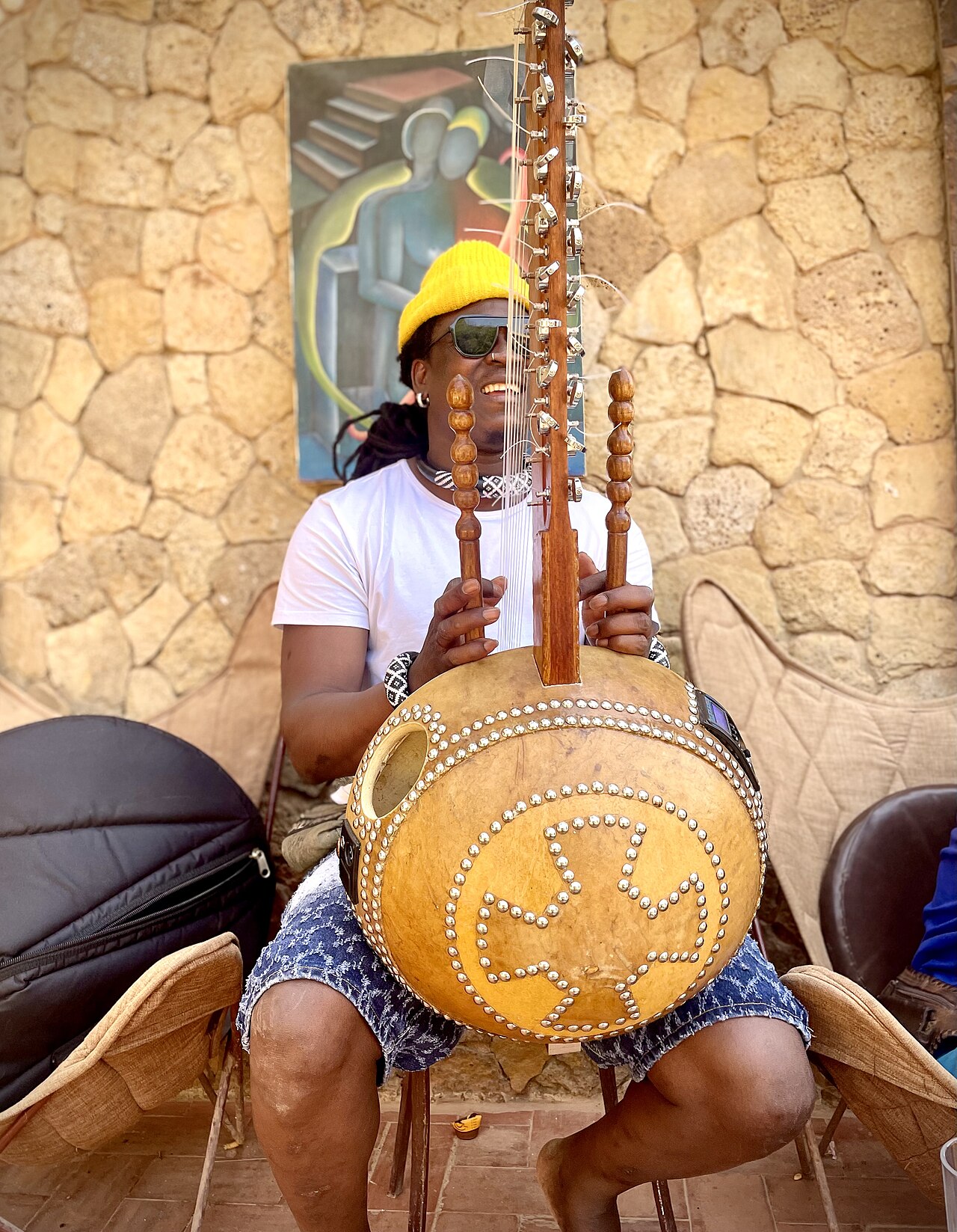
The kora belongs to a small family of West African stringed instruments that ethnomusicologists classify as “harp-lutes” — a hybrid category that describes how the strings are arranged. On a true harp, strings attach directly to the soundboard; on a lute, they run along a neck and are stopped against a fingerboard. The kora does both: its 21 strings pass over a tall, notched bridge (like a harp) and run up a wooden neck, where they are tied to tuning rings (like a lute). The player plucks with the thumbs and index fingers of both hands, and the remaining fingers grip two vertical handholds on either side of the strings.
Physically, the instrument is built around a large, round calabash gourd (the calebash or hale) cut in half, hollowed out, and covered with cowhide — traditionally fresh hide stretched and pegged tight as it dries. A hardwood neck (dandal) passes through the gourd, and the strings run from the neck down to the bridge, which sits on the hide soundboard. The bridge is the instrument’s acoustic heart: its notches divide each string’s length, so that plucking a string produces a note on one side and a higher note on the other. This is why a 21-string kora can produce a range of melody and bass patterns that sounds like two or three instruments playing at once.
Strings, Tuning, and Range
Historically, kora strings were made from twisted antelope hide or fine leather; today most players use nylon fishing line, which is durable, cheap, and available in any market town from Casamance to Banjul. The instrument is tuned to a heptatonic (seven-note) scale, and different regions use different tunings — the sauta, silaba, and tomora tunings are the best known, each associated with particular repertoires and moods. The kora’s range spans roughly three to four octaves, and its sound has been described as resembling a harp crossed with a lute and, in the hands of a master, a small orchestra.
Who Plays Kora Music? The Jali Tradition and Its Hereditary Roots
Kora music is inseparable from the jaliya tradition — the craft of the jali (plural jalolu), known in French as griot. Among the Mandinka and related Mande peoples, jali status is hereditary, passed through specific lineages such as the Kouyaté, Diabaté, Sissoko, Jobarteh (also spelled Jobarteh or Jabateh), and Cissokho families. A jali is not simply a musician: the role combines historian, genealogist, praise-singer, diplomat, mediator, and news-carrier. In pre-colonial Mande society, a jali accompanied a noble patron, recited his ancestry, settled disputes, and preserved the oral constitution of the community.
The most famous jali epic is Sunjata (also spelled Sundiata), the foundation narrative of the Mali Empire, which recounts the life of Sunjata Keita, who defeated the Sosso king Sumanguru Kanté at the Battle of Kirina around 1235 and established Mali’s dominance in the western Sahel. Jali lineages trace their ancestral instrument — the kora itself — to a spirit or genius named Jali Mady Wuleng, and the instrument’s origin story is recited as part of the repertoire. When a jali performs, he or she is not merely entertaining: the performance is a form of record-keeping, and the audience’s recognition of a lineage name can trigger gifts, tears, and dancing.
- Jali lineages: Kouyaté, Diabaté, Sissoko, Jobarteh, Cissokho, and Suso families dominate kora performance across the Senegambia and Mali.
- Core repertoire: Epics (Sunjata, Lambango), praise songs for patrons, and instrumental pieces such as Kaira and Jarabi.
- Performance context: Naming ceremonies, weddings, Islamic holidays, harvest celebrations, and, increasingly, international concert tours.
A Short History of Kora Music: From Mande Courts to Global Stages
The kora’s precise origins are debated, but most scholars place its emergence in the Mande heartland — the region spanning modern Mali, Guinea, and The Gambia — sometime between the 16th and 18th centuries, evolving from earlier harp-lute traditions such as the bolon and the simbi. Its spread followed the migration of Mandinka communities down the Gambia River and into the Casamance region of southern Senegal and Guinea-Bissau, where it remains central to local musical life.
| Period | Key Development |
|---|---|
| c. 13th century | Mali Empire founded after the Battle of Kirina; jali tradition consolidates around royal courts. |
| 16th–18th centuries | Kora emerges and spreads along the Gambia River and into Casamance; tuning systems and repertoire formalize. |
| 1970s | Jali Foday Musa Suso and others bring kora music to European and American audiences; the instrument enters world music circuits. |
| 1980s–1990s | Toumani Diabaté’s solo kora recordings redefine the instrument’s possibilities; kora appears on pop and jazz records. |
| 2000s–present | Kora players win Grammy Awards; festivals such as the Kora Awards and Gambia’s kora gatherings celebrate the instrument; digital amplification and fusion projects expand its reach. |
The 20th century transformed the kora’s audience. Radio, recording, and migration brought jali musicians to Dakar, Abidjan, Paris, London, and New York. In 1970, the Gambian jali Alhaji Bai Konte recorded Bai Konte for the American label Rounder Records, one of the first widely distributed kora albums in the West. His son Dembo Konte and the British musician Adam Rudolph later collaborated across continents. In the 1980s, Foday Musa Suso, a Gambian jali, worked with Herbie Hancock and Philip Glass, and in 1984 co-composed the score for the film The Killing Fields with Glass — a landmark moment for the instrument in Western contemporary music.
How Is Kora Music Played? Technique, Tuning, and the Art of the Ostinato
Kora technique is built on the independence of the hands. The player’s thumbs carry the bass and middle-register ostinato patterns — repeating figures that anchor the harmony — while the index fingers pick out melodic lines and ornaments in the upper register. The two remaining fingers of each hand grip the instrument’s vertical handles, leaving the thumbs and index fingers free. Because the bridge divides each string, a single string can yield two pitches, and skilled players exploit this to create interlocking textures that sound like multiple parts.
The kora’s tuning is not standardized in the Western sense. The tomora tuning, associated with the western Mande repertoire, is the most common; the sauta tuning is used for certain praise songs; and the silaba tuning appears in specific regional repertoires. Players retune by sliding leather or nylon rings up and down the neck, and a single performance may involve retuning between pieces. This flexibility is one reason the kora adapts so readily to jazz, flamenco, and pop collaborations.
Learning the Kora
Traditionally, kora study began in childhood within jali families, with apprentices learning by ear and by imitation, often starting on a smaller instrument or a single-string practice stick. Today, formal instruction exists alongside the hereditary path: the École Nationale des Arts in Dakar, the Kora Workshop in The Gambia, and private teaching in Bamako and Conakry train players from non-jali backgrounds. Instruments are also built by specialist craftsmen — often in the Casamance region of Senegal and in The Gambia — and a well-made kora can take weeks to construct and cost several hundred dollars.
Which Artists Define Kora Music Today?
Modern kora music is defined by a generation of players who have both preserved the jali repertoire and pushed the instrument into new territory. Toumani Diabaté, born in Bamako in 1965 into a jali family (his father was Sidiki Diabaté, a legendary kora player), is widely regarded as the instrument’s greatest living virtuoso. His 1987 solo album Kaira demonstrated that the kora could sustain a full solo concert, and his collaborations with the Spanish flamenco group Ketama (Songhai, 1988) and with the American blues musician Taj Mahal (Kulanjan, 1999) showed the instrument’s range across genres. In 2006, Diabaté won a Grammy Award for In the Heart of the Moon, a duo album with the Malian guitarist Ali Farka Touré.
Other essential figures include:
- Ballaké Sissoko (Mali) — a classically trained jali whose duo work with the French cellist Vincent Ségal (Chamber Music, 2009) and his solo albums have brought the kora into contemporary classical and chamber-music settings.
- Sona Jobarteh (The Gambia/UK) — the first widely recognized female kora virtuoso from a jali lineage, a composer and educator whose 2020 album Badinyaa Kumoo blends Mandinka tradition with modern production.
- Foday Musa Suso (The Gambia/US) — a pioneer of kora fusion who collaborated with Herbie Hancock, Philip Glass, and the Kronos Quartet.
- Seckou Keita (Senegal/UK) — a Senegalese kora player known for cross-cultural projects, including work with the Welsh harpist Catrin Finch.
- Mamadou Diabaté (Mali/US) — a Grammy-nominated player based in New York who has recorded extensively with Western jazz and folk musicians.
Women’s participation deserves particular note. The jali tradition has historically been male-dominated in kora performance, but artists such as Sona Jobarteh, the Gambian singer and kora player N’Faly Kouyaté’s ensembles, and a growing number of female students in Dakar and Banjul are reshaping the instrument’s gender profile — a shift that is both artistically and socially significant.
How Has Kora Music Shaped Global Music?
The kora’s influence on global music runs deeper than most listeners realize. Its rippling, arpeggiated textures and its role as a melodic and harmonic engine have drawn comparisons to the harp, the guitar, and the piano, and musicians from outside West Africa have repeatedly turned to it for inspiration. The American banjo, often traced to West African lute traditions, shares a distant ancestor with the kora’s string-and-gourd construction; the blues guitarist Ali Farka Touré, a Malian, described the kora’s patterns as a foundation for the music he grew up hearing.
In the 1990s and 2000s, kora players became regular collaborators in world music, jazz, and contemporary classical scenes. Toumani Diabaté’s Boulevard de l’Indépendance (2006) paired him with the Brazilian guitarist Kassin and other collaborators; Ballaké Sissoko’s work with Vincent Ségal earned widespread critical praise; and the kora has appeared on film scores, in video-game soundtracks, and in the work of Western composers who study its tuning systems. In 2019, the kora was featured prominently in the soundtrack of the acclaimed film Atlantics by the Senegalese director Mati Diop, bringing its sound to a new generation of cinema audiences.
Festivals and institutions have also institutionalized the instrument’s global presence. The Kora Awards, founded in 1994 and based in Abidjan and later Burkina Faso, celebrate African music across the continent and take their name from the instrument. In The Gambia, the annual Kora Music Festival and the Kora Workshop draw players and students from Europe and North America. In Mali, the Festival on the Niger in Ségou and the Bamako encounters (Rencontres) have hosted kora performances alongside other Mande traditions.
What Does Kora Music Sound Like in the 21st Century?
Contemporary kora music is a wide field. At one end sits the classical jali repertoire — long, meditative solo performances of pieces such as Kaira, Jarabi, and Lambango, often performed at ceremonies and now also in concert halls. At the other end are fusion projects that place the kora alongside electronics, orchestras, and pop production. Sona Jobarteh’s Badinyaa Kumoo (2020) combines Mandinka lyrics and kora lines with bass, drums, and modern mixing; Seckou Keita’s duo albums with Catrin Finch (Clychau, 2018) pair kora and Welsh harp in a cross-cultural dialogue; and younger players in Dakar and Bamako experiment with hip-hop and R&B rhythms while keeping the instrument’s tuning and technique intact.
Digital technology has changed access as well as sound. YouTube tutorials, online lessons, and social media have made kora technique visible to students worldwide, and luthiers in The Gambia and Senegal now ship instruments internationally. At the same time, jali families continue to transmit the repertoire orally, and the instrument’s ceremonial role — at naming ceremonies, weddings, and funerals — remains central in Senegambian communities. The tension between preservation and innovation is not a crisis but a characteristic of the tradition: the kora has always absorbed new influences, from the introduction of nylon strings to the adoption of amplification.
- For listeners new to kora music: start with Toumani Diabaté’s Kaira (1987) and In the Heart of the Moon (2005), then explore Ballaké Sissoko’s Chamber Music (2009).
- For live experiences: the Kora Music Festival in The Gambia and the Festival on the Niger in Ségou, Mali, offer the instrument in its ceremonial and concert contexts.
- For students: the Kora Workshop (The Gambia) and the École Nationale des Arts (Dakar) offer formal instruction, while online resources make basic technique accessible anywhere.
Why the Kora Still Matters
The kora is more than an instrument: it is an archive. Its strings carry genealogies, epics, and the memory of empires, and its players are trained to remember what written records elsewhere forgot. In a continent whose cultural contributions are too often reduced to a handful of export genres, kora music stands as a reminder of the depth and sophistication of West African musical thought — a tradition that produced complex tuning systems, virtuosic technique, and a professional class of musicians centuries before the recording industry existed.
That tradition is not frozen. It is being carried forward by jali families in Banjul and Bamako, by female virtuosos challenging old exclusions, by fusion artists in London and Paris, and by students who first encounter the instrument on a screen. The kora’s sound — rippling, bright, and unmistakably West African — continues to travel, and each generation of players adds a new chapter to a story that began in the courts of the Mali Empire and shows no sign of ending.