📅 Last updated: 02.11.2026
The Okavango Delta is the world’s largest inland delta, a 15,000-square-kilometre labyrinth of channels, lagoons, floodplains and islands that fans across northwestern Botswana without ever reaching the sea. Every year, water that fell as rain in the highlands of Angola takes months to travel south, arriving in the Kalahari at the height of the dry season and transforming a parched landscape into one of the richest wildlife habitats on Earth. It is a place where the physics of a river and the patience of geology have conspired to create something close to a miracle.
The Okavango Delta is an alluvial fan in northwestern Botswana where the Okavango River, having travelled some 1,600 kilometres from Angola’s highlands, spreads across the Kalahari Desert and evaporates rather than reaching the sea. Covering roughly 15,000 square kilometres at peak flood, it was declared a UNESCO World Heritage Site in 2014 and is one of the largest freshwater wetlands on the planet. It supports exceptional concentrations of elephant, buffalo, lion, wild dog, lechwe and more than 400 bird species.
- Where exactly is the Okavango Delta, and why does it end in the desert?
- What wildlife makes the Okavango Delta extraordinary?
- Who lives in and around the Okavango Delta?
- A short timeline of the Okavango Delta
- How is the Okavango Delta protected — and what threatens it?
- How do you experience the Okavango Delta?
- Why the Okavango Delta matters far beyond Botswana
- A lasting perspective on the Okavango Delta
Where exactly is the Okavango Delta, and why does it end in the desert?
The delta lies in the Ngamiland district of northwestern Botswana, anchored by the town of Maun — a bustling frontier town of about 60,000 people that has grown from a cattle-and-trading outpost into the gateway for the country’s entire safari economy. The water arrives via the Okavango River, which rises in the Angolan highlands near Huambo, flows south through Namibia’s Caprivi Strip, and crosses into Botswana at Mohembo.
What happens next is a lesson in hydrology. The river enters the Kalahari Basin, a vast geological depression created by tectonic movement along the Okavango Rift Zone. The land here is extraordinarily flat — the gradient across the delta averages roughly 1:3,000, meaning the water drops only about a metre for every three kilometres travelled. Confronted with this near-level plain and the hot, dry air above it, the river cannot carve a single channel to the sea. Instead it braids, splits and spreads, depositing sediment, building islands, and ultimately losing almost all its volume to evaporation and transpiration by plants. Roughly 95 per cent of the water that enters the delta never leaves it as liquid.
The flood that arrives in the dry season
Here is the counterintuitive detail that defines the Okavango: its flood peaks in the dry winter months. Angola’s rainy season runs from roughly December to March. That water takes months to percolate through the system and travel the length of the river, so the flood front typically reaches the panhandle around March and spreads across the lower delta between June and August — precisely when the surrounding Kalahari is at its driest. Local rainfall (about 450 mm a year, falling mostly between December and March) and the distant Angolan flood thus arrive out of phase, giving the delta two pulses of water and an unusually long season of abundance.
What wildlife makes the Okavango Delta extraordinary?
The delta’s ecological productivity is staggering, and it is best understood through its seasons and habitats rather than a simple species list.
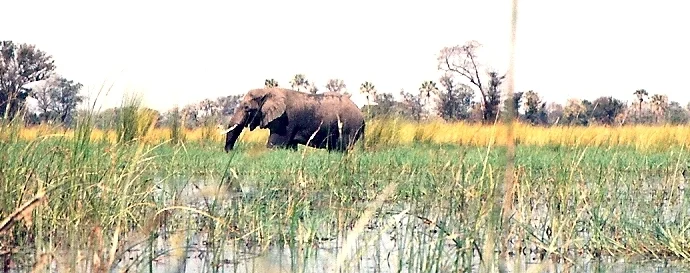
Botswana holds the largest elephant population in the world, estimated at around 130,000 animals in the most recent comprehensive surveys, and a substantial share of them move through the Okavango and the adjoining Chobe–Linyanti system. The delta’s floodplains are prime habitat for the red lechwe, an antelope with splayed hooves adapted to sprinting through shallow water; the Moremi Game Reserve and the seasonal grasslands around Chief’s Island support tens of thousands. African wild dogs — among the continent’s most endangered large carnivores, with only a few thousand adults remaining worldwide — den and hunt across the delta’s northern reaches, and the Okavango is one of the most reliable places on Earth to see them. Lion, leopard, cheetah, spotted hyena, sable antelope, giraffe, hippo and Nile crocodile are all resident.
The birdlife of a water wilderness
More than 400 bird species have been recorded in the delta. The Okavango is a stronghold for the African fish eagle, whose call is the unofficial soundtrack of the region; for wattled cranes, slaty egrets, African skimmers and Pel’s fishing owl. Herons, egrets, storks and ibises gather in enormous breeding colonies at places like the Godikwe lagoon, where thousands of birds nest in the papyrus and reed beds.
Chief’s Island and the Moremi Game Reserve
Chief’s Island, the largest landmass in the delta at roughly 1,000 square kilometres, was formed by sediment accumulation over millennia and is named for Chief Moremi III of the Batawana, the Tswana people whose territory this is. In 1963, in a decision that shaped conservation history, the Batawana tribal authority set aside the Moremi Game Reserve — named for Chief Moremi — becoming one of the first communities in Africa to voluntarily protect land for wildlife. Moremi now covers around 5,000 square kilometres of the eastern delta and remains the only officially protected game reserve within the delta itself.
Who lives in and around the Okavango Delta?
The delta is not empty wilderness. It is home to the Wayeyi (Bayei), Hambukushu, Sekgalagadi, Bugakwe and other communities, alongside Herero pastoralists who arrived in the early twentieth century, and the Batawana, the dominant Tswana group of the region.
The Hambukushu are renowned reed-and-thatch craftspeople and fishermen; the Wayeyi have long practised fishing and farming along the channels. The Bugakwe, sometimes called River Bushmen, maintain deep knowledge of the delta’s waterways. The traditional mokoro — a dugout canoe once carved from ebony or sausage-tree trunks, now increasingly made from fibreglass to protect slow-growing hardwoods — remains an emblem of local navigation and is still poled through the shallows by guides whose families have done so for generations.
This human presence is not incidental to conservation; it is central to it. Community trusts and joint-venture arrangements, in which villages lease land to safari operators and share the revenue, underpin much of the modern delta economy. The Okavango Community Trust and similar bodies in the panhandle have used tourism income to fund schools, clinics and scholarships — a model studied across southern Africa.
A short timeline of the Okavango Delta
The delta’s story spans deep geological time and a remarkably compressed modern history of protection.
| Period | Key development |
|---|---|
| c. 2–3 million years ago | Tectonic activity along the Okavango Rift Zone shapes the Kalahari Basin; the river’s course and the delta’s fan begin to form. |
| 18th–19th centuries | Batawana and other Tswana groups consolidate control of Ngamiland; Maun emerges as an administrative and trading centre. |
| 1963 | The Batawana tribal authority establishes the Moremi Game Reserve — one of Africa’s first community-initiated protected areas. |
| 1996 | Botswana and riparian states formalise transboundary water cooperation through the Okavango River Basin Water Commission (OKACOM). |
| 2014 | The Okavango Delta is inscribed as UNESCO’s 1,000th World Heritage Site. |
| 2020s | Botswana bans elephant hunting on public land (2019) and expands community-based tourism; oil and gas exploration in the Angolan catchment raises transboundary concerns. |
How is the Okavango Delta protected — and what threatens it?
Botswana’s conservation record is among the strongest in Africa, built on a simple economic logic: wildlife pays. Tourism is the country’s second-largest foreign-exchange earner after diamonds, and the high-value, low-volume safari model — small camps, strict vehicle limits, no off-road driving in many areas — has kept the delta’s core remarkably intact.
Yet the threats are real and mostly upstream. The Okavango’s water originates in Angola, a country rebuilding after decades of civil war and pursuing irrigation, hydropower and, controversially, oil and gas exploration in the Cubango-Okavango basin. Namibia has long discussed water-transfer schemes from the river. Any large-scale abstraction in Angola or Namibia could reduce the flood that sustains the delta. The Okavango River Basin Water Commission (OKACOM), established in 1994 and formalised by the three states in 1996, provides the diplomatic framework for managing these competing demands — but it depends on political will.
Climate change adds pressure. Higher temperatures increase evaporation from the delta’s vast shallow surfaces; altered rainfall patterns in Angola could shift the timing and volume of the flood. Meanwhile, the delta’s growing elephant population — a consequence of protection and of poaching pressure elsewhere — places strain on vegetation in some areas, a debate that divides conservationists.
- Upstream water use: irrigation and hydropower development in Angola’s catchment is the single largest long-term risk to the delta’s flow.
- Oil and gas exploration: prospecting in the Cubango-Okavango basin has drawn international concern over pollution and habitat fragmentation.
- Climate shifts: rising temperatures increase evaporation losses and could disrupt the timing of the annual flood.
- Tourism pressure: while tightly regulated, the growth of lodges and air traffic requires careful carrying-capacity management.
How do you experience the Okavango Delta?
Most visitors fly into Maun’s international airport and transfer by light aircraft to bush camps — the small Cessna Caravan is the workhorse of the delta. From the air, the delta reveals its true structure: pale channels winding between green floodplains and termite-mound islands fringed with palms.
Water and land activities
The classic delta experience combines three modes. Mokoro excursions glide silently through lily-covered channels, guided by polers who read the water with their eyes and ears. Motorised boat safaris reach deeper lagoons and bird colonies. Game drives — in open 4×4 vehicles — track predators and herds across the islands and floodplains. Many camps add guided walks, and the seasonal water levels determine which activities are possible: the “wet” delta in the north and west (around the Panhandle, Moremi and Chief’s Island) contrasts with the drier reaches of the south and east.
When to go
The peak flood months of June to August coincide with the dry season and offer superb game viewing as animals concentrate around water. September and October are hotter and drier, with predators easier to spot but water levels falling. The green season, from December to March, brings dramatic skies, calving herds, newborn animals and excellent birdwatching — at lower prices.
- Best for wildlife: July to October, when flood and dry season overlap.
- Best for birds: November to March, when migrants arrive and breeding colonies are active.
- Best for value: the green season, with lush scenery and fewer visitors.
Why the Okavango Delta matters far beyond Botswana
The delta is a global reference point for what conservation can achieve when it is economically rational, locally owned and scientifically managed. It is also a living laboratory. Hydrologists from the University of Botswana, the Okavango Research Institute in Maun and international partners monitor its channels and groundwater; ecologists study the delta’s role as a carbon sink and as a corridor for wildlife moving between Angola, Namibia, Botswana and Zambia.
The delta’s Ramsar designation (it was listed as a Wetland of International Importance in 1996) and its 2014 World Heritage inscription underline that its value is not merely national. It is one of the last great unspoiled wetland systems on Earth, and the water that sustains it falls in a country that has every right to develop its own resources. That tension — between Angola’s development and Botswana’s downstream dependence — is one of the defining conservation challenges of the century.
A lasting perspective on the Okavango Delta
Stand on a mokoro in a quiet channel at dawn, with fish eagles calling and a herd of lechwe splashing across the floodplain, and the Okavango Delta feels timeless. It is not. It exists because of a precise alignment of geology, climate and — crucially — human decisions: the Batawana’s choice to protect Moremi in 1963, Botswana’s decision to value wildlife over quick extraction, and the ongoing diplomacy that keeps the river flowing across three borders.
The delta is a reminder that Eden is not found; it is maintained. Its future will be decided not only in Maun and Gaborone but in Luanda and Windhoek, by how the three nations sharing the Okavango River choose to use its water. For travellers, the delta offers one of the most profound wildlife experiences on the planet. For the world, it offers a working model of how a river that ends in the desert can still sustain life — if we let it.