📅 Last updated: 28.10.2026
The Great Zimbabwe ruins rise from the granite plateau of south-central Zimbabwe like a declaration in stone — massive dry-stone walls, some eleven metres high, curving across the savanna with a precision that has confounded visitors for six centuries. This is the largest ancient stone structure in sub-Saharan Africa, the capital of a Shona kingdom that traded gold and ivory as far as China, and a site whose true builders were denied by colonial scholarship for nearly a century before archaeology and Shona oral tradition reclaimed the truth.
The Great Zimbabwe ruins are the remains of the capital of the Kingdom of Zimbabwe, built and occupied roughly between 1100 and 1450 CE by the Shona people, ancestors of the modern Shona of Zimbabwe. The site covers about 720 hectares and includes the Hill Complex, the Great Enclosure — the largest ancient structure in sub-Saharan Africa — and the Valley Complex, all built from granite blocks cut and stacked without mortar. It was a major trading centre linked to the Indian Ocean gold trade via the port of Sofala, and it gave the modern nation of Zimbabwe its name, from the Shona words dzimba dza mabwe, meaning “houses of stone.”
- Where Are the Great Zimbabwe Ruins and Why Do They Matter?
- Who Built Great Zimbabwe? The Evidence That Settled a Colonial Lie
- The Three Zones of the Great Zimbabwe Ruins
- What Was Life Like in the Kingdom of Zimbabwe?
- Timeline: The Rise and Fall of the Great Zimbabwe Ruins
- Why Was Great Zimbabwe Abandoned?
- How to Visit the Great Zimbabwe Ruins Today
- What the Great Zimbabwe Ruins Mean for Africa and the World
- The Walls Speak: A Lasting Perspective on Great Zimbabwe
Where Are the Great Zimbabwe Ruins and Why Do They Matter?
The ruins sit about 30 kilometres southeast of Masvingo, near the town of the same name, on a high plateau between the Zambezi and Limpopo rivers. The site’s position was strategic: it lay on the edge of the gold-bearing plateau, close to grazing land, and connected through the Save River valley to the Swahili coast trading ports of Sofala and Kilwa. From there, Indian Ocean dhows carried Zimbabwean gold north to Arabia, Persia, India, and eventually China.
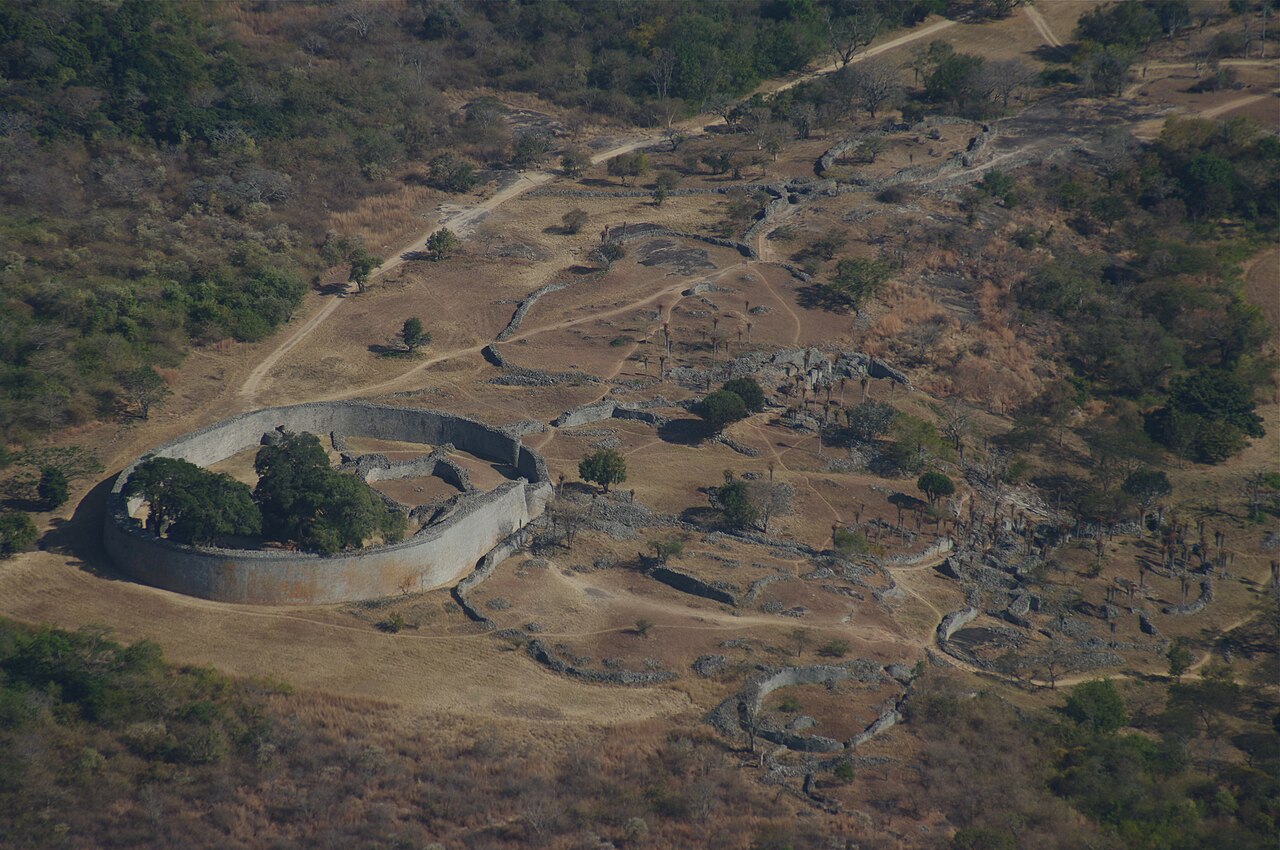
What survives today is a city built entirely of locally quarried granite. The builders split the stone along natural fractures, using heat and water, then dressed the blocks and stacked them in courses without any mortar. The walls lean inward slightly, a technique that gives them stability — a structural logic that engineers still admire. The largest single structure, the Great Enclosure, has an outer wall about 250 metres in circumference, up to 11 metres tall and 5 metres thick at the base, enclosing an area of roughly 1,800 square metres.
UNESCO inscribed the Great Zimbabwe ruins as a World Heritage Site in 1986. The site is a national monument, and the soapstone Zimbabwe Birds carved at the site — now national symbols appearing on the country’s flag and currency — were removed during the colonial era and only partially returned after independence in 1980.
Who Built Great Zimbabwe? The Evidence That Settled a Colonial Lie
For decades, European writers attributed the ruins to Phoenicians, Arabs, or the Queen of Sheba. The reasoning was not archaeological but ideological: the prevailing colonial view held that Africans could not have built such a sophisticated city. The consequences were severe. In 1929, the colonial government of Southern Rhodesia passed legislation restricting archaeological excavation, and the curator of the site, Richard Nicklin Hall, was permitted to strip away layers of occupation debris in a search for “foreign” origins — destroying irreplaceable stratigraphic evidence in the process.
The Archaeologists Who Got It Right
The case was closed not by rhetoric but by careful science. In 1929, the British archaeologist Gertrude Caton-Thompson excavated at Great Zimbabwe and concluded, in her report The Zimbabwe Culture (1931), that the ruins were “of African origin and of considerable antiquity.” Her findings were dismissed by settler authorities. David Randall-MacIver had reached a similar conclusion in 1906. The decisive work came later: excavations by Roger Summers and Keith Robinson in the mid-twentieth century, and radiocarbon dating from the 1950s onward, established the chronology firmly.
Shona oral traditions, preserved by elders and recorded in the nineteenth and twentieth centuries, describe the site as the work of their ancestors. Place names across the landscape — including the name Zimbabwe itself — belong to the Shona language. The pottery, the soapstone birds, the gold-working techniques, and the architectural style all connect directly to Shona material culture. Today, the archaeological consensus is unambiguous: Great Zimbabwe was built by the Shona, and the colonial denial of this fact is treated by historians as a case study in how politics distorts science.
The Three Zones of the Great Zimbabwe Ruins
The city is conventionally divided into three architectural zones, each with a distinct character and likely function.
The Hill Complex
The Hill Complex occupies a granite outcrop rising about 80 metres above the surrounding plain, with walls threading between natural boulders. This is the oldest part of the site, with occupation dating to around 900–1000 CE in its earliest phases. The Hill Complex contains a series of enclosures, passages, and platforms, including a structure sometimes called the “Western Enclosure” and a “ritual enclosure” with a narrow entrance. The positioning and the presence of what appear to be ceremonial spaces suggest a religious and political centre — the seat of the ruler’s spiritual authority.
The Great Enclosure
The Great Enclosure sits in the valley below the hill and is the site’s most photographed structure. Its outer wall is the largest ancient dry-stone construction in sub-Saharan Africa. Inside stands the Conical Tower, a solid granite cone about 10 metres high, and a smaller parallel wall creating a narrow passage. The tower’s purpose is debated — interpretations range from a symbolic granary representing royal abundance to a ceremonial or astronomical marker. The enclosure’s scale and the quality of its masonry suggest it served the royal court, possibly housing the king’s principal wife and the court’s most important functions.
The Valley Complex
Between the hill and the great enclosure, and extending eastward, lie the remains of the Valley Complex — a dense settlement of smaller walled enclosures and house platforms. This is where much of the city’s population lived. Excavations have revealed evidence of metalworking, including gold and iron, along with imported goods from the coast.
What Was Life Like in the Kingdom of Zimbabwe?
At its height, between roughly 1250 and 1450 CE, Great Zimbabwe was home to an estimated 10,000 to 18,000 people. The surrounding plateau supported cattle herding and agriculture — sorghum, millet, and later maize after its introduction from the Americas — while the city’s wealth rested on trade.
Goods recovered from the ruins tell the story of a connected world. Archaeologists have found Chinese celadon pottery, Persian faience, glass beads from India, and coins and metalwork from the Swahili coast. In exchange, the kingdom exported gold, ivory, and possibly copper and cattle products. The gold trade was the engine: Zimbabwean gold moved through the port of Sofala, controlled by the Swahili sultanate of Kilwa, and entered the Indian Ocean economy that linked East Africa to Arabia, India, and China.
Soapstone carvings — the Zimbabwe Birds, each perched on a column — were found in the Hill Complex and are among the finest examples of Shona stone sculpture. The birds, likely representing fish eagles, are thought to have had ritual significance connected to royal ancestors. Their removal by colonial authorities, and the long campaign for their return, remains a live issue in Zimbabwean heritage politics.
Timeline: The Rise and Fall of the Great Zimbabwe Ruins
| Period | Key Development |
|---|---|
| c. 900–1100 CE | Early occupation of the Hill Complex; farming and herding communities settle the plateau. |
| c. 1100–1250 CE | Construction of the first stone walls; the settlement grows into a regional centre. |
| c. 1250–1450 CE | Peak of the Kingdom of Zimbabwe; the Great Enclosure is built; population reaches an estimated 10,000–18,000; long-distance trade with the Swahili coast flourishes. |
| c. 1450–1550 CE | Decline and abandonment; likely causes include environmental degradation, drought, and the rise of competitor states such as the Kingdom of Mutapa to the north. |
| 1871 | German explorer Karl Mauch visits the ruins and wrongly attributes them to the Queen of Sheba. |
| 1929–1931 | Gertrude Caton-Thompson’s excavations confirm African origin; her findings are politically resisted. |
| 1980 / 1986 | Zimbabwe gains independence and takes its name from the ruins; UNESCO inscribes the site as a World Heritage Site. |
Why Was Great Zimbabwe Abandoned?
The city was largely abandoned by around 1450, though occupation continued in reduced form into the sixteenth century. No single cause explains the decline, and historians weigh several factors:
- Environmental stress: Intensive cattle grazing and fuelwood harvesting around a city of up to 18,000 people likely degraded the surrounding land, reducing the agricultural surplus that sustained the capital.
- Climate: Regional drought episodes in the fifteenth century may have undermined food security.
- Trade shifts: The rise of the Kingdom of Mutapa to the north, and changes in the routes connecting the interior to the coast, redirected gold trade away from Great Zimbabwe.
- Political fragmentation: As with many pre-modern capitals, succession disputes and the centrifugal pull of provincial elites could have drained the centre’s authority.
The ruins were never “lost” to local people — Shona communities continued to live nearby and to hold the site in reverence. What was lost, for a time, was the wider world’s willingness to credit Africans with the achievement.
How to Visit the Great Zimbabwe Ruins Today
The site is managed by the National Museums and Monuments of Zimbabwe and is open to visitors year-round. The nearest city is Masvingo, about 30 kilometres away, and the site is reachable by road from Harare (roughly 300 kilometres) and Bulawayo. A small museum at the entrance displays artefacts and explains the site’s history; guided tours are available and worth taking, since the layout and the masonry techniques are best understood with explanation.
Practical notes for visitors:
- Best time to go: The dry season, May to October, offers cooler temperatures and easier walking; the site is hot and the grass tall in the rainy months.
- What to see: Allow at least half a day. The Hill Complex involves a steep climb; the Great Enclosure is a gentle walk from the car park.
- Respect the site: The ruins are a national monument and a place of cultural significance to Shona communities; climbing on walls is prohibited.
- Nearby: Lake Mutirikwi and the surrounding granite hills make for a good extension of the trip.
What the Great Zimbabwe Ruins Mean for Africa and the World
The Great Zimbabwe ruins matter beyond their walls. They are a standing rebuttal to the colonial myth that complex architecture and statecraft arrived in southern Africa from outside. They connect the Zimbabwean plateau to the Indian Ocean world that linked Africa to Asia centuries before European ships rounded the Cape. And they carry a living name: when Zimbabwe won independence in 1980, the new nation took its name from the ruins, a deliberate act of historical reclamation.
The site also raises unfinished questions. The Zimbabwe Birds remain partly dispersed, with some held in collections abroad; campaigns for their return continue. Conservation of dry-stone walls in a changing climate is a constant challenge, and tourism revenue — constrained by years of economic difficulty in Zimbabwe — is essential to maintenance. The ruins are not a relic but a working heritage site, staffed by Zimbabwean archaeologists and custodians who are writing the next chapter of its history.
The Walls Speak: A Lasting Perspective on Great Zimbabwe
Stand at the base of the Great Enclosure and the scale is immediate: the wall rises above you in courses of grey granite, fitted so tightly that a knife blade will not pass between the stones. Six centuries of rain and sun have not moved them. The people who built this place had no mortar, no iron tools capable of cutting granite easily, and no written records that survive — yet they engineered a city that has outlasted empires. The Great Zimbabwe ruins are Africa’s stone, and they are a reminder that the continent’s history was never waiting to be discovered. It was there all along, waiting to be acknowledged.