📅 Last updated: 27.10.2026
The Asante Empire rose from the forest belt of present-day Ghana to become one of the most powerful states in West African history, built on gold, disciplined armies, and a political system anchored in a single sacred object: the Golden Stool. At its height in the nineteenth century, it governed millions of people, fielded tens of thousands of soldiers, and negotiated — and fought — with the British Empire on its own terms.
The Asante Empire was a West African state centered on Kumasi, in modern Ghana, that flourished from the late 17th century until 1901. It grew wealthy through gold production and trade, expanded through military campaigns, and unified its constituent states around the Golden Stool, the sacred symbol of the Asante nation’s soul. The empire resisted British colonization through four Anglo-Asante wars before annexation in 1901, and the Golden Stool remains a living national treasure today.
- Where did the Asante Empire come from?
- How did gold shape the Asante Empire's power?
- How was the Asante Empire governed and organized?
- How did the Asante Empire fight and expand?
- What was the Golden Stool, and why did it matter?
- How did the Asante Empire confront British colonialism?
- What does the Asante Empire mean today?
- What can the Asante Empire teach us about power and memory?
Where did the Asante Empire come from?
The Asante state emerged in the late seventeenth century from a cluster of Akan chiefdoms in the dense forests around Kumasi, roughly 250 kilometers north of the Atlantic coast. According to Asante oral tradition, recorded in the early twentieth century and preserved by the royal court at Manhyia Palace, a priest named Okomfo Anokye summoned a stool from the heavens and it descended onto the lap of Osei Tutu, the first Asantehene. That stool, covered in gold, became the Sika Dwa Kofi — the Golden Stool — and the spiritual embodiment of the Asante nation.
The political logic was shrewd. Osei Tutu and Okomfo Anokye forged the Asanteman, a confederation of states bound by oath to the Golden Stool rather than to any single person. Each member state retained its own chief and internal affairs but pledged loyalty and military service to the Asantehene in Kumasi. This structure turned rivals like Denkyira — defeated around 1701 at the Battle of Feyiase — into subjects and allies, and it gave the young empire a cohesion that larger, looser coalitions lacked.
Key early milestones
- c. 1670s–1701: Osei Tutu consolidates power and defeats Denkyira, securing access to coastal trade routes.
- 1701–1740s: Under Opoku Ware I, Asante expands north toward the Volta basin and the trading towns of the savanna.
- 1744–1803: Asantehene Osei Kwadwo and Osei Kwame reform the bureaucracy, creating specialized offices for finance, foreign affairs, and the army.
- 1807: Asante forces reach the coast, and the empire becomes a decisive power in regional commerce.
How did gold shape the Asante Empire’s power?
Gold was the engine of Asante wealth and the material of its sacred art. The region’s alluvial deposits and mines, worked by local communities long before European contact, supplied the empire with a steady stream of the metal. Asante gold flowed into the trans-Saharan trade and, from the late fifteenth century onward, into coastal trade with Portuguese, Dutch, Danish, and later British merchants at forts such as Elmina and Cape Coast.
The Asante state managed gold with remarkable sophistication. The Gyaasewa, a treasury office, oversaw revenues, and the Asantehene controlled the minting of gold dust, weighed with brass weights called mbramoo. Gold dust functioned as currency, measured in units such as the pereguan and the taku. The famous golden masks, rings, swords, and ceremonial regalia of the Asante court — many now displayed in the Manhyia Palace Museum and the British Museum — were not mere ornament; they signaled the state’s capacity to concentrate and display wealth.
That wealth funded the army, the bureaucracy, and the elaborate diplomacy that kept Asante at the center of regional politics for two centuries. It also made the empire a target. British traders and officials on the coast came to see Asante gold and Asante sovereignty as obstacles to their own commercial ambitions.
How was the Asante Empire governed and organized?
The Asante Empire was not a simple monarchy. It was a constitutional confederacy with a capital, a court, and a system of checks on royal power that surprised many European observers. The Asantehene ruled from Kumasi, advised by the Asantemanhyiamu, a council of senior chiefs, and by the Queen Mother (the Asantehemaa), who held real political authority and could nominate candidates for the throne.
The structure of power
- The Asantehene: Head of state, commander-in-chief, and chief judge, but bound by council advice and customary law.
- The Asantemanhyiamu: A national assembly of paramount chiefs that debated war, peace, and taxation.
- The Queen Mother: Guardian of royal lineage and a powerful voice in succession and policy.
- Provincial chiefs: Governed conquered and allied territories, collecting tribute and supplying soldiers.
The empire’s bureaucracy included offices for foreign affairs, roads, and the army, and the state maintained a network of roads radiating from Kumasi. Tribute from provinces — gold, slaves, livestock, cloth, and kola nuts — sustained the capital. Kola, in particular, was a lucrative export to the savanna and beyond, and Asante control of kola routes gave it leverage far beyond its borders.
How did the Asante Empire fight and expand?
Asante military power rested on a combination of numbers, organization, and gunpowder. The army was divided into wings and divisions, with a core of professional soldiers and a levy of provincial troops. By the early nineteenth century, Asante could field tens of thousands of fighters, and its generals were skilled at forest warfare, siegecraft, and the logistics of long campaigns.
The empire expanded in several directions: south toward the coast, north into the Volta basin and the lands of the Gonja and Dagomba, and west against the Fante and other coastal states. The Asante–Fante wars of the early nineteenth century were partly about control of coastal trade and partly about the terms on which Asante power would be recognized. In 1824, Asante forces defeated and killed Sir Charles MacCarthy, the British governor of the Gold Coast, at the Battle of Nsamankow — a shock that shaped British policy for decades.
Yet the empire was not invincible. The 1826 Battle of Katamanso, near Accra, ended in a costly Asante defeat, and the 1863–64 campaign against the British and their allies strained Asante resources. The 1874 British expedition under Sir Garnet Wolseley captured Kumasi and burned much of the city, a blow from which the empire’s regional dominance never fully recovered.
What was the Golden Stool, and why did it matter?
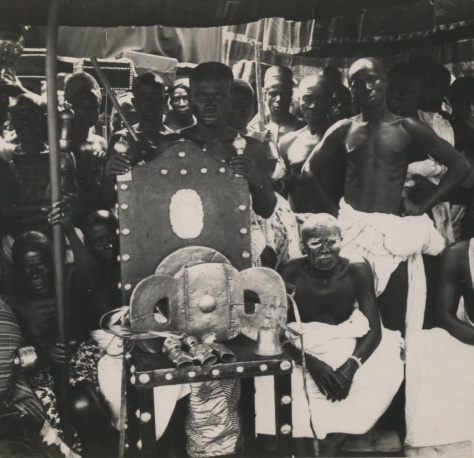
The Golden Stool is the most important object in Asante history. According to tradition, it descended from the sky and landed on Osei Tutu’s lap, and it contains the sunsum — the spirit — of the Asante people. No one sits on it, not even the Asantehene. It is carried on its own cushion during great festivals, and its safety is bound up with the nation’s wellbeing.
The stool’s political significance became clear in 1900, when Sir Frederick Hodgson, the British governor of the Gold Coast, demanded to sit on it during a visit to Kumasi. The demand was a profound insult. Yaa Asantewaa, the Queen Mother of Ejisu, rallied resistance and led what became known as the War of the Golden Stool, or the Yaa Asantewaa War. The uprising was eventually suppressed and Yaa Asantewaa was exiled to the Seychelles, where she died in 1921. But the stool was never captured, and the episode became a defining moment of Asante and Ghanaian anti-colonial history.
When the British finally located the stool in 1921, they found it had been hidden by loyalists. Its return to public ceremonial use, and its continued role in the enstoolment of Asantehenes, underscores a simple fact: the Golden Stool survived colonialism, and with it the political and spiritual identity of the Asante Empire.
How did the Asante Empire confront British colonialism?
The Anglo-Asante wars spanned nearly a century, from 1824 to 1901. Each conflict had its own causes — trade disputes, border tensions, the status of coastal peoples, and British determination to extend control inland — but together they tell a story of a powerful African state negotiating with, and ultimately succumbing to, an industrial empire.
| Conflict | Dates | Key Event | Outcome |
|---|---|---|---|
| First Anglo-Asante War | 1824–1831 | Death of Governor MacCarthy at Nsamankow (1824) | Treaty of 1831; Asante recognizes British coastal claims |
| Second Anglo-Asante War | 1863–1864 | Asante campaign against British-allied Fante | Stalemate with heavy losses on both sides |
| Third Anglo-Asante War | 1873–1874 | Wolseley’s expedition; Kumasi burned | Asante sues for peace; pays indemnity |
| War of the Golden Stool | 1900 | Hodgson demands the Golden Stool; Yaa Asantewaa leads resistance | Uprising suppressed; Yaa Asantewaa exiled |
| Annexation | 1901 | Asante incorporated into the Gold Coast Colony | Empire ends as a sovereign state; stool survives |
The 1874 defeat was decisive. Wolseley’s troops, supported by Maxim guns and steamships, demonstrated the asymmetry between a forest empire and an industrial power. The Asantehene Kofi Karikari was deposed, and the empire’s tributary system began to unravel. By 1896, the British had exiled Asantehene Prempeh I to the Seychelles, and in 1901 the Asante territories were formally annexed.
What does the Asante Empire mean today?
The Asante Empire’s legacy is visible across modern Ghana. Kumasi remains the heart of Asante identity, and the Manhyia Palace is still the seat of the Asantehene. The current Asantehene, Otumfuo Osei Tutu II, enstooled in 1999, is a respected figure in Ghanaian public life and a global advocate for education and cultural heritage. The annual Akwasidae festivals draw thousands to Kumasi to see the Asantehene in full regalia, and the Golden Stool remains a national symbol.
Asante goldwork, kente cloth, and adinkra symbols are now part of global design vocabulary, and Asante history is taught in schools across Ghana and studied in universities worldwide. The empire’s story also complicates any simple narrative of African weakness before colonialism: here was a state with a constitution, a treasury, a diplomatic service, and an army that fought the British to a standstill more than once.
Why the Asante Empire still matters
- Political innovation: The confederacy model balanced central authority with local autonomy, a lesson in governance that resonates today.
- Cultural continuity: The Golden Stool, kente, and adinkra traditions remain living practices, not museum pieces.
- Anti-colonial resistance: Yaa Asantewaa’s leadership is celebrated across Africa and the diaspora as a model of courage.
- Economic history: Asante gold and trade networks show how African states shaped global commerce long before the colonial era.
What can the Asante Empire teach us about power and memory?
The Asante Empire was never just a story about gold. It was a story about how a society builds institutions, negotiates with rivals, and preserves its identity through catastrophe. The Golden Stool survived the burning of Kumasi, the exile of kings, and the annexation of a nation. That survival is not a footnote — it is the point. Empires rise and fall, but the ideas and symbols that hold a people together can outlast the armies that tried to destroy them.
For anyone tracing the history of West Africa, the Asante Empire offers a vivid case study in statecraft, military organization, and cultural resilience. It also reminds us that the continent’s past is not a prelude to colonialism but a history in its own right — full of ambition, conflict, art, and enduring memory. The Asante Empire’s gold is still in its museums and palaces; its wars are still debated; and its Golden Stool still sits at the center of a nation’s soul.