📅 Last updated: 26.10.2026
The Himba people Namibia are a semi-nomadic pastoralist community of roughly 50,000 people who live in the arid Kunene Region of northwestern Namibia, where they raise cattle and goats and preserve a way of life shaped by centuries of adaptation to one of the harshest environments on Earth. Known globally for the red ochre paste (otjize) that gives their skin and hair its distinctive hue, they are far more than a striking image: they are skilled herders, sophisticated land managers, and a community negotiating the tensions between tradition, tourism, and modernity.
The Himba are an Otjiherero-speaking pastoralist people concentrated in Namibia’s Kunene Region, with an estimated population of about 50,000. They are closely related to the Herero and are renowned for their use of otjize — a paste of red ochre, butterfat, and aromatic resin applied to skin and hair — as well as for their ancestral cattle-herding traditions, sacred fire rituals, and matrilineal clan structure.
- Who Are the Himba People of Namibia?
- Why the Red Ochre Matters: Inside the Otjize Tradition
- Himba People Namibia: Cattle, Kinship, and Sacred Fire
- How Do the Himba Govern Themselves and Manage Land?
- Key Facts About the Himba at a Glance
- What Does Daily Life Look Like in a Himba Homestead?
- Himba People Namibia and the Ethics of Tourism
- What Challenges Do the Himba Face Today?
- How Can Travelers Experience Himba Culture Respectfully?
- Why the Himba Matter Beyond Namibia
- A Lasting Perspective on the Himba
Who Are the Himba People of Namibia?
The Himba (singular: OmuHimba) speak Otjiherero, a Bantu language they share with the Herero, and trace their ancestry to Herero groups who migrated southward from the Great Lakes region of East Africa centuries ago. Oral tradition holds that the Himba and Herero were once a single people; they parted ways in the 19th century when some groups moved east and south toward the central Namibian plateau while others remained in the remote northwest, in what is now the Kunene Region.
That geographic separation proved consequential. The Herero who moved east encountered German colonial forces and suffered near-genocide in the 1904–1908 Herero and Namaqua War, in which an estimated 65,000 Herero and 10,000 Nama died. The Himba, isolated in the Kaokoveld and separated from the main colonial routes by desert and mountain, were largely shielded from that catastrophe. Their relative isolation preserved much of their social structure, language, and ritual life.
Today the Himba live in scattered settlements across the Kunene Region, from the town of Opuwo — the administrative capital of the region and the main trading hub for Himba communities — to more remote areas along the Kunene River and into the surrounding mountains and plains. Many continue to move seasonally with their herds, while others live part-time in towns where their children attend school and family members trade or work.
Why the Red Ochre Matters: Inside the Otjize Tradition
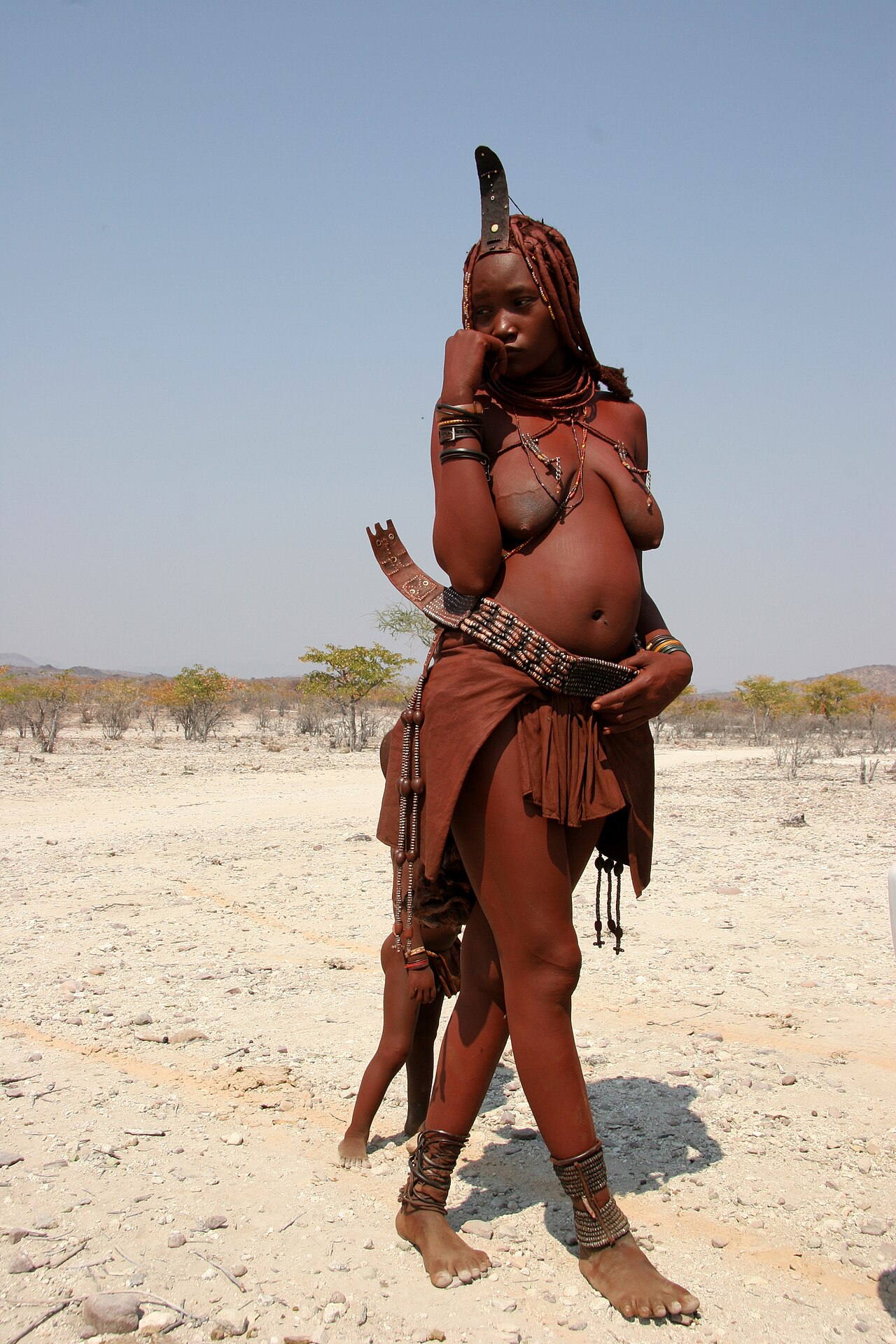
The image of the Himba that circulates most widely is the ochre-coated skin and hair. The substance behind it, otjize, is a paste made by mixing ground red ochre with butterfat or, increasingly, petroleum jelly, and often scented with the resin of the omuzumba shrub. Women and girls apply it daily to their skin and hair, working it into elaborate braided styles.
Otjize is not cosmetic in the way Western beauty products are. In a semi-arid climate where water is scarce and daily bathing impractical, the paste serves as a practical cleanser and sunblock, protects against insect bites, and helps regulate skin moisture. The ochre’s iron oxide content gives the skin its characteristic reddish tone, which the Himba associate with beauty, life, and the earth itself.
The hairstyles that depend on otjize are a social language. Young girls wear two thick braids curving forward over the forehead. Girls approaching puberty wear braids that cover the face. After marriage and the birth of a child, women wear the ekori, a headdress made of tanned goatskin, and later switch to the elaborate braided style that signals a woman with children. Men’s styles are simpler, often a single braid or shaved head, and change with age and status.
Himba People Namibia: Cattle, Kinship, and Sacred Fire
At the center of Himba life is cattle. Herds of long-horned cattle — descendants of the Sanga cattle that accompanied Bantu-speaking herders across southern Africa — are the primary measure of wealth, the currency of bridewealth (lobola), and the focus of daily labor. A man’s status is expressed through his herd, and a family’s survival depends on the animals’ health.
Himba society is organized around matrilineal clans: descent and inheritance pass through the mother’s line, and a child belongs to the clan of their mother. This does not mean women hold political authority — day-to-day decision-making often rests with senior men — but it shapes marriage arrangements, land rights, and the distribution of cattle. Polygyny is practiced, and a man’s wives typically live in separate homesteads within a compound, each with her own hut, fire, and responsibilities.
Each homestead centers on a sacred fire (okuruwo) that is never allowed to go out. The fire represents the ancestors and the continuity of the family line; it is tended by the family’s senior members and serves as the focal point for rituals, blessings, and the transmission of news and decisions. When a family relocates, embers from the sacred fire are carried to the new site.
Herding itself follows the rhythm of the seasons. During the dry months, men and boys drive cattle long distances in search of water and grazing, sometimes moving into the mountains or toward the Kunene River. Women manage the homestead, milk the cattle, process milk into butter and sour milk, and care for children and the elderly. Goats, sheep, and — in some areas — small-scale farming of maize, sorghum, and pumpkins supplement the diet.
How Do the Himba Govern Themselves and Manage Land?
Himba political authority rests with a system of headmen and chiefs, layered from the homestead level upward. Each community has a headman who mediates disputes, allocates grazing land, and represents the group in dealings with outsiders. Above them are chiefs, whose authority is recognized by the Namibian state and whose role includes relations with government and tourists.
Land tenure is customary. Grazing areas are held collectively by the community, and access is negotiated through the headmen and elders. This system has been tested repeatedly. In the 1990s, the Namibian government proposed the Epupa Falls hydroelectric dam on the Kunene River, which would have flooded Himba grazing land and sacred sites. Sustained opposition from Himba communities, supported by international advocacy groups, led to the project’s suspension — a landmark case in the recognition of indigenous land rights in southern Africa.
More recently, Himba communities have contended with diamond mining concessions and conservation areas. The establishment of communal conservancies — community-managed conservation areas recognized under Namibian law — has given some Himba communities a formal role in managing wildlife and tourism, and a share of the revenue. The results have been uneven, but the conservancy model has become one of Namibia’s most celebrated conservation innovations, and Himba leaders sit on several conservancy committees.
Key Facts About the Himba at a Glance
| Category | Detail |
|---|---|
| Population | Approximately 50,000 people, concentrated in the Kunene Region of northwestern Namibia |
| Language | Otjiherero, a Bantu language shared with the Herero |
| Economy | Pastoralism — cattle, goats, and sheep — supplemented by small-scale farming and trade |
| Social structure | Matrilineal clans, polygynous homesteads, headmen and chiefs |
| Signature tradition | Otjize — red ochre, butterfat, and resin paste applied to skin and hair |
| Key location | Opuwo, the regional capital, and the surrounding Kaokoveld |
What Does Daily Life Look Like in a Himba Homestead?
A Himba homestead is a cluster of dome-shaped huts built from mud, dung, and branches, arranged around the sacred fire. The huts are modest but carefully constructed for insulation against desert heat and cold nights. Women build and maintain them, and a newly married woman typically builds her own hut within her husband’s compound.
Mornings begin early. Women milk the cattle before sunrise, then churn the milk into butter and prepare sour milk, a staple food. Children herd goats and help with household tasks; boys begin learning cattle management young. Men may spend days away from the homestead with the herds, returning when water and grazing permit.
Food is simple and adapted to the environment. Sour milk, maize meal porridge, and occasionally meat form the core diet. The Himba trade with neighboring communities and at markets in Opuwo for goods they cannot produce themselves — salt, sugar, cloth, metal tools, and increasingly, mobile phones and solar chargers.
Health, Education, and the Encounter with Modernity
Himba communities face significant challenges in access to healthcare and education. Distances to clinics are long, and mobile clinics serve remote areas intermittently. Traditional medicine remains important, and Himba healers are respected for their knowledge of local plants and their role in ritual life.
Education is a source of tension. Government schools exist in Opuwo and some larger settlements, but children who attend school often board away from their families, and the curriculum is in English and Afrikaans rather than Otjiherero. Some parents worry that schooling pulls children away from herding knowledge and community life; others see it as essential for their children’s future in a modern Namibia. Many families compromise, sending some children to school while keeping others at home to herd.
Mobile phones, solar panels, and motorbikes have become common in some areas, and Himba men and women increasingly work in tourism, conservation, and trade. This is not a people frozen in time — it is a community making choices about which traditions to carry forward and which to adapt.
Himba People Namibia and the Ethics of Tourism
The Himba have become one of Namibia’s most photographed peoples. Tour operators run visits to Himba settlements from Opuwo and from lodges in the Kunene Region, and images of ochre-covered women and children appear on postcards, travel brochures, and social media feeds around the world.
This visibility brings income — some communities receive payments from tour operators and sell crafts — but it also brings problems. Visitors sometimes photograph people without consent, treat settlements as exhibits, and leave behind money and goods that distort local economies. The Himba themselves have become more organized about managing visitors: some communities have set rules about photography, dress, and payment, and community-run tourism initiatives aim to keep control in local hands.
Responsible tourism in the region depends on a few principles:
- Book with operators who have formal agreements with Himba communities and pay fees directly to them.
- Ask before photographing anyone, and respect a refusal without argument.
- Avoid giving sweets, money, or gifts to children, which encourages begging and disrupts community norms.
- Buy crafts directly from makers, and pay the price asked rather than bargaining aggressively.
- Treat the visit as an encounter between people, not a photo opportunity.
What Challenges Do the Himba Face Today?
The Himba’s way of life is under pressure from several directions. Climate change has brought more frequent and severe droughts to the Kunene Region; the 2019 drought was among the worst in living memory, killing large numbers of livestock and pushing families toward towns in search of food and water. Herders who once moved freely now find their routes blocked by fences, mining concessions, and conservation areas.
Land rights remain a central issue. The Namibian government recognizes customary land tenure in communal areas, but the pressure to develop — through mining, tourism, and infrastructure — creates conflicts that are often resolved in favor of outside interests. Himba leaders have become adept at using the courts, the media, and international advocacy to defend their land, with mixed success.
Cultural change is equally significant. Young Himba increasingly move to towns, marry outside the community, or adopt Western dress and hairstyles. Some elders see this as loss; others point out that Himba culture has always adapted, absorbing new tools and ideas while preserving its core values of kinship, respect for ancestors, and care for cattle.
How Can Travelers Experience Himba Culture Respectfully?
The best starting point for any visit is Opuwo, the regional capital, where the Kunene Regional Council and local tour operators can advise on community agreements. From there, visitors can reach Himba settlements with guides who have established relationships with specific communities. The town itself has markets where Himba women sell crafts, and the surrounding landscape — the Kaokoveld, the Kunene River, and Epupa Falls — is among the most spectacular in Namibia.
Travelers should also consider visiting the region’s other attractions: the Skeleton Coast to the west, the Etosha National Park to the southeast, and the rock art sites scattered across the Kunene Region, some of which date back thousands of years and are among the oldest evidence of human habitation in southern Africa. A visit to Himba communities is best understood as part of a broader encounter with a remarkable landscape and its long human history.
Why the Himba Matter Beyond Namibia
The Himba are often described as one of the last “traditional” peoples of Africa, a framing that does them a disservice. They are not a relic but a living community with a sophisticated understanding of their environment, a legal and political system that has survived colonialism and independence, and a clear-eyed engagement with the modern world. Their success in blocking the Epupa dam and in securing roles in conservancies shows that indigenous communities can defend their interests effectively when they have allies and legal tools.
Their story also matters for the broader conversation about how Africa’s heritage is represented. The Himba are not a backdrop for tourists’ photographs. They are herders, parents, students, entrepreneurs, and citizens of Namibia, making choices about their future in a country that is itself young, diverse, and changing fast. Understanding them means seeing both the ochre and the person beneath it.
A Lasting Perspective on the Himba
The red ochre that gives the Himba their global image is a practical response to a hard environment and a statement of identity — a daily act of care for the body and a visible link to ancestors and community. Behind it are cattle herds moving across the Kaokoveld, sacred fires that have burned for generations, and a people who have weathered drought, colonialism, and the pressures of modern tourism without losing their sense of who they are. The Himba people of Namibia are not a curiosity to be photographed and forgotten. They are a community worth understanding on their own terms, and their story is one of the most compelling in contemporary Africa.