📅 Last updated: 24.10.2026
The Kingdom of Kush rose along the Nile in what is now northern Sudan and, at its height, ruled not only its own lands but also Egypt itself — becoming one of the great powers of the ancient world. For nearly a thousand years, its kings and queens built cities of sandstone and granite, traded gold and ivory across the Red Sea and the Sahara, and left behind more pyramids than Egypt. Yet outside Sudan and the world of archaeology, this remarkable civilisation remains far less known than it deserves.
The Kingdom of Kush was an ancient African state centred on the Nile Valley in modern-day Sudan, flourishing from roughly 2500 BCE to 350 CE. Its capitals at Kerma, Napata, and Meroë anchored a powerful trading culture, and during the 25th Dynasty (about 747–656 BCE) Kushite kings ruled Egypt as pharaohs. Kush is famed for its pyramids at Meroë, its ironworking, and its distinctive script, the Meroitic language.
- Where Was the Kingdom of Kush, and Why Did It Matter?
- Kerma: The First Flowering of the Kingdom of Kush
- Napata and the Kushite Pharaohs of Egypt
- Meroë: The Later Kingdom of Kush and Its Iron and Pyramids
- How Did the Kingdom of Kush Trade and Govern?
- Key Dates in the History of the Kingdom of Kush
- What Ended the Kingdom of Kush?
- Why Is the Kingdom of Kush So Often Overlooked?
- Visiting Kush Today: Meroë, Gebel Barkal, and Beyond
- What the Kingdom of Kush Teaches Us
Where Was the Kingdom of Kush, and Why Did It Matter?
Kush occupied the fertile stretch of the Nile between the first and sixth cataracts — the rocky rapids that punctuate the river north of modern Khartoum. This geography was the kingdom’s fortune. The Nile provided water, transport, and a corridor for trade; the surrounding deserts offered gold, copper, and stone; and the Red Sea coast, reachable through the eastern desert, connected Kush to Arabia, India, and the Mediterranean world.
The ancient Egyptians, Kush’s northern neighbours, called the region “Ta-Seti,” the Land of the Bow, a nod to the famed archers of Nubia. Egyptian texts from the Old Kingdom (around 2400 BCE) already mention trade and military expeditions into Kush. Over centuries the relationship swung between commerce, rivalry, and conquest — a dynamic that shaped both civilisations.
Kush mattered because it was not a peripheral client state but a centre in its own right. Its rulers commanded armies, minted diplomatic relationships, and developed their own writing system. The kingdom’s cities were nodes in networks stretching from sub-Saharan Africa to the Mediterranean, making Kush a bridge between continents.
Kerma: The First Flowering of the Kingdom of Kush
The earliest great phase of Kush is associated with Kerma, a city near the third cataract that flourished from roughly 2500 to 1500 BCE. Kerma grew wealthy on cattle herding, agriculture, and trade in gold, ivory, and ebony. Its rulers were buried in enormous tumuli — earthen mounds that rank among the largest funerary monuments in Africa.
Kerma’s most striking architectural achievement was the Western Deffufa, a massive mud-brick temple whose surviving core still rises some 18 metres above the plain. Excavations by George Reisner in the early twentieth century and by Swiss teams since the 1970s revealed a sophisticated urban centre with workshops, granaries, and a royal palace.
Kerma’s confidence showed in its dealings with Egypt. When the Middle Kingdom pharaohs built fortresses at the second cataract to control the frontier, Kerma pushed back. Egyptian records describe campaigns against “wretched Kush,” but the archaeology tells a more balanced story of two powers jostling for influence along a shared river. Around 1500 BCE, the New Kingdom pharaoh Thutmose I finally conquered Kerma, and Kush became an Egyptian province for roughly five centuries.
Napata and the Kushite Pharaohs of Egypt
Egyptian rule left deep marks: temples, language, and religious practice. But as the New Kingdom weakened around 1070 BCE, Kush reasserted independence. A new capital emerged at Napata, near the holy mountain of Gebel Barkal, which the Egyptians and Kushites alike regarded as the home of the god Amun.
From Napata, the Kingdom of Kush produced one of the most extraordinary episodes in African history. Around 747 BCE, King Piye (also spelled Piankhy) marched north and brought Egypt under Kushite control, founding the 25th Dynasty. His victory stele, discovered at Gebel Barkal in 1862 and now in the Cairo Museum, records the campaign in vivid detail — including Piye’s displeasure at finding Egyptian princes with unshaven hair and fish-eating habits.
Piye’s successors ruled a vast territory from the Mediterranean to the sixth cataract. Taharqa, perhaps the best known of the dynasty, built extensively at Karnak and Kawa and features in the Hebrew Bible as an ally of Judah against Assyria. The dynasty ended when the Assyrian king Ashurbanipal sacked Thebes around 663 BCE, and Kushite power withdrew south.
The Kandakes: Kushite Queens Who Ruled in Their Own Right
Kushite royal women held exceptional authority. The title kandake — often rendered “Candace” in classical sources — denoted a queen mother or reigning queen with real political power. Amanirenas, who ruled around 40–10 BCE, led resistance to Roman expansion and is remembered for a bronze head of Augustus, buried beneath the steps of a Meroitic temple at Meroë, that her forces reportedly carried off as a trophy. Strabo records that her envoys negotiated a favourable peace with the emperor Augustus. Later kandakes, including Amanishakheto and Amanitore, appear on temple reliefs and in their own pyramid burials, depicted with the regalia of kings.
Meroë: The Later Kingdom of Kush and Its Iron and Pyramids
Around 590 BCE, the Kushite court shifted south to Meroë, between the fifth and sixth cataracts. The move is sometimes linked to Assyrian pressure and sometimes to the economic pull of the region’s iron ore and hardwood forests. Whatever the cause, Meroë became the heart of a renewed Kush that lasted nearly a millennium.
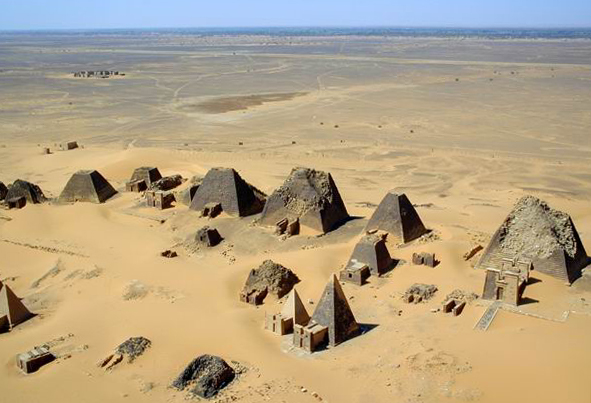
Meroë is famous for its pyramids — steep, narrow structures with attached chapels, quite different from the broad Egyptian pyramids. More than 200 pyramids and tombs cluster at Meroë, with others at Napata and El-Kurru, giving Sudan more pyramids than Egypt. The site was inscribed on the UNESCO World Heritage List in 2011.
The city was also an industrial centre. Large slag heaps at Meroë show that iron was smelted on a considerable scale, though historians debate whether Kushite iron production was truly the dominant industry once imagined. What is clear is that Meroë’s artisans worked iron, gold, and bronze with skill, and its potters produced some of the finest painted ceramics in the ancient world.
The Meroitic Script: Africa’s Early Writing System
Kush developed its own writing, the Meroitic script, which appeared around the third century BCE. It used two forms — a hieroglyphic version for monuments and a cursive version for documents — and was used to write the Meroitic language. The script was deciphered phonetically in 1909 by Francis Llewellyn Griffith, but the language itself remains only partly understood. Every new inscription is a small step toward recovering the voices of Meroë.
How Did the Kingdom of Kush Trade and Govern?
Kush’s wealth rested on a network of exchange. Gold from the eastern desert, ivory, ebony, ostrich feathers, and slaves moved north into Egypt and beyond, while luxury goods — wine, olive oil, glass, and fine textiles — flowed south. Red Sea ports linked Kush to Arabian and Indian Ocean commerce.
Governance combined royal authority with local administration. Kings and kandakes ruled from palace capitals, supported by officials and priests. Amun temples at Gebel Barkal, Meroë, and elsewhere were centres of religious and political legitimacy; the king was understood as Amun’s chosen representative. Royal succession could pass through the female line, which helps explain the prominence of queens.
- Trade network: Nile corridor to Egypt, desert routes to the Red Sea, and connections to the Mediterranean and Indian Ocean worlds.
- Key exports: gold, ivory, ebony, ostrich feathers, cattle products, and iron goods.
- Imports: wine, oil, glass, textiles, and luxury crafts from Egypt and the Mediterranean.
- Religious centre: Amun temples, especially at Gebel Barkal, legitimised royal power.
Key Dates in the History of the Kingdom of Kush
| Period | Event or Development | Significance |
|---|---|---|
| c. 2500–1500 BCE | Kerma culture flourishes | First great Kushite state; Western Deffufa built |
| c. 1500–1070 BCE | Egyptian New Kingdom rule over Kush | Temples and Egyptian religious practice take root |
| c. 747–656 BCE | 25th Dynasty: Kushite pharaohs rule Egypt | Piye, Taharqa, and others reign from Napata |
| c. 590 BCE | Court moves to Meroë | Start of the long Meroitic phase |
| c. 3rd century BCE | Meroitic script developed | Africa’s early indigenous writing system |
| c. 40–10 BCE | Reign of Queen Amanirenas | Resistance to Rome; negotiated peace with Augustus |
| c. 350 CE | Decline of Meroë | Kingdom fades; Aksum and internal pressures cited |
What Ended the Kingdom of Kush?
The decline of Meroë was gradual. Classical sources and inscriptions hint at internal conflict, shifting trade routes, and pressure from desert peoples. The rise of the Aksumite kingdom in the Ethiopian highlands added a rival power to the south-east. Around 350 CE, an Aksumite inscription of King Ezana claims victory over a people called the Noba, and by the fourth century the old Kushite state had fragmented into successor kingdoms such as Nobatia, Makuria, and Alodia.
These later Nubian kingdoms were Christian for centuries and left their own remarkable legacy — the painted churches of Faras, the cathedral at Dongola, and a tradition of literacy in Greek and Old Nubian. Kush’s story thus continues into medieval Nubia rather than ending abruptly.
Why Is the Kingdom of Kush So Often Overlooked?
Several factors explain Kush’s relative obscurity outside Africa. Nineteenth- and twentieth-century archaeology in the Nile Valley focused heavily on Egypt, and early interpretations often framed Kush through an Egyptian lens, emphasising influence rather than independent achievement. Colonial-era scholarship sometimes dismissed African civilisations outright.
Practical obstacles also played a role. Sudan’s archaeology has faced decades of conflict, limited funding, and difficult logistics. Many artefacts were removed to museums abroad — the bust of Amanirenas’s trophy head of Augustus is in the British Museum, and countless objects are in European collections. Meanwhile, the pyramids at Meroë, though spectacular, sit far from major tourist routes.
Recent decades have brought change. Sudanese and international teams continue to excavate at Kerma, Dangeil, Meroë, and Gebel Barkal. UNESCO recognition and growing interest from the African diaspora are raising the profile of a heritage that belongs to the world.
Visiting Kush Today: Meroë, Gebel Barkal, and Beyond
Travellers who reach Sudan can see Kushite monuments in the landscape where they were built. The Meroë pyramids stand in the desert north of Khartoum, a cluster of steep-sided tombs with offering chapels. Gebel Barkal, near modern Karima, preserves temples and pyramids beneath a flat-topped mountain long held sacred. The site of Kerma, with its great deffufa, lies near the third cataract.
Visiting requires planning: permits, guided transport, and attention to local conditions. But those who make the journey encounter monuments with few crowds and a landscape that still carries the imprint of an African empire.
What the Kingdom of Kush Teaches Us
Kush challenges the habit of treating ancient Africa as a footnote to Egypt. Here was a state that produced its own script, its own royal ideology, its own art and architecture, and that at one point governed the most famous civilisation of the ancient Mediterranean. Its queens negotiated with Rome; its kings marched to the Nile Delta; its artisans smelted iron and painted pottery of real refinement.
For Sudan, the Kingdom of Kush is a deep source of national identity. For the African diaspora, it is evidence of a long, sophisticated history that predates and outlasts many of the narratives imposed from outside. For everyone, it is a reminder that the Nile Valley’s story is plural — and that some of its greatest chapters remain to be fully read.