📅 Last updated: 21.10.2026
The Tuareg people are a Berber-speaking, traditionally nomadic community whose homelands stretch across the central Sahara and Sahel — from southern Algeria and southwestern Libya through Mali and Niger into Burkina Faso and Nigeria. For more than a millennium they have moved goods, livestock, and ideas across one of the most unforgiving landscapes on Earth.
The Tuareg are an Amazigh (Berber) people of the central Sahara and Sahel, numbering roughly 2–3 million across Mali, Niger, Algeria, Libya, and Burkina Faso. They speak Tamasheq, a Berber language written in the ancient Tifinagh script, and are historically organized into confederations such as the Kel Ahaggar, Kel Ajjer, and Kel Adagh. Long known as caravan traders and camel herders, many Tuareg today are urban professionals, artisans, musicians, and activists shaping modern Saharan life.
- Who Are the Tuareg People? Identity, Language, and Origins
- How Did the Tuareg People Become the "Lords of the Caravan"?
- Tuareg Society: Confederations, Clans, and Social Structure
- Culture, Music, and the Art of Survival
- Key Milestones in Tuareg History
- Tuareg People in the Modern Sahel: Conflict, Climate, and Creativity
- What Does the Future Hold for the Tuareg People?
- A Lasting Perspective: The Desert as a Place of Connection
Who Are the Tuareg People? Identity, Language, and Origins
The Tuareg call themselves Kel Tamasheq — “those who speak Tamasheq.” The word “Tuareg” is an exonym, likely derived from an Arabic root, and the singular form is Targi. Their language belongs to the Berber branch of the Afroasiatic family and is closely related to Tamazight spoken in Morocco’s Atlas Mountains and Kabyle in Algeria, though centuries of separation have made it distinct.
Linguistic and historical evidence places Amazigh peoples across North Africa long before the Arab conquests of the seventh century. The Tuareg emerged as a distinct Saharan society between roughly the fourth and eleventh centuries CE, shaped by the trans-Saharan trade and by the domestication of the dromedary camel, which arrived in the region around the third century and transformed desert mobility.
Tifinagh: a living script
One of the most striking features of Tuareg identity is the continued use of Tifinagh, an alphabet with roots in the ancient Libyco-Berber inscriptions found across North Africa. Tuareg women traditionally teach the script to children, and it remains in use for personal letters, jewelry engraving, and cultural expression. In 2003, Algeria standardized a modernized version called Neo-Tifinagh, and it appears today on signage, in schools, and in digital fonts. Tamasheq itself is recognized as a national language in Mali and Niger, though pressures from schooling in French, Arabic, and Hausa continue.
How Did the Tuareg People Become the “Lords of the Caravan”?
Geography made the Tuareg indispensable. Their homelands sit astride the great Saharan routes linking the Mediterranean coast to the Niger Bend — the arc of the Niger River around Timbuktu and Gao. From roughly the eighth century onward, caravans carried salt from mines like Taghaza and Idjil northward, and gold, ivory, and enslaved people northward from West Africa toward Tripoli, Tunis, and Cairo.
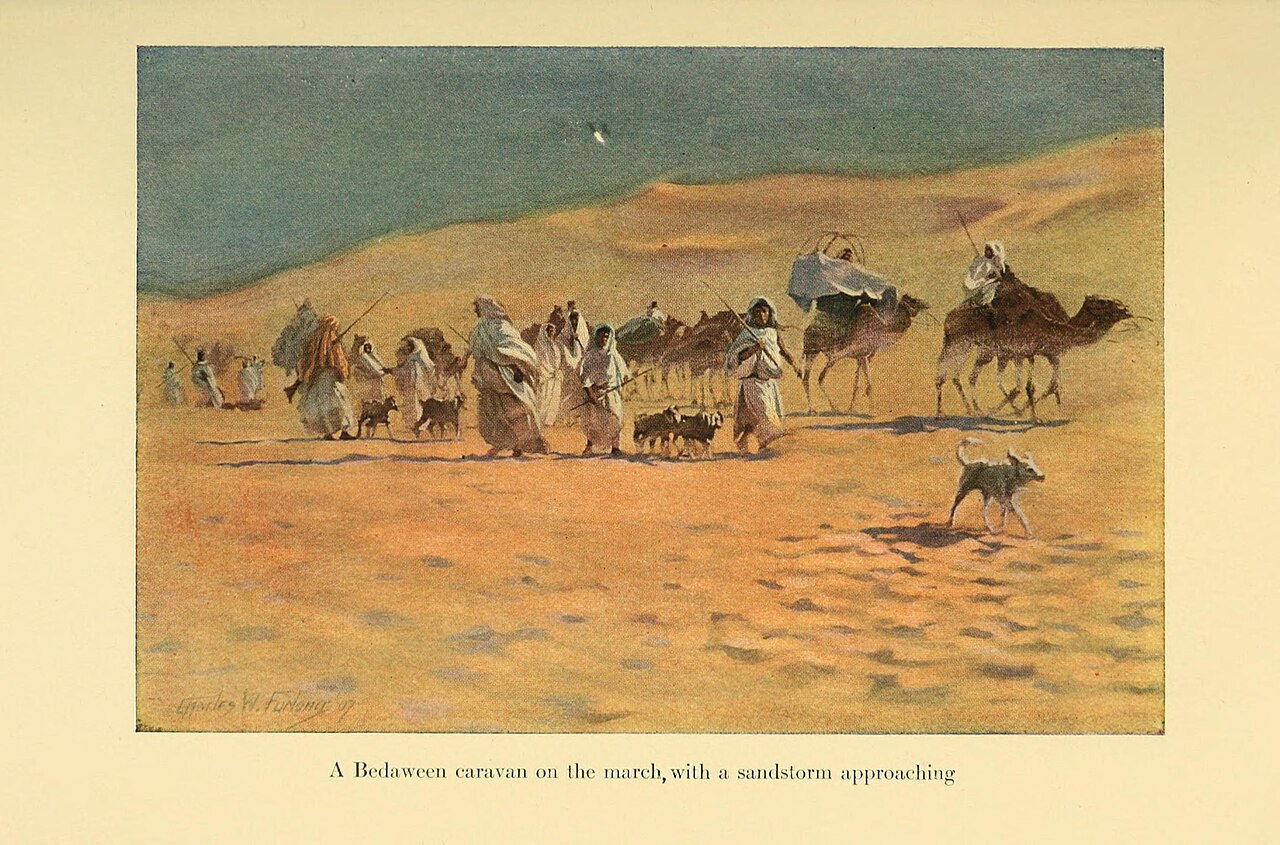
The Tuareg were not merely transporters; they were the political and logistical infrastructure of the desert. They controlled wells, provided guides and protection, levied tolls, and maintained the networks of oasis settlements that made crossing possible. Camel caravans of hundreds of animals could take two to three months to traverse the Sahara, moving at night and resting by day.
“The desert is not empty. It is a sea with its own ports and its own sailors.” — a sentiment widely echoed among Saharan traders, including Tuareg caravan families interviewed by ethnographers such as Johannes Nicolaisen in the 1950s and 1960s.
Salt, gold, and the Niger Bend
The salt trade was the backbone of the northern economy. Blocks of salt cut from Saharan deposits were carried south and exchanged for grain, cloth, and gold. Timbuktu, founded around 1100 CE, became a legendary entrepôt where Tuareg, Songhai, and Arab merchants converged. The city’s scholars and libraries — including the thousands of manuscripts now preserved in the Ahmed Baba Institute — reflect a cosmopolitan intellectual culture in which desert peoples were full participants.
Tuareg Society: Confederations, Clans, and Social Structure
Tuareg society is organized into confederations, each with its own territory, leadership, and customary law. Well-known groups include the Kel Ahaggar (Hoggar Mountains of Algeria), the Kel Ajjer (southeastern Algeria and southwestern Libya), the Kel Adagh (Adrar des Ifoghas in Mali), and the Kel Aïr (Aïr Mountains of Niger). Within these, clans and families trace descent and obligations through complex networks.
Social roles historically included noble warrior lineages, vassal groups, artisans such as blacksmiths (inadan), and formerly enslaved communities whose descendants still face marginalization — a legacy that modern Tuareg activists and Malian and Nigerien governments continue to address. This hierarchy was never static, and colonial disruption, drought, and migration have reshaped it profoundly.
The role of women
Tuareg women hold a position unusual among many societies in the region. Descent is often traced through the maternal line for certain status purposes, women own property independently, and they are the custodians of poetry, music, and the Tifinagh script. Monogamy is the norm among many Tuareg groups, and divorce is recognized under customary law. The matrilineal emphasis has fascinated scholars for generations, though it should not be overstated — political leadership has typically passed through male lines.
Culture, Music, and the Art of Survival
Tuareg material culture is a study in elegance and utility. The tagelmust, the indigo-dyed turban and veil worn by men, is both practical — protecting against sun and wind-driven sand — and symbolic of maturity and respect. The deep blue dye often stains the skin, giving rise to the romanticized European nickname “blue men of the desert,” a phrase many Tuareg regard as a foreign simplification.
Silver jewelry, engraved with geometric and talismanic motifs, is a signature craft of inadan artisans. The agadez cross, produced in Agadez, Niger, is among the most recognizable forms — each of its many regional variants carries a distinct meaning and is passed down within families.
Desert blues and global stages
Tuareg music has traveled far beyond the Sahara. The band Tinariwen, formed in the late 1970s in Muammar Gaddafi’s Libya among Tuareg exiles and later based in Mali, fused traditional assouf rhythms with electric guitars and rock. Their 2012 album Tassili won a Grammy Award for Best World Music Album. Groups such as Tartit, Imarhan, and Les Filles de Illighadad have brought Tuareg voices — including women’s tende percussion and chant — to international audiences. This music is not nostalgia; it is a living commentary on exile, rebellion, and belonging.
- Tifinagh script: a Berber alphabet still taught by Tuareg women and standardized in Algeria in 2003.
- Tagelmust: the indigo veil, a marker of male maturity and desert practicality.
- Agadez cross: a regional silver pendant tradition with distinct forms across Tuareg territories.
- Assouf music: the “desert blues” genre carried to global audiences by Tinariwen and peers.
Key Milestones in Tuareg History
| Period | Event | Significance |
|---|---|---|
| c. 4th–11th century CE | Emergence of distinct Tuareg society; camel caravans expand | Foundations of trans-Saharan trade and Tamasheq-speaking identity |
| c. 1100 CE | Founding of Timbuktu | Major entrepôt linking Tuareg routes to West African markets and scholarship |
| 1899–1902 | French conquest of the Hoggar; death of Kaocen’s predecessor leaders | Colonial pacification disrupted caravan economies |
| 1916–1917 | Kaocen Revolt in the Aïr | Major anti-colonial uprising led by Ag Mohammed Wau Teguidda Kaocen |
| 1960–1963 | Independence of Mali, Niger, Algeria; first Tuareg rebellions | New borders divided Tuareg homelands; drought and marginalization followed |
| 1990–1996 | Tuareg uprisings in Mali and Niger; peace accords | Demands for autonomy, development, and recognition of Tamasheq |
Tuareg People in the Modern Sahel: Conflict, Climate, and Creativity
The twentieth century brought upheaval. Colonial borders drawn in Berlin in 1884–85 and finalized by later treaties cut across Tuareg territories, dividing families among Algeria, Mali, Niger, and Libya. The catastrophic droughts of the late 1960s and 1970s killed herds and forced many into towns and refugee camps. In the 1980s, thousands of young Tuareg men, trained and armed in Libya, returned home to find few opportunities — a spark for the rebellions of the 1990s.
Those uprisings produced peace agreements in Mali (1992, 1996) and Niger (1995), and brought Tuareg figures into national politics. But the 2012 collapse of northern Mali, when a Tuareg-led movement declared an independent Azawad before being displaced by jihadist groups, exposed deep fragility. French military intervention followed in 2013, and the 2015 Algiers Accord attempted a durable settlement. Instability persists, compounded by trafficking, climate stress, and weak state presence.
New livelihoods, new voices
Yet the Tuareg story is not only one of conflict. Many Tuareg are teachers, doctors, engineers, and entrepreneurs. In Agadez, Niger, tourism — including the famed Festival of Aïr — has been a crucial income source when security allows. In Mali, Tuareg musicians tour internationally and Tuareg artisans sell silverwork online. Women’s cooperatives in Niger produce leather goods and textiles for export. Satellite phones, solar panels, and trucks now supplement camels on routes their ancestors knew by star and dune.
- Climate adaptation: solar-powered wells and drought-resistant livestock practices are spreading across Tuareg pastoral zones.
- Language rights: Tamasheq is taught in some Malian and Nigerien schools; Tifinagh appears on official signage in Algeria.
- Diaspora networks: Tuareg communities in Europe and North America fund schools and cultural festivals back home.
What Does the Future Hold for the Tuareg People?
The central question is whether Saharan states can deliver the recognition and development that Tuareg movements have demanded for decades. The 2015 Algiers Accord promised decentralization and investment in northern Mali, but implementation has been uneven. In Niger, the 2023 coup added new uncertainty to a country that had made notable progress in integrating Tuareg communities into national life. Across the region, climate change — with intensifying heat and erratic rainfall — threatens pastoral livelihoods further.
At the same time, cultural revival is real. Tifinagh is increasingly visible online. Tuareg musicians fill concert halls in Europe. Scholars in Bamako, Niamey, and Algiers are documenting oral histories and manuscripts. Young Tuareg are building apps, creating art, and organizing festivals. The caravan may have shrunk, but the network of knowledge and kinship that sustained it endures.
A Lasting Perspective: The Desert as a Place of Connection
The Tuareg remind us that the Sahara was never a barrier — it was a highway, and the Tuareg were its navigators, toll-keepers, poets, and diplomats. Their history is inseparable from the gold and salt that built cities, the manuscripts that preserved scholarship, and the music that now travels the world. To understand the Tuareg is to understand that Africa’s deserts are not empty margins but centers of civilization and exchange. As the Sahel faces its hardest decades, the Tuareg people’s long experience of adaptation — of reading the wind, sharing scarce water, and carrying culture across distance — may prove among the region’s most valuable inheritances.