📅 Last updated: 18.10.2026
The Dogon Sirius mystery is one of the most debated intersections of African oral tradition, colonial-era ethnography, and modern astronomy — a story that begins in the sandstone cliffs of Mali’s Bandiagara Escarpment and ends in arguments about how knowledge travels between cultures. For more than seventy years, researchers, sceptics, and storytellers have argued over how the Dogon people came to describe a companion star to Sirius, a star system invisible to the naked eye. The question has never quite been settled, and that is precisely what makes it worth examining carefully.
The Dogon Sirius mystery refers to the claim that the Dogon people of Mali possessed detailed traditional knowledge about Sirius B, a white dwarf companion to Sirius that cannot be seen without a telescope. The knowledge was recorded by French anthropologists Marcel Griaule and Germaine Dieterlen between the 1930s and 1950s. Most historians of science attribute the astronomical details to cultural exchange or later contamination rather than ancient telescopic observation.
- Where the Dogon Live: Cliffs, Villages, and a Living Cosmology
- How Did the Dogon Sirius Mystery Begin? Griaule, Dieterlen, and the Fieldwork Record
- What Did the Dogon Actually Say About Sirius? Reading the Sources Closely
- Who Popularised the Dogon Sirius Mystery? From Ethnography to Bestseller
- What Are the Main Explanations for the Dogon Sirius Mystery?
- Dogon Sirius Mystery: A Timeline of Key Events
- Why Does the Dogon Sirius Mystery Matter Beyond the Debate?
- What Can We Learn From the Dogon Sirius Mystery Today?
- Frequently Asked Questions About the Dogon Sirius Mystery
- Beyond the Mystery: The Dogon and the Sky Today
Where the Dogon Live: Cliffs, Villages, and a Living Cosmology
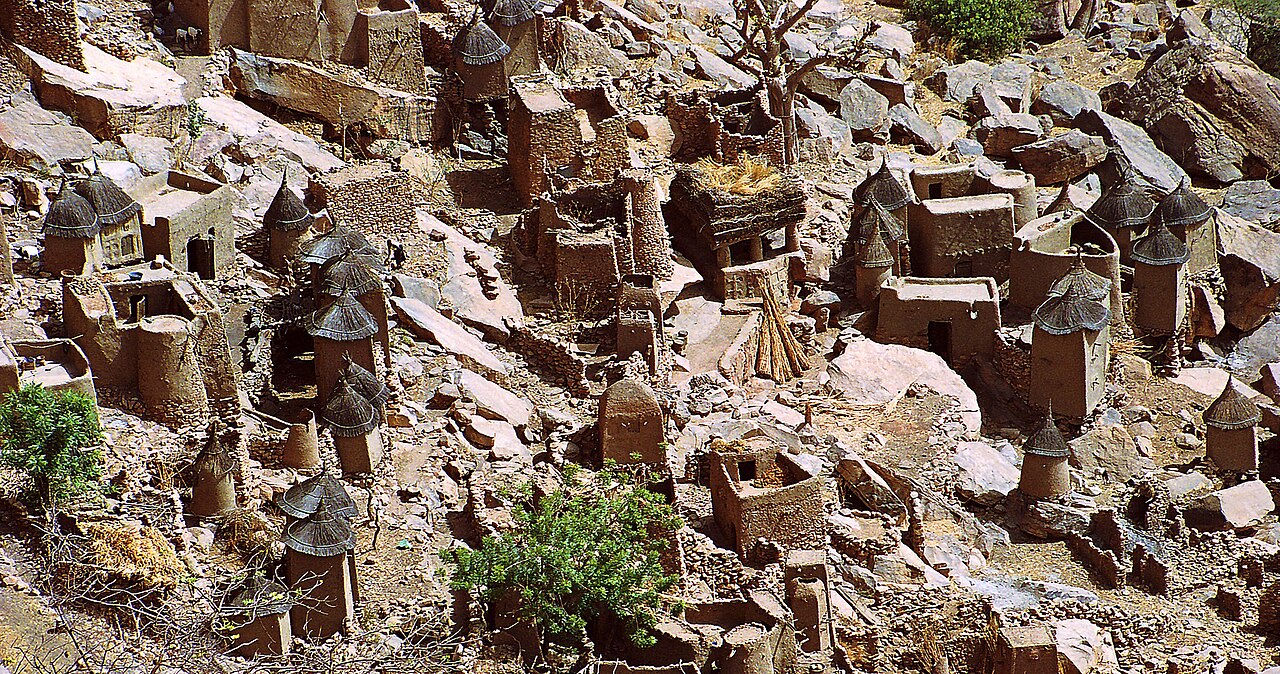
The Dogon number roughly 800,000 people today, concentrated along the Bandiagara Escarpment in the Mopti Region of central Mali, with communities also in Burkina Faso. Their villages — Sangha, Bandiagara, Sanga, Tireli, Irelli — cling to a 150-kilometre sandstone cliff face that rises abruptly from the Sahelian plain. The escarpment was inscribed as a UNESCO World Heritage Site in 1989, recognised both for its dramatic geology and for the extraordinary architecture of Dogon granaries, togu na (men’s meeting houses with low roofs), and ginna (family compounds).
Dogon society is organised around lineage, age grades, and a dense ceremonial calendar. The Sigui ceremony, held roughly every sixty years and lasting seven years, is the most important ritual cycle; the most recent concluded in 1967, and the next is not due until the 2030s. Masked dama dances honour the dead and guide souls toward the ancestral realm. Into this framework the Dogon weave a cosmology populated by the creator god Amma, the rebellious Nommo — amphibious twin spirits — and a complex system of signs, seeds, and celestial bodies.
How Did the Dogon Sirius Mystery Begin? Griaule, Dieterlen, and the Fieldwork Record
Marcel Griaule first visited Dogon country in 1931 as part of the Dakar–Djibouti ethnographic mission. He returned repeatedly, and from 1946 onward he worked closely with Germaine Dieterlen, a meticulous ethnographer who would spend decades documenting Dogon thought. Their landmark publication, Le Renard Pâle (“The Pale Fox”), appeared in 1965, though its core material was gathered in the 1940s.
According to their accounts, Dogon elders — most famously a blind hunter-priest named Ogotemmêli, whose conversations with Griaule were published in Dieu d’Eau (1948) — described the Sirius system in striking terms. They spoke of sigi talo, the star of Sigui, and po tolo, a tiny, heavy, invisible star that orbits Sirius every sixty years. They described po tolo as made of a substance heavier than iron, spiralling around the main star, and said that its orbit was essential to the timing of the Sigui ceremony. In later retellings, the Dogon were said to know that Sirius had a companion made of “the seed of the star,” and that the companion was small, dense, and white.
Sirius B, a white dwarf, was first observed by American astronomer Alvan Graham Clark in 1862, orbiting Sirius A roughly every fifty years. Its extraordinary density — a teaspoon of its material would weigh several tonnes — was not understood until the early twentieth century. If the Dogon accounts are taken at face value, they anticipate some of modern astrophysics by decades.
What Did the Dogon Actually Say About Sirius? Reading the Sources Closely
Here the story becomes more complicated, and more interesting. The primary sources — Griaule’s and Dieterlen’s field notes, published texts, and later interviews — do not present a single, consistent Dogon astronomy. Careful readers have noted several issues:
- The “invisible companion” claim is ambiguous. Dogon informants described po tolo in symbolic and ritual language, not as an observational fact. The distinction between a ritual concept and an astronomical body is central to the debate.
- The sixty-year period is contested. Sirius B’s actual orbital period is about fifty years, not sixty. Defenders of the mystery argue the Dogon figure refers to the Sigui cycle, not the orbit.
- Later informants may have been influenced by earlier researchers. Griaule’s work spanned decades, and some scholars argue that questions from anthropologists shaped the answers they received.
- Translation and interpretation matter. The Dogon language, Dogon Toro So and related dialects, encode cosmology in metaphor; rendering po tolo as “Sirius B” is an interpretive leap.
Who Popularised the Dogon Sirius Mystery? From Ethnography to Bestseller
The wider world learned of the Dogon through two books published in the 1970s. Robert K. G. Temple’s The Sirius Mystery (1976) argued that the Dogon had received their knowledge from extraterrestrial visitors — the amphibious Nommo — who came from the Sirius system. Temple drew heavily on Griaule and Dieterlen, and his book became a bestseller, seeding the story into popular culture, science fiction, and New Age literature.
A parallel strand came from writers such as Eric Guerrier and, later, the authors of The Sirius Mystery adaptations in France and the United States. The 1970s were fertile ground for ancient-astronaut theories; Erich von Däniken’s Chariots of the Gods? had appeared in 1968, and Temple’s book rode that wave. The Dogon Sirius mystery became a staple of television documentaries and paperback cosmology.
What Are the Main Explanations for the Dogon Sirius Mystery?
Over five decades, the debate has settled into three broad positions, each with serious adherents.
The Cultural Contamination Hypothesis
Most professional historians of science and anthropologists favour this explanation. They argue that the Dogon could have encountered Western astronomical knowledge through several channels: French colonial administration, missionary schools, visiting researchers, or even the widely circulated 1920s and 1930s literature on Sirius B. The Dutch-American astronomer and sceptic Robert H. van Gent, writing in the Journal of the Royal Astronomical Society of Canada in 1991, and later the astronomer Carl Sagan in Broca’s Brain (1979), both pointed to the possibility that Griaule’s questioning introduced the concepts. Sagan noted that the Dogon’s knowledge of Sirius B “might have been acquired from European visitors.”
The Ancient Knowledge Hypothesis
Defenders of the mystery, including Temple and some later writers, argue that the Dogon possessed the knowledge long before European contact, transmitted through generations of oral tradition. They point to the consistency of the Sirius references across different Dogon communities and to the symbolic centrality of po tolo in Dogon cosmology. Some also note that the Dogon are far from the only African people with sophisticated astronomical traditions — the Bambara, the Yoruba, and the ancient Egyptians all developed detailed sky knowledge.
The Symbolic and Ritual Hypothesis
A third position, favoured by some anthropologists, holds that the Dogon were not making astronomical claims at all. Po tolo may be a ritual and cosmological concept — a “seed” in a system of correspondences linking sky, earth, and society — rather than a description of a physical star. On this reading, the apparent parallels with Sirius B are coincidental or the result of later reinterpretation by researchers eager to find them.
Dogon Sirius Mystery: A Timeline of Key Events
| Year | Event | Significance |
|---|---|---|
| 1844 | Friedrich Bessel detects gravitational wobble in Sirius’s motion | First hint that Sirius has an unseen companion |
| 1862 | Alvan Graham Clark observes Sirius B | Companion star confirmed telescopically |
| 1915 | Sirius B identified as a white dwarf | Its extreme density becomes known to science |
| 1931–1948 | Griaule and Dieterlen conduct Dogon fieldwork | Core ethnographic material gathered |
| 1965 | Le Renard Pâle published | Full account of Dogon cosmology appears |
| 1976 | Robert Temple’s The Sirius Mystery published | Global popularisation of the extraterrestrial theory |
| 1991 | Van Gent publishes sceptical analysis | Scholarly rebuttal of the ancient-knowledge claim |
Why Does the Dogon Sirius Mystery Matter Beyond the Debate?
The controversy has real consequences beyond academic argument. Dogon country is a living cultural landscape, and the story has brought tourism, media attention, and — sometimes — misrepresentation. Visitors arrive expecting to hear about aliens; they find instead a society with a rich, internally coherent cosmology that deserves to be understood on its own terms.
The Dogon are also custodians of a remarkable astronomical tradition in their own right. Their calendar, their observation of the Pleiades and other stars, and their ritual timing all demonstrate careful attention to the sky. Whether or not they knew about Sirius B before 1862, they were doing astronomy — observing, recording, and integrating celestial phenomena into social life. That fact is often lost in the noise of the extraterrestrial debate.
There is also a broader lesson about how African knowledge systems have been treated. For much of the colonial period, African cosmologies were dismissed as superstition or folklore. The Dogon Sirius mystery, whatever its origins, forced Western scholars to take Dogon thought seriously — even if some of that attention took the form of exoticising speculation. Today, scholars such as those working with the Institut des Sciences Humaines in Bamako and international partners are documenting Dogon knowledge with greater care and respect, treating elders as collaborators rather than informants.
What Can We Learn From the Dogon Sirius Mystery Today?
Several practical lessons emerge for anyone interested in African heritage, astronomy, or the history of ideas:
- Oral traditions are complex and deserve careful reading. Dogon cosmology is not a simple “fact” to be verified or debunked; it is a symbolic system with its own internal logic.
- Colonial-era ethnography must be read critically. Griaule and Dieterlen did important work, but their methods and assumptions shaped what they recorded.
- African astronomical traditions are real and understudied. From the Dogon to the ancient Egyptians to the Bambara, the continent has a deep history of sky knowledge that deserves modern scholarly attention.
- Popular theories can obscure living cultures. The extraterrestrial narrative has sometimes overshadowed the Dogon themselves — their art, architecture, music, and contemporary life.
The Dogon Sirius mystery also connects to a wider revival of interest in African astronomy. Projects such as the Southern African Large Telescope (SALT) in South Africa, the Square Kilometre Array (SKA) spanning South Africa and Australia, and the growing network of African astronomy outreach programmes are building on a long heritage. The Dogon, who have watched the sky for centuries, are part of that story.
Frequently Asked Questions About the Dogon Sirius Mystery
Did the Dogon really know about Sirius B before telescopes?
There is no scholarly consensus. The claim rests on Griaule and Dieterlen’s ethnographic records, which most historians of science believe were shaped by cultural exchange or later contamination. Some Dogon oral traditions do reference a companion star, but the interpretation of those traditions remains contested.
Who were Marcel Griaule and Germaine Dieterlen?
Marcel Griaule (1898–1956) was a French ethnographer who first studied the Dogon in 1931. Germaine Dieterlen (1903–1999) was his collaborator and a major figure in French anthropology. Together they produced Le Renard Pâle (1965), the key source for the Dogon Sirius mystery.
What is po tolo?
Po tolo is the Dogon term often translated as “the star of the deep beginning” or “the seed star.” It is described in Dogon cosmology as a tiny, heavy, invisible companion to Sirius, and is central to the Sirius mystery debate.
Is the Dogon Sirius mystery accepted by scientists?
Most astronomers and anthropologists reject the extraterrestrial hypothesis. The cultural contamination and symbolic interpretations are more widely accepted, though the debate continues in popular literature.
Beyond the Mystery: The Dogon and the Sky Today
The Dogon Sirius mystery will probably never be fully resolved to everyone’s satisfaction. The evidence is fragmentary, the sources are layered, and the stakes — cultural pride, scholarly reputation, the allure of the extraterrestrial — are high. What is clear is that the Dogon have a sophisticated astronomical tradition that long predates any European contact, and that their cosmology deserves to be studied with the same rigour and respect as any other intellectual tradition.
In the villages along the Bandiagara Escarpment, elders still time ceremonies by the stars. Children learn the names of celestial bodies alongside the names of ancestors. The Dogon Sirius mystery, whatever its origins, has drawn the world’s attention to a place where the sky is not just a backdrop but a living part of social and spiritual life. That attention is a gift — provided we use it to listen rather than to speculate, and to celebrate a culture that has been watching the heavens for centuries with curiosity, precision, and meaning.