📅 Last updated: 09.10.2026
The Kingdom of Kush rose along the Nile in what is now northern Sudan, and for nearly a thousand years it was one of the most formidable powers of the ancient world. Its kings ruled Egypt as pharaohs, its queens commanded armies, its archers were feared from the Mediterranean to the Red Sea, and its pyramids — more numerous than those of Egypt — still stand on the desert plains of Meroë. Yet Kush is often reduced to a footnote in the story of its northern neighbour. This is the tale of a civilisation that deserves far better.
- Where the Kingdom of Kush Began
- The Kushite Pharaohs Who Ruled Egypt
- Meroë: The Golden Age of the Kingdom of Kush
- Key Dates in the Kingdom of Kush
- Everyday Life, Trade, and Belief in Ancient Nubia
- The Pyramids of Meroë: A Landscape of Kings
- The Fall of Kush and the Rise of Aksum
- Why the Kingdom of Kush Still Matters
Where the Kingdom of Kush Began
Long before the first pyramids appeared at Meroë, the region the ancient Egyptians called Ta-Seti — “Land of the Bow” — was already a sophisticated society. Egyptian records from the Old Kingdom, around 2300 BCE, describe campaigns against Nubian peoples and speak of the Nehesy, or southerners, whose archery was legendary. The Egyptians traded with them, recruited them as soldiers, and feared them in equal measure.
The Kingdom of Kush proper emerges into the historical record around 1070 BCE, at the end of Egypt’s New Kingdom. With Egypt weakened and its empire in retreat, a new power consolidated around the city of Napata, near the Fourth Cataract of the Nile, close to the sacred mountain of Gebel Barkal. The Napatan kings adopted many Egyptian traditions — hieroglyphs, temple architecture, the worship of Amun — but they were never merely imitators. They fused Egyptian practice with distinctly Nubian customs, including matrilineal succession patterns that gave royal women extraordinary power.
Gebel Barkal was the spiritual heart of the kingdom. Its sandstone cliff, which resembles a rearing cobra, was believed to be the home of the god Amun. Today the site is a UNESCO World Heritage Site, and its temples and pyramids remain among the most striking monuments in Africa.
The Kushite Pharaohs Who Ruled Egypt
The most extraordinary chapter in Kushite history came when its kings turned their attention northward and conquered Egypt itself. Around 744 BCE, a Kushite ruler named Kashta pushed into Upper Egypt and installed his daughter Amenirdis as a priestess in Thebes. His successor, Piye (also spelled Piankhi), completed the conquest, and by 728 BCE Kushite authority extended from the Nile Delta to the confluence of the Blue and White Niles.
Piye left behind a remarkable victory stele, inscribed in Egyptian hieroglyphs, that records his campaign in vivid detail. It is one of the great historical documents of the ancient world, and it reveals a king who was both a warrior and a devout servant of Amun. After defeating the northern princes, Piye famously refused to enter their palaces, complaining that they were “unclean” because they had eaten fish — a detail that says much about Kushite ritual purity and cultural confidence.
Piye’s successors ruled Egypt as the Twenty-Fifth Dynasty. His brother Shabaka (r. c. 705–690 BCE) moved the capital to Memphis and sponsored a revival of Egyptian art and religion. Taharqa (r. c. 690–664 BCE) was perhaps the greatest of them all — a builder of temples at Karnak and Kawa, a military commander who confronted the Assyrian Empire, and a figure remembered in both Egyptian and biblical sources. The Hebrew Bible mentions Taharqa by name as an ally of Judah against Assyria.
The dynasty ended when the Assyrian king Ashurbanipal sacked Thebes in 663 BCE, driving the Kushites back south. But the memory of Kushite pharaohs endured, and the kingdom’s centre of gravity shifted permanently upriver — to a new capital that would define the next phase of its history.
Meroë: The Golden Age of the Kingdom of Kush
After the loss of Egypt, the Kushite court relocated to Meroë, a city on the east bank of the Nile between the Fifth and Sixth Cataracts, about 200 kilometres north of modern Khartoum. This was the beginning of the Meroitic period, roughly 300 BCE to 350 CE, and it was arguably the kingdom’s most creative era.
Meroë was not a backward retreat but a thriving metropolis. It sat at the crossroads of trade routes linking the Nile Valley to the Red Sea, sub-Saharan Africa, and the Mediterranean. Its economy rested on gold, ivory, ebony, ostrich feathers, and above all iron. The region’s iron ore and hardwood forests made Meroë one of the earliest and most important ironworking centres in Africa. Archaeologists have found extensive slag heaps near the city — evidence of large-scale smelting that supplied tools and weapons across the region.
The Meroitic kings and queens developed their own script, known today as Meroitic. It has been partially deciphered — scholars can read the sounds but not fully understand the language — making it one of the great unsolved puzzles of African epigraphy. The script appears on stelae, temple walls, and funerary inscriptions throughout the kingdom.
The Candaces: Queens Who Ruled and Fought
One of Meroë’s most distinctive features was the power of its royal women. The title Kandake (often Latinised as “Candace”) referred to a queen mother or reigning queen who wielded real political and military authority. These were not ceremonial figures. Strabo, the Greek geographer, records that a Kandake led troops against the Roman army in 25 BCE, when Rome attempted to extend its control up the Nile.
The Roman prefect Gaius Petronius marched on Napata and sacked it, but the Kushites fought back fiercely. The conflict ended in a negotiated peace that favoured Kush — a rare outcome against Rome at the height of its power. The Kandake’s envoys travelled to Samos to meet the Emperor Augustus himself, and the resulting treaty established a border that held for centuries.
Later Kandakes are named in Meroitic inscriptions and in the New Testament: the Book of Acts mentions “the Candace, queen of the Ethiopians” — a reference to the reigning Kushite queen. Among the most famous is Amanirenas, who led the resistance against Rome, and Amanishakheto, whose elaborate treasure was discovered in a pyramid at Meroë in 1834 and partly dispersed across European museums.
Key Dates in the Kingdom of Kush
| Period | Event |
|---|---|
| c. 2500–1500 BCE | Egyptian trade and conflict with Nubian peoples; “Land of the Bow” referenced in Old Kingdom records |
| c. 1070 BCE | Kingdom of Kush consolidates around Napata and Gebel Barkal |
| c. 744 BCE | King Kashta extends Kushite control into Upper Egypt |
| c. 728 BCE | Piye completes the conquest of Egypt; Twenty-Fifth Dynasty founded |
| c. 690–664 BCE | Reign of Taharqa; Kushite power at its height |
| 663 BCE | Assyrians sack Thebes; Kushite rule in Egypt ends |
| c. 300 BCE–350 CE | Meroitic period; iron production, Meroitic script, powerful Kandakes |
| c. 350 CE | Kingdom of Kush declines; Aksum emerges as regional power |
Everyday Life, Trade, and Belief in Ancient Nubia
What did it mean to live in the Kingdom of Kush? For farmers along the Nile, life revolved around the annual flood, which deposited fertile silt on the fields — much as in Egypt. They grew sorghum, millet, barley, and wheat, and kept cattle, sheep, and goats. The Nile was also a highway: boats carried grain, gold, and goods north and south.
Meroitic cities were planned and prosperous. Excavations at Meroë, Musawwarat es-Sufra, and Naqa have revealed temples, palaces, baths, and extensive walls. Musawwarat es-Sufra contains the Great Enclosure, a sprawling complex of corridors and courtyards whose purpose remains debated — perhaps a royal training ground, perhaps a pilgrimage centre. At Naqa, the Temple of Amun and the Temple of Apedemak stand side by side, showing how Kushites honoured both Egyptian and indigenous gods.
Apedemak, the lion-headed warrior god, was uniquely Kushite. Temples to him were built at Naqa, Musawwarat, and elsewhere, and he appears on royal reliefs as a protector of kings. The Kushites also worshipped Isis, Osiris, and Amun, and their funerary practices combined Egyptian-style pyramid tombs with Nubian burial customs.
Trade Networks and Cultural Exchange
Meroë was a cosmopolitan hub. Goods moved along routes that connected the Nile to the Red Sea port of Adulis and onward to Arabia and India. Kushite merchants traded with Greeks, Romans, and later Aksumites. Roman glass, Indian beads, and Mediterranean pottery have all been found in Meroitic contexts.
This exchange went both ways. Kushite gold and iron reached the Mediterranean; Kushite soldiers served in Roman armies; and Kushite religious ideas influenced neighbouring cultures. The kingdom was never isolated — it was a bridge between the Mediterranean world and inner Africa.
- Gold: Mined in the Eastern Desert and Nubian deserts, traded north and east.
- Iron: Smelted at Meroë and other centres, used for tools, weapons, and trade.
- Ivory and ebony: Highly prized in Rome and the Hellenistic world.
- Textiles: Cotton was cultivated in Nubia earlier than in many other regions.
The Pyramids of Meroë: A Landscape of Kings
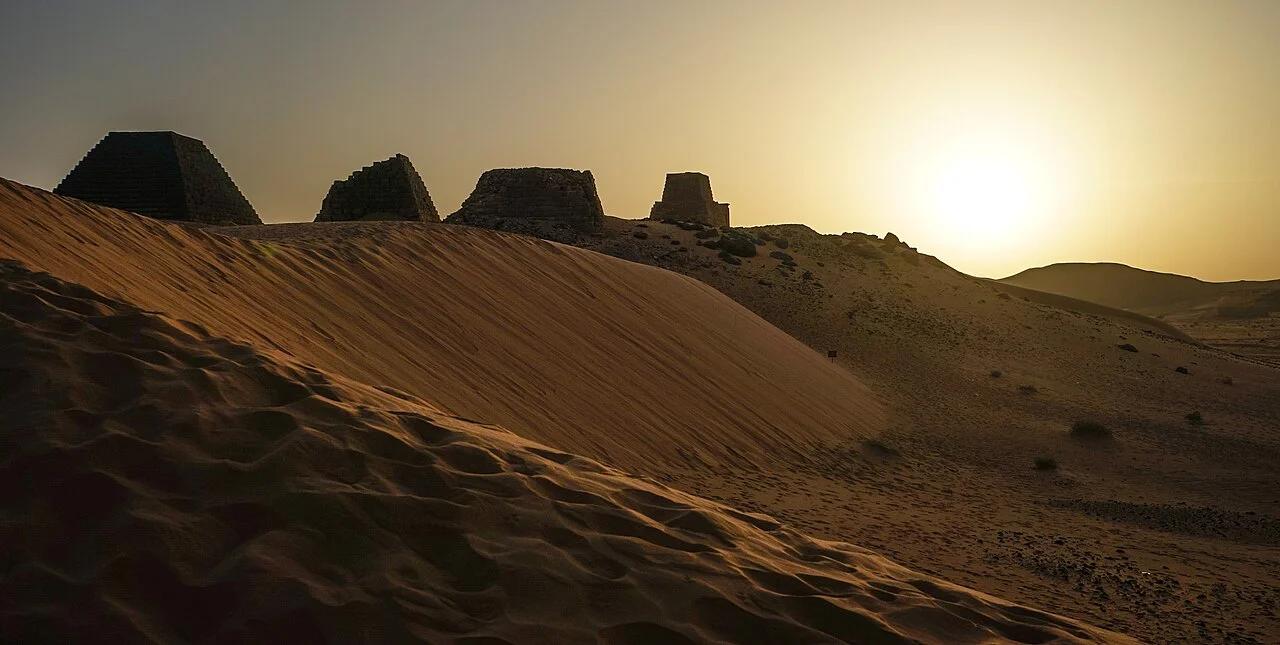
If the pyramids of Giza are the most famous monuments of the Nile, the pyramids of Meroë are among the most haunting. More than 200 pyramids stand in clusters across the desert at Meroë, built over several centuries as tombs for kings, queens, and nobles. They are smaller and steeper than their Egyptian counterparts — the largest is about 30 metres high — but their number and setting give the site an extraordinary power.
Each pyramid was topped with a chapel, and the walls were decorated with reliefs showing the deceased ruler before the gods. Many of these reliefs were damaged or removed in the nineteenth century, when the Italian explorer Giuseppe Ferlini dynamited several pyramids in search of treasure. His finds — including a cache of gold jewellery from the pyramid of Amanishakheto — ended up in museums in Berlin and Munich, where they remain today.
Despite this loss, Meroë remains a UNESCO World Heritage Site and one of the most important archaeological landscapes in Africa. Excavations continue, and new discoveries — including evidence of ancient water management and urban planning — keep reshaping our understanding of the kingdom.
“The Kingdom of Kush was not a peripheral shadow of Egypt. It was a centre of power, innovation, and culture in its own right — one that shaped the history of the Nile Valley for a millennium.”
The Fall of Kush and the Rise of Aksum
No empire lasts forever. By the third century CE, the Kingdom of Kush was under pressure from multiple directions. The rise of the Aksumite Empire in the Ethiopian highlands disrupted Red Sea trade routes, shifting wealth away from the Nile. Climate change and shifting rainfall patterns may have strained agriculture. Internal political fragmentation, visible in the growing number of local rulers, weakened central authority.
Around 350 CE, the Aksumite king Ezana invaded Nubia. His inscriptions record victories over the “Kas” — almost certainly Kush — and the destruction of cities. Whether this was the final blow or merely one of several factors, the Kingdom of Kush as a unified state disappears from the historical record around this time.
What followed was not a void. Nubian civilisation continued in the Christian kingdoms of Nobatia, Makuria, and Alwa, which flourished for centuries and left their own remarkable legacy — including the frescoes of Faras and the cathedral of Dongola. The people, languages, and traditions of Nubia endured, and their descendants live today in southern Egypt and northern Sudan.
Why the Kingdom of Kush Still Matters
The Kingdom of Kush challenges the way we tell the story of ancient Africa. It was not a passive recipient of Egyptian civilisation but an active creator of its own. Its kings ruled Egypt, its queens led armies, its engineers built cities, and its artists developed a script that scholars are still working to fully understand.
For the African diaspora, Kush is a powerful reminder of a deep and sophisticated history that predates colonialism by millennia. For historians, it is a case study in cultural exchange, resilience, and the complexity of power in the ancient world. For anyone who loves Africa, it is a source of wonder — and a call to look beyond the familiar landmarks.
Today, Sudan’s archaeological sites face real challenges: conflict, climate change, and limited resources for preservation. Yet they also hold extraordinary potential. Museums in Khartoum and around the world are re-examining their collections, and a new generation of Sudanese and international scholars is bringing fresh eyes to the evidence.
The Kingdom of Kush may be forgotten by many, but it is not lost. Its pyramids still catch the desert light. Its inscriptions still speak. And its story — of a proud, inventive, and powerful African civilisation — is one the world is only beginning to fully appreciate.