📅 Last updated: 26.09.2026
The Ouidah Slave Route begins at the edge of a quiet town in southern Benin, where a sandy road slips between palm groves and pastel colonial walls before emptying onto a beach the color of wet clay. Standing there, with the Atlantic rolling in and fishing boats bobbing offshore, it is almost impossible to reconcile the calm with what this coastline witnessed: for roughly three centuries, Ouidah was one of the most important departure points for enslaved Africans in the entire transatlantic trade. Today it is a place of pilgrimage, memory, and — increasingly — of reckoning and celebration.
- Why Ouidah Became a Global Crossroads
- Tracing the Ouidah Slave Route on Foot
- Key Landmarks Along the Ouidah Slave Route
- Vodun, Memory, and the Living Culture of Ouidah
- Beyond the Route: Modern Ouidah and Benin
- Practical Guide: Visiting the Ouidah Slave Route
- What the Door of No Return Means Today
- A Final Word: Memory as a Form of Power
Benin, the small West African nation wedged between Togo and Nigeria, has turned this painful history into one of the continent’s most powerful heritage experiences. The Route des Esclaves, as it is known in French, draws visitors from across Africa, Europe, the Americas, and the Caribbean — many of them descendants of people who were forced through this very landscape. What they find is not a monument to shame but a carefully tended story of endurance, ancestry, and the unbroken thread connecting Africa to its diaspora.
Why Ouidah Became a Global Crossroads
To understand the Ouidah Slave Route, you first have to understand why this particular stretch of coast mattered so much. The Kingdom of Dahomey, with its capital at Abomey roughly 100 kilometers inland, rose to dominance in the 17th and 18th centuries as a formidable military power. Ouidah, then a coastal town with its own complex politics, served as the kingdom’s principal gateway to the Atlantic.
European traders arrived in waves — Portuguese, Dutch, English, French, and Danish — each establishing forts and competing for access. The Portuguese built Fort São João Baptista de Ajudá in 1721, a small outpost that would remain under Portuguese control, astonishingly, until 1961, more than a year after Benin (then Dahomey) gained independence from France. The fort still stands, its ochre walls and cannons a stark reminder of how long European powers clung to this coast.
Ouidah’s geography made it ideal for the trade. Unlike many West African ports, it offered a relatively calm landing and a network of lagoons and paths that connected the interior to the sea. Enslaved people captured in wars or raids far inland — from what is now Nigeria, Niger, Burkina Faso, and beyond — were marched to the coast, held in barracoons, and loaded onto ships bound for the Americas.
The numbers are staggering. Historians estimate that between the 17th and 19th centuries, more than one million Africans were shipped through the Bight of Benin, with Ouidah among the busiest single ports. The majority went to Brazil, Cuba, and the Caribbean, though significant numbers also landed in what became the United States. The cultural fingerprints of this forced migration are everywhere: in Brazilian Candomblé, Cuban Santería, Haitian Vodou, and the rhythms of New Orleans.
Tracing the Ouidah Slave Route on Foot
The modern route is a roughly 3.5-kilometer walk from the center of Ouidah to the beach, and it is designed to be experienced slowly. Most visitors begin at the Musée d’Histoire de Ouidah, housed in the old Portuguese fort, where artifacts, maps, and documents lay out the mechanics of the trade with unflinching clarity. From there, the path is marked by monuments, each one a station of memory.
The Tree of Forgetfulness
One of the first stops is the Arbre de l’Oubli — the Tree of Forgetfulness. According to oral tradition, enslaved people were made to circle the tree, women nine times and men seven, to erase their memories of home, family, and identity. The ritual was a psychological weapon: a person who could not remember who they were could be more easily controlled.
Standing beside the tree today, visitors often pause longer than they expect. The story is harrowing, but it is also a testament to something else — the fact that memory survived anyway. The names, languages, recipes, and spiritual practices carried across the ocean prove that the forgetting never fully worked.
Zomachi and the Memorial of Remembrance
Further along the route stands the Zomachi monument, a circular memorial unveiled in 1995 that honors the ancestors lost to the trade. The word Zomachi comes from the Fon language and evokes the idea of remembering and honoring. The monument’s design — a ring of figures and symbols — invites contemplation rather than spectacle.
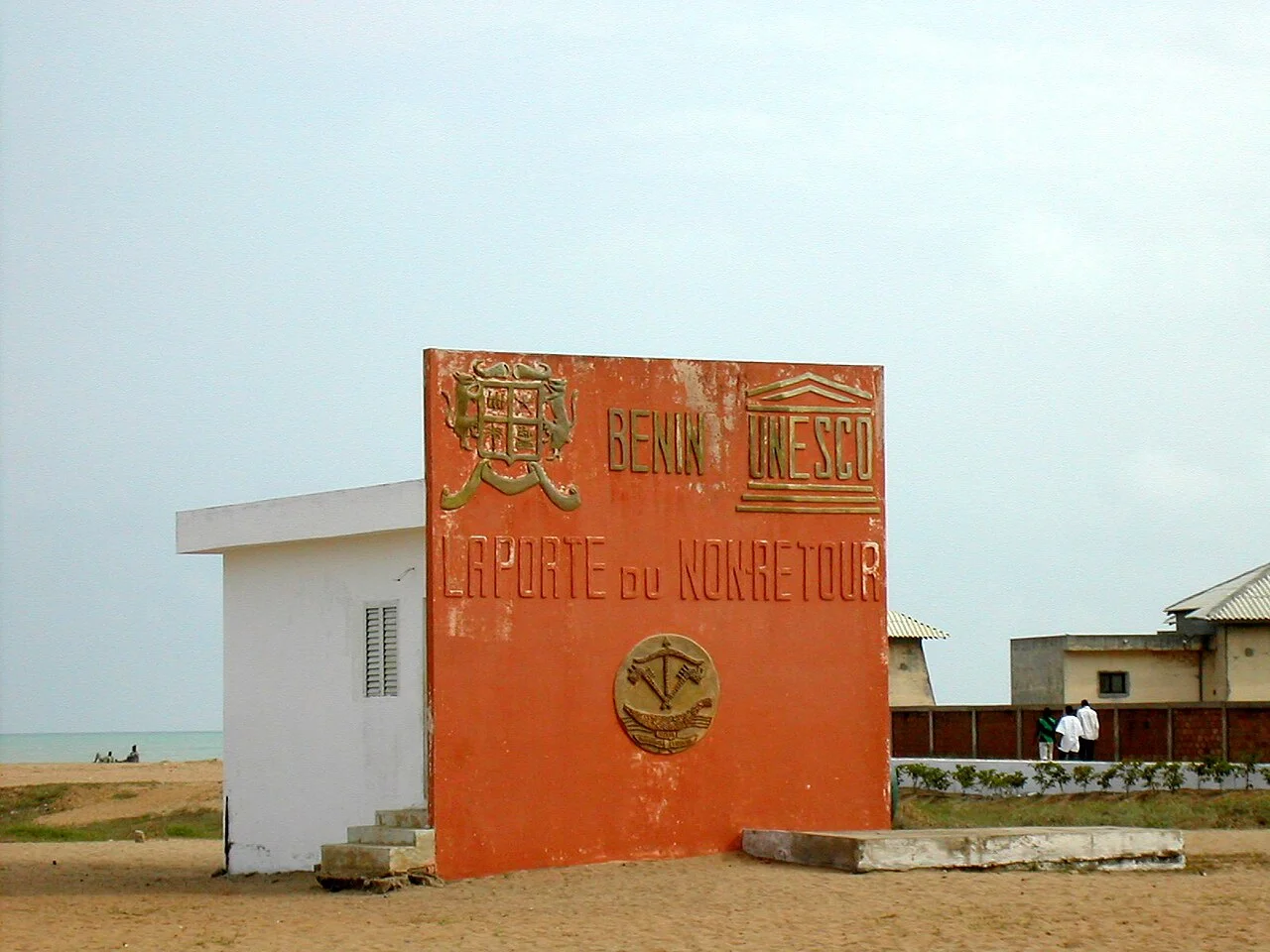
Nearby, the Door of No Return itself sits at the water’s edge: a concrete archway facing the sea, topped with a carved relief depicting a ship and human figures. It was erected in 1992 and has since become the emotional climax of the route. Passing through it, many visitors weep. Others stand in silence. Some leave flowers, pour libations, or simply touch the stone.
“We did not come here to cry. We came here to remember, and to tell the world that we are still here.” — a sentiment echoed by countless diaspora visitors at the Door of No Return
Key Landmarks Along the Ouidah Slave Route
The route is dense with meaning, and a quick reference helps visitors plan and understand what they are seeing. The table below summarizes the principal stops and their significance.
| Landmark | Location | Significance |
|---|---|---|
| Musée d’Histoire de Ouidah | Old Portuguese Fort, town center | Historical exhibits on the slave trade; former Fort São João Baptista de Ajudá (1721) |
| Tree of Forgetfulness | Mid-route | Site of the ritual of memory erasure imposed on captives |
| Zomachi Monument | Near the coast | Memorial to the ancestors, unveiled 1995 |
| Door of No Return | Beach, end of route | Symbolic archway erected 1992; emotional focal point |
| Python Temple | Town center | Vodun spiritual site tied to Ouidah’s religious heritage |
Vodun, Memory, and the Living Culture of Ouidah
It would be a mistake to reduce Ouidah to its slave-trade history alone. The town is also the spiritual heartland of Vodun, the West African religion that — despite centuries of misrepresentation in Western popular culture — is a sophisticated system of philosophy, medicine, and community. Ouidah hosts the annual Vodun Festival every January 10th, a national holiday in Benin since the 1990s, when thousands of practitioners and curious visitors gather for ceremonies, drumming, and dance.
The Temple of Pythons, in the center of town, is one of Ouidah’s most visited sites. Priests care for dozens of royal pythons, considered sacred messengers. Visitors can hold the snakes — a practice that delights some and terrifies others — and learn about the role of Vodun in daily life.
This spiritual richness is inseparable from the slave-trade story. Many of the religious traditions that took root in the Americas — Brazilian Candomblé, Cuban Santería, Haitian Vodou — trace directly back to this region and to the Fon, Yoruba, and Ewe peoples who were carried away. When a Brazilian visitor walks the Ouidah Slave Route and recognizes a deity’s name, they are encountering a fragment of their own ancestry.
The Return of the Diaspora
In recent decades, Ouidah has become a site of literal return. Every year, particularly around January 10th, thousands of Afro-descendants from Brazil, the United States, the Caribbean, and Europe make the pilgrimage. Many come to reconnect with ancestral roots; some come to mourn; others come to celebrate survival.
Benin has actively courted this connection. The government declared 2020 the “Year of Return” — though the COVID-19 pandemic curtailed much of the programming — and continues to promote heritage tourism. In 2018, President Patrice Talon attended memorial ceremonies at the Door of No Return. The message is consistent: Benin sees the diaspora not as a lost branch but as part of the same tree.
For many visitors, the most moving moments are unscripted. A woman from Bahia kneels at the water’s edge and pours water from a calabash. A man from Georgia stands at the Door of No Return and quietly recites the names of ancestors he has traced through genealogical research. These personal rituals have become as much a part of the route as the monuments themselves.
Beyond the Route: Modern Ouidah and Benin
Ouidah today is a town of about 100,000 people, and it is far more than a memorial site. Its streets are alive with markets, motorbike taxis, and the sounds of Afrobeat and traditional drumming. The Sacred Forest of Kpassè, a tranquil grove in the town center, offers shade and legend — it is said to be guarded by spirits and to have once sheltered the town’s founders.
Benin itself is a stable democracy by regional standards, having held multiparty elections since the early 1990s. Its economy relies on agriculture — cotton, cashews, pineapples — and increasingly on tourism and services. Cotonou, the economic capital about 40 kilometers east of Ouidah, buzzes with markets, music, and the famous Dan Tokpa, one of West Africa’s largest open-air markets.
Beninese cuisine alone is worth the trip: amiwo (a savory cornmeal dish), grilled tilapia with spicy pepper sauce, akassa wrapped in leaves, and the ubiquitous pâte, a starchy staple served with rich sauces. Street food vendors sell yovo doko — sweet fried dough — and fresh coconut water. The food, like the culture, is a blend of local tradition and outside influence, shaped by centuries of trade and exchange.
A Growing Heritage Economy
The Ouidah Slave Route has become an economic engine. Guesthouses, guides, and craft vendors have grown up around it. This brings both opportunity and tension: how do you market pain without cheapening it? How do you welcome tourists without turning ancestors into attractions?
Local guides — many of them trained historians or members of families with deep roots in the town — handle this question with care. They emphasize context, dignity, and the importance of listening. The best tours are less about spectacle and more about understanding: the economics of the trade, the complicity of African elites as well as European traders, the resistance and rebellion that also marked this history.
That nuance matters. The transatlantic slave trade was not a simple story of villains and victims. It was a complex system involving African kingdoms, European merchants, and a global economy hungry for labor. Ouidah’s monuments do not shy away from this complexity — and that honesty is part of what makes the experience so powerful.
Practical Guide: Visiting the Ouidah Slave Route
If you are planning a visit, here is what you need to know.
- Getting there: Ouidah is about 40 kilometers west of Cotonou, roughly an hour by car or taxi. Shared taxis and motorbike taxis (zemidjans) are affordable and frequent.
- Best time to visit: The dry season runs from November to March, with January 10th — the Vodun Festival — being the most vibrant and crowded time. Expect heat and humidity year-round.
- What to wear: Light, breathable clothing and comfortable walking shoes. Modest dress is respectful, especially at spiritual sites.
- Guides: Hiring a local guide is strongly recommended. They provide context, translation, and access to stories you would otherwise miss.
- Language: French is the official language; Fon and other local languages are widely spoken. English is less common, so a few French phrases help.
- Respect: This is a site of mourning and memory for many. Approach it with humility, ask before photographing people, and follow the guidance of local custodians.
- Combine with: The Royal Palaces of Abomey (a UNESCO World Heritage Site), Ganvié stilt village on Lake Nokoué, and the Pendjari National Park in the north for wildlife.
What the Door of No Return Means Today
The phrase “Door of No Return” carries a heavy irony. The door was never truly one-way. The people who passed through it did not disappear; they became the ancestors of millions across the Americas, the Caribbean, and Europe. Their descendants are now returning — not in ships, but on planes, with cameras, DNA tests, and a hunger to understand.
Ouidah’s power lies in this paradox. It is a site of profound loss and of astonishing continuity. The drums that echo through the town today are relatives of the drums that crossed the ocean. The gods honored in the Python Temple have cousins in Salvador, Havana, and Port-au-Prince. The Ouidah Slave Route is not just a history lesson; it is a living bridge.
For African visitors, the route offers something different but equally important: a reminder that the continent’s story is not only one of extraction and suffering, but of resilience, creativity, and survival. Benin has chosen to confront its past openly — not to dwell in guilt, but to honor those who endured and to claim the future.
A Final Word: Memory as a Form of Power
Walking the Ouidah Slave Route is not an easy experience, and it is not meant to be. But it is a necessary one. In a world that often prefers to forget uncomfortable histories, Ouidah insists on remembering. The tree, the monuments, the archway by the sea — they are not just stones and stories. They are acts of defiance against erasure.
What stays with most visitors is not the horror, but the humanity. The guides who tell these stories with dignity. The elders who tend the sacred sites. The children who run along the beach, unaware that they are playing on ground that once held so much grief. And the diaspora visitors who arrive as strangers and leave as family.
Benin has given the world a gift: a place to confront the past without being crushed by it. The Door of No Return is, in the end, also a door of return — a threshold where memory becomes meaning, and where the descendants of the stolen can stand on the shore and say, simply and powerfully: we are still here.