📅 Last updated: 13.09.2026
The Walls of Benin once formed the largest earthworks ever built by human hands — a sprawling network of banks, ditches and moats that enclosed the heart of the Kingdom of Benin in what is now Edo State, Nigeria. For centuries they protected a sophisticated city-state renowned for its bronze casters, its coral-beaded obas and its far-reaching trade networks. Today, though much has been lost to urban expansion, the surviving segments still whisper of an engineering feat that predates many of Europe’s great fortifications.
What Were the Walls of Benin?
The Walls of Benin were not a single wall in the way that tourists might imagine the Great Wall of China. They were a system of earthworks — ramparts, ditches, and moats — built over roughly six centuries to defend and define the capital of the Kingdom of Benin, known in Edo as Edo or Igodomigodo. The complex surrounded the royal palace, the homes of chiefs and guilds, and the farmlands and villages that fed the city.
At their peak, the earthworks extended for an estimated 16,000 kilometres if all the interlocking banks and ditches were laid end to end — a figure cited in the Guinness Book of Records in 1974, which described them as the world’s largest earthworks carried out prior to the mechanical era. The main city wall enclosed roughly 1,200 square kilometres, with a denser inner ring around the royal precinct.
What makes the Walls of Benin remarkable is not just their scale but their design. The builders used a technique that archaeologists call segmented construction: rather than one continuous rampart, they dug a series of interlocking ditches, piling the excavated earth into banks behind them. This created a defensive system that could be flooded in places, channeled water in others, and maintained by local communities who knew their own stretch of the wall intimately.
Not a Single Builder, But Generations
The walls were not the work of one ruler or one century. Construction began as early as the 13th century, possibly earlier, and continued into the 15th and 16th centuries under obas such as Ewuare the Great (reigned c. 1440–1473) and Oba Esigie (reigned c. 1504–1550). Each generation added, repaired, and extended. The system grew organically, shaped by warfare, trade, and the spiritual geography of Edo cosmology.
This incremental building explains why the walls are so vast and so varied. Some sections were simple earth banks; others were deep moats lined with laterite; still others incorporated natural streams and gullies. The result was a defensive landscape that blended human engineering with the terrain itself.
How Were the Walls of Benin Built?
The builders of the Walls of Benin had no wheeled vehicles, no pulleys, and no iron machinery of the kind used in medieval Europe. They worked with hoes, baskets, and human labour — and with an intimate knowledge of the soil and seasons.
The process was deceptively simple but labour-intensive. Workers dug a ditch, piling the spoil into a bank on the inner side. The ditch could be up to 6 metres deep and the bank up to 9 metres high in places. Where the ground was swampy, they reinforced the banks with clay and palm fronds. Where the wall crossed a stream, they built sluices to control water flow.
What is striking is the coordination required. The walls were built in segments, each the responsibility of a particular quarter, guild, or chief. This decentralized system meant that no single central bureaucracy had to manage the entire project at once — a lesson in how large-scale infrastructure can emerge from local initiative.
The Role of the Guilds
Edo society was organized around powerful guilds — the Igun (bronze casters), the Igbesamwan (wood carvers), the Ewaise (physicians), and others. These guilds not only produced the famous Benin bronzes but also contributed labour and expertise to civic projects. The walls were, in a sense, a collective enterprise of the guilds and quarters, each maintaining its own section.
This guild structure also explains the walls’ durability. Because local communities had a stake in the defences, they repaired them after floods and battles. The walls were not a distant imperial project; they were part of everyday life.
What Did the Walls Protect?
The Walls of Benin protected more than a city. They enclosed a cosmological and political order. Inside the inner ring lay the Oba’s palace, a sprawling complex of courtyards, shrines, and meeting halls. Around it lived the chiefs, the guilds, and the priests. Beyond the inner ring were the farmlands, markets, and villages that sustained the capital.
The walls also regulated movement and trade. Gates controlled entry to the city, and tolls were collected. The moats served as fish ponds and water sources in dry seasons. In times of war, they became traps for attackers. In times of peace, they were boundaries between quarters and lineages.
European visitors in the 15th and 16th centuries were astonished by what they saw. The Portuguese, who arrived on the coast in the 1480s, described Benin City as one of the most impressive cities in Africa. Lourenço Pinto, a Portuguese ship captain, wrote in 1691 that the city was “very large” and that the walls were “a great work.” The Dutch physician Olfert Dapper published a description in 1668, based on Dutch traders’ accounts, that depicted Benin City as a city of wide streets, orderly houses, and a royal court of immense wealth.
“The city is very large; when you enter it, you are struck by its great size. The houses are close together, and the streets are wide. The king’s palace is a collection of buildings that covers a great area, and within it are many courtyards and galleries.”
— Adapted from Olfert Dapper, Naukeurige Beschrijvinge der Afrikaensche Gewesten, 1668
These accounts challenge the persistent myth that pre-colonial Africa lacked urban planning or monumental architecture. Benin City was a metropolis of perhaps 100,000 people at its height — comparable to many European cities of the same period.
Key Facts and Timeline of the Walls of Benin
The table below summarizes the most important dates, figures, and dimensions associated with the Walls of Benin. It is intended as a quick reference for readers who want the essentials at a glance.
| Category | Detail |
|---|---|
| Estimated total length | Up to 16,000 km of banks and ditches (if laid end to end) |
| Main city wall enclosure | Approximately 1,200 km² |
| Construction period | 13th to 16th centuries, with later repairs |
| Key obas | Ewuare the Great (c. 1440–1473), Esigie (c. 1504–1550) |
| Peak population of Benin City | Estimated 100,000 |
| Recognition | Guinness Book of Records, 1974 — largest earthworks before mechanical era |
What the table cannot capture is the sheer human effort behind these numbers. To move the volume of earth required for 16,000 kilometres of banks and ditches — an estimated 100 million cubic metres — would have taken hundreds of thousands of worker-days. This was not slave labour on a pharaonic scale; it was a sustained, community-based effort over generations.
Why Were the Walls of Benin Abandoned?
The Walls of Benin did not fall in a single dramatic battle. They eroded, were quarried for building materials, and were swallowed by the city that grew around them. But the decisive blow came in 1897.
In that year, a British force led by Rear Admiral Harry Rawson launched a punitive expedition against Benin City. The pretext was the killing of British officials who had ignored the Oba’s orders not to enter during a sacred festival. The real motive was control of trade and the desire to end Benin’s independence. The British burned the city, looted the royal palace, and exiled Oba Ovonramwen to Calabar. Thousands of bronzes and ivory carvings were taken to Europe, where many remain in museums today.
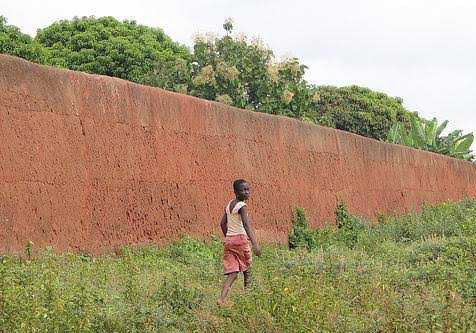
The walls, already weakened by neglect, were further damaged by the fire and the subsequent scramble for land. In the decades that followed, Benin City expanded rapidly. Builders dug up the earth banks for laterite, filled the moats with refuse, and built roads and houses over the ancient lines. Today, only scattered segments remain — some in the Ogba and Ugbowo areas of Benin City, others near Udo and Iguobazuwa.
The 1897 Expedition and Its Aftermath
The 1897 expedition was not just a military event; it was a cultural catastrophe. The bronzes that were looted — now known as the Benin Bronzes — ended up in the British Museum, the Horniman Museum, and collections across Europe and North America. For over a century, Nigeria and the Edo people have campaigned for their return. In recent years, some museums have begun to repatriate objects, and in 2022 the Smithsonian Institution in Washington, D.C., announced it would return its Benin Bronzes. The walls, however, cannot be repatriated. They can only be remembered, studied, and where possible, preserved.
It is worth noting that the destruction of the walls was not total. Many sections survived into the 20th century, and some are still visible today. Archaeologists such as Graham Connah, who excavated in Benin City in the 1960s, documented the surviving earthworks and helped establish their chronology. His work, along with that of Nigerian scholars like Jacob Egharevba, whose A Short History of Benin (1934) remains a foundational text, has kept the memory of the walls alive.
What Remains Today?
If you visit Benin City today, you will not see the Walls of Benin as they once were. The city has grown into a bustling metropolis of over 1.5 million people, the capital of Edo State and a centre of Nigeria’s rubber and oil palm industries. But traces of the walls remain for those who know where to look.
- Ogba: A section of the inner wall and moat survives near the Ogba area, though it is overgrown and threatened by construction.
- Ugbowo: Earth banks are visible near the University of Benin campus, where students sometimes walk past them without knowing their significance.
- Udo: A smaller earthwork complex near the town of Udo, about 30 kilometres from Benin City, is associated with the same tradition of rampart building.
- Iguobazuwa: Another surviving segment lies in this town, though it is poorly maintained.
These remnants are not protected by any comprehensive heritage law. Local historians and activists have called for UNESCO World Heritage status, but progress has been slow. In 2021, the Edo State Government announced plans to restore and promote the walls as a tourist attraction, but funding and political will remain uncertain.
The Case for Preservation
The Walls of Benin are not just a Nigerian heritage site; they are a world heritage site in waiting. They represent an African contribution to the history of engineering, urban planning, and state formation that has been systematically undervalued. Preserving them is not about nostalgia. It is about correcting a historical record that has too often dismissed African achievements as primitive or derivative.
There is also an economic argument. Cultural tourism is a growing sector in West Africa. A well-preserved and well-interpreted Walls of Benin site could attract visitors from around the world, create jobs, and generate revenue for local communities. The challenge is to balance development with conservation — a challenge that cities like Rome, Istanbul, and Kyoto have faced, with varying degrees of success.
Why the Walls of Benin Matter Today
The Walls of Benin matter because they remind us that Africa’s past is not a story of stasis. They are evidence of a society that could organize labour on a massive scale, that understood hydrology and defensive engineering, and that built for the long term. They challenge the colonial narrative that Africa had no history before Europeans arrived.
They also matter because they are living heritage. The Edo people still tell stories about the walls. The oba still sits on a throne that the walls once protected. The bronzes that were looted are still being returned, piece by piece. The walls themselves, though broken, are still there — under the roads, under the houses, under the feet of millions of people who walk over them every day without knowing.
In a continent often defined by its challenges, the Walls of Benin are a reminder of what Africans have built and can build again. They are not a relic. They are a lesson.
Conclusion: A Legacy of Earth and Memory
The Walls of Benin were the largest earthworks ever built by human hands before the age of machines. They were not built by slaves or by a single tyrant, but by generations of Edo communities who dug, piled, and maintained them over centuries. They protected a city of extraordinary wealth and culture, and they fell not in battle but to the slow erosion of neglect and the violence of colonial conquest.
Today, what remains is fragmentary — a bank here, a moat there — but the memory of the Walls of Benin endures. It endures in the scholarship of historians like Egharevba and Connah, in the activism of those who demand the return of the Benin Bronzes, and in the quiet persistence of the earth itself. To stand at the edge of a surviving section of the wall is to stand at the edge of a history that is still being written. The walls may be broken, but they are not gone. They are waiting to be remembered — and, perhaps, to be rebuilt in the imagination of a new generation.