📅 Last updated: 23.11.2026
The Skeleton Coast Namibia stretches along the Atlantic edge of the Namib Desert, a fog-shrouded strip of dunes, salt pans and shipwrecks that has fascinated travellers, scientists and storytellers for centuries. Stretching roughly 500 kilometres from the Ugab River in the south to the Kunene River on the Angolan border, it is one of the most remote and hauntingly beautiful coastlines on Earth. The name alone conjures images of bleached bones and broken hulls — and the reality, shaped by cold currents, relentless surf and some of the driest air in Africa, is every bit as dramatic.
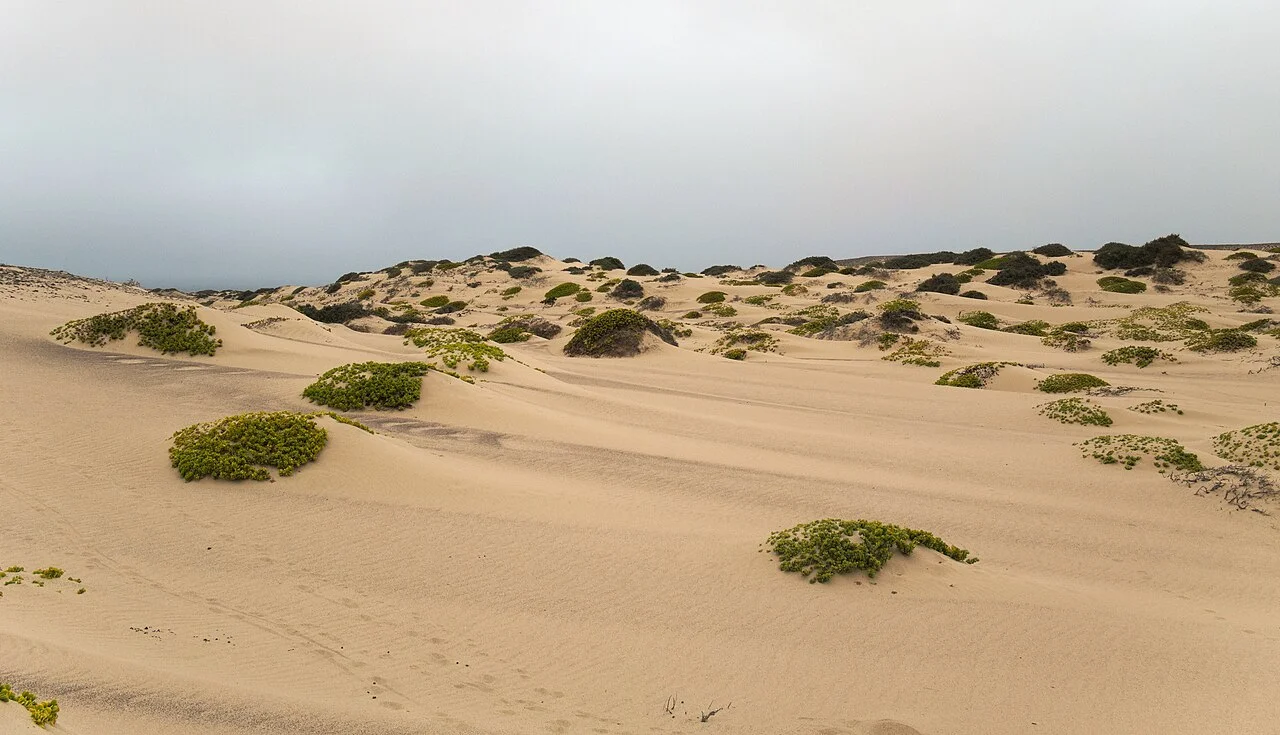
The Skeleton Coast Namibia is a roughly 500-kilometre stretch of Atlantic shoreline running from the Ugab River to the Kunene River, named for the whale bones and shipwrecks scattered along its beaches. It lies within the Namib Desert — considered the world’s oldest desert — and is protected by the Skeleton Coast National Park, declared in 1971. Its cold Benguela Current, dense coastal fog and near-total aridity make it one of the least populated and most biologically specialised landscapes in Africa.
- Why Is It Called the Skeleton Coast Namibia?
- Where Exactly Is the Skeleton Coast, and How Do You Reach It?
- The Science of a Desert Coast: Fog, Current and the World's Oldest Desert
- Life on the Edge: Wildlife of the Skeleton Coast Namibia
- A Timeline of the Skeleton Coast: Shipwrecks, Seals and Protection
- Shipwrecks and Stories: The Coast's Human Drama
- How to Visit the Skeleton Coast Responsibly
- Conservation and the Future of the Coast
- The Skeleton Coast Namibia: A Place That Changes You
Why Is It Called the Skeleton Coast Namibia?
The name is not marketing. For centuries, sailors who survived a grounding on this shore faced a coastline with no fresh water, no shelter and no route inland across hundreds of kilometres of desert. The Portuguese, who navigated these waters from the 15th century, reportedly called it As Areias do Inferno — “the Sands of Hell.” Whalers and sealers working the coast in the 19th and early 20th centuries left behind bleached whale vertebrae and rib cages on the beaches, alongside the ribs of wrecked ships. Whichever image came first, both are accurate.
The coast has claimed an estimated 1,000 vessels or more over the centuries, though precise counts are impossible — many wrecks were pounded to fragments within a season. The cold, powerful Benguela Current and the region’s notorious fog banks have historically confounded navigation. Ships that ran aground were often stripped by surf within days. What remains today is a scatter of rusting hulls, boilers and engine blocks half-buried in sand — some dating to the 19th century, others to the mid-20th.
The coast’s human history runs deeper than the wrecks. The San, the region’s earliest inhabitants, knew this shoreline for millennia and developed extraordinary survival knowledge of a land with almost no surface water. The name “Skeleton Coast” itself was popularised in the 20th century through books and films, but the coast’s reputation as a place of bones and survival is far older than any of the ships that gave it its modern fame.
Where Exactly Is the Skeleton Coast, and How Do You Reach It?
The coast forms the western edge of the Kunene and Erongo regions, bordering the Namib Desert to the east and the Atlantic to the west. The nearest town of any size is Swakopmund, a German-colonial seaside town of around 50,000 people that serves as the gateway for most visitors. From Swakopmund, the coastal road runs north past Henties Bay and the salt pans of the Cape Cross area, where a large Cape fur seal colony draws visitors, before reaching the southern boundary of Skeleton Coast National Park at the Ugab River.
North of the Ugab, public access is tightly controlled. The park’s southern section, from the Ugab to Torra Bay, is open to self-drive visitors, with basic camping at Torra Bay and Terrace Bay. Beyond Terrace Bay, the northern section is a private-access zone reachable only by licensed fly-in safari operators, typically from Windhoek or Swakopmund. This restriction is deliberate: the northern coast is one of the most sensitive wilderness areas in Africa, and limiting access has kept it largely pristine.
Most travellers experience the coast in one of three ways:
- Self-drive from Swakopmund — the southern park section, Cape Cross seals and the coastal towns, ideal for independent travellers with a 4×4.
- Fly-in safaris — light aircraft from Windhoek or Swakopmund into the northern wilderness, often combined with Damaraland and Etosha.
- Coastal expeditions — specialist operators running multi-day 4×4 trips along the shore, including wreck visits and dune driving.
The Science of a Desert Coast: Fog, Current and the World’s Oldest Desert
The Benguela Current and the Fog Machine
Everything about the Skeleton Coast Namibia is shaped by the Benguela Current, a cold, nutrient-rich upwelling that flows northward along the coast from the Southern Ocean. The current cools the air above it, and when warm, moist air from the interior meets that cold layer, it condenses into dense coastal fog — locally called cassimba — that can blanket the shore for days. Some estimates suggest fog occurs on well over 100 days a year along parts of the coast.
This fog is the region’s life-support system. It is the primary water source for many of the coast’s plants and animals, from the iconic Welwitschia to the beetles that harvest droplets on their bodies. It also made the coast treacherous for sailors: ships could run aground in visibility of a few dozen metres, unable to see the surf until it was too late.
The Namib: A Desert Older Than the Dinosaurs’ Demise
The Namib Desert, which the coast fringes, is widely regarded as the oldest desert on Earth, with arid conditions dating back at least 55 million years. The Skeleton Coast sits at its hyper-arid western edge, where annual rainfall can be under 10 millimetres — among the lowest on the planet. The result is a landscape of extraordinary geological age and biological specialisation, where life has evolved around fog rather than rain.
Life on the Edge: Wildlife of the Skeleton Coast Namibia
The coast looks barren from a distance. Up close, it is a specialist’s paradise, with species adapted to fog, salt and scarcity in ways found almost nowhere else.
Desert-Adapted Elephants and Lions
The northern reaches, particularly along the dry riverbeds of the Hoanib and Uniab, are home to desert-adapted elephants — animals that can travel enormous distances between water sources and whose range extends into the Skeleton Coast’s hinterland. The Hoanib River, which reaches the coast north of Terrace Bay, is one of the most important corridors for these elephants, and the coast’s northern wilderness is also home to desert-adapted lions and brown hyenas. These populations are among the most sparsely distributed large mammals on Earth, and sightings are rare and precious.
Seals, Seabirds and the Benguela Food Web
The Cape fur seal colonies, particularly around Cape Cross, are among the largest in southern Africa, with tens of thousands of animals hauling out on the rocks. The cold, nutrient-rich Benguela waters support a vast food web — sardines, anchovies and other small pelagics — that in turn draws seabirds, seals and, historically, whales. The coast’s shipwrecks and whale bones are reminders that the ocean here has long been both abundant and lethal.
Welwitschia and the Fog Harvesters
The Welwitschia mirabilis, a living fossil plant found only in the Namib, grows in the coastal desert and can live for over a thousand years. Its long, leathery leaves harvest fog, and specimens in the Skeleton Coast region are among the most celebrated in Namibia. Alongside it, the coast’s beetles, lizards and tenebrionid insects have evolved fog-basking behaviours — the Namib desert beetle famously angles its body to catch fog droplets, a mechanism that has inspired water-harvesting technology worldwide.
A Timeline of the Skeleton Coast: Shipwrecks, Seals and Protection
| Period | Key Event or Feature | Significance |
|---|---|---|
| Pre-15th century | San and later Khoisan peoples inhabit the region | Deep indigenous knowledge of a waterless coast; the coast’s human history predates European contact by millennia |
| 15th–19th centuries | Portuguese and later European navigators encounter the coast; whaling and sealing industries operate | Shipwrecks accumulate; whale bones on beaches give the coast its name |
| 1884–1915 | German colonial rule over South West Africa | Coastal settlements like Swakopmund founded; the coast’s isolation preserved |
| 1971 | Skeleton Coast National Park proclaimed | Formal protection of the coastline and its wilderness |
| 1980s–present | Fly-in safari tourism and conservation research expand | Northern coast remains restricted; desert-adapted wildlife monitored |
Shipwrecks and Stories: The Coast’s Human Drama
The Skeleton Coast’s wrecks are its most photographed feature, and each carries a story. The Eduard Bohlen, a German cargo ship that ran aground in 1909 near Conception Bay, is perhaps the most famous — its rusting hull now sits hundreds of metres inland, stranded by the shifting sands and the coast’s relentless northerly drift. The Dunedin Star, wrecked in 1942, became a survival epic: its crew and passengers, including women and children, endured weeks on the beach before rescue, with some making an extraordinary overland trek to safety.
These stories are not merely romantic. They are records of a coast that has always demanded respect, and of the resilience of the people — sailors, sealers, San trackers, and later conservationists — who have lived with it. The wrecks also serve a scientific purpose: they are time capsules of maritime history, studied by archaeologists and historians, and their decay is a measure of the coast’s harsh climate.
How to Visit the Skeleton Coast Responsibly
Tourism here is a privilege, and it comes with obligations. The northern wilderness is accessible only through licensed operators, and even the southern park section demands preparation: fuel, water, communications and a reliable 4×4 are non-negotiable. The coast’s wildlife is sensitive to disturbance, and the desert’s recovery from vehicle tracks can take decades.
- Travel with licensed operators in the northern section — permits are not optional, and rangers enforce them.
- Carry more water than you think you need — the coast’s aridity is deceptive, and help can be hours away.
- Keep to established tracks — dune and gravel damage persists for generations in this climate.
- Respect seal colonies and nesting birds — approach quietly and keep your distance, especially in breeding season.
The best time to visit is generally the cooler, drier months from May to September, when fog is common but temperatures are manageable. The coast can be visited year-round, but summer heat and wind demand extra caution. Swakopmund makes an excellent base for the southern coast, with its German-colonial architecture, museums and adventure-tourism scene offering a striking contrast to the wilderness beyond.
Conservation and the Future of the Coast
The Skeleton Coast National Park is managed by Namibia’s Ministry of Environment, Forestry and Tourism, and the country’s community-based natural resource management model — which gives local communities rights over wildlife and tourism — has been influential across Africa. The northern coast’s restricted access is a conservation success story: it has kept the wilderness largely free of the infrastructure that has degraded coastlines elsewhere.
Challenges remain. Climate change is altering fog patterns and ocean temperatures, with uncertain consequences for the Benguela ecosystem. Mining interests — diamonds are extracted along parts of the Namib coast — and offshore oil and gas exploration create ongoing tension between extraction and conservation. The coast’s future depends on balancing these pressures with the wilderness values that make it extraordinary.
The Skeleton Coast Namibia: A Place That Changes You
There is nowhere quite like it. The Skeleton Coast Namibia is not a beach holiday destination; it is a confrontation with scale, silence and survival. The fog rolls in, the surf pounds, the wrecks rust, and the desert holds its ground. To stand on that shore is to understand why the San, the sailors and the scientists have all been drawn to it — and why Namibia has chosen to protect it. It is a graveyard, yes, but also a living laboratory, a wilderness and a reminder that some places are worth leaving almost untouched.