📅 Last updated: 11.11.2026
The Mali Empire was one of the largest and wealthiest states in the medieval world, a West African federation that at its height stretched from the Atlantic coast to the Niger Bend and governed millions of people through a sophisticated system of law, trade, and diplomacy. For roughly three centuries after its founding in the thirteenth century, Mali controlled the trans-Saharan gold and salt routes, built cities that drew scholars from across the Islamic world, and produced a constitutional charter that is still cited today. Its story is not a footnote to world history — it is one of its central chapters.
The Mali Empire (c. 1235–1600) was a West African state founded by Sundiata Keita after the Battle of Kirina. At its peak under Mansa Musa (r. c. 1312–1337), it controlled the gold fields of Bambuk and Bure, the salt trade of Taghaza, and the Niger River trade cities of Timbuktu, Djenné, and Gao. Its wealth, scholarship, and legal traditions made it one of the most influential powers of the medieval world.
- Where Did the Mali Empire Come From?
- How Did the Mali Empire Become So Wealthy?
- Who Was Mansa Musa, and Why Does He Matter?
- How Was the Mali Empire Governed?
- Mali Empire Timeline: Key Dates and Rulers
- What Was Life Like in the Mali Empire?
- Why Did the Mali Empire Decline?
- What Can the Mali Empire Teach Us Today?
- A Golden Age Worth Remembering
Where Did the Mali Empire Come From?
The Mali Empire grew out of the ruins of the Ghana Empire, whose dominance of the trans-Saharan gold trade had faded by the early thirteenth century. In its place rose a patchwork of small kingdoms — Sosso, Mema, Do, and Kangaba — each jostling for control of the fertile lands along the upper Niger River. The Mandinka people, whose oral traditions remain the primary source for this era, lived in these lands and spoke Mande languages that are still widely spoken across West Africa today.
The turning point came with a man named Sundiata Keita, remembered in the epic tradition as Maghan — the prince — who overcame childhood disability and exile to rally a coalition of Mandinka clans against the Sosso king Soumaoro Kanté. The decisive battle took place at Kirina, near present-day Koulikoro in Mali, traditionally dated to around 1235. Sundiata’s victory united the Mandinka kingdoms under a single federation, and the Mali Empire was born.
The Kouroukan Fouga: A Constitution Before Constitutions
What Sundiata established at Kirina was not merely a military victory but a political order. The oral tradition preserves the Kouroukan Fouga (also spelled Kurukan Fuga), a charter of 44 articles proclaimed at the plain of Kouroukan Fouga after the battle. It addressed the division of the empire into clans and provinces, the prohibition of slavery by caste, the rights of women to inherit property, the protection of foreigners, and rules of war. In 2009, UNESCO inscribed the Kouroukan Fouga on its Representative List of the Intangible Cultural Heritage of Humanity, recognizing it as a living tradition of governance.
The charter’s principles — consultation, social harmony, and the dignity of the individual — were recited by griots (Mande oral historians called jeliw) for generations. They remain a point of pride in Mali today, where the charter is taught in schools and cited in public life.
How Did the Mali Empire Become So Wealthy?
The Mali Empire’s economy rested on three pillars: gold, salt, and agriculture. The gold fields of Bambuk, south of the Senegal River, and Bure, near the headwaters of the Niger, produced the metal that medieval Europe and the Islamic world craved. Salt came from the mines of Taghaza in the Sahara, where it was cut into slabs and carried south by camel caravan. The Niger River carried grain, cattle, fish, and cloth through the empire’s heartland.
The empire taxed this trade at every stage. Merchants passing through Mali paid duties on goods, and the mansa (emperor) controlled the export of gold, maintaining its value by keeping the metal’s circulation tightly regulated. The fourteenth-century North African traveler Ibn Battuta, who visited Mali in 1352–1353, noted that gold was so abundant that it was weighed in mithqals and exchanged without ceremony. The Moroccan scholar Ibn Khaldun, writing in the same century, recorded that Mali’s gold was the standard for the western Islamic world.
The Trans-Saharan Trade Network
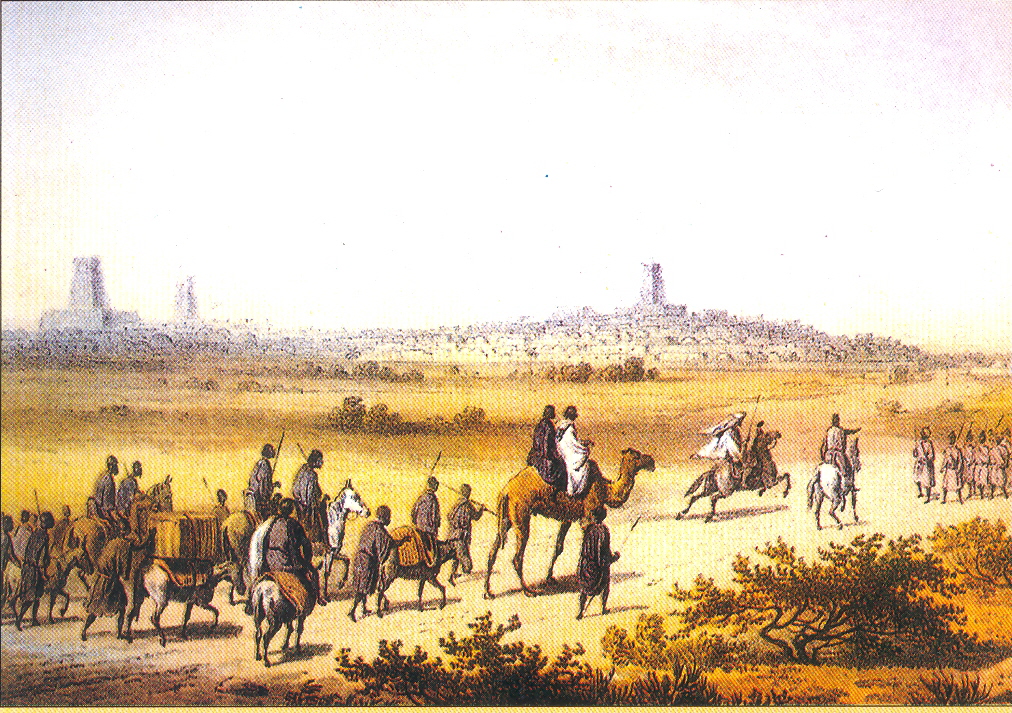
Mali’s position at the southern end of the trans-Saharan routes made it the gateway between the Mediterranean world and sub-Saharan Africa. Caravans of hundreds of camels crossed the desert from Sijilmasa in Morocco and from Tunis, carrying horses, textiles, books, and manufactured goods southward, and returning with gold, ivory, kola nuts, and enslaved people. The empire’s control of the Niger Bend — the great curve of the river where Timbuktu, Djenné, and Gao cluster — gave it command of the river trade as well.
- Gold: From Bambuk and Bure, traded north across the Sahara and east to Cairo.
- Salt: From Taghaza, essential for preserving food in the tropics and a major source of revenue.
- Copper and kola: From the southern forests, traded north and east.
- Books and textiles: Imported from North Africa and the Middle East, fueling Mali’s scholarly cities.
Who Was Mansa Musa, and Why Does He Matter?
No figure from the Mali Empire is better known than Mansa Musa I, who ruled from around 1312 to 1337. His reign marked the empire’s zenith. A devout Muslim, Musa made the hajj to Mecca in 1324, traveling with a caravan that contemporary sources describe as numbering thousands of people, including soldiers, officials, and enslaved attendants, and carrying vast quantities of gold dust.
The Arab historian al-Umari, writing in Cairo a decade later, recorded that Musa’s generosity during his stopover in the Mamluk capital flooded the market with gold, depressing its value for years afterward. Whether the deflation was as severe as later chroniclers claimed is debated by historians, but the impression Musa made on the Islamic world was unmistakable. He returned to Mali with scholars, architects, and administrators, and he commissioned the construction of mosques and madrasas in Timbuktu and Gao.
The Djinguereber Mosque and Timbuktu’s Golden Age
Among Musa’s most enduring legacies is the Djinguereber Mosque in Timbuktu, built around 1327 under the direction of the Andalusian architect Abu Ishaq al-Sahili. Constructed of mud brick and stone in the Sudano-Sahelian style, it became a center of learning and remains a UNESCO World Heritage Site today. Under Musa and his successors, Timbuktu grew into a city of scholars, libraries, and manuscript workshops. The Sankore Mosque and its associated university attracted students from across West Africa and the Maghreb.
The manuscript tradition that flourished in Timbuktu — thousands of handwritten texts on astronomy, medicine, law, history, and poetry — survives in family collections and in the Ahmed Baba Institute. Many were smuggled to safety in 2012–2013 when armed groups threatened the city, a rescue operation that preserved one of Africa’s great intellectual archives.
How Was the Mali Empire Governed?
The Mali Empire was a federation, not a centralized autocracy. The mansa ruled from the capital, which moved between Niani and other royal towns, and governed through a hierarchy of provincial governors, clan chiefs, and appointed officials. The empire was divided into provinces, each administered by a farba (governor) who collected tribute and maintained order. The griot tradition served as a check on royal power, preserving the memory of rulers’ deeds and obligations.
Ibn Battuta, who spent months in Mali, described the court’s ceremonial order, the role of the dugha (a senior official who spoke for the king), and the strict enforcement of justice. He noted that the people of Mali were “more upright in their dealings” than many he had encountered, and that they observed prayer and the study of the Quran with diligence. His account, though filtered through his own Andalusian sensibilities, remains a valuable eyewitness source.
Law, Justice, and Religious Tolerance
Mali’s legal system blended Islamic law with Mandinka custom. The mansa adjudicated major disputes, while local chiefs handled community matters. Religious tolerance was a hallmark: Muslim merchants and scholars lived alongside practitioners of traditional Mandinka religion, and the empire’s rulers did not impose Islam by force. This pragmatism helped hold together a vast, multi-ethnic state.
Mali Empire Timeline: Key Dates and Rulers
| Date | Event or Ruler | Significance |
|---|---|---|
| c. 1235 | Battle of Kirina; Sundiata Keita | Founding of the Mali Empire; Kouroukan Fouga proclaimed |
| c. 1255–1270 | Mansa Uli (Wali) | Consolidation of imperial power; expansion toward the Niger Bend |
| c. 1312–1337 | Mansa Musa I | Peak of wealth and influence; hajj of 1324; Djinguereber Mosque built |
| 1352–1353 | Ibn Battuta’s visit | Eyewitness account of Mali’s court and society |
| c. 1468 | Fall of Timbuktu to the Songhai | Rise of the Songhai Empire; decline of Mali’s eastern provinces |
| c. 1600 | Dissolution of the empire | Mali reduced to a small kingdom around Kangaba |
What Was Life Like in the Mali Empire?
Daily life in Mali varied enormously across the empire’s territories. In the Niger Bend cities, merchants, scholars, and artisans lived in densely built towns of mud-brick architecture, connected by river and caravan routes. In the countryside, farmers cultivated millet, sorghum, rice, and cotton, while herders moved cattle and goats across the savanna. Women played central roles in trade, agriculture, and the transmission of oral history.
The empire’s cities were cosmopolitan. Timbuktu’s markets sold books alongside gold and salt; Djenné’s great mosque, rebuilt in its current form in 1907 but rooted in a much older tradition, anchored a city that had been a center of trade and Islamic learning since the eleventh century. Gao, on the eastern Niger, was a commercial hub with links to the Songhai people who would later eclipse Mali.
Architecture and Art
Mali’s architectural heritage — the earthen mosques of Timbuktu, Djenné, and Gao — reflects a distinctive Sudano-Sahelian style adapted to the climate and available materials. These buildings are maintained through annual communal replastering ceremonies, a tradition that continues today and was recognized by UNESCO. The empire also produced distinctive textiles, metalwork, and jewelry, much of which survives in museum collections and in the hands of Mande artisan families.
Why Did the Mali Empire Decline?
Mali’s decline was gradual and multifaceted. The rise of the Songhai Empire under Sunni Ali Ber in the late fifteenth century challenged Mali’s control of the eastern Niger Bend. Timbuktu fell to Songhai around 1468, and Gao followed. Internal succession disputes, the weakening of central authority, and the shifting of trade routes toward the Atlantic coast in the sixteenth century further eroded the empire’s power.
By the early seventeenth century, Mali had shrunk to a small kingdom centered on Kangaba, the traditional heartland of the Mandinka. Yet its cultural and political legacy endured. The Mande languages, the griot tradition, and the memory of Sundiata and Mansa Musa remained central to West African identity, and the Kouroukan Fouga continues to be invoked as a model of participatory governance.
What Can the Mali Empire Teach Us Today?
The Mali Empire’s history challenges the assumption that Africa’s past is a story of isolation or stagnation. It was a state that traded with the Mediterranean world, sent pilgrims and scholars across the Sahara, built universities, and produced legal charters centuries before similar documents in Europe. Its wealth was built on control of strategic resources and trade routes, and its rulers governed a multi-ethnic, multi-religious society with a pragmatism that modern states might envy.
For the African diaspora and for anyone interested in global history, Mali offers a counter-narrative to the stereotypes that still shape popular perceptions of the continent. The empire’s cities were centers of learning; its rulers were patrons of architecture and scholarship; its people were connected to networks that spanned three continents. The manuscripts of Timbuktu, the mosques of Djenné and Djinguereber, and the oral epics of the Mande jeliw are living evidence of that heritage.
Key Takeaways
- The Mali Empire was founded around 1235 by Sundiata Keita after the Battle of Kirina.
- Its wealth derived from gold, salt, and control of trans-Saharan and Niger River trade.
- Mansa Musa’s 1324 hajj and his patronage of Timbuktu made Mali famous across the Islamic world.
- The Kouroukan Fouga, Mali’s oral constitution, is recognized by UNESCO as intangible cultural heritage.
- Mali’s decline was gradual, driven by Songhai expansion and shifting trade routes, but its cultural legacy endures.
A Golden Age Worth Remembering
The Mali Empire was not a myth or a curiosity. It was a functioning state with laws, taxes, diplomacy, and a vibrant intellectual life, and it shaped the history of West Africa for three centuries. Its story belongs to the world — not as a distant legend, but as a reminder that Africa’s golden ages were real, documented, and consequential. When we speak of the Mali Empire, we are speaking of a civilization that traded with Cairo, built universities in Timbuktu, and wrote a constitution on the savanna. That is a legacy worth carrying forward.