📅 Last updated: 29.10.2026
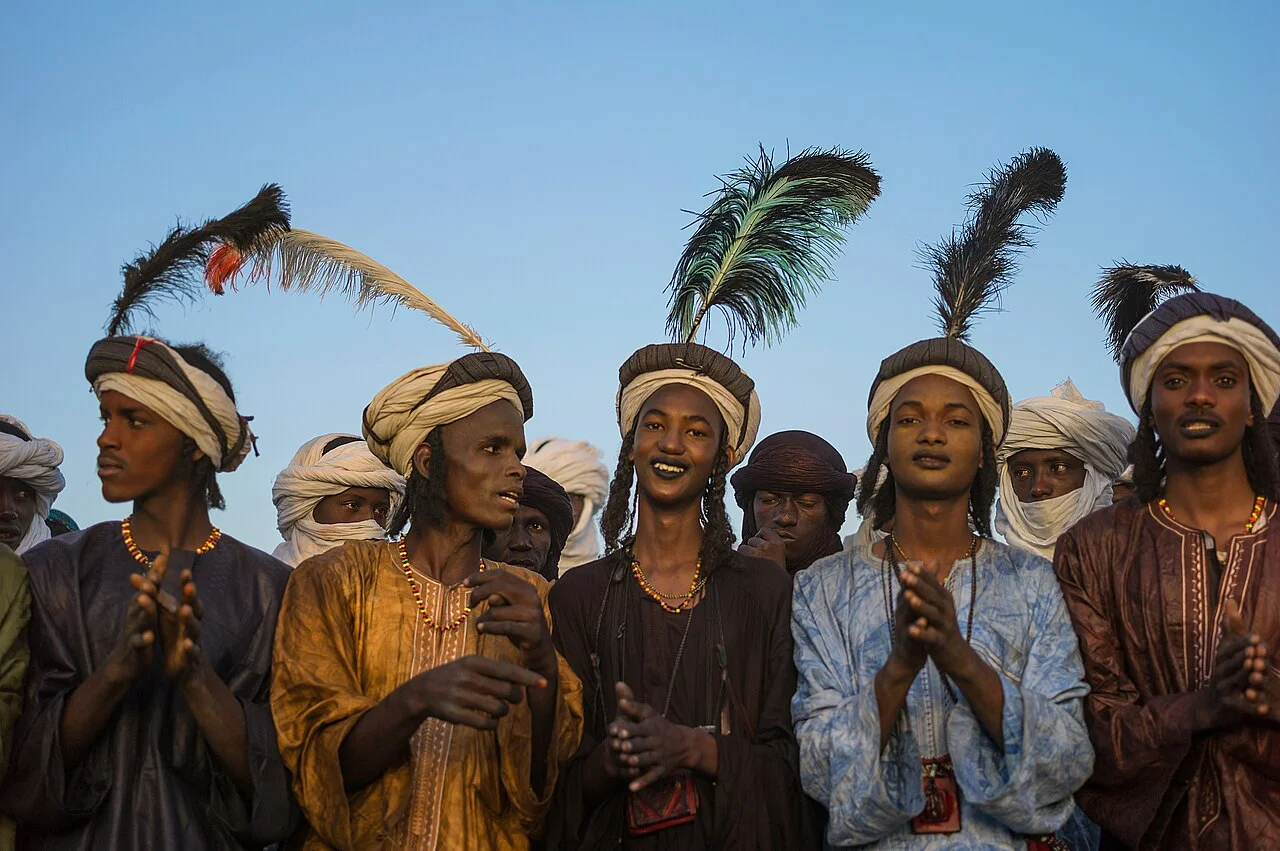
The Gerewol festival is one of the most visually arresting ceremonies on Earth: an annual gathering of Wodaabe herders in the Sahel where men paint their faces, braid their hair, and dance for hours to be judged on beauty by women. Held each year at the end of the rainy season, most famously at the Cure Salée near In-Gall in Niger, the Gerewol festival is a courtship ritual, a cultural showcase, and a living expression of Fulani identity.
The Gerewol festival (also spelled Guérewol) is an annual beauty pageant held by the Wodaabe, a nomadic Fulani people of the Sahel. Men—not women—compete, dancing in elaborate makeup and ornament before female judges who select the most beautiful. The best-known gathering takes place at the Cure Salée salt cure near In-Gall, Niger, usually in September.
- What Is the Gerewol Festival, and Who Are the Wodaabe?
- Where and When Does the Gerewol Festival Take Place?
- What Happens During the Gerewol Festival?
- Why Do Wodaabe Men Wear Makeup? The Meaning Behind the Ritual
- Gerewol Festival Key Facts at a Glance
- How Has the Gerewol Festival Changed in Modern Times?
- How Can Visitors Experience the Gerewol Festival Respectfully?
- Why the Gerewol Festival Still Matters
What Is the Gerewol Festival, and Who Are the Wodaabe?
The Wodaabe are a subgroup of the Fulani (Fulɓe), the vast pastoralist ethnic group scattered across the Sahel from Senegal to Sudan. Within that larger world, the Wodaabe—who call themselves Wodaabe, sometimes rendered Bororo by outsiders—maintain a fiercely independent nomadic life, moving their cattle across the semi-arid grasslands of Niger, Chad, Cameroon, Nigeria, and the Central African Republic. Estimates of their population vary widely, from roughly 100,000 to several times that number depending on how communities are counted; they are a minority within a minority, and they know it.
Their culture prizes two things above almost all else: cattle and beauty. The Gerewol festival sits at the intersection. It is a celebration of semteende—modesty and reserve—and its mirror image, mbaɗi, the flamboyant display of charm and physical beauty that the Gerewol unleashes once a year.
Timing matters. The Gerewol follows the rains. When the hayo—the rainy season—has greened the Sahel and the herds are fat, families converge. The most celebrated gathering coincides with the Cure Salée, the “salt cure,” a mass convergence of herders at the salt flats and watering points around In-Gall in the Agadez Region of northern Niger, typically in September. Similar dances occur elsewhere among Wodaabe communities in Chad and Nigeria, though In-Gall’s is the one most photographed, filmed, and written about.
Where and When Does the Gerewol Festival Take Place?
In-Gall, a small town on the edge of the Ténéré desert, swells into a temporary city during the Cure Salée. Herders arrive from hundreds of kilometres away, driving zebu cattle toward mineral-rich pastures and salt licks that restore the animals’ health after the long dry season. The gathering is at once veterinary, economic, social, and ceremonial.
The Gerewol itself unfolds over several days, and there is no single “opening night.” Different lineages and camps hold their own dances, and the largest public events draw spectators, journalists, and dignitaries. Niger’s government has long treated the Cure Salée as a national cultural event, and in recent decades it has been attended by ministers and even heads of state—an official embrace of a ritual that remains, at its core, profoundly local.
A Note on Dates
Because the Gerewol is tied to rainfall and pasture rather than a fixed calendar, its dates shift. The Cure Salée generally falls in the second half of September, but organisers and communities adjust. Travellers planning to attend should confirm with Nigerien tourism authorities or licensed operators, and should consult their own government’s travel advisories—security conditions in parts of the Sahel change, and the Agadez region has experienced instability. Responsible visits are possible but require planning and local guidance.
What Happens During the Gerewol Festival?
The dance is the centrepiece, but it is embedded in a sequence of rituals that give it meaning. A rough arc looks like this:
- Preparation: Young men spend hours on adornment—grinding and applying yellow gawri (a mineral-based cosmetic) and red ochre, drawing precise lines down the nose and around the eyes, whitening teeth and lips, and braiding hair with shells and beads.
- The dance: Dancers line up shoulder to shoulder, then perform the yaake—a sequence of swaying, stamping, and wide-eyed, teeth-baring expressions designed to display height, symmetry, white eyes, and white teeth, all prized Wodaabe markers of beauty.
- Judging: A panel of women—often including a designated “chief judge”—circulates, watching closely, and eventually selects winners.
- Courtship and aftermath: The dance creates openings for flirtation, elopement, and the renegotiation of relationships, within rules the community understands intimately.
The Yaake and the Ruume
Two distinct dances are often conflated. The yaake is the daytime beauty contest—the one most associated with the word “Gerewol.” A second, the ruume, is a more intimate nighttime dance, sometimes described as a “jealousy dance,” in which married women may dance with former suitors. Both are governed by custom and both are about seeing and being seen.
What the Judges Look For
Wodaabe aesthetics are specific. Judges assess height and slenderness, the whiteness of eyes and teeth, the symmetry of the face, the grace of movement, and above all the dancer’s mbaɗi—his charisma, his command of the space. A man who dances with restraint and precision can outscore a taller rival. The judging is serious, and winners gain prestige that follows them for years.
Why Do Wodaabe Men Wear Makeup? The Meaning Behind the Ritual
The inversion is the point. In everyday Wodaabe life, modesty and self-effacement are prized; boasting is shameful. The Gerewol is a licensed exception—a few days when men may be openly vain, competitive, and beautiful, and when women hold the power of judgment.
Anthropologists who have studied the Wodaabe, including the late French researcher Marguerite Dupire, whose fieldwork from the 1950s onward remains foundational, documented a society in which women’s choices carry real weight. Marriage among the Wodaabe is often arranged, but divorce and remarriage are relatively common, and women retain considerable autonomy. The Gerewol formalises that leverage: it is a public arena in which women’s preferences are expressed and acted upon.
The dance also serves practical social functions. It is a marriage market, a reunion for scattered lineages, a venue for settling disputes, and a moment of collective identity in a region where pastoralists face mounting pressure from drought, land enclosure, and conflict.
Gerewol Festival Key Facts at a Glance
| Element | Detail |
|---|---|
| People | Wodaabe, a nomadic subgroup of the Fulani (Fulɓe) |
| Primary location | Cure Salée gathering near In-Gall, Agadez Region, Niger; other dances in Chad, Nigeria, and elsewhere |
| Typical timing | End of the rainy season, usually September; dates vary with rainfall |
| Competitors | Young men, adorned with ochre, gawri, braids, and beads |
| Judges | Women, often led by a designated chief judge |
| Core dance | Yaake (daytime beauty contest); ruume is a related nighttime dance |
How Has the Gerewol Festival Changed in Modern Times?
The Gerewol is not a frozen relic. It has adapted continuously, and the last half-century has brought rapid change.
From Sahel to Screen
Photography transformed the festival’s global profile. Images of painted dancers appeared in European magazines from the mid-twentieth century, and the Gerewol became a fixture of travel photography. Today, smartphones and social media mean Wodaabe dancers see themselves circulated globally within hours. Some communities welcome the attention; others are wary of being reduced to spectacle.
Tourism, Ethics, and the Camera
Visitor numbers at In-Gall have fluctuated with security conditions and travel advisories. Where tourism exists, it raises familiar questions: who profits, how much intrusion is acceptable, and whether staged dances for paying visitors distort a ritual with its own internal logic. The most responsible approach is to work through licensed local operators, respect photography restrictions set by elders, and treat the Gerewol as a ceremony first and a photo opportunity second.
Pressure on the Pastoral Way of Life
The deeper change is environmental and political. Droughts, desertification, the expansion of farmland, and armed conflict across the Sahel have squeezed nomadic routes. Climate variability makes the rains less predictable, and with them the timing and scale of the Gerewol. Meanwhile, many Wodaabe children now attend school, and some families settle seasonally near towns. The festival persists—arguably with renewed symbolic importance—as a statement of who the Wodaabe are.
How Can Visitors Experience the Gerewol Festival Respectfully?
For those who make the journey, preparation and humility matter more than camera gear.
- Plan around the rains, not a fixed date: Confirm arrangements with licensed Nigerien operators and check your government’s travel advice for the Agadez region.
- Ask before photographing: Elders and organisers may set rules; follow them, and pay any agreed fees through proper channels.
- Dress and behave modestly: The Wodaabe value semteende; visitors who respect local norms are received far better than those who treat the event as a carnival.
- Support local livelihoods: Hire local guides, buy from local vendors, and ensure your spending reaches Wodaabe communities rather than only outside operators.
It is also worth remembering that the Gerewol is not the only expression of Wodaabe culture. Their poetry, their cattle lore, their intricate social codes, and their resilience as herders are equally worth attention—and less frequently photographed.
Why the Gerewol Festival Still Matters
Strip away the postcard images and the Gerewol festival is a statement about value. It says that beauty is worth cultivating, that women’s judgment counts, that a people under pressure can still gather, adorn themselves, and dance. In a Sahel too often described only through crisis, the Gerewol is a reminder of cultural wealth that predates and outlasts the headlines.
It is also a lesson in how tradition works. The Wodaabe have not preserved the Gerewol by sealing it off from the world; they have kept it alive by holding it, year after year, on their own terms. For anyone who witnesses it—herder, judge, dancer, or careful visitor—the sight of painted men dancing under a Sahelian sky remains one of the most striking images Africa offers. And it belongs, first and last, to the Wodaabe.