📅 Last updated: 19.09.2026
The Osun-Osogbo Sacred Grove is not a ruin, a museum, or a relic — it is a living, breathing forest in the heart of one of Nigeria’s busiest cities, and it has been a place of worship for centuries. Spread across roughly 75 hectares on the outskirts of Osogbo, the capital of Osun State in south-western Nigeria, the grove shelters more than 400 species of plants, rare wildlife, and dozens of shrines, sculptures, and sanctuaries dedicated to Osun, the Yoruba goddess of fertility, love, and water. In 2005, UNESCO inscribed it as a World Heritage Site — not because it is old, but because it is alive.
- Where the Forest Meets the City
- Osun, the Goddess of the River
- The Sacred Grove in History: From Refuge to World Heritage
- Key Facts About the Osun-Osogbo Sacred Grove
- The Osun-Osogbo Festival: A City Comes to the River
- Biodiversity: A Forest That Is Also a Sanctuary
- Art, Sculpture, and the New Sacred Art Movement
- Threats and Tensions: Protecting a Living Place
- A Global Spiritual Home
- Visiting the Grove: What to Know
- Why the Osun-Osogbo Sacred Grove Still Matters
Where the Forest Meets the City
Drive north-west out of central Osogbo and the transition is abrupt. One moment you are in traffic — okadas weaving between minibuses, traders calling from roadside stalls — and the next you are standing at the edge of a dense, cathedral-like forest, separated from the city by little more than a low wall and a gate. This proximity is part of what makes the Osun-Osogbo Sacred Grove so extraordinary. Most World Heritage forests are remote. This one sits within a metropolitan area of more than half a million people.
The grove lies along the banks of the Osun River, which curves through it for about 4 kilometres before continuing south. Tall iroko, mahogany, and obeche trees form a canopy that filters the light into something green and shifting. Mona monkeys chatter overhead. Hornbills cross the clearings. The river itself is considered the physical body of the goddess — its water is sacred, and in places it pools around rocks that worshippers have venerated for generations.
For the Yoruba people, this is not simply nature. It is a home of deities. The grove is dotted with more than 40 shrines and nine worship points along the river, each tied to a specific orisa (deity) in the Yoruba spiritual system. Osun is the central figure, but she is not alone: Obatala, Ogun, Sango, Oya, and others are honoured here too. The forest is, in effect, a sprawling open-air temple — one that happens to be made of living trees.
Osun, the Goddess of the River
To understand the grove, you have to understand Osun. In Yoruba cosmology, she is one of the most beloved of the orisa — the goddess of the Osun River, of fertility, of love, of sweet water, and of the gentle power that persuades rather than forces. Oral tradition holds that she was one of the wives of Sango, the deity of thunder, and that her wisdom and diplomacy once saved the other orisa from a crisis of leadership. When she left the sky to descend to earth, she turned into the river that now bears her name.
Her character is often described as both tender and formidable. She gives children to the childless, heals the sick, and settles disputes — but she is also a goddess who demands respect. Worshippers approach her with offerings of white cloth, kola nuts, honey, and cool water. Her colour is white; her day is Wednesday; her number is five. Those details matter to devotees, and they shape the rituals performed inside the grove to this day.
Osun is not a distant or abstract figure. Millions of people across Nigeria, Benin, Togo, Brazil, Cuba, and the United States trace spiritual lineages back to her. The grove in Osogbo is one of the most important physical anchors of that global devotion — a place where the diaspora comes home.
“The grove is not a monument to the past. It is a house where the goddess still lives, and where her people still come to speak with her.” — a common sentiment among Osogbo worshippers and custodians
The Sacred Grove in History: From Refuge to World Heritage
The Osun-Osogbo Sacred Grove has its origins in the founding of Osogbo itself, traditionally dated to the 17th century. According to Yoruba oral history, a group of hunters led by a man named Larooye settled near the river after a long migration, and the goddess Osun promised to protect them if they honoured her. The grove became the spiritual heart of the new town, and the annual festival in her name — the Osun-Osogbo Festival — has been celebrated ever since.
For much of its history, the grove was simply the forest at the edge of town: sacred, protected by custom, and left largely untouched. That changed in the 20th century. By the 1950s and 1960s, urban expansion, logging, and the pressures of a growing city began to encroach on the forest. Shrines fell into disrepair. Some sacred trees were felled. The grove was shrinking.
The Austrian Priestess Who Saved the Forest
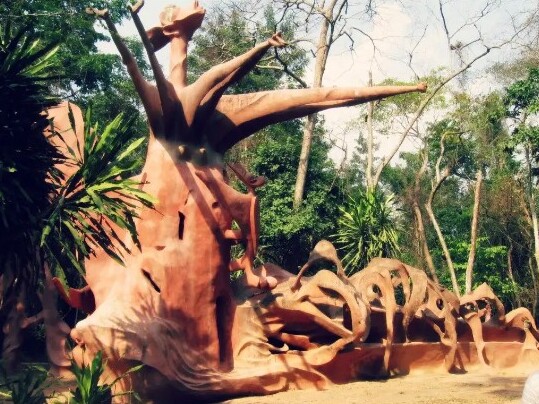
The turning point came in 1965, when Susanne Wenger — an Austrian artist and priestess who had moved to Osogbo and been initiated into the Yoruba priesthood as Adunni Olorisha — founded the New Sacred Art Movement alongside local artists and priests. Wenger and her collaborators, including the sculptor Adeyinka Adeyemi and others, began restoring the shrines and creating new sculptures in concrete, clay, and iron — works that blended Yoruba religious symbolism with modern artistic forms.
Wenger lived in Osogbo until her death in 2009 at the age of 93. Her work, and that of the movement she founded, is one of the reasons the grove survived the 20th century. Today, the grove contains dozens of these sculptures: towering figures of Osun and other orisa, elaborate gateways, and carved pillars that stand alongside older, more weathered shrines. It is a rare example of a sacred landscape that has been actively, continuously reimagined by its own worshippers.
UNESCO Recognition, 2005
On 15 July 2005, UNESCO’s World Heritage Committee inscribed the Osun-Osogbo Sacred Grove on the World Heritage List at its 29th session in Durban, South Africa. The citation described it as “a testimony to the living tradition of the Yoruba people” and noted that it is “one of the last remaining sacred groves in Yorubaland.” The listing brought international attention — and, crucially, new resources and legal protections for the grove.
Key Facts About the Osun-Osogbo Sacred Grove
| Detail | Information |
|---|---|
| Location | Osogbo, Osun State, south-western Nigeria |
| Size | Approximately 75 hectares |
| UNESCO World Heritage inscription | 15 July 2005 (29th session, Durban, South Africa) |
| Central deity | Osun, goddess of the river, fertility, and love |
| Key festival | Osun-Osogbo Festival, held annually in August |
| Major restoration figure | Susanne Wenger (Adunni Olorisha), from 1965 until her death in 2009 |
The Osun-Osogbo Festival: A City Comes to the River
Every August, the grove fills with people. The Osun-Osogbo Festival is one of the largest and most vibrant traditional festivals in West Africa, drawing hundreds of thousands of worshippers, tourists, and dignitaries over a two-week period. The climax is the Arugba procession — a ritual journey from the palace of the Ataoja of Osogbo, the town’s traditional ruler, to the river inside the grove.
The Arugba is a young virgin woman, chosen each year to carry a large calabash of ritual offerings on her head. She is considered a living intermediary between the community and the goddess, and her safe passage through the crowd is seen as a sign of the town’s spiritual health. The crowd that follows her is immense — drummers, priests in white, masked dancers, and ordinary families who have come to ask Osun for children, healing, or good fortune.
It is worth noting that the festival is not a performance for tourists. It is a working religious event. Non-worshippers are welcome to observe, and the atmosphere is famously joyful, but the rituals themselves are taken seriously by the people who perform them. The festival has been held for centuries, surviving colonialism, war, and urbanisation — and it continues to adapt, with livestreams and social media now carrying it to a global audience.
A Festival in Numbers
- Duration: roughly two weeks, with the Arugba procession as the climax
- Timing: annually in August, tied to the Yoruba calendar
- Attendance: often estimated in the hundreds of thousands, including international visitors
- Key participants: the Ataoja of Osogbo, the Arugba, priests and priestesses, and the Osogbo community
Biodiversity: A Forest That Is Also a Sanctuary
Because the Osun-Osogbo Sacred Grove has been protected by religious custom for centuries, it has become an accidental nature reserve — one of the best-preserved patches of primary and secondary forest in south-western Nigeria’s derived savannah zone. The surrounding landscape has been heavily cleared for farming, timber, and housing. Inside the grove, the canopy remains.
Botanists have recorded more than 400 plant species in the grove, including several that are rare or endangered elsewhere in the region. The tall iroko tree (Milicia excelsa), sacred in Yoruba tradition, is well represented. So are mahogany, African oil bean, and various medicinal plants that priests and healers still harvest according to traditional rules.
The grove is also home to a variety of wildlife. Mona monkeys are common and famously bold around visitors. Monitor lizards, duikers, civets, and a wide range of birds — including hornbills, turacos, and kingfishers — have been recorded. The Osun River itself supports fish and freshwater species that have disappeared from other waterways in the region.
This ecological richness is not incidental. It is a direct consequence of the sacred status of the land. In a country where deforestation has been severe, the grove stands as proof that cultural protection can function as conservation — and that Indigenous belief systems can be among the most effective environmental tools we have.
Art, Sculpture, and the New Sacred Art Movement
Walk through the Osun-Osogbo Sacred Grove today and you will encounter art at almost every turn — but not the kind you find in a gallery. The sculptures here are part of the landscape, and they are meant to be lived with, not simply looked at. Susanne Wenger’s New Sacred Art Movement produced dozens of major works, including the towering Iya Osun figure, intricate shrine gates, and carved pillars that blend Yoruba motifs with modernist forms.
Wenger was not a lone genius imposing her vision on the grove. She worked with Yoruba priests, artists, and craftspeople — many of whose names are less widely known but whose hands shaped much of what visitors see today. The movement was a genuine collaboration between an outsider who became an insider and a community determined to preserve its spiritual home.
Why the Art Matters
- It restored and re-sanctified shrines that had fallen into disrepair.
- It created a distinctive visual language for Yoruba sacred art in the 20th century.
- It helped attract international attention, which contributed to the UNESCO listing.
- It continues to inspire contemporary Nigerian artists, including those working in Lagos and beyond.
Threats and Tensions: Protecting a Living Place
World Heritage status has not made the grove invulnerable. Osogbo is growing, and the pressure of urban expansion is constant. Encroachment, illegal logging, pollution of the Osun River, and the challenges of managing a sacred site with both religious and governmental stakeholders are ongoing concerns. The grove is administered under a framework that involves the Osun State government, the National Commission for Museums and Monuments, and traditional authorities — a structure that sometimes creates friction.
There is also the delicate question of access and authenticity. As tourism grows, so does the risk of the grove becoming a spectacle rather than a sanctuary. Custodians have generally managed this well — rules about photography, dress, and behaviour are enforced, and the annual festival remains a religious event first. But the balance is never static.
Climate change adds another layer of uncertainty. Changing rainfall patterns affect the Osun River, and the forest depends on that water. For a goddess whose body is the river, the stakes are not merely ecological. They are theological.
A Global Spiritual Home
One of the most striking things about the Osun-Osogbo Sacred Grove is how far its influence reaches. The Yoruba diaspora — carried to the Americas through the transatlantic slave trade — preserved and transformed the worship of Osun in Brazil, Cuba, Trinidad, and the United States. In Salvador da Bahia, in Havana, in New York, devotees honour Oxum or Oshun, the same goddess, under different names and in different languages.
For many of them, a pilgrimage to Osogbo is a homecoming. During the festival, you will meet Brazilians in white lace, Cubans carrying offerings, and African Americans tracing their spiritual ancestry. The grove is one of the few places on earth where the African and diaspora branches of a major world religion meet in the landscape where it began.
This is part of what makes the Osun-Osogbo Sacred Grove so significant. It is not only a Nigerian treasure. It is a global one — a place where a river, a forest, a goddess, and a community have held each other together for centuries.
Visiting the Grove: What to Know
If you go — and you should — here are a few practical notes. The grove is open to visitors year-round, though the festival in August is by far the busiest time. Entrance fees are modest, and guides are available. Photography is permitted in most areas, but be respectful: this is a place of worship, not a theme park. Dress modestly. Ask before filming rituals. And take your time — the grove rewards slowness.
Osogbo itself is easy to reach from Lagos (about 4 to 5 hours by road) or Ibadan (about 2 hours). The city has hotels, restaurants, and a lively arts scene, including the famous Osogbo Art School tradition associated with Wenger and the artists she worked with. A visit to the grove can easily be combined with a stop at the Osun State Museum or the nearby Erin-Ijesha Waterfalls.
Quick Tips
- Go early in the morning for cooler temperatures and better wildlife sightings.
- Wear comfortable shoes — the paths are uneven and can be muddy after rain.
- Bring water, but do not litter; the grove is sacred ground.
- Hire a local guide to understand the shrines and their meanings.
- If you visit during the festival, arrive early and expect crowds.
Why the Osun-Osogbo Sacred Grove Still Matters
In a world that often treats heritage as something to be fenced off, labelled, and admired from a distance, the Osun-Osogbo Sacred Grove offers a different model. It is protected not because it is frozen in time, but because people still use it. The goddess is still worshipped. The river is still sacred. The forest is still growing. And the festival still draws crowds who come not to look at history, but to participate in it.
That is the real lesson of the grove. Conservation and culture are not opposites. Indigenous spirituality is not a curiosity to be studied — it is a living force that has, in this case, preserved one of the most biodiverse urban forests in West Africa. The Osun-Osogbo Sacred Grove is a reminder that the most durable protections for a place are often the ones rooted in love, reverence, and daily practice.
Stand at the riverbank, watch the water move, and you understand why the Yoruba say Osun never leaves. She is the river. She is the forest. And as long as the grove stands, she is still here — in the heart of Osogbo, in the heart of Nigeria, and in the hearts of everyone who has ever asked her for anything.