📅 Last updated: 05.09.2026
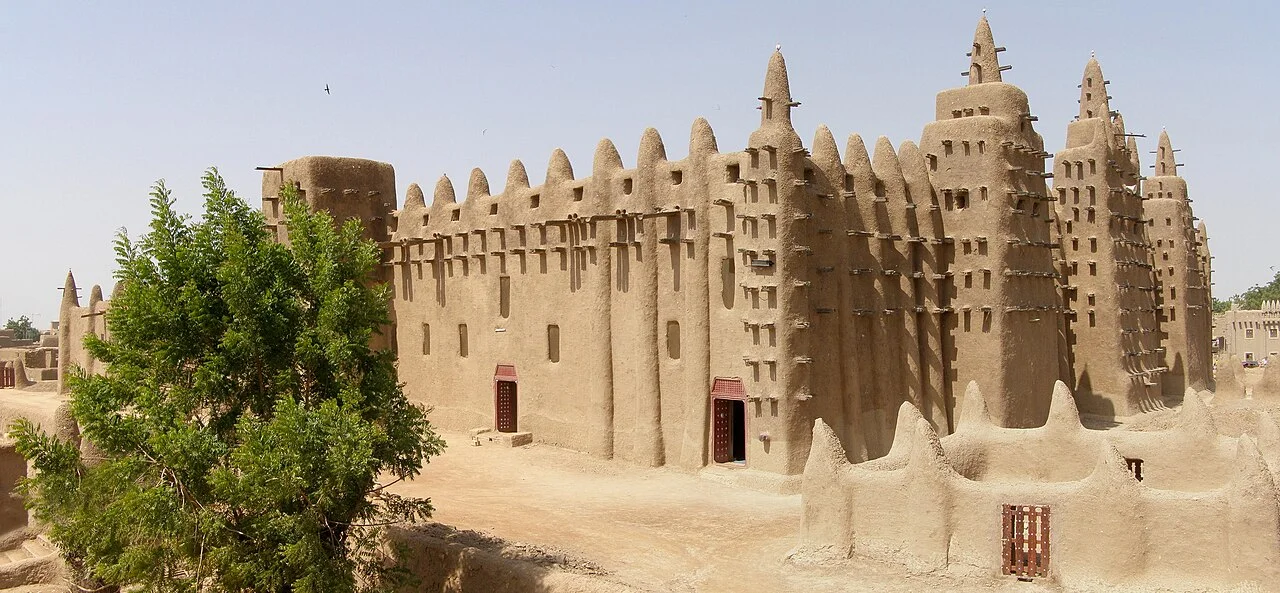
The first glimpse of the Djenné Mosque, rising like a colossal, ochre-hued sandcastle from the shimmering heat haze of the Sahel, is an image that etches itself permanently into the memory. This is not merely a building; it is the spiritual and architectural heartbeat of one of Africa’s most storied cities, a monument built not of steel or stone, but of the very earth itself, and one that demands to be understood on its own terms.
The Great Mosque: An Architectural Tapestry Woven in Mud
The Djenné Mosque is the largest mud-brick building in the world, a title that speaks to its sheer scale, but the word “mud” does a disservice to the sophisticated engineering and artistic brilliance it represents. The structure is a masterpiece of Sudano-Sahelian architecture, a style that flourished in the vast savanna belt south of the Sahara. Its defining features are both practical and profoundly symbolic. The walls, some of which are over 40 centimeters thick, are constructed from banco, a mixture of clay, water, and organic binding agents like rice husks and millet chaff. This material acts as a natural insulator, keeping the interior cool in the searing daytime heat and releasing warmth during the chilly desert nights.
Yet, the mosque’s genius lies in its details. Its facade is punctuated by a forest of roughly 100 toron—pointed wooden stakes that jut out from the walls. To an uninitiated eye, they may appear decorative, but they are vital scaffolding, permanently embedded to provide footholds for the workers who re-apply a fresh layer of plaster to the entire exterior each year. These stakes, alongside bundles of palm fronds woven into the roof structure, are not merely functional; they create a striking visual rhythm, a play of light and shadow that makes the monumental structure appear almost organic, as if it grew from the ground it stands upon. The prayer hall is a forest of ninety massive pillars supporting a ceiling of palm logs, creating a vast, cool, and dimly lit space that inspires a sense of profound peace and awe, a stark contrast to the blinding sun outside.
A History Etched in Clay and Conflict
The story of the mosque is a palimpsest of faith, trade, and resilience. The current structure, completed in 1907, is not the first house of worship on this site. Its history is layered, reflecting the complex spiritual and political evolution of the region. The original mosque was built in the 13th century, when Djenné was already a flourishing hub in the trans-Saharan gold and salt trade. According to local legend, King Koi Konboro, the 26th ruler of Djenné, converted to Islam and had his royal palace demolished to make way for the first mosque, a symbol of his new faith’s ascendancy in a city that had long been a center of traditional beliefs.
This early mosque became a renowned center of Islamic learning, attracting scholars from across the Muslim world. However, its fate was sealed in the 19th century by another powerful leader, Shehu Amadou of the Fulani-led Massina Empire. A strict reformist, he considered the elaborate mosque a vanity that contravened his interpretation of Islamic principles. In a dramatic act of iconoclasm, he had the original building razed in 1834, leaving only the tomb of a local saint and the site itself. The community was forced to pray at a smaller, less ornate structure for decades. The mosque that stands today was rebuilt in 1907, a period when French colonial rule was consolidating its power in the region. While the French administration provided some logistical support and pressure, the impetus and skilled labor came entirely from the local masons, led by the legendary Barey (master mason) Ismaïla Traoré, whose descendants still hold the title of head mason today. This reconstruction was not a colonial creation but a powerful reassertion of local identity, adapted to a new era.
Djenné Mosque and the Annual Festival of the Crepissage
To truly grasp the significance of the Djenné Mosque, one must witness the Crépissage (Plastering) of the mosque, an annual festival that transforms the city into a vibrant, communal spectacle of faith and labor. This is not a tourist event; it is a sacred civic duty that binds the community together. The festival, which takes place in the spring when the rains are not yet heavy, is a testament to the mosque’s status as a living organism that requires constant care to survive.
In the days leading up to the event, young men from the city’s various quarters, or quartiers, venture out to the Banikani, the designated clay pits outside the city, to mix the new plaster. They work in teams, singing traditional songs and competing to see who can prepare the best-quality banco first. On the day of the festival, a festive yet reverent atmosphere descends upon Djenné. The town’s elite, including the Imam and the head mason, who is responsible for the mosque’s repair, lead a procession. The men of the community, along with boys who are coming of age, swarm up the toron, scrambling over the walls like a human tide to smear the fresh mud onto the facade. The entire operation is a feat of coordination and physical endurance, a vibrant spectacle that demonstrates the deep sense of ownership and pride the people of Djenné feel for their architectural patrimony.
“This is not just about maintaining a building; it is about preserving our history, our unity, and our identity as a people of Djenné,” a local mason explained during one such festival. “When we work on the mosque, we are connected to our ancestors who built it.”
However, this vital tradition faces significant challenges in the 21st century. The intense heat and occasional torrential rains, exacerbated by climate change, cause more rapid erosion of the mud walls. The availability of skilled masons is also a concern, as younger generations are increasingly drawn to more lucrative opportunities in Mali’s larger cities or abroad. Furthermore, the festival itself has been impacted by security concerns in the region, which have at times reduced the number of participants and international visitors, threatening the scale and vitality of this essential communal effort.
Djenné: The Jewel of the Sahel
The mosque is the crowning glory of Djenné, but it is by no means the city’s only treasure. Often called “the Jewel of the Sahel,” Djenné-Jeno (Old Djenné) is one of the oldest known cities in sub-Saharan Africa, with archaeological evidence dating back to 250 BC. This makes it a contemporary of ancient Rome and a vital link in the history of urban civilization on the continent. The city flourished as a central market for the trans-Saharan trade, connecting the forests of West Africa, rich in gold, ivory, and slaves, with the great Berber and Arab trading centers of North Africa.
Today, Djenné’s historical importance is globally recognized. In 1988, both the mosque and the old town were collectively designated a UNESCO World Heritage Site, a status that brought international attention and, at times, funding for preservation. The city’s architecture is a remarkable collection of over 2,000 traditional houses, many of which are multi-story and built in the same banco style as the mosque. These homes, with their intricate facades, decorative wooden doors, and cleverly designed courtyards, are a testament to the wealth and sophistication of its former merchant class. Walking through the narrow, winding streets is like stepping back in time, yet it is also a vibrant, living city, with bustling markets, artisan workshops, and the daily rhythms of a community deeply rooted in its heritage.
The Rhythm of the Marché
No visit to Djenné is complete without experiencing the weekly Monday market, which sprawls across the large square directly in front of the mosque. This is the economic heart of the region, a chaotic and colorful affair that draws Fulani herders from the surrounding bush, Bozo fishermen from the Bani River, and Dogon farmers from the nearby escarpment. The market is a sensory overload of sights, sounds, and smells. Here, one can find everything from vibrant textiles and hand-crafted leather goods to baskets of spices, dried fish, and the region’s famous onions, which are grown in the fertile floodplains of the inland Niger Delta.
The market is a powerful reminder that Djenné is not a museum piece but a dynamic, living city. It is a place where the past and present converge, where age-old trading customs meet modern commerce. While the architecture is the primary draw for many visitors, the market provides an authentic and unforgettable glimpse into the daily life and cultural diversity that have sustained Djenné for centuries. The square itself, a vast expanse of sand that is meticulously cleaned before the market, is a focal point of civic life, hosting not only the market but also public gatherings, festivals, and, of course, the annual plastering of the mosque.
| Date | Event | Significance |
|---|---|---|
| c. 250 BC | Founding of Djenné-Jeno | Marks the beginning of urban settlement in the region. |
| 13th Century | First Great Mosque built by King Koi Konboro | Establishes Djenné as a major center of Islamic learning and trade. |
| 1834 | Shehu Amadou demolishes the original mosque | A period of religious reform and decline for Djenné’s architectural prominence. |
| 1907 | Current Djenné Mosque is completed | Rebuilt under French colonial rule, led by master mason Ismaïla Traoré. |
| 1988 | UNESCO World Heritage Site designation | International recognition of the site’s “outstanding universal value.” |
Preservation in a Precarious Present
The preservation of the Djenné Mosque and its surrounding city is a monumental task that has become increasingly precarious. The challenges are multifaceted, ranging from the purely environmental to the deeply political. The primary threat is, and always has been, the weather. The Sahel is notorious for its extreme climate, with long dry seasons followed by intense, short-lived rainstorms. The heavy rains can cause significant structural damage to the banco walls, which is precisely why the annual Crépissage is so vital. However, climate change is making these weather patterns more erratic and severe, with stronger winds and more intense downpours, putting unprecedented stress on the ancient structure.
Beyond the weather, the mosque and the city face a host of other pressures. The lack of adequate funding and technical expertise for large-scale conservation projects is a constant struggle. While UNESCO provides some support, it is often insufficient for the scale of the need. Furthermore, the ongoing political and security crisis in Mali, which has seen a rise in extremist violence and instability in the northern and central regions of the country, poses a direct threat. While Djenné itself has not been the target of major attacks, the presence of armed groups in the broader region has severely curtailed tourism, a crucial source of revenue for the city’s economy and for funding preservation efforts. The instability also makes it difficult for international experts and organizations to operate safely in the area. This fragile situation has led to a reliance on the resilience and commitment of the local community, who remain the true custodians of this heritage.
The Human Element of a Living Monument
In the face of these challenges, the soul of the Djenné Mosque lies in its people. The Barey, the masonry guild responsible for its upkeep, are the living link to centuries of architectural knowledge, passed down from master to apprentice through generations. Their expertise is not just technical; it is a profound cultural knowledge that includes the correct composition of the banco mixture, the timing of its application, and the spiritual rituals that accompany the work. They are the guardians of an intangible heritage that is just as important as the physical structure itself.
Organizations like the Aga Khan Trust for Culture have also been working in Djenné, collaborating with the local Barey to implement conservation projects that respect traditional techniques while introducing modern methods for strengthening the structure. These partnerships are crucial, as they aim to empower local communities to be the primary agents of their own heritage preservation. The focus is on training a new generation of masons, ensuring that the skills required to maintain this architectural marvel are not lost. This investment in human capital is perhaps the most important step in securing the mosque’s future. The mosque is not a static monument to be preserved under glass; it is a living entity that is constantly being renewed and reinterpreted by the community that loves it.
Beyond the Mud Walls: The Spirit of Djenné
To see the Djenné Mosque only as a feat of engineering or a relic of the past is to miss its deeper spiritual and cultural resonance. The mosque is the spiritual center of a city that has been a crossroads of cultures for over a millennium. It is a symbol of the profound Islam that has been practiced and adapted in West Africa for centuries, a faith that has woven itself into the fabric of daily life, coexisting with and absorbing local traditions. The mosque’s role in the community is not limited to prayer; it is a space for gathering, for education, and for celebrating the key moments of life. The call to prayer that echoes from its walls five times a day is the rhythm that punctuates the city’s day, a constant, reassuring presence.
This spirit is also found in the city’s rich musical and oral traditions. The griots, or jeliw, are the hereditary storytellers, musicians, and historians who have preserved the epic tales of Mali’s great empires and heroes for centuries. Their music, played on instruments like the kora and the balafon, is not just entertainment; it is the living memory of the people. In Djenné, this tradition remains strong, with griots often performing at weddings and other ceremonies, keeping the history and culture of the region vibrantly alive. The city’s identity is a rich tapestry woven from its architecture, its faith, its trade, and its people, all of which are intrinsically linked to the mosque that stands at its heart.
The Mosque in the Modern World
For the global African diaspora, the Djenné Mosque holds a particularly potent symbolism. It stands as a tangible, awe-inspiring testament to the intellectual, spiritual, and architectural sophistication of pre-colonial Africa. In a world where African history is often told through a lens of colonialism and underdevelopment, the mosque is a powerful counter-narrative. It is a proud reminder that great civilizations and monumental artistic achievements flourished in West Africa long before the arrival of Europeans, building cities and centers of learning that were the envy of many parts of the world. The mosque is a source of Pan-African pride, an icon that connects people of African descent to a deep and glorious past that is not defined by slavery or subjugation.
Today, the mosque is also navigating the complexities of the 21st century. The rise of social media has brought images of the mosque to a global audience, inspiring a new generation of architects, artists, and travelers. The intense global interest in heritage and sustainable architecture has also brought new attention to the mosque’s use of local, natural materials and its remarkably low carbon footprint, a stark contrast to the energy-intensive concrete and steel construction prevalent in the modern world. The mosque is being re-evaluated not just as a historical artifact, but as a model for sustainable building in a climate-stressed world. Its ancient techniques are being studied for their relevance in creating more resilient and environmentally friendly architecture for the future.
A Tapestry of Time, A Future in the Balance
As the sun sets over Djenné, painting the sky in brilliant shades of orange and purple, the Great Mosque is bathed in a final, glorious light. The rough texture of its banco walls glows warmly, and the long shadows of the toron streak across its facade. In this quiet moment, the weight of its history and the profound beauty of its form are undeniable. The mosque has stood as a silent witness to the rise and fall of empires, the ebb and flow of trade, and the unwavering faith of its people. It is a monument to resilience, a physical manifestation of the idea that culture and identity can be built from the very ground beneath one’s feet, and that they can endure even the most turbulent of times.
The future of the Djenné Mosque is, however, by no means guaranteed. It hangs in a delicate balance, threatened by the forces of climate, conflict, and neglect. Yet, to see it is to believe in the power of human ingenuity and collective will. The story of the mosque is not over; it is being written anew each year with every handful of mud applied by the hands of its devoted community. Its preservation is not simply a matter of maintaining a building for tourists to admire; it is a profound act of cultural and historical defiance. The mosque stands as a challenge to the world to recognize and support the custodians of this irreplaceable heritage, ensuring that the mud marvel of West Africa continues to inspire awe for centuries to come. Its earthen walls whisper not of decay, but of the enduring spirit of Djenné, a spirit that refuses to be silenced by the sands of time.