📅 Last updated: 05.07.2026
- A Kingdom of Brass: The Artistic and Spiritual World of the Benin Bronzes
- The Night of Fire: The 1897 Punitive Expedition
- The Global Diaspora: Where Are the Benin Bronzes Today?
- The Long Road Home: The Politics and Practice of Restitution
- Nigeria Today: A Modern Nation Reclaiming Its Past
- What the Return Means: Beyond the Art
- The Future of the Loot: A New Chapter
- Conclusion: The Bronzes Are Coming Home
The Benin Bronzes. The very name conjures images of intricate brass plaques, sculpted ivory tusks, and carved wooden roosters that once adorned the royal palace of the Kingdom of Benin, in what is now Edo State, Nigeria. These are not mere artifacts; they are a three-dimensional history book, a sacred chronicle of the Oba (king) and his court, a testament to the technical brilliance of Edo artists, and, for the past 127 years, a symbol of one of the most significant cultural restitution debates of our time. They are the silent, stolen witnesses to the brutal 1897 British Punitive Expedition, and their return home is a story of resilience, diplomacy, and a continent reclaiming its narrative.
A Kingdom of Brass: The Artistic and Spiritual World of the Benin Bronzes
To understand the weight of the Benin Bronzes, one must first step into the world that created them. The Kingdom of Benin, which reached its zenith between the 14th and 19th centuries, was not a random collection of villages. It was a sophisticated, highly centralized empire with a complex urban system, a powerful army (which famously repelled a Portuguese invasion in the 16th century), and a court that rivaled any in Renaissance Europe for its opulence and ritual. The capital, Edo (modern-day Benin City), was described by early European visitors as a city of wide, straight streets, lined with homes built in neat rows, all enclosed by massive earthen walls—a feat of engineering that, until recently, was considered one of the largest man-made structures on Earth.
At the heart of this civilization was the Oba, a divine ruler whose authority was both political and spiritual. The art we call the Benin Bronzes was not created for mere decoration. It was a form of statecraft, a tool of history, and a conduit to the ancestors.
The Lost-Wax Mastery
The term “Bronzes” is itself a misnomer. Most of the famous plaques and heads are actually made of brass, with a smaller number of true bronze and copper alloys. The technique used to create them is the cire perdue, or lost-wax casting, a process of such precision that it was jealously guarded by the royal guild of brass casters, the Igun Eronmwon. A clay core was sculpted, covered in wax, and then the intricate details—the patterns on a warrior’s tunic, the interlocking scales of a mudfish, the plaiting of a queen mother’s hair—were carved into the wax. A clay mold was applied, and when heated, the wax melted away, leaving a perfect negative space for molten metal to fill. Each piece was unique, a one-of-a-kind creation made for a specific purpose.
“To see a Benin bronze for the first time is to be confronted not by an artifact, but by a personality. The stoicism on the face of an Oba, the coiled tension in a warrior’s leopard-tooth necklace—these are not generic figures. They are portraits of power, cast in metal to endure for eternity.” — Dr. Peju Layiwola, artist and art historian.
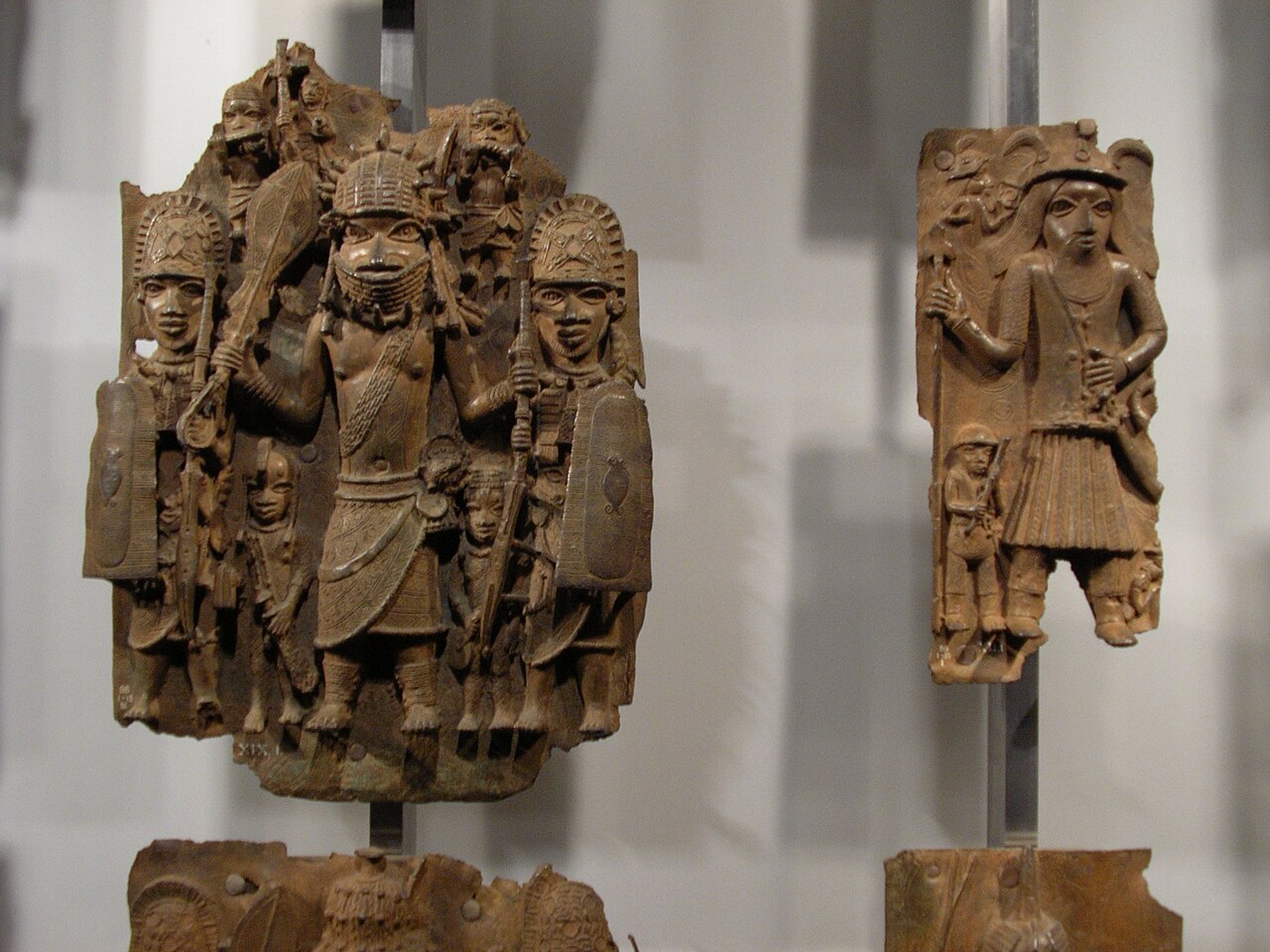
These pieces were organized into a strict visual hierarchy. The most famous are the hundreds of rectangular brass plaques that once sheathed the pillars of the Oba’s palace. They depict a world of courtly ritual: the Oba flanked by his attendants, Portuguese merchants with their distinctive beards and hats (a sign of Benin’s international trade), victorious warriors holding the severed heads of enemies, and the Oba as a mystical figure with legs of mudfish—a symbol of his dual nature as a ruler of both land and sea.
The Night of Fire: The 1897 Punitive Expedition
The story of how the Benin Bronzes left Africa is not one of gradual trade or cultural exchange. It is a story of colonial violence, greed, and calculated looting. By the late 19th century, the British Empire was aggressively expanding its influence in the Niger Delta region. The Kingdom of Benin, however, was not a colony. It was a sovereign state that controlled trade routes and fiercely guarded its independence. The Oba at the time, Ovonramwen Nogbaisi, was determined to maintain his kingdom’s sovereignty, particularly over the lucrative palm oil and ivory trade.
The flashpoint came in January 1897. A British delegation, led by Acting Consul General James Phillips, attempted to force their way into Benin City during the sacred Igue festival—a period when the Oba was ritually secluded and no foreigners were permitted to enter. Phillips had been explicitly warned by the Oba to delay his visit. He ignored the warning. On January 4, 1897, Phillips and his party of 250 armed men were ambushed and killed by Benin warriors. It was a fatal miscalculation by the British, but it provided the perfect pretext for war.
The Sacking of Benin City
The British response was swift and devastating. A “Punitive Expedition” of over 1,200 sailors, marines, and native troops was assembled under the command of Admiral Sir Harry Rawson. On February 18, 1897, the force landed near Benin City. The Oba’s army, armed mostly with muskets and machetes, was no match for the British Maxim guns and naval artillery. The city fell within days. Ovonramwen was captured, tried in a kangaroo court, and exiled to Calabar, where he died in 1914.
But the military conquest was only half the mission. The British officers and men were given explicit orders to plunder the royal palace. What they found was a treasure trove of staggering proportions. The palace was a labyrinth of courtyards, altars, and storerooms, each filled with hundreds of brass heads, ivory tusks carved with intricate scenes, coral bead regalia, bronze bells, and the famous plaques. The soldiers, many of whom had no understanding of what they were seeing, systematically stripped the palace. They used the plaques as packing crates. They smashed heads from their bases. They threw delicate ivories into sacks.
The loot was then auctioned off in London to cover the costs of the expedition. The British Museum acquired over 200 pieces. Other major museums in Vienna, Berlin, Paris, and New York quickly followed. Private collectors snapped up the rest. In a single, brutal act, the cultural patrimony of an entire kingdom was scattered across the globe.
The Global Diaspora: Where Are the Benin Bronzes Today?
For over a century, the Benin Bronzes have sat in museums far from the humid air and red earth of Benin City. They have been studied, cataloged, and exhibited as masterpieces of “primitive” art, a term that art historians now reject as deeply condescending. Today, the digital landscape allows us to track this diaspora with unprecedented precision.
| Institution | Estimated Number of Pieces | Notable Items | Status of Repatriation |
|---|---|---|---|
| British Museum, London | 900+ | The largest collection globally; includes the famous “Idia” ivory mask and over 200 plaques. | Ongoing negotiations; UK law (British Museum Act 1963) currently prohibits deaccessioning. Loan agreements are being explored. |
| Humboldt Forum, Berlin | 530+ | One of the most extensive collections outside the UK; includes a rare brass “Olokun” head. | Announced transfer of ownership to Nigeria in 2022; first items returned in December 2022. |
| Metropolitan Museum of Art, New York | 160+ | Four brass plaques, a famous ivory armlet, and several commemorative heads. | Returned two plaques in 2022; ongoing discussions for more. |
| Quai Branly Museum, Paris | 70+ | A partial ivory gong and several brass heads. | France passed a law in 2020 to return 26 pieces to Benin (Republic), but this has been slow to implement for Nigerian objects. |
| National Museum of African Art, Smithsonian, Washington D.C. | 30+ | A brass “Oba” head and a carved ivory tusk. | Returned 29 pieces to Nigeria in October 2022. |
The figures are staggering. It is estimated that between 3,000 and 5,000 individual pieces from the 1897 looting are held in over 160 museums and private collections worldwide. The largest single collection resides in the British Museum, which holds well over 900 objects. Germany’s collections, particularly the Humboldt Forum in Berlin, hold another 1,100. The sheer scale of the dispersal is a constant reminder of the violence of the original act.
The Long Road Home: The Politics and Practice of Restitution
The demand for the return of the Benin Bronzes is not a new phenomenon. It began almost immediately after the looting. Oba Akenzua II, who reigned from 1933 to 1978, made formal requests to the British government in the 1930s and again after Nigeria’s independence in 1960. These early appeals were routinely dismissed. The argument from Western museums was consistent: the objects were better preserved, studied, and accessible to a global audience in the West. Nigeria, it was said, lacked the facilities and expertise to care for them. This was a self-serving colonial argument—a way of justifying the original theft.
A Shifting Tide: The Digital and Legal Revolution
The last decade has seen a seismic shift in this dynamic. Several key factors have converged to make restitution a tangible reality rather than a distant dream.
– The Digital Benin Project: A groundbreaking digital database, Digital Benin, has cataloged over 5,000 objects from 131 institutions worldwide. For the first time, the Nigerian government, scholars, and the public have a comprehensive, searchable inventory of what was taken. You cannot reclaim what you cannot name.
– German Leadership: In a stunning reversal, Germany has become the global leader in restitution. In 2022, the German government signed a joint declaration with Nigeria to transfer ownership of over 1,100 objects from its state museums. The first 20 objects were formally handed over in December 2022. This move was driven by a deep, critical examination of Germany’s own colonial history and a recognition that the moral argument for keeping the objects had collapsed.
– Changing Legal Landscapes: The “universal museum” argument—that museums like the British Museum hold objects for all humanity—is increasingly seen as a relic of imperialism. New laws in France, the Netherlands, and Belgium are making it easier for national museums to return contested objects. The British Museum remains a stubborn outlier, constrained by the 1963 Act, but public and political pressure is mounting. The return of the Ghanaian “Asante Gold” in 2024 on loan, and the return of the “Lachish Reliefs” from the British Museum to Israel on loan, shows that creative solutions are possible.
The Edo Museum of West African Art (EMOWAA)
Central to the repatriation effort is the vision for the future. The Nigerian government and the Oba of Benin, Ewuare II, have embarked on an ambitious project: the construction of the Edo Museum of West African Art (EMOWAA) in Benin City. Designed by the world-renowned Ghanaian-British architect Sir David Adjaye, the museum will be a state-of-the-art facility built on the grounds of the original royal palace. It is not just a storage building. It is a cultural hub, a research center, and a living archive.
The museum will house the returned Benin Bronzes, but its vision is far broader. It will also showcase the art of the wider Edo and West African region. The design itself is a statement: it will incorporate ancient rammed-earth techniques and modern sustainable materials, connecting the past to the future. The project is a powerful rebuke to the old colonial argument that Africa cannot care for its heritage. EMOWAA is designed to world-class standards, with climate control, security, and conservation labs that rival any in Europe.
Nigeria Today: A Modern Nation Reclaiming Its Past
The return of the Benin Bronzes is not an act of nostalgia. It is a deeply modern project. Nigeria is the most populous country in Africa, a tech hub, a cultural powerhouse of Nollywood and Afrobeats, and a nation grappling with its complex present while reclaiming its magnificent past.
The process of receiving the bronzes has been a masterclass in diplomacy and cultural strategy. The Nigerian delegation, led by the Director-General of the National Commission for Museums and Monuments, Professor Abba Isa Tijani, has navigated complex international laws, negotiated with skeptical trustees, and secured major commitments from governments. The returns are being celebrated not just in the palace, but in Lagos, Abuja, and across the diaspora.
Consider the journey of a single brass plaque. For 125 years, it sat in a climate-controlled gallery in Berlin, labeled as “Benin, 16th-17th century.” Today, that same plaque, after being cleaned and conserved in Nigeria, sits in a temporary exhibition space in Benin City. Schoolchildren from Edo State can now see it, touch the edge of it (under supervision), and hear the story of the Oba it depicts. They can learn the names of the guild of casters who made it. The object is no longer a mute witness to a colonial crime; it is a living teacher in its own land.
What the Return Means: Beyond the Art
The restitution of the Benin Bronzes is about far more than the objects themselves. It is a profound act of healing and a re-calibration of global power.
- Historical Justice: It acknowledges the violence of the original theft. It is an admission by Western nations that the acquisition of these objects was not a neutral act of collecting, but an act of war and looting.
- Cultural Sovereignty: It affirms that a nation’s cultural heritage is integral to its identity and self-determination. A country cannot be fully sovereign if its history is held hostage in foreign vaults.
- Economic and Social Impact: The return of the bronzes is a major driver for cultural tourism in Edo State. The EMOWAA project is creating jobs for local craftsmen, architects, and conservators. It is a tangible symbol of the “Nigeria Rising” narrative—a nation that is not just exporting oil and music, but also its deep history.
- A Model for the World: The Benin Bronzes case has become the template for other restitution claims across Africa and the Global South. The Maqdala treasures from Ethiopia, the Ngonnso’ statue from Cameroon, and the Makonde artifacts from Mozambique are all following the path blazed by the Edo people.
The Future of the Loot: A New Chapter
The work is far from over. The British Museum, which holds the largest and most iconic collection, remains a formidable obstacle. The legal barriers are significant, but the moral argument is now overwhelming. Many in the UK, including members of Parliament and prominent museum directors, are calling for a change in the law. The British Museum’s argument that it must hold the objects for all humanity rings hollow when the “all humanity” it serves has been denied access to its own heritage for over a century.
Meanwhile, private collectors are beginning to return pieces. The Fowler Museum in Los Angeles returned a key piece in 2022. The University of Aberdeen and Jesus College, Cambridge, were among the first in the UK to do so. Each return is a small victory, a crack in the wall of colonial intransigence.
Conclusion: The Bronzes Are Coming Home
The story of the Benin Bronzes is not a closed chapter. It is a living, breathing narrative of loss, resilience, and triumphant return. They are not just objects of brass and ivory. They are the memory of a kingdom, the pride of a people, and a mirror held up to the world, reflecting both the heights of human creativity and the depths of colonial greed.
As you read this, the first of the German bronzes are being prepared for their permanent display in the new Edo Museum. The streets of Benin City are buzzing with anticipation. The Oba’s palace, once stripped of its glory, is slowly being re-adorned. The Benin Bronzes are not just returning to a museum. They are returning to a home that has been waiting for them for over a century. They are coming home to the land of their birth, to the descendants of the artists who cast them, to the kingdom they were made to serve. And in that homecoming, they are not just artifacts of the past. They are a foundation for the future.