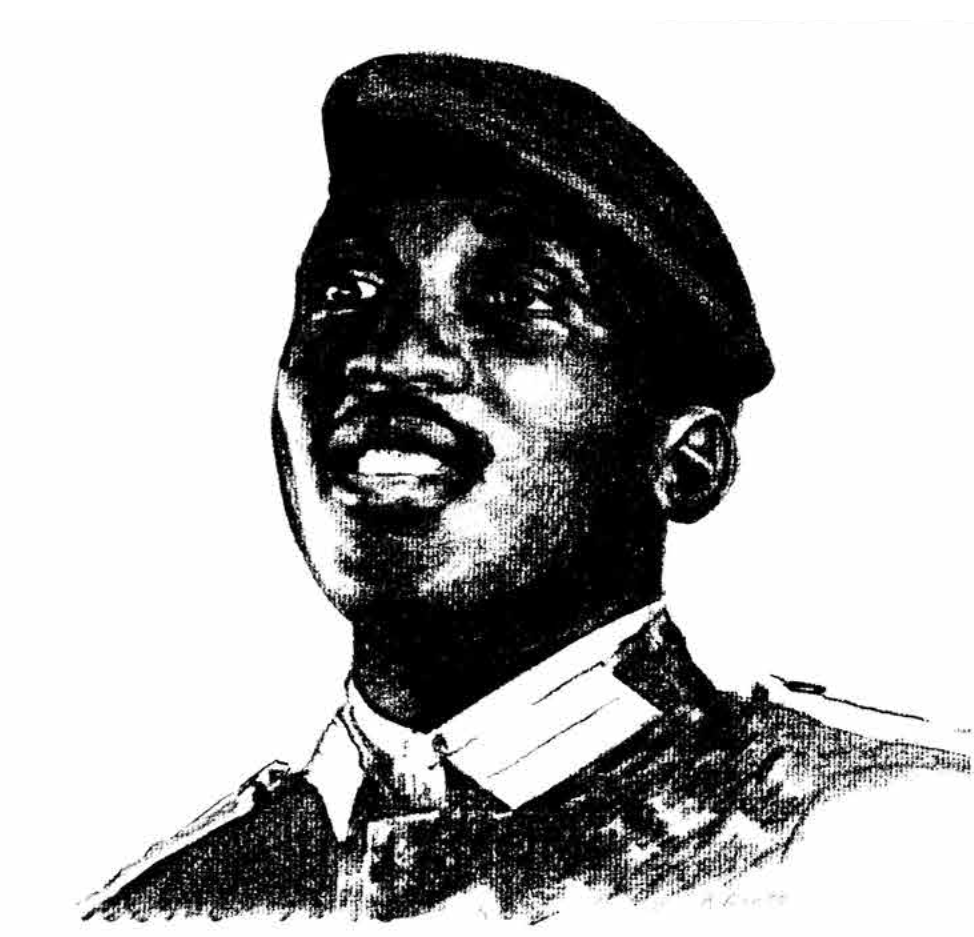
📅 Last updated: 14.11.2026
Thomas Sankara remains one of the most electrifying figures in modern African history — a soldier who seized power in a poor, landlocked Sahelian nation and spent four years trying to prove that its people could feed, house, educate and govern themselves. Between 1983 and 1987, the man his compatriots called “the Upright Man” renamed his country from Upper Volta to Burkina Faso, “the land of upright people,” and pushed through a social and economic revolution that touched everything from land tenure to women’s rights. He was assassinated at 38, yet his ideas still echo across the continent.
Thomas Sankara was a Burkinabè military officer and Marxist revolutionary who ruled Burkina Faso from August 1983 until his assassination on 15 October 1987. In four years he launched mass vaccination drives, anti-corruption campaigns, tree-planting and rail-building projects, banned female genital mutilation and forced marriage, and refused debt payments. He was killed in a coup that brought Blaise Compaoré to power.
- Who was Thomas Sankara before he became president?
- What did Thomas Sankara actually change in Burkina Faso?
- Why did Thomas Sankara rename Upper Volta to Burkina Faso?
- What was Thomas Sankara's foreign policy?
- How did Thomas Sankara die, and what happened to his legacy?
- Thomas Sankara in context: a timeline of a revolution
- What can Thomas Sankara still teach us?
- Why Thomas Sankara still matters
Who was Thomas Sankara before he became president?
Born on 21 December 1949 in Yako, a town in the north of what was then French Upper Volta, Sankara grew up in a family that valued education. His father was a gendarme and former prisoner of war; his mother a homemaker. He attended primary school in Gaoua and later the Lycée Ouezzin Coulibaly in Bobo-Dioulasso, the country’s second city and commercial hub, before being sent to Madagascar in 1966 for military academy training at Antsirabe.
Madagascar in the late 1960s was a crucible. Sankara arrived as a teenager and witnessed the 1972 uprising against the government of Philibert Tsiranana, a revolt driven by students and workers. He read Marx, Lenin and the Cuban revolutionary writers, and he watched how a popular movement could shake a state. He returned to Upper Volta in 1973 and was commissioned as an officer, but the country he came back to was unstable: drought, coups, and a political class closely tied to Paris.
The making of a soldier-revolutionary
In 1976, Sankara met Blaise Compaoré in Morocco, where both were undergoing military training. The two men, along with Henri Zongo and Jean-Baptiste Boukary Lingani, formed a clandestine group that would later become the nucleus of the 1983 coup. Sankara’s early military career included a stint in the 1974 border war with Mali, and he was posted to the parachute regiment in Po, a garrison town in the southwest that became a hotbed of radical politics.
By 1981, Sankara was a captain and had served briefly as Minister of Information in the government of Colonel Saye Zerbo. He resigned in 1982 after refusing to muzzle the press, a decision that cost him his post but built his reputation. When Jean-Baptiste Ouédraogo took power in a November 1982 coup, Sankara became Prime Minister — and was arrested and detained within months after a visit by French President François Mitterrand’s Africa adviser, Jean-Christophe Mitterrand, reportedly alarmed by Sankara’s anti-imperialist rhetoric.
The arrest triggered mass protests in Ouagadougou. On 4 August 1983, while Sankara was under house arrest at his home in Ouagadougou, a group of soldiers led by Compaoré and supported by Libya and other allies launched a coup that freed him and installed him as head of state. He was 33.
What did Thomas Sankara actually change in Burkina Faso?
The list is long, and much of it is verifiable. Sankara’s government launched a national literacy campaign in eight local languages, including Mooré, Dioula and Fulfulde, and by 1986 claimed literacy had risen from roughly 13 percent to over 70 percent in some rural areas — a figure contested by critics but indicative of the scale of effort. More than 2,500 schools were built in three years, and school enrollment rose sharply.
Health was a flagship. In a single week in 1984, the government organized a mass vaccination campaign that reached an estimated 2.5 million children against measles, meningitis and yellow fever. The World Health Organization later cited the campaign as a model. Sankara’s government also built hundreds of health posts and clinics, and pushed through a ban on female genital mutilation, forced marriage and polygamy — one of the most explicit anti-FGM legal stances in Africa at the time.
Land, grain and the war on corruption
Sankara nationalized land and distributed it to peasants, abolished the traditional chief’s right to levy tribute, and launched a “One Village, One Grove” tree-planting campaign that eventually planted tens of millions of trees across the country. He created the “Sankarist” village committees that bypassed the old administrative hierarchy and gave rural communities direct control over development projects.
He also waged a public war on corruption and privilege. He sold the government’s fleet of Mercedes-Benz cars and replaced them with the cheapest available vehicles, cut ministerial salaries, and required officials to wear a locally woven cotton tunic called the faso dan fani instead of imported suits. He famously refused to install air conditioning in his office and lived on a modest salary.
- Mass vaccination: A single-week campaign in 1984 immunized an estimated 2.5 million children.
- Education: Over 2,500 schools built in three years and a literacy drive in eight national languages.
- Women’s rights: Banned female genital mutilation, forced marriage and polygamy; appointed women to senior government posts.
- Environment: The “One Village, One Grove” tree-planting campaign and anti-desertification projects.
- Infrastructure: A “battle of the rails” push to extend the Ouagadougou–Kaya railway line using volunteer labor.
Why did Thomas Sankara rename Upper Volta to Burkina Faso?
On 4 August 1984, exactly one year after taking power, Sankara changed the country’s name from Upper Volta — a colonial label derived from the Volta River — to Burkina Faso. The name combines Mooré and Dioula words to mean “land of upright people.” The national anthem, flag, and motto were also changed. The new motto, “Unity, Progress, Justice,” replaced “Unity, Work, Justice.”
The renaming was not cosmetic. It was a deliberate act of decolonization, an attempt to replace a geographic label imposed by France with a name that expressed a political ethic. Sankara’s own nickname, “the Upright Man,” grew out of this moment. The word burkinabè was coined to describe the country’s citizens, and it has stuck.
The country also changed its flag from the old tricolor to a red and green banner with a yellow star, and adopted a new national anthem, Une Seule Nuit (“One Single Night”). These changes were part of a broader cultural program that included promoting local languages, traditional music, and the faso dan fani textile.
What was Thomas Sankara’s foreign policy?
Sankara was a fierce critic of the international financial system and of French influence in West Africa. At the Organisation of African Unity summit in Addis Ababa in July 1987, he delivered a speech that became legendary: he called for a united front against debt, arguing that “he who feeds you controls you,” and said that debt was a form of re-colonization. He refused to pay Burkina Faso’s external debt on the grounds that the country’s creditors were the same powers that had impoverished it.
He was also a champion of Pan-Africanism. He hosted and supported liberation movements, including the African National Congress of South Africa and the South West Africa People’s Organisation (SWAPO) of Namibia. He called for the creation of a united West African front and pushed for African economic integration. He was close to Libya’s Muammar Gaddafi, who had helped fund the 1983 coup, and to Ghana’s Jerry Rawlings, another military leader who had taken power in 1981.
Sankara’s foreign policy made him enemies. France, the United States and neighboring Côte d’Ivoire viewed him as a destabilizing radical. His relationship with Compaoré, his former comrade and now his second-in-command, also deteriorated as Compaoré built ties with Paris and Abidjan.
How did Thomas Sankara die, and what happened to his legacy?
On 15 October 1987, Sankara was killed in Ouagadougou in a coup led by Blaise Compaoré. He was 38. The official account claimed he was killed in a shootout, but witnesses and later investigations pointed to a deliberate assassination. Compaoré took power and ruled for 27 years, until he was ousted in a popular uprising in October 2014.
For decades, the circumstances of Sankara’s death were shrouded in silence. In 2015, a commission of inquiry was established, and in 2021 a military court in Ouagadougou began trying Compaoré and others in absentia. In April 2022, the court convicted Compaoré and several co-defendants of complicity in Sankara’s assassination and sentenced them to life in prison. Compaoré, who had fled to Côte d’Ivoire, was tried in absentia.
Sankara’s legacy has only grown. His speeches circulate on social media, his image appears on murals from Dakar to Nairobi, and his ideas about debt, sovereignty and self-reliance are invoked by activists and politicians across the continent. In Burkina Faso itself, his memory is contested but potent: the 2014 uprising that toppled Compaoré was partly inspired by Sankarist ideals, and the country’s current transitional government has invoked his name.
Thomas Sankara in context: a timeline of a revolution
| Date | Event |
|---|---|
| 21 December 1949 | Born in Yako, French Upper Volta |
| 1966–1973 | Military training in Madagascar; witnesses the 1972 uprising |
| 1981–1982 | Serves as Minister of Information; resigns over press censorship |
| January 1983 | Appointed Prime Minister; arrested within months |
| 4 August 1983 | Coup frees Sankara and installs him as head of state |
| 4 August 1984 | Upper Volta renamed Burkina Faso |
| 1984–1987 | Vaccination drives, literacy campaign, land reform, anti-corruption measures |
| 15 October 1987 | Assassinated in Ouagadougou; Blaise Compaoré takes power |
| April 2022 | Military court convicts Compaoré in absentia for complicity in the assassination |
What can Thomas Sankara still teach us?
The most striking thing about Sankara’s program was its insistence that the solutions to African problems had to come from Africans themselves. He did not wait for foreign aid to build schools; he mobilized villagers. He did not accept the logic of structural adjustment; he argued that debt was a political instrument. He did not treat women’s rights as a Western import; he made it central to his revolution, appointing women to cabinet posts and to the committees that ran local development.
His methods were not always democratic. His government banned political parties, restricted the press at times, and used revolutionary committees that sometimes overstepped. Critics point to human rights abuses, including the detention of opponents and the suppression of strikes. A serious assessment of Sankara has to hold both truths: he was a genuine radical reformer and a military ruler who concentrated power.
Yet the comparison with his successors is stark. Under Compaoré, Burkina Faso became a client state of France, and the country’s development stalled. Sankara’s four years produced measurable gains in literacy, health and infrastructure that later governments did not sustain. His refusal to accept the terms of the international financial system anticipated the debt-relief campaigns of the 1990s and 2000s.
Lessons for a new generation
- Sovereignty is practical: Sankara showed that a poor country can make policy choices that prioritize its own people, even under pressure.
- Women’s rights are central: His government treated gender equality as a development issue, not a cultural afterthought.
- Corruption is a choice: The sell-off of state Mercedes and the modest lifestyle of officials were symbolic but consequential.
- Pan-Africanism needs institutions: His calls for integration were ahead of their time and remain unfinished business.
Why Thomas Sankara still matters
Thomas Sankara’s life was short and his government was brief, but the questions he raised have not gone away. How does a poor country escape dependence on foreign creditors? How does it build institutions that serve its people rather than its elites? How does it honor its cultures while modernizing? Sankara did not answer these questions fully, and some of his methods were flawed. But he asked them with a clarity and courage that few leaders have matched.
In Ouagadougou today, a memorial stands near the spot where he was killed. His face appears on T-shirts and murals, and his speeches are sampled in music from Lagos to Johannesburg. For a generation of Africans frustrated by corruption and foreign interference, he remains a symbol of what is possible when a leader refuses to accept the status quo. The Upright Man is gone, but the land of upright people — and the idea that another Africa is possible — endures.