📅 Last updated: 01.11.2026
No meal in the Horn of Africa begins without it, and few foods anywhere carry as much cultural weight as Ethiopian injera — the vast, spongy sourdough flatbread that serves simultaneously as plate, utensil, and staff of life across Ethiopia and Eritrea. Made from the tiny indigenous grain teff and fermented over several days, injera anchors a culinary tradition that UNESCO recognised in 2017, when it inscribed the Ethiopian coffee ceremony — the ritual that almost always ends with injera at the table — on its Intangible Cultural Heritage list. To understand injera is to understand how Ethiopians eat, gather, fast, celebrate, and share.
Ethiopian injera is a large, round sourdough flatbread made primarily from teff flour and water, fermented for two to four days and cooked on a hot clay griddle called a mogogo. Its porous surface traps stews and salads, and diners eat by tearing off pieces with their right hand. It is the staple food of Ethiopia and Eritrea and the centrepiece of the communal mesob table.
- What Exactly Is Ethiopian Injera?
- Why Teff Makes Ethiopian Injera Unlike Any Other Bread
- How Is Ethiopian Injera Made? From Batter to Mesob
- What Do You Eat With Ethiopian Injera?
- Fasting, Faith, and the Ethiopian Injera Tradition
- Injera Across Borders: Ethiopia, Eritrea, and the Diaspora
- Nutrition, Sustainability, and the Future of Injera
- Why Ethiopian Injera Matters Beyond the Plate
What Exactly Is Ethiopian Injera?
Injera looks deceptively simple: a pale, slightly glossy disc, roughly half a metre across, covered in thousands of tiny “eyes” — the gas bubbles that form during fermentation and burst as the batter cooks. Those bubbles are functional, not decorative. They give the bread a texture somewhere between a crumpet and a thin pancake, allowing it to soak up sauces without disintegrating. The flavour is gently sour, a tang produced by wild yeasts and lactic acid bacteria that develop naturally in the batter.
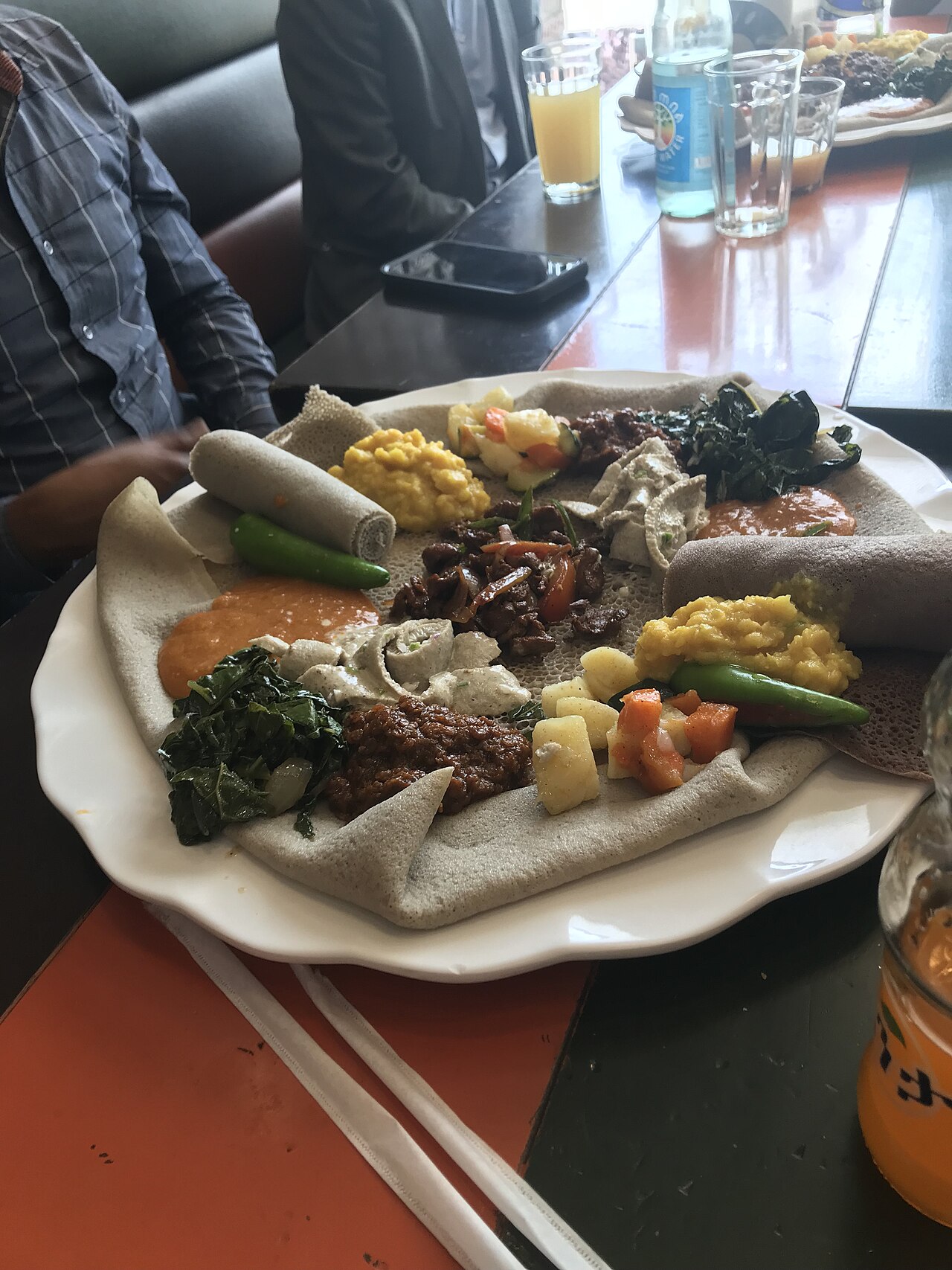
The bread is cooked one side only, briefly covered, on a mogogo, the traditional clay griddle set over a fire or electric heat source. Because only the bottom is seared while steam sets the top, injera stays pliable enough to roll around mouthfuls of food. A finished injera is served flat on a woven tray or a mesob, the colourful woven table-basket found in nearly every home, and topped with an array of stews called wot (or wat) and salads.
What separates injera from other flatbreads is its role. It is not a side. It is the plate, the cutlery, and often the majority of the calories in a meal. Diners tear pieces with their right hand, wrap them around a scoop of stew, and eat. At the end of a shared meal, the injera that lined the bottom of the tray has absorbed every sauce — and in many households, that final, deeply flavoured piece is the most prized.
Why Teff Makes Ethiopian Injera Unlike Any Other Bread
Injera’s identity is inseparable from teff (Eragrostis tef), a cereal domesticated in the Ethiopian highlands thousands of years ago. Teff grains are remarkably small — roughly the size of a poppy seed, about one-hundredth the weight of a wheat kernel — yet the crop is hardy, thriving in both drought and waterlogged soils. Ethiopia is the world’s largest producer, and teff remains central to national agriculture and food security.
The chemistry of the “eyes”
Teff is naturally rich in iron and calcium and, critically for injera, contains a community of wild yeasts and lactic acid bacteria that drive fermentation. Traditional bakers rely on an ersho — a saved portion of fermented batter that acts as a starter, much like a sourdough mother. Over two to four days, the batter bubbles, sours, and develops the signature tang. The resulting bread is naturally gluten-free, which has driven growing international interest in teff flour.
Beyond teff: sorghum, barley, and corn
Teff is not the only grain in the story. In parts of Tigray, Amhara, and Eritrea, injera is made from sorghum or barley; in some lowland areas, corn (maize) is used. These variations reflect local agriculture and taste. Many connoisseurs insist that pure teff produces the finest injera — lighter, more elastic, and more finely bubbled — while blends with other grains are common in everyday cooking and in commercial production.
- Teff injera: the classic; pale, finely bubbled, mildly sour, naturally gluten-free.
- Sorghum injera: darker, heartier, common in sorghum-growing regions.
- Barley injera: earthier flavour, traditional in highland areas.
- Corn injera: sweeter and coarser, found in some lowland communities.
How Is Ethiopian Injera Made? From Batter to Mesob
Making injera is a slow craft measured in days, not minutes. The process begins with teff flour mixed with water and a starter culture, then left to ferment in a covered clay or plastic container. Home cooks judge readiness by sight, smell, and sound — the batter should be fragrantly sour and alive with bubbles.
The fermentation days
Fermentation typically runs two to four days, depending on temperature and the baker’s preference. A portion of batter is reserved as ersho for the next batch, creating a continuous lineage of starter that some families maintain for years. Before cooking, a little water is stirred in to thin the batter, and it is poured in a spiral onto the hot mogogo.
Cooking on the mogogo
The cook covers the griddle briefly so steam sets the top while the base browns lightly. Timing is everything: too long, and the injera turns crisp and brittle; too short, and it stays raw. A skilled baker produces injera with an even field of “eyes” and a soft, foldable body. Large-scale bakeries and modern injera-making machines now produce the bread commercially in Addis Ababa and abroad, but the home mogogo remains the benchmark.
Serving at the mesob
Injera is laid flat on the mesob or a large tray, and stews are spooned on top in a colourful arrangement. Diners gather around, tear injera from the edges, and eat from the shared centre. The meal is communal by design — there are no individual plates — and hospitality is expressed through abundance.
What Do You Eat With Ethiopian Injera?
The stews that crown injera are as varied as Ethiopia’s regions and seasons. Foremost is doro wot, a slow-simmered chicken stew built on caramelised red onions, berbere spice, and niter kibbeh (clarified butter infused with ginger, garlic, and cardamom), often finished with hard-boiled eggs. It is the celebratory dish of holidays and weddings. Shiro, a smooth purée of ground chickpeas or broad beans, is the everyday staple; misir wot (red lentils) and atikilt wot (cabbage, carrot, and potato) are ubiquitous. Kitfo, finely minced raw beef seasoned with mitmita and niter kibbeh, and tibs, sautéed meat or vegetables, round out the repertoire.
Alongside the stews come cooling salads — azifa of lentils, timatim salata of tomato and onion — and ayib, a mild fresh cheese. The balance of spicy, sour, and cool is deliberate. Injera’s acidity cuts through the richness of butter and berbere, while its spongy surface holds sauce.
Fasting, Faith, and the Ethiopian Injera Tradition
Ethiopia’s religious calendar shapes the table profoundly. The Ethiopian Orthodox Tewahedo Church observes numerous fasting days — including Lent and Advent — during which adherents abstain from animal products. On these days, injera is served with an entirely plant-based spread of lentil, chickpea, and vegetable stews. The result is one of the world’s great vegan cuisines, born of faith rather than fashion.
Injera also marks celebration. At weddings, baptisms, and the great festivals of Timkat and Meskel, doro wot and kitfo appear atop the injera. The coffee ceremony — roasting, grinding, and brewing beans in a jebena pot — frequently follows the meal, extending hospitality into the afternoon. Food, faith, and community converge at the mesob.
Injera Across Borders: Ethiopia, Eritrea, and the Diaspora
Injera is shared heritage between Ethiopia and Eritrea, where it is equally central and known as taita in some contexts. The bread travels with the diaspora to Washington, D.C. — home to one of the largest Ethiopian communities outside Africa — to London, Toronto, and Tel Aviv, where injera bakeries and restaurants have become neighbourhood fixtures. In these cities, teff flour is imported or increasingly grown by diaspora-led farming ventures in the United States.
Global interest in gluten-free and ancient grains has pushed teff and injera into new markets, while Ethiopian chefs abroad are reimagining the bread in modern settings. Yet the core remains unchanged: a fermented batter, a hot griddle, and a shared table.
| Element | Detail |
|---|---|
| Primary grain | Teff (Eragrostis tef), domesticated in the Ethiopian highlands |
| Fermentation time | Typically 2–4 days, using a saved starter called ersho |
| Cooking surface | Mogogo, a traditional clay griddle |
| Serving vessel | Mesob, a woven table-basket |
| Signature dishes | Doro wot, shiro, misir wot, kitfo, tibs |
| Cultural recognition | Ethiopian coffee ceremony inscribed by UNESCO in 2017 |
Nutrition, Sustainability, and the Future of Injera
Teff’s nutritional profile is notable: it is gluten-free, high in fibre, and a source of iron and calcium. Fermentation further improves digestibility and adds beneficial microbes. For a bread that has fed highland communities for millennia, these are modern selling points — but they are also reasons the crop matters for food security across the Horn of Africa.
Challenges remain. Teff yields are relatively low compared with other cereals, and climate variability affects harvests. Researchers in Ethiopia and abroad are working on improved teff varieties, while entrepreneurs develop mechanised injera production to meet urban demand. The tension between tradition and scale is real, but the bread’s adaptability — its many grain variations and its deep cultural roots — suggests it will endure.
- Gluten-free appeal: pure teff injera suits coeliac and gluten-sensitive diets.
- Fermentation benefits: natural probiotics and improved nutrient absorption.
- Agricultural resilience: teff tolerates both drought and waterlogging.
Why Ethiopian Injera Matters Beyond the Plate
Injera is a lesson in patience and community. It cannot be rushed; the batter demands days of waiting. It cannot be eaten alone; the meal is shared from a single tray. In a world of fast food and individual portions, the mesob offers a different model — one where food is a collective act and hospitality is measured in generosity. That is the enduring power of Ethiopian injera: a humble sourdough disc that carries the history of a nation, the rhythm of its faith, and the warmth of its table.