📅 Last updated: 22.10.2026
The Tuareg people are a proud, historically powerful Berber-speaking nation of the central Sahara and Sahel, spread across northern Mali, Niger, southern Algeria, southwestern Libya, and Burkina Faso. Known as the “Lords of the Sahara,” they built a trans-Saharan caravan economy, created the matrilineal Kel Tamasheq society, and produced the modern desert blues that now fills concert halls from Bamako to Berlin.
The Tuareg people (Kel Tamasheq) are an Amazigh (Berber) group of roughly 2–3 million people living across the central Sahara and Sahel. They speak Tamasheq, write in the ancient Tifinagh script, and historically controlled trans-Saharan trade routes linking Timbuktu, Agadez, and Ghadames. Their society is matrilineal, their identity is famously tied to the indigo veil and the camel, and their contemporary story is one of rebellion, resilience, and a globally influential music culture.
- Who Are the Tuareg People? Origins, Identity, and the Tifinagh Script
- Lords of the Sahara: Trade, Caravans, and the Desert Economy
- The Indigo Veil, the Agal, and Tuareg Culture
- How Did the Tuareg People Shape Saharan History? Rebellions and the Modern State
- Tuareg People in the 21st Century: Migration, Music, and Modernity
- Tuareg People: Key Facts and Timeline
- What Makes Tuareg Culture Distinctive — and Misunderstood?
- Why the Tuareg People Matter to Africa and the World
- A Lasting Perspective on the Lords of the Sahara
Who Are the Tuareg People? Origins, Identity, and the Tifinagh Script
Linguists and historians trace the Tuareg to the Amazigh peoples of North Africa, with Tamasheq belonging to the Berber branch of the Afroasiatic language family. The Tuareg call themselves Kel Tamasheq — “those who speak Tamasheq” — and their presence in the Sahara is documented in rock art, early Arabic chronicles, and the medieval trade records of the Mali and Songhai empires. Unlike many neighboring societies, the Tuareg preserved their own script, Tifinagh, which survives in the form of tifinagh inscriptions on rocks, jewelry, and, since 2003, in Niger’s national alphabet.
Tuareg society is organized into confederations — the Kel Ahaggar and Kel Ajjer in Algeria, the Kel Aïr in Niger, and the Kel Adagh and Kel Antessar in Mali — each with its own chiefs, customary law, and territory. A defining feature is matrilineal descent: lineage, property, and status pass through the mother, and women hold rights to inheritance, divorce, and literacy that have long surprised outside observers. The poet-musicians known as imzad players are traditionally women, and the one-stringed imzad fiddle remains a symbol of Tuareg cultural continuity.
Colonial borders cut through Tuareg lands in the late 19th and early 20th centuries, when French forces took Timbuktu in 1893 and, after fierce resistance led by figures such as Kaocen Ag Geda in the 1916–1917 Aïr uprising, imposed a fragile peace. Those borders — drawn at the Berlin Conference of 1884–1885 and refined by later French administrative decisions — still shape the Tuareg political condition today.
Lords of the Sahara: Trade, Caravans, and the Desert Economy
The Tuareg earned the title “Lords of the Sahara” not through conquest alone but through mastery of movement. For centuries their caravans moved salt from the mines of Taghaza and Taoudenni, gold from the Niger bend, dates from the oases, and — tragically — enslaved people across routes connecting Timbuktu, Gao, Agadez, Ghat, and Ghadames. At their height, these routes supplied the medieval empires of Mali and Songhai with the salt and gold that underpinned their wealth. The Moroccan traveler Leo Africanus, writing in the early 16th century, described Timbuktu as a city of scholars and merchants whose prosperity rested on this desert commerce.
Camels — specifically the one-humped dromedary, bred for endurance — made this possible. Tuareg herders developed detailed knowledge of wells, grazing, and star navigation; the amghar, or caravan leader, was a position of prestige. The trade also produced the azalai, the great salt caravan from Agadez to the Bilma oasis, which still runs today as a cultural and economic institution, though trucks now share the route with camels.
Key features of the traditional Tuareg economy
- Pastoralism: Goats, sheep, and camels herded across seasonal pastures, with movement timed to the rains.
- Caravan trade: Salt, gold, dates, grain, and textiles moved along routes crossing thousands of kilometers.
- Oasis agriculture: Date palms and gardens in places such as Timia and Bilma in Niger.
- Craft and metalwork: The inadan caste of smiths produced silver jewelry, leatherwork, and the distinctive agal headband.
The Indigo Veil, the Agal, and Tuareg Culture
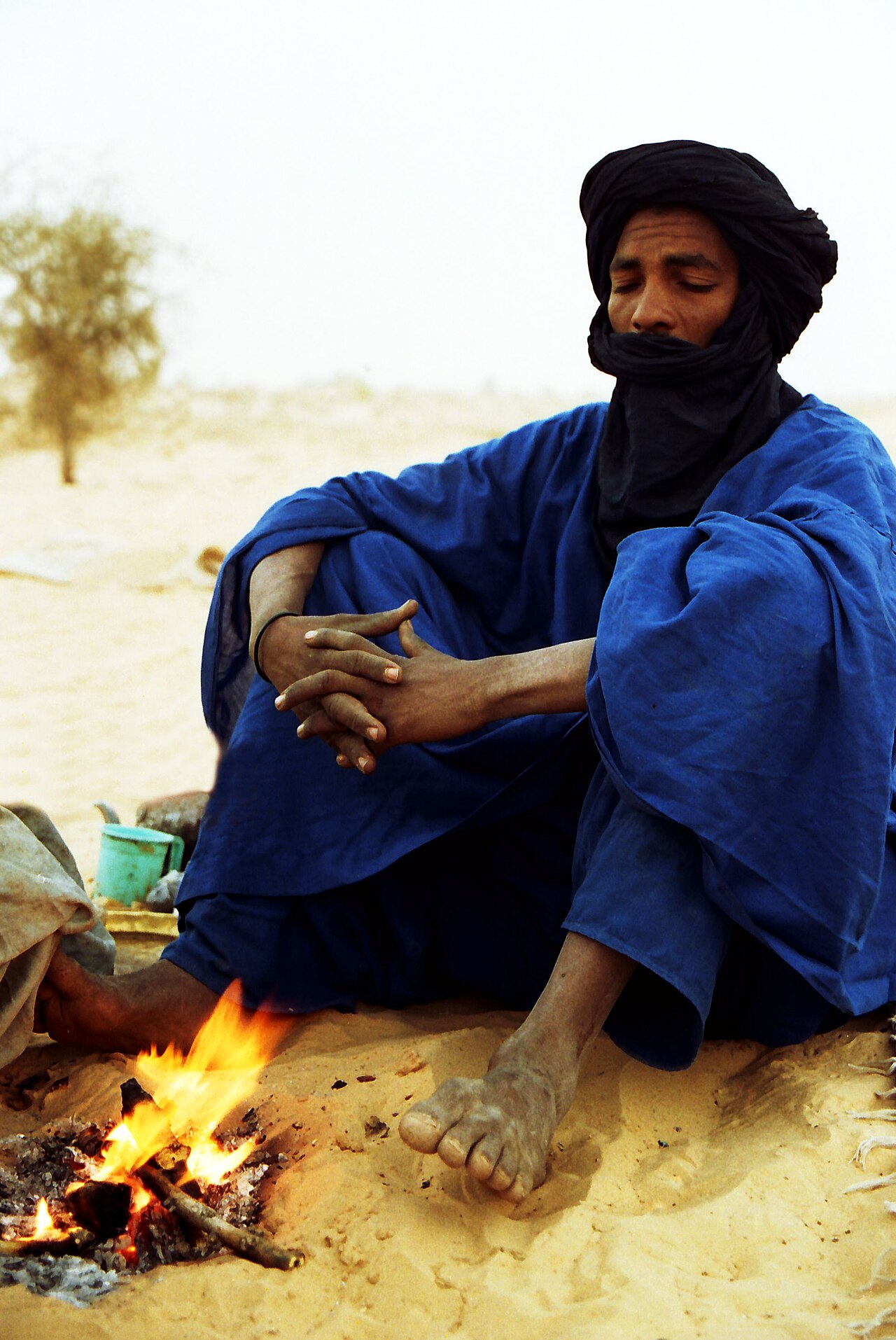
Perhaps no image is more associated with the Tuareg than the indigo veil, the tagelmust, worn by men and dyed with indigo that stains the skin blue — the origin of the colonial-era nickname “blue men of the desert.” The veil is not merely clothing: it is a marker of adulthood, modesty, and status, and the agal, the camel-hair cord that holds it in place, is a symbol of manhood. Women traditionally wear loose robes and elaborate silver jewelry, and the silver crosses of Agadez — each town with its own design — are among the most recognizable Tuareg art forms.
Oral poetry, praise songs, and the tinde drum accompany ceremonies, and the imzad fiddle is played almost exclusively by women. Islam arrived in the region from the 7th century onward and is the dominant faith, but Tuareg religious practice has long blended Quranic learning with local custom, and the marabout families — such as the Kel es-Souk — hold religious authority alongside the warrior and vassal groups of the traditional hierarchy.
How Did the Tuareg People Shape Saharan History? Rebellions and the Modern State
Tuareg history after independence is inseparable from the politics of the post-colonial state. When Mali, Niger, Algeria, and Libya became independent between 1960 and 1962, the Tuareg found themselves divided by borders they had never recognized, with their grazing lands and trade routes sliced by national frontiers. Droughts in the 1970s and 1980s — including the catastrophic Sahel drought of 1972–1974 — devastated herds and pushed many young men into migration to Libya and Algeria, where some received military training.
That training fed the Tuareg rebellions. In 1990, a uprising began in northern Mali and Niger, led in part by figures such as Mano Dayak and Rhissa ag Boula; peace accords in 1992 (Mali) and 1995 (Niger) brought a fragile settlement, with many fighters integrated into national armies. A second major rebellion erupted in Mali in 2012, when the National Movement for the Liberation of Azawad (MNLA) declared an independent state of Azawad — a declaration that collapsed within months as jihadist groups seized the north, prompting the French military intervention Operation Serval in January 2013. The 2015 Algiers Accord attempted to restore stability, though insecurity persists in the borderlands of Mali, Niger, and Burkina Faso.
In Niger, the 1990s rebellion produced the 1995 Ouagadougou peace agreement and, later, the 2009 rebellion of the Nigerien Movement for Justice (MNJ). The Tuareg have also been central to Niger’s politics: Mohamed Bazoum, president from 2021 to 2023, was of Tuareg and Arab descent, and the 2023 coup that ousted him underscored how central the Sahara’s peoples remain to the region’s stability.
Tuareg People in the 21st Century: Migration, Music, and Modernity
Contemporary Tuareg life is anything but frozen in time. In Agadez, Niger, a city of roughly 120,000 people, satellite dishes and mobile phones sit beside mud-brick mosques, and the city’s historic center is a UNESCO World Heritage Site. Tuareg men work as drivers, guides, and mechanics on the trans-Saharan routes; women run cooperatives producing silverwork and textiles sold to tourists and exported to Europe. Diaspora communities in France, Belgium, and the United States maintain cultural associations and fund development projects back home.
Music has been the Tuareg’s most visible global export. The band Tinariwen, formed in Libyan training camps in the late 1970s and early 1980s, won a Grammy Award in 2012 for Tassili and has toured globally, blending Tamasheq poetry with electric guitars. Other artists — Bombino, Mdou Moctar, Les Filles de Illighadad, and Tartit — have carried the sound further, and the annual Festival au Désert, founded in Essakane, Mali, in 2001 and later relocated to Anderamboukane and beyond amid security concerns, became a symbol of Saharan cultural diplomacy.
Tuareg society today: key dynamics
- Urbanization: Growing populations in Agadez, Tamanrasset, Kidal, and Bamako, with remittances from Libya and Europe.
- Education: Tamasheq-language broadcasting on national radio and the teaching of Tifinagh in Nigerien schools.
- Security: The persistent threat of armed groups in the tri-border region, and the role of Tuareg militias in local ceasefires.
- Climate pressure: Desertification and erratic rainfall forcing adaptation in herding and farming.
Tuareg People: Key Facts and Timeline
| Period | Event | Significance |
|---|---|---|
| c. 7th–11th century | Arrival of Islam and growth of trans-Saharan trade | Tuareg become central to Saharan commerce and Quranic learning |
| 14th–16th century | Mali and Songhai empires dominate the Niger bend | Tuareg caravans supply salt and gold; Timbuktu flourishes |
| 1893–1917 | French conquest; Kaocen uprising (1916–1917) | Colonial borders imposed; resistance becomes a founding memory |
| 1960–1962 | Independence of Mali, Niger, Algeria, Libya | Tuareg lands divided among new nation-states |
| 1990–1995 | Tuareg rebellions in Mali and Niger; peace accords | Fighters integrated into armies; autonomy debate begins |
| 2012–2013 | MNLA declares Azawad; French Operation Serval | Northern Mali crisis reshapes regional security |
| 2012 | Tinariwen wins Grammy for Tassili | Tuareg music reaches a global audience |
What Makes Tuareg Culture Distinctive — and Misunderstood?
Outsiders often reduce the Tuareg to a single image: the veiled warrior on a camel. That image obscures a complex society with a stratified traditional order — warrior nobles, vassal groups, religious families, and the inadan smiths — that has been reshaped by decades of migration, education, and state integration. It also obscures the Tuareg role in the slave trade, a history that scholars such as those working on the esclaves of the Sahel have documented and that contemporary Tuareg communities continue to confront.
Gender is another area where stereotypes fail. Tuareg women historically enjoyed greater literacy and property rights than women in many neighboring societies, and the matrilineal principle remains a source of identity even as Islamic inheritance practice and modern law interact with it. The imzad tradition, UNESCO-recognized in 2013 as intangible cultural heritage, is carried by women, and female poets and singers remain central to public life.
Language is a battleground and a bond. Tamasheq is spoken by an estimated 1–2 million people, written in Tifinagh and increasingly in Latin and Arabic script, and broadcast on radio stations in Niger and Mali. In 2003, Niger adopted Tifinagh as an official national script, a quiet but significant recognition of Tuareg cultural rights.
Why the Tuareg People Matter to Africa and the World
The Tuareg story is a case study in how desert peoples adapt to the modern state without losing their identity. Their caravans once connected empires; today their musicians connect continents, their drivers keep remote routes open, and their political leaders sit in national assemblies. The Sahara is often described as a barrier, but the Tuareg have always shown it to be a highway — a place of passage, exchange, and survival.
That heritage carries lessons for the Sahel’s present crisis. Stability in northern Mali and Niger depends on addressing the grievances that fueled rebellion: marginalization, weak services, and the sense that distant capitals ignore desert communities. Tuareg civil society organizations, women’s cooperatives, and cultural festivals are part of the answer, building bridges where borders once divided.
A Lasting Perspective on the Lords of the Sahara
The Tuareg people have been called lords of the Sahara for good reason: they mastered a landscape that defeats armies, built trade networks that enriched empires, and preserved a language and script older than many of the states that now govern them. Their history includes conquest, trade, and painful chapters such as slavery, and their present includes rebellion, migration, and Grammy-winning music. What endures is a culture of movement and memory — the indigo veil, the silver cross of Agadez, the imzad fiddle, and the Tifinagh letters scratched into desert rock. To understand the Tuareg is to understand that the Sahara was never empty, never static, and never beyond the reach of the people who call it home.