📅 Last updated: 20.10.2026
The Great Zimbabwe ruins rise from the granite plateau of south-central Zimbabwe like a stone argument that refuses to be silenced — mortarless walls, some eleven metres high, laid with such precision that a knife blade still cannot slip between the blocks. For nearly a thousand years these structures have watched over the savanna, and for the past century and a half they have stood at the centre of one of archaeology’s most bitter debates: who built them, and what does that tell us about Africa’s past?
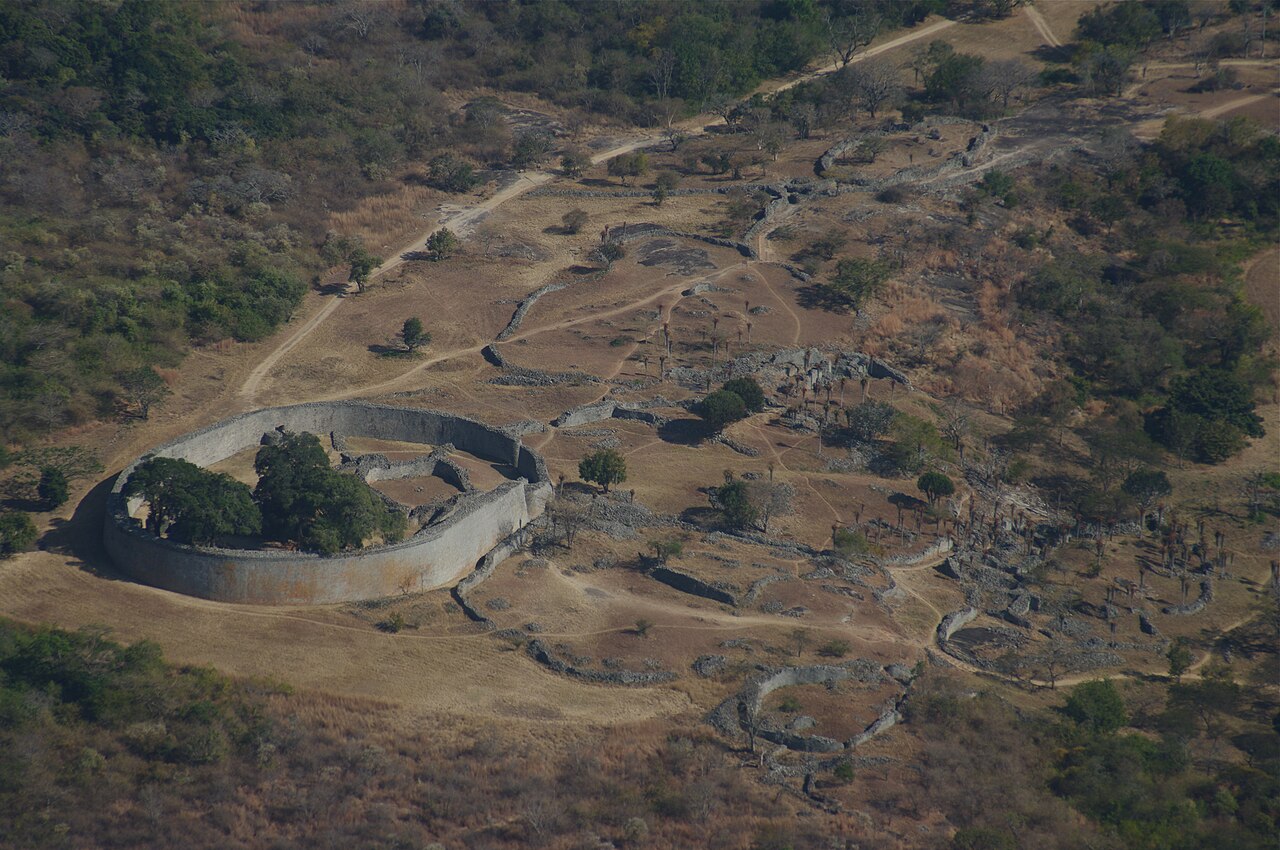
The Great Zimbabwe ruins are the remains of the capital of the Kingdom of Zimbabwe, a Shona civilisation that flourished between roughly 1100 and 1450 CE. Built entirely of dry-stone granite — no mortar was used — the site covers some 720 hectares and includes the Hill Complex, the Great Enclosure, and the Valley Complex. It was a major trading centre linked to the Indian Ocean gold and ivory trade, and it is the largest ancient stone structure in sub-Saharan Africa.
- What Are the Great Zimbabwe Ruins, Exactly?
- How Did the Great Zimbabwe Ruins Become Africa's Most Contested Heritage Site?
- When Was Great Zimbabwe Built, and By Whom?
- How Do You Read the Walls? Architecture as Power
- What Did Trade Bring to the Great Zimbabwe Ruins?
- What Happened to Great Zimbabwe — and Why Does It Still Matter?
- Practical Guide: Visiting the Great Zimbabwe Ruins Today
- Why the Walls of Great Zimbabwe Still Speak
What Are the Great Zimbabwe Ruins, Exactly?
Great Zimbabwe is not a single building but a sprawling royal city. The name itself comes from the Shona words dzimba dza mabwe — “houses of stone” — or, in another reading, dzimba woye, “venerated houses.” The modern nation of Zimbabwe took its name from the site in 1980, a deliberate act of national reclamation.
The ruins sit about 27 kilometres southeast of the modern city of Masvingo, in a landscape of kopjes and granite outcrops. Three main zones make up the core of the site:
- The Hill Complex — the oldest section, perched on a granite hill some 80 metres above the valley floor. Its narrow passages and high walls suggest a royal or ritual precinct, possibly the residence of the Mambo (king).
- The Great Enclosure — the largest single ancient structure in sub-Saharan Africa. Its outer wall runs about 250 metres around, rises to 11 metres, and encloses a conical stone tower roughly 9 metres tall.
- The Valley Complex — a dense scatter of smaller stone enclosures where much of the city’s ordinary population lived and worked.
Estimates of the population at its height range from 10,000 to 18,000 people — a true city by any medieval standard. The site was inscribed as a UNESCO World Heritage Site in 1986.
How Did the Great Zimbabwe Ruins Become Africa’s Most Contested Heritage Site?
The story of how outsiders interpreted the Great Zimbabwe ruins says as much about colonial ideology as it does about archaeology. When European travellers reached the site in the late nineteenth century, they found stonework too sophisticated for their prejudices to accommodate.
The Colonial Denial
In 1871, the German geologist Carl Mauch visited Great Zimbabwe and — despite the obvious Shona oral traditions linking the site to local ancestors — attributed the ruins to the Queen of Sheba and the Phoenicians. In 1895, the British South Africa Company, under Cecil Rhodes, backed the creation of the Rhodesia Ancient Ruins Company, which was granted the right to mine the site for gold and treasure. In the process, vast quantities of archaeological stratigraphy were destroyed.
The colonial Rhodesian government went further. From 1929 onward, a succession of state-appointed custodians — most notoriously the amateur archaeologist Richard Nicklin Hall, and later the site curator from 1946, Roger Summers‘ predecessor Cathedral archaeologist figures — actively suppressed evidence of African construction. The official guidebooks of the 1960s and 1970s attributed the walls to “a vanished white race” or to Phoenician traders. This was not fringe theory; it was state policy.
The Evidence That Settled the Question
The scientific case was already solid by 1929, when the British Association for the Advancement of Science sent the archaeologist Gertrude Caton-Thompson to excavate. Her conclusion, published in 1931, was unambiguous: the ruins were “of African origin.” She was ridiculed by the Rhodesian press. But later work — by David Randall-MacIver in 1905, by Roger Summers in the 1950s, and by Peter Garlake in the 1960s and 1970s — confirmed the Shona authorship through stratigraphy, radiocarbon dating, and the analysis of locally made artefacts including soapstone birds, gold beads, and imported Chinese celadon and Persian faience.
Today no serious archaeologist disputes that Great Zimbabwe was built by ancestors of the Shona people. The debate is over — but the wounds of the denial are still part of the site’s meaning.
When Was Great Zimbabwe Built, and By Whom?
Radiocarbon dates place the earliest stone construction at the Hill Complex around 1100 CE, with the Great Enclosure and the great walls built in phases through the thirteenth and fourteenth centuries. The kingdom declined and was largely abandoned by about 1450 — a date still debated, with trade disruption, drought, and the rise of the Mutapa state all offered as explanations.
| Period | Key Development | Evidence |
|---|---|---|
| c. 900–1100 CE | Early Iron Age settlement; first stone terracing on the hill | Pottery styles, radiocarbon dates |
| c. 1100–1250 CE | Hill Complex consolidated; royal precinct takes shape | Stratigraphy, soapstone carvings |
| c. 1250–1450 CE | Great Enclosure built; city reaches peak population and trade reach | Imported ceramics, gold, ivory, glass beads |
| c. 1450–1500 CE | Decline and abandonment; power shifts to Mutapa state to the north | Falling artefact density, Portuguese records |
| 1871–1931 | Colonial misinterpretation and treasure hunting; Caton-Thompson’s rebuttal | Excavation reports, published correspondence |
The builders were Shona-speaking peoples of the Zimbabwe plateau, organised under a monarchy whose wealth came from cattle, gold, and control of trade routes to the Swahili coast. The Portuguese chronicler Duarte Barbosa wrote in the early sixteenth century of a great inland market where “much gold” was traded — a description that fits the Zimbabwe-Mutapa economic world.
How Do You Read the Walls? Architecture as Power
The Great Zimbabwe ruins are not merely large; they are rhetorically sophisticated. The dry-stone technique — granite blocks laid without mortar, using a slight inward batter so that the walls lean in toward the top — is a structural and aesthetic achievement in its own right. The walls curve and undulate, following the contours of the land rather than imposing a grid upon it.
The Great Enclosure and Its Conical Tower
The Great Enclosure’s outer wall is the largest ancient structure in sub-Saharan Africa. Its inner face is decorated with a chevron pattern — a zigzag course of granite — that appears nowhere else on the site. Inside, a parallel wall creates a narrow passage, and at the centre stands the conical tower, its purpose still unresolved. Theories include a granary symbol, a phallic or fertility emblem, and a marker of royal authority. The tower’s base is solid; it was never a dwelling.
The Soapstone Birds
Eight soapstone birds were carved at Great Zimbabwe, each mounted on a stone column. They are among the most iconic artefacts of African art. One was taken to Cecil Rhodes’s estate at Groote Schuur in Cape Town; the others are held in the Zimbabwe Museum of Human Sciences in Harare. The birds — probably representing bateleur eagles or fish eagles — appear to have had ritual significance, and the Zimbabwe Bird is now the national emblem, appearing on the flag and the coat of arms.
What Did Trade Bring to the Great Zimbabwe Ruins?
Great Zimbabwe was a cosmopolitan city. Excavations have recovered Chinese celadon from the Ming dynasty, Persian faience, glass beads from India, and Arab coins — artefacts that trace a trade network stretching from the Zimbabwe plateau to the Swahili coast ports of Sofala and Kilwa, and from there across the Indian Ocean to Arabia, Persia, India, and China.
The exports were gold, ivory, and cattle. The gold came from the plateau’s alluvial deposits and from mines in the region; the ivory from the elephant herds of the Zambezi valley. This trade made the Mambo wealthy enough to command the labour of thousands — the construction of the Great Enclosure alone would have required an organised workforce over many years.
- Gold: the kingdom’s principal export, traded through Sofala to the Swahili coast and onward to India and the Middle East.
- Ivory: highly valued in Indian and Chinese markets.
- Cattle: the domestic economy’s backbone, and a measure of status and wealth.
- Imports: ceramics, glass beads, cloth, and metalware that marked elite status.
What Happened to Great Zimbabwe — and Why Does It Still Matter?
The city’s decline remains one of African archaeology’s open questions. The most widely accepted explanation is a combination of factors: the exhaustion of nearby gold deposits, drought and environmental degradation from overgrazing and deforestation, and the rise of the Mutapa state to the north, which redirected trade away from the plateau. By 1500 the great walls stood empty.
What survived was memory. Shona oral traditions preserved the knowledge that the stone houses were built by ancestors, and the site remained sacred to local communities. That memory is now national heritage: the Great Zimbabwe ruins are protected under Zimbabwe’s National Museums and Monuments Act, and the site is managed by the National Museums and Monuments of Zimbabwe in partnership with UNESCO.
Modern Zimbabwean scholars and archaeologists — including Gilbert Pwiti and Innocent Pikirayi — have built a body of research that places Great Zimbabwe firmly within the wider archaeology of southern Africa’s Iron Age, connecting it to related stone-walled sites such as Mapungubwe in South Africa and Khami near Bulawayo. The story is not one of isolated genius but of a regional civilisation with deep roots.
Practical Guide: Visiting the Great Zimbabwe Ruins Today
The site is open to visitors year-round and is easily reached from Masvingo, where guides and accommodation are available. A few things worth knowing:
- Best time to visit: the dry season, May to October, when the paths are firm and the light is clear.
- Guides: local Shona guides offer context that no signboard can — ask about the oral traditions attached to the Hill Complex.
- Respect: parts of the site remain sacred to local communities; follow guidance on where to walk and photograph.
- Combine with: the nearby Great Zimbabwe Museum, which holds interpretive exhibits and replicas of the soapstone birds.
The site is also a living place of ceremony. In 1980, at Zimbabwe’s independence, the ruins became a symbol of national rebirth; today they host cultural events and school visits, and the surrounding communities maintain a relationship with the stones that predates any museum.
Why the Walls of Great Zimbabwe Still Speak
The Great Zimbabwe ruins are often described as a mystery, but the mystery is not who built them — that question has been answered for nearly a century. The real achievement is what the walls represent: a society that organised labour on a monumental scale, traded across oceans, and expressed its cosmology in stone. The chevron pattern on the Great Enclosure, the soaring conical tower, the eagles carved in soapstone — these are not the work of a “lost civilisation.” They are the work of ancestors whose descendants still live in the region, speak the language of the builders, and carry the site’s name into the twenty-first century.
Stand at the foot of the Great Enclosure and the wall rises above you like a held breath. It has stood for eight hundred years without a drop of mortar, and it will stand for centuries more. The lesson of Great Zimbabwe is not that Africa had a past worth remembering — it is that Africa’s past is still present, still contested, and still being written by the people who claim it.