📅 Last updated: 10.10.2026
Every August, tens of thousands of people converge on a forest on the edge of Osogbo, the capital of Osun State in south-western Nigeria, for the Osun-Osogbo Festival — a two-week celebration that is at once a religious rite, a cultural homecoming, and one of the most striking public spectacles in West Africa. At its heart lies a promise said to have been made centuries ago between a goddess and the people who settled beside her river. That promise is renewed each year in a grove that UNESCO added to its World Heritage List in 2005, and it is the reason pilgrims, priests, drummers, artists and diaspora visitors keep returning to a patch of sacred forest that has survived war, urban sprawl and the pressures of modern Nigeria.
- What Exactly Is the Osun-Osogbo Festival?
- The Sacred Grove: A Forest That Survived
- The Legend Behind the Covenant
- How the Festival Unfolds: A Ritual Calendar
- Why the Grove Is Sacred — and Why It Matters Today
- Osun-Osogbo Festival in the Diaspora and the Wider World
- Controversies, Pressures and the Future
- A Festival That Belongs to Everyone and No One
What Exactly Is the Osun-Osogbo Festival?
The Osun-Osogbo Festival is the annual renewal of a covenant between the people of Osogbo and Osun, the Yoruba goddess (or orisa) associated with fresh water, fertility, love, wealth and, in local tradition, the protection of the town itself. The festival is not a single day but a cycle of rituals that builds over roughly two weeks, culminating in a grand procession from the Oba’s palace in the centre of Osogbo to the banks of the Osun River inside the grove.
Two figures dominate the ritual calendar. The Ataoja of Osogbo, the town’s traditional ruler, leads the community through the rites; the current Ataoja is Oba Jimoh Olanipekun Larooye II, who has occupied the throne since 2003. Walking beside (or just ahead of) him is the Arugba, a young virgin maiden chosen for the year, who carries the symbolic calabash of offering to the river. In Yoruba tradition, the Arugba is a conduit: through her, the community’s prayers are carried to the goddess. Her selection and preparation are taken extremely seriously, and she is drawn from one of the families traditionally charged with providing her.
Around these central figures swirls a fortnight of activity: traditional drumming and dancing, masquerade displays, prayers by Ifa diviners and Osun priestesses, cultural performances, art exhibitions and a trade fair. For the roughly 30 million-strong Yoruba nation and its diaspora, and increasingly for curious travellers from elsewhere, it has become a landmark event on the African cultural calendar.
The Sacred Grove: A Forest That Survived
The festival cannot be understood without the grove. The Osun-Osogbo Sacred Grove covers about 75 hectares of dense forest and riverside land on the outskirts of Osogbo, roughly 250 kilometres north-east of Lagos. Inside it are shrines, sanctuaries and more than 40 sculptures, many of them monumental works created in the 1960s and after by the Austrian-born artist Susanne Wenger — who took the Yoruba name Adunni Olorisha — and her collaborators among the local New Sacred Art movement.
Wenger’s contribution is one of the festival’s most remarkable modern chapters. Arriving in Nigeria in the late 1940s with her husband, the linguist Ulli Beier, she became an initiated priestess of Osun and spent the rest of her life restoring and reimagining the grove’s shrines, working alongside Yoruba craftsmen and priests. Her sculptures — elongated, dreamlike figures in mud, concrete and iron — stand among the trees rather than in a gallery, blurring the line between art, worship and landscape. When she died in 2009 at the age of 93, she was buried in the grove she had devoted herself to protecting.
That protection mattered. By the mid-20th century, urban expansion and neglect threatened the forest, and several other sacred groves in Yorubaland had already been swallowed by development. The grove’s 2005 inscription as a UNESCO World Heritage Site — the second Nigerian site so listed, after Sukur Cultural Landscape — gave it international recognition and, crucially, leverage against encroachment. UNESCO described it as a “living” heritage site, meaning worship continues there, unlike a museum. The distinction is central: this is not a monument to a dead religion but a working sanctuary.
The Legend Behind the Covenant
The founding story of Osogbo begins, in most accounts, with a hunter. A man named Larooye (some traditions name him Olarooye) and his companion Timchin were hunting near the Osun River when they encountered the goddess. They settled on the riverbank, and the settlement that grew there became Osogbo. According to the tradition passed down by the town’s priests and elders, Osun agreed to let the people live there and to bring them prosperity, on one condition: that they would remember her and honour her every year.
Another strand of the legend tells of a famine or crisis that drove the early settlers to seek the goddess’s help, and of a vow made in desperation that was answered with abundance. Across the various tellings — and Yoruba oral history tolerates several versions coexisting — the message is consistent. The festival is not a performance of gratitude tacked onto history; it is the fulfilment of an obligation, and the community’s wellbeing is understood to depend on keeping it.
“Osun does not need the festival. We need it. It is the day we remember who we are and who protects us.”
That sentiment, repeated in different words by priests and residents year after year, explains why the rites are conducted with such formality. To skip them, in the traditional understanding, is to break a contract that has held for centuries.
How the Festival Unfolds: A Ritual Calendar
The Osun-Osogbo Festival is best imagined as a crescendo. Different rites belong to different days, and the public-facing events sit on top of a deeper layer of private, priestly observance. The table below sketches the main phases.
| Phase | Timing | What Happens |
|---|---|---|
| Opening rites | Late July / early August | Priests and priestesses begin purification and offerings at the grove’s shrines; the festival is formally declared open. |
| Traditional cleansing (Iwopopo) | First days of the cycle | The Ataoja and chiefs perform rites to cleanse the town and its people ahead of the main procession. |
| Lighting of the 16-point lamp (Olojumerindinlogun) | Mid-cycle | A lamp with sixteen points is lit at the palace, symbolising the sixteen principal orisa and the presence of the divine in the town. |
| Grand procession to the river | Final Friday of the cycle | The Arugba carries the offering calabash from the palace to the Osun River, accompanied by the Ataoja, chiefs, priests, drummers and thousands of worshippers. |
| Closing rites and celebration | Days after the procession | Final prayers at the river, followed by cultural performances, parties and the winding down of the crowds. |
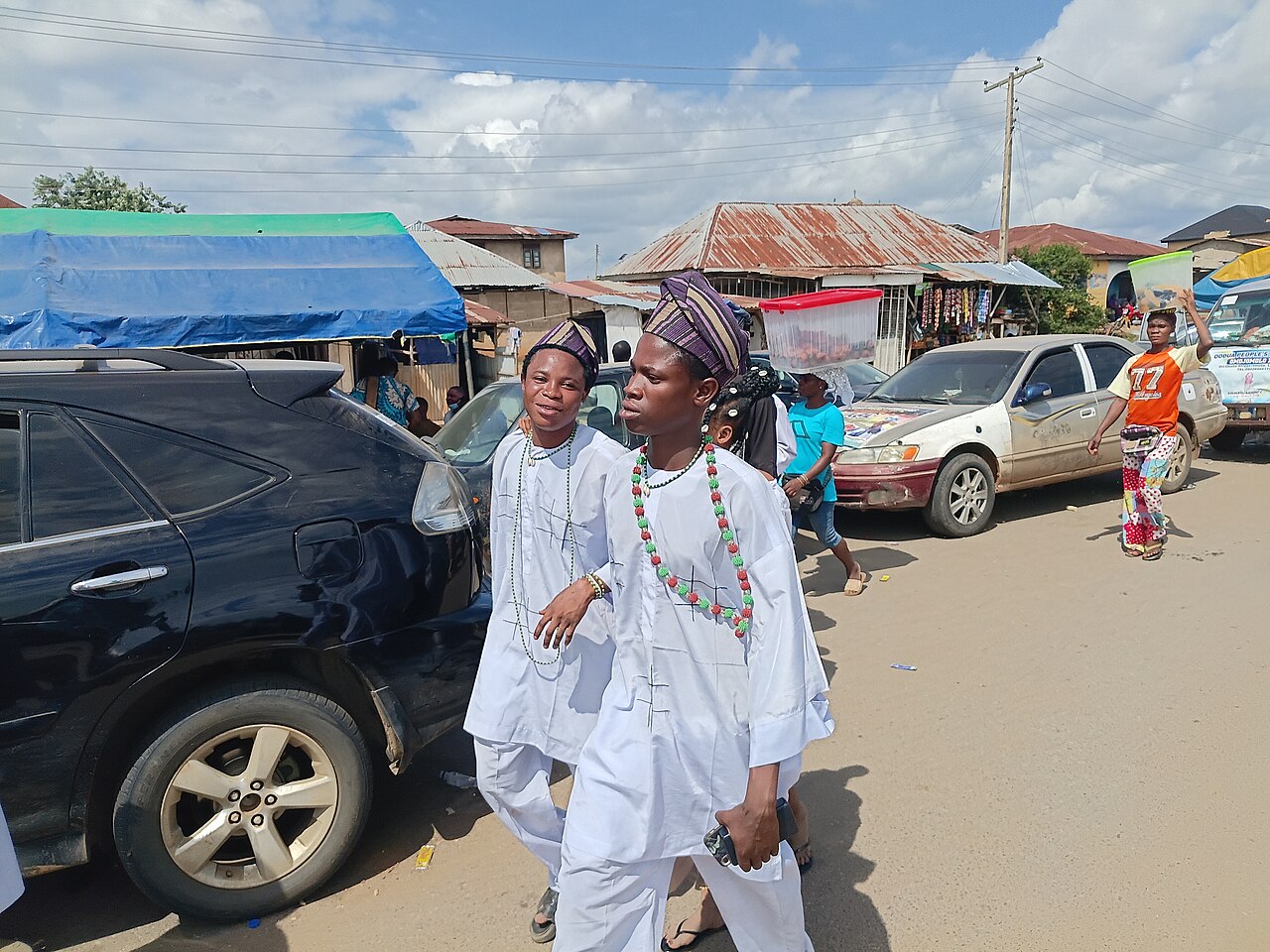
The procession is the moment the world sees. Crowds line the route from the palace through Oja Oba and on toward the grove, many dressed in white, the colour associated with Osun. Drummers play dundun talking drums; women sing; the Arugba moves slowly, shielded, her calabash held high. Security is heavy and phones are everywhere — a striking fusion of ancient rite and 21st-century documentation.
The Role of the Arugba
The Arugba is more than a ceremonial figurehead. She is expected to be a virgin, to undergo spiritual preparation with the priestesses, and to maintain ritual purity in the period leading up to the procession. Popular tradition holds that if she stumbles or the calabash falls, it signals misfortune for the community — which is why the route is cleared and her steps are guarded. In a modern twist, the Arugba has become something of a public figure; her photograph appears in newspapers and on social media, and young women from the designated families regard selection as a profound honour.
Why the Grove Is Sacred — and Why It Matters Today
Sacred groves are a distinctive feature of Yoruba and wider West African religious geography. They are patches of forest set aside for deities, left largely uncultivated and undeveloped, and protected by taboo and custom. In a region where deforestation has been relentless — Nigeria has lost a large share of its forest cover over the past half-century — these groves have quietly functioned as conservation zones, preserving biodiversity that the surrounding farmland and city no longer hold.
The Osun-Osogbo grove shelters monkeys, birds, butterflies and a range of plant species, and the river itself is central to the local ecosystem. This overlap between religion and ecology is not incidental. When UNESCO inscribed the site, it recognised both cultural and natural values. For the worshippers, the two are inseparable: the forest is the goddess’s home, and damaging it is a sacrilege as much as an ecological loss.
The grove also anchors a broader cultural landscape. Osogbo has become a recognised centre for contemporary Nigerian art, partly through the influence of Wenger and Beier and the Mbari artists’ club, and the annual festival has grown to include exhibitions and performances that connect the traditional rites with modern creative practice. The result is a rare thing: a living religious site that is also a working arts hub.
Osun-Osogbo Festival in the Diaspora and the Wider World
Osun is not confined to Osogbo. Through the transatlantic slave trade, devotion to Osun and other orisa travelled to the Americas, where it took new forms — Oshun in Cuban Santería (Regla de Ocha), and related figures in Brazilian Candomblé and Trinidadian traditions. In recent decades, that connection has flowed back. Each year, practitioners and researchers from Cuba, Brazil, the United States and the Caribbean travel to Osogbo, some to fulfil vows, others to reconnect with a heritage they can name.
This return traffic has given the festival a genuinely global dimension without diluting its local character. The rites remain in Yoruba, led by hereditary priests; there is no “tourist version.” Visitors are welcome, but they are guests at a religious event, and expectations of respect — modest dress, no photography in certain areas, following the guidance of priests and security — are made clear. That balance is part of why the site retains its integrity and why the festival has been able to grow without becoming a theme park.
Practical Notes for Visitors
- When: The main procession typically falls in August, with the exact date set by the traditional calendar. Plan around the final week of the cycle.
- Where: Osogbo, Osun State. The grove lies a short drive from the city centre; the procession route runs from the Ataoja’s palace.
- Getting there: Osogbo is reachable by road from Lagos (roughly four to five hours) and by air via nearby Ibadan or Akure, then road.
- Respect: Dress modestly, ask before photographing worshippers or shrines, and follow instructions from priests and officials.
- Beyond the festival: The grove is open year-round and can be visited with a guide; the Susanne Wenger sculptures and riverside shrines are the highlights.
Controversies, Pressures and the Future
No living tradition is free of tension, and the Osun-Osogbo Festival has had its share. Urban growth around Osogbo continues to press against the grove’s boundaries, and enforcement of protections depends on a sometimes uneasy partnership between traditional authorities, the state government and federal heritage agencies. Funding for maintenance of the sculptures and shrines is a perennial concern; the mud-and-concrete works require constant care in a humid climate.
There are also internal debates about commercialisation. As the festival has grown — with corporate sponsorships, a trade fair, and a heavy media presence — some elders worry that the spiritual core is being crowded by spectacle. Others argue the opposite: that visibility is protection, because a festival the world watches is harder to encroach upon or neglect. Both views carry weight, and the community navigates them year by year.
Then there is the question of continuity. The knowledge required to lead the rites — the incantations, the order of offerings, the protocols of the priesthood — is held by a relatively small number of people, many of them elderly. Efforts to document and transmit this knowledge, including through the grove’s management and cultural programmes, are ongoing, but the challenge is real across Yoruba religious institutions. The festival’s survival is not automatic; it is actively worked for.
A Festival That Belongs to Everyone and No One
What makes the Osun-Osogbo Festival endure is that it refuses easy categories. It is a religious obligation and a public celebration; a local event with a global audience; a heritage site that is also a living neighbourhood of gods. It has absorbed modernity without dissolving into it — the Arugba is photographed on smartphones, the drumming is streamed, and the covenant is still kept.
For Nigerians, and for the diaspora that traces its roots to this coast, the festival is a reminder that African spiritual traditions are not relics to be studied but systems that are still generating meaning, art and community. For visitors, it is an invitation to witness something rare: a place where the sacred is not fenced off from daily life but woven through it, and where a promise made centuries ago is still, every August, being kept.
If you go, go with curiosity and respect. Stand at the edge of the crowd as the drums start and the Arugba steps out of the palace. You will be watching a tradition that has outlasted empires, and that shows no sign of ending.